Showing posts with label Liverpool Cooking. Show all posts

Thursday, 18 November 2021

Tushery!


This is so true, though stretching a point, I was twelve when I first read The Black Arrow by Robert Louis Stevenson. It totally captured me and decades later, though much of the plot was forgotten, the flavour of the book remained strong, along with certain indelible images. The outlaws' semi-underground den created from the roots of a huge fallen oak was the template for every underground den I made as a boy.


How to describe it? Robert Louis Stevenson referred to it as ‘tushery’ especially in relation to his use of archaic English dialogue, and it puzzles me now how a twelve-year old boy dealt with it. Much the same as a man several decades older, I suppose. The story carries you through, allows you to slip below the surface of the language and enter a deeply coloured world.  


But back to Stevenson and his affectionate self-mockery of the book. ‘Tushery, by the mass! Ay, friend, a whole tale of tushery. And every tusher tushes me so free, that may I be tushed if the whole thing is worth a tush. The Black Arrow: A Tale of Tunstall Forest is his name: Tush! A poor thing.’ Mind you, to put this self-criticism into perspective, Stevenson was equally disparaging about, what some see as his masterpiece, ‘The Strange Case of Dr. Jekyll and Mr. Hyde.'

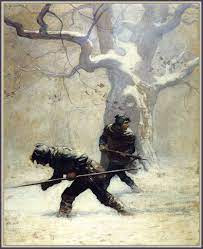


Re-reading a book you loved as a child has its dangers. The disappointment of an adult might not just tarnish a memory but destroy something golden. In this case, mercifully, CS Lewis hit the nail on the head. The twelve-year old Keyton was blown away by a fast moving plot and evocative imagery that stayed in the mind. The much older Keyton saw things he hadn’t before: the subtleties of character. The villainous Sir Daniel Brackley has his merits, charisma and courage, a certain fine recklessness; the future Richard III though not deviating from Shakespeare’s ‘villain’ is also bold and decisive, a natural leader of men. Minor characters like Benett Hatch and his wife Goody Hatch, though working for the villainous Sir Daniel are rounded characters, so that you grieve for their fate. And the young Richard Shelton, the hero of the book is reckless and naïve, only later recognising and accepting the guilt of destroying other people’s lives in derring-do.  


Women may cavil at the heroine Joanne, for she is very much the Victorian stereotype: feisty but push-come-to-shove, dependent on men in a swoony kind of way. 

In short, summing up The Black Arrow, think The Eve of St Agnes, meets The Famous Five with a Pre-Raphaelite gloss. Not something a twelve-year old boy would have thought of but true all the same. 

PS Another book I’d like to re-read is ‘The Dark is Rising’ by Susan Cooper, though that doesn’t quite fall into the CS Lewis category, since I was enjoying that in my twenties. 

Wednesday, 30 January 2008

A knife in his chest


Unlike Sheila Pound, I can’t quite remember how we met, or how we became friends. It just happened. Because of your middle name (St. John) you were frequently called ‘The Saint’ after the series on TV at the time, and I seem to remember the Simon Templar motif on your bag. I also remember the theme tune - DA -DARA - DA - DOM - DOM - DA. (Bloody hell, I’d forgotten that. The early books were a little darker and more gritty than the sanitised TV version. I re read one of them recently - They evoke post war Britain perfectly)

In my first year I was unfortunate enough to be persuaded by my parents to wear the College Uniform, a green jacket with braiding around the collar and cuffs a pocket badge depicting bees and a hive - and the word ‘Industrial’ springs to mind. (This uniform must have hurt deeply for you to remember it so well) I felt a right pillock and would have fitted in well at St. Trinians. You on the other hand wore a polo neck shirt with a brown corduroy jacket and brown suede shoes. I’m not to sure about the trousers but feel sure you wore some.

Some of the people I remember:

A blonde girl with Olympic calves and child bearing hips, spoke with a lisp, and believe it or not had no eyelids - like a fish.

Jennifer Gee. Dark hair, pretty, a bit posh with a turned up nose. She was the first girl to kiss me one Christmas at College. My legs went to jelly unlike another part of my anatomy.

Justina Atoyabe African, traditionally dressed and wore open toed sandals, even in winter. The mean-minded subjected her to vile abuse and she would retaliate by throwing kitchen knives at them.

Sheila Connolly - sat next to Justina and was a trainee nun (must be another word for that)

John Passey - Although not in our group and in his final year, deserves a mention. He was the person everyone liked and wanted to be seen with. Although John had a crowd of followers he still found time to acknowledge me and frequently gave me a lift home when a seat was available in his yellow Reliant three-wheeler. John sadly died of bowel cancer a good number of years ago, and although I felt he was destined for great things, he lived and died in Widnes. Even so I still envy his charisma and remember him with great affection.

The Fletcher Maffia. The Tonge brothers and their followers were the hard boys of the college, George in particular. I was in the changing rooms with Tony Alexander, or Alex as we called him, and one or two others from our year, when George came in and took out a 10 inch Sabatiere knife. He was larking about and then lunged with it into Alex’s chest. George’s expression didn’t change as he removed the knife from Alex, just watched the blood pouring down from his chest. Alex was taken to hospital for treatment and was told that the knife had just missed a main artery, that he was lucky to be alive. Ronny Tonge was as crazy as his brother. When his girlfriend, Tina, finished with him, he took a knife and slashed both of his wrist.

Well Mike, I could rime on for hours about our memories - the Chinese business lunches for 2/-6d with Sheila and Jennifer - the trip to New Brighton instead of attending lectures and getting caught and scrubbing copper pans for three days afterwards. Mike, it seems like yesterday. Thank you, Mike for giving me the opportunity to re-live and value those very happy years.

Which is what this blog is all about. Thanks Mike, I really enjoyed reading this We’ll share a drink soon.

Tuesday, 29 January 2008

Mike Adams

Mike is a gifted chef and has cooked for the rich and famous. I taught the poor and infamous. Thanks, Mike for the memories. Your letter, interspersed with the odd comment is below. Part two continues tomorrow.


Well, Mike, this is the start of my contribution to your blog. I’m sorry for the delay but, as with all good ideas, I started with great enthusiasm then life got in the way.

I failed the entrance exam to Mable Fletcher Technical College, which was an achievement in itself as a reasonably intelligent ten year old could have passed it with ease. However, after a phone call by my father to the Careers Officer I was accepted on a six month trial. (A great morale boost)

As with you, Mike, I clearly remember my first day, walking to the bus stop in Widnes, and waiting for the bus to Liverpool. Waiting for the same bus was Alan Dixon who I thought I always thought of as a Rod Stewart look-alike (umm, I don’t see that - sorry Alan) He was a student at Mabel Fletcher and doing the same catering course. He offered me a cigarette, which I felt too embarrassed to refuse, thus starting a habit that was last many years.

College had begun two weeks prior to my starting, allowing the other students to form relationships, but leaving me like a fish out of water. Having been deserted by Alan Dixon, I eventually found the classroom and was already ten minutes late. I knocked and walked in…There was a sudden silence. All eyes were on my red glowing face and I became very conscious of my large ears and the spots that Clearasil had failed to clear.

Mr Byers told me to take a seat at the front of the class (not at the back as I was hoping for ) next to a girl with platinum blond hair. She told me her name was Sheila Pound, and to this day, she remains the prettiest and kindest girl in my life. At the end of the lecture and sensing my obvious discomfort at being left on my own amongst a crowd of strange faces, she made no attempt to leave me, and stayed by my side as we walked to the next lecture, and once again we sat together. (I remember the two of you well and often felt jealous. She was nice - probably still is…somewhere)

Can you remember our first day in the kitchen. We all looked very uncomfortable in our whites and, to crown it all, the tall chefs hat! Mine was balanced on my ears, while yours hung at the back of your head, giving the illusion of speed even when motionless. The thing we made was Tomato Soup, and we were both delighted when it actually tasted like Heinz.

Right, Mike. It is 9pm and I have just poured the first of many large whiskeys. Now do I carry on and slowly sink into gibberish (yes please) or give up while I’m ahead. I must say, I’m very tempted to carry on (drink has that effect on me too.) But I also know there is a good chance that I’ll press the wrong button on the keyboard and lose the lot. This being the case I will continue in pencil….

Tomorrow, bloody duels in the changing rooms!

Sunday, 9 December 2007

A Discontented Cook


Meanwhile I moved on from Mabel Fletcher to the more prestigious Colquitt St. College of Crafts and Catering, still unsure about everything, but determined to give it a go. It didn’t help that I was taught pastry making by a Polish Chef called Mr. Polaki. His voice resounded around the kitchen - ‘Develop the gluten’ - and he had a metal leg with which he would kick me at every opportunity. I vaguely remember a bruise on my calf because my sausage rolls were a centimetre too short. Only later did I discover that the Russians were responsible for the loss of his leg and once he discovered I was a socialist, the kickings increased - despite now perfect sausage rolls. Money was short and I took every part time job, most often contract waiting where I learnt mischief alleviated boredom. “Water Madam?” And I’d pour the water so that it formed a convex sphere above the rim of the glass. It was done too quickly to appear deliberate and accompanied with a smile as one pleased to be of service. The fun, such as it was, lay in watching the woman trying to raise the glass without spilling it, or lowering her head to suck at it first. Petty, but amusing for a time. 

 There are many reasons behind industrial sabotage, boredom is one of them, a sense of grievance another. My favourite story is that of the disgruntled worker in a sweet factory making Blackpool Rock. (This consisted of a foot long cylinder of candy, pink on the outside, white in the middle, and with a message like ‘Welcome to Blackpool’ in red throughout the length of its interior) He changed the lettering and they’d made about ten miles of the stuff - packaged and distributed before they discovered his alternative message: ‘ Fuck Off.’ Catering was highly exploitive. Profit margins weren’t high, wages were low, hours long. 

I learnt French service, distributing slices of meat from red-hot salvers. You needed four layers of napkins separating the metal from an already sleeved arm and even then, the heat would seep through within minutes. You had to get rid of that meat fast or either you or the customer suffered. There was a Masonic banquet in a hall so small that the tables were squeezed in densely packed rows. When everyone was seated only narrow aisles remained. We were forced to weave our way through these long six-inch wide aisles with these burning salvers on our arms, whispering with increasing desperation: “Excuse me Madam, Excuse me Sir.” Our pleas were in vain. They were there to eat and get drunk. We became more ruthless and terse. The side of a red-hot salver makes for an effective cattle prod if sliced across a fleshy back, or in the case of men, against the neck. Black suits and gowns wilted as we passed, the aisle widening miraculously, like the parting of the Red sea. 

 Chefs could be equally bloody-minded. Myself and Mike Adams worked for a time in the Grand Hotel in Llandudno. It was a beautiful building ,which loomed out over the sea. Later it was badly burnt, insurance scam or an aggrieved cook is my guess. We slept in a garret and were up by 5.30 preparing the tables for early breakfast. When breakfast was finished, we had about an hour’s break before relaying the tables for early lunches. After that, another hour break before laying for dinner - which dragged on for most of the night. Then bed, and up again at 5.30. It didn’t make for happy puppies; the cooks though were surly Rottweilers. Dirty Rottweilers. Bacon and eggs were cooked on the up-turned lids of large stock pots because you could fry a much greater amount in one go. Eggs, bacon, sausages, sometimes black-puddings, drifted in grease - and worse. The cooks also used these pans as ashtrays and eggs sizzled amidst discarded cigarettes and deep-fried tobacco. We developed tough stomachs, but ate elsewhere. 


 After the Grand Hotel, working in the kitchens of Broad Green Hospital was like working in heaven. Old and middle-aged ladies clucked round us, offering tea at the slightest provocation. For weeks on end I was responsible for turning out the jam-buns - hundreds of them - for the entire hospital. Surgeons and consultants, even patients, all got to eat one of my jam-buns. In between times I drank tea and listened to heated discussions as to whether Kathy Kirby was a better singer than Cilla Black. I brooded as I contemplated years and years of this, and became increasingly desperate. The only other image I retain from Broad Green Hospital is an incident, which took place in my very first week. The corridors were long and confusing. The Operating Theatre was dangerously close to the kitchens, and I was late. Dressed in blue checked trousers and Chef’s hat, my knives resting on a folded apron and prominent, I burst through the swinging doors and was confronted by a posse of shocked doctors and an even more shocked patient awaiting surgery. I think he saw the funny side.

Friday, 16 November 2007

Abattoir Nights

Days actually, well in fact one day. To be precise a morning. It was enough. St. Bonaventure’s had taken me on a visit to Bootle Gasworks. Mable Fletcher Tech College took us to an abattoir.

I read somewhere that Hannibal, before crossing the Alps, had to cross the River Rhone with a bunch of reluctant elephants. His solution was to build rafts, each holding three elephants - one female to every two males - the principle being that the female would have a calming effect. Makes you wonder what we’re paying modern psychiatrists all the money for.

Anyway, this principle proved true on our visit to the slaughtering house. The boys showing a certain raucous callousness which in effect hid our discomfort, and the girls, afraid of retreating into a stereotypical ‘girlishness’, biting their lips, sometimes turning away as blood spattered a little too close.

I don’t know really what was worse, the clanging of metal gates, the smell of blood and fear, men coarsened by habit, their shouts echoing over the dying. On balance I think it was in the eyes of the animals.

We stood alongside a long and narrow metal pen filled with cattle squashed in single file. There was no escape for them and they knew what was happening. At the far end was a man with a stun gun, which in theory was quick and painless. The process was simple: stun, hook on to an overhead conveyor belt, which in turn led to where they were skinned and dismembered. They were still writhing and twitching as they passed overhead, each on a strong metal hook. ‘Just their nervous systems girls and boys. They’re all dead.’ Great.

We stood watching these animals, distancing ourselves with varying degrees of success. It was their eyes - anger, fear, dull acceptance - there was no single expression. Sometimes a cow would go wild and try to shoulder down the walls on either side, but with no space, there was no momentum - only the relentless push from the other cows behind.

Pigs however were killed a little more humanly, not so much from mercy, more pragmatism. We learnt that a frightened pig releases amino acids which give their meat a sour taste. I thought of south sea cannibals eating their ‘long pig’, and whether we released amino acids when scared, whether missionaries had sour meat.

Anyway, I digress. These fortunate pigs were allowed to run between a man’s legs whereupon what looked like ear-phones were placed over its head. Instead of Bruce Springsteen they got an electric shock, and before they knew what had happened they were pushed into a giant vat of boiling water.

Kosher killing we were assured was pretty painless. The chickens didn’t look to happy though.

As ‘day-outs’ went, it wasn’t the best.

Happy Thanksgiving!

Saturday, 3 November 2007

Readers he had his way with me

The day I started Catering College, the bus ran over a dog. It should have told me something. There’d been many false starts in my choice of career. Hartley’s jam factory exuded its daily lure of hot strawberries. Further down the road was the Crisp factory, and once, the only career lesson we ever had, the class was taken to Bootle Gasworks. I still remember the thick gooey brightly coloured paint on metal handrails, the clang of feet on metal steps, and the smell of dust and gas. And yet, I knew what I wanted to do.

I wanted to go to sea, like my dad. I wanted to spend long hours on the deck at night staring at sea and sky, and descend into the boiler room when it got too cold and drink very hot chocolate. I had it all worked out.

Only my Dad was adamant. If I went to sea, I had to have a trade. He must have looked at me and wept - this fresh-faced shortsighted boy - must have thought of crews he had sailed with over the years, time lost in the South China seas, the kind of life I’d have to expect.

I spent a week or two convinced I’d be a radio officer, until Morse code eventually wore me down; and then it came: the answer, combining my two great obsessions, a life at sea, and food.

I’d be a ship’s cook.

Hence my presence on a bus that ran down a dog.


Mabel Fletcher Technical College taught hairdressers and cooks, and gradually it dawned on me I had made a mistake, only it was now too late. My blue checked trousers had been bought, along with two white tunics and a tall chef’s hat, which, however long or hard you starched it, always flopped down.

A lot of my memories of Mabel Fletcher are lost in a blur of kitchen knives and steam, but I remember this. Mr Radcliffe, a liberal studies tutor with black glasses and a blue striped shirt pestered me every day for a month. I had something he wanted. A Bob Dylan ticket, no, more than that, The Bob Dylan ticket. It was the year Dylan went electric and he was playing in Manchester. And I had a ticket. He pursued me for weeks, Radcliffe not Bob. Kept raising his price, until eventually, dear readers I… succumbed and he had his way with me for a £10 note. I’d sold a piece of history for a £10 note and have regretted it ever since.

Not to worry though. I acquired another piece of history in Mabel Fletcher, and many years later sold it for £2000.