Showing posts with label Liverpool Higher Education. Show all posts

Thursday, 18 November 2021

Tushery!


This is so true, though stretching a point, I was twelve when I first read The Black Arrow by Robert Louis Stevenson. It totally captured me and decades later, though much of the plot was forgotten, the flavour of the book remained strong, along with certain indelible images. The outlaws' semi-underground den created from the roots of a huge fallen oak was the template for every underground den I made as a boy.


How to describe it? Robert Louis Stevenson referred to it as ‘tushery’ especially in relation to his use of archaic English dialogue, and it puzzles me now how a twelve-year old boy dealt with it. Much the same as a man several decades older, I suppose. The story carries you through, allows you to slip below the surface of the language and enter a deeply coloured world.  


But back to Stevenson and his affectionate self-mockery of the book. ‘Tushery, by the mass! Ay, friend, a whole tale of tushery. And every tusher tushes me so free, that may I be tushed if the whole thing is worth a tush. The Black Arrow: A Tale of Tunstall Forest is his name: Tush! A poor thing.’ Mind you, to put this self-criticism into perspective, Stevenson was equally disparaging about, what some see as his masterpiece, ‘The Strange Case of Dr. Jekyll and Mr. Hyde.'

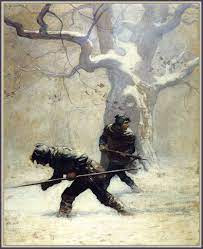


Re-reading a book you loved as a child has its dangers. The disappointment of an adult might not just tarnish a memory but destroy something golden. In this case, mercifully, CS Lewis hit the nail on the head. The twelve-year old Keyton was blown away by a fast moving plot and evocative imagery that stayed in the mind. The much older Keyton saw things he hadn’t before: the subtleties of character. The villainous Sir Daniel Brackley has his merits, charisma and courage, a certain fine recklessness; the future Richard III though not deviating from Shakespeare’s ‘villain’ is also bold and decisive, a natural leader of men. Minor characters like Benett Hatch and his wife Goody Hatch, though working for the villainous Sir Daniel are rounded characters, so that you grieve for their fate. And the young Richard Shelton, the hero of the book is reckless and naïve, only later recognising and accepting the guilt of destroying other people’s lives in derring-do.  


Women may cavil at the heroine Joanne, for she is very much the Victorian stereotype: feisty but push-come-to-shove, dependent on men in a swoony kind of way. 

In short, summing up The Black Arrow, think The Eve of St Agnes, meets The Famous Five with a Pre-Raphaelite gloss. Not something a twelve-year old boy would have thought of but true all the same. 

PS Another book I’d like to re-read is ‘The Dark is Rising’ by Susan Cooper, though that doesn’t quite fall into the CS Lewis category, since I was enjoying that in my twenties. 

Thursday, 28 February 2008

Shelagh Williams

Last night I had a dream of Harry and Felicity Dowling. They were sitting on the pavement alongside a small bookstall, both dressed in brightly coloured clothes. Felicity was not the first great love of my life, but I went out with her briefly, largely because I felt it was about time I had a girl friend. It started badly. We agreed to meet outside the Cavern in Matthew Street, but she didn’t turn up. As she said later, she hadn’t thought I’d been particularly serious. The second time was more successful, but coming home on the bus, I noticed her face looked slightly yellow beneath the fluorescent lighting and I lost enthusiasm.

Harry Dowling was a working class Marxist who also enrolled at the Liverpool Institute for Further Education. Within a few months, he’d discovered the delights of romantic poetry, psychedelic shirts, and Felicity Corcoran. And shortly after that they married. I haven’t seen them since - except in that dream. Nor have I seen Shelagh Williams since then.

She taught me what it was to be in love. She could have sat under a ten-gig watt fluorescent strip, a face with the tonal quality of butter, and I would still have loved her. Fortunately she never put me to the test.

Shelagh had a lean, intelligent face with a wry smile and dark shoulder length hair. Her mother was a teacher, her father head librarian in Bootle Library and I realized I was scaling dizzy heights. Even her name, Shelagh, was spelt different to the Sheilas I had known.

Our first date would have to be special. She was educated, more cultured than I, intensely bohemian. I settled on Ballet - The Nutcracker suite, and read a book on what it was about. To my relief she settled on the pub.

It’s hard to recapture now the excitement in first holding her hand. I tingled in ways I’d never tingled before, but we’ve all been there, so enough about emotion and strange sensations. I just enjoyed being with her, even when she cut her hair short and took to wearing a grey pinstripe suit. My last abiding memory of Shelagh was at a party. She wore a black dress. Sergeant Pepper was playing, and we got gloriously drunk.

We split up when I was at University and I was heartbroken. I hope my own children never experience this, though the odds are they will…and then get over it.

Wednesday, 13 February 2008

Jesse James and King Zog of Albania


The Liverpool Institute of Further Education was a pale blue Victorian building on Duke Street almost opposite the Anglican Cathedral. The building itself seems to have gone, which is a shame because a large part of myself has gone with it. The Anglican Cathedral remains, which is something.

The Institute was an exam factory for anarchists and free spirits. Mrs Clough was one of them, a sixty year old student who’d just given up smoking because she wanted to live longer. Then there were Balbur and Daljeet Kanijar, two Indian brothers who were hopelessly in love with Lily, a diminutive pre Raphaelite blonde. It was a place where the unexpected happened, and sometimes sex. Toni was her name, an intense nervy looking girl in a blue corduroy dress. She had an interesting way of breaking the ice, unbuttoning the front of her dress and taking out a breast. ‘You can feel it if you want.’ Then there were those who were less sexy.

Mark Serralier was less sexy, a porky looking boy with black hair and a high pitched lisp. He claimed to be descended from Jessie James and King Zog of Albania. Worse, he believed it, which made him irresistible. My abiding memory of Mark is of him sidling up to us in Liverpool Central Library. The main reading room is a huge acoustic reservoir, a vast book-lined dome where a dropped pencil reverberated like a World War I cannon.

“Have you seen my new umbrella?” he whispered.
A thousand faces looked up.
We shook our heads, but said nothing.
“It opens out with a touch of a button.” (We’d never heard of such a thing!)
The devil spoke to me then. “Show us,” I said.
He looked round as one who hoped he wouldn’t be seen, then pressed down his thumb.
Metallic spokes exploded. It was like the crack of a hundred bull-hide whips, and he stood there, in the middle of the reading room beneath an open umbrella, waiting for rain or for the ground to swallow him up.

The place was an exam factory, the teachers cynical and dedicated at a time when you could be both. Notes were dictated, a two-year course compressed into one and we valued the teachers who spoke clearly, gave good notes and told it as it was. We’re not here to educate you lot; just learn the damn notes. As a teaching method, it can’t be faulted, except by progressives who find beauty in complexity.
The Institute was also a place of laughter and excitement. One window opened out onto sky and the gothic grandeur of a great cathedral. Below us was the hum of a Liverpool in ferment, and just a little down the hill was small seedy café where you learnt to make tea last an hour.

I learnt’ Sixteenth and Seventeenth century history from Mr. Radcliffe. He may be dead now, but then he resembled a prince of the church, a Cardinal Wolsey in a grey suit. He was fleshy, sardonic, good humored and cynical. Later I learnt English Economic History 1750 to 1920 from Bob Waring a man with the face of a battered cherub. He later became a Labour MP and grew less cherubic, though no doubt rich. For English I had Ms Fahey, a Catholic with a merry smile and a very sharp tongue.

Finally there was a tall thin man in a grey pinstripe suit. He was bald, and I think his name was Basil. He made the workings of the British Constitution even more mysterious, his notes a patchwork of random thoughts, biographical asides and finely tuned boredom. His real passion was Moral Rearmament a Christian cult that spearheaded the importance of the individual. I would have settled for decent notes.
He was more interested in making converts, focusing on those lads he thought had ‘leadership’ qualities. So I was spared. Tony McMullen however was not and went to his Hope St. Flat on a number of occasions to meet Mrs Basil (I wish I could remember his damn surname) for pamphlets and tea.

Portals have become cliché in speculative fiction, and we struggle to find new names to refresh a useful device. The Liverpool Institute of Further Education was no Star-gate but it was a magical portal - and thoroughly human. It whirled me from the kitchen to University and introduced me to the first great love of my life.

Friday, 25 January 2008

'There is a tide in the affairs of men....'


After the Lemuria debacle they took in hand my political education. I was pretty certain I wasn’t a Marxist; trouble was I didn’t know what I was - a fairly enviable state. Dave Galashan invited me for a drink. We met in an ornate Victorian pub in the centre of Liverpool. He was waiting for me and so was a pint. On the table were a collection of books.

We drank several pints that night and I learnt how a ‘Socratic dialogue’ worked. You basically said ‘yes’ or ‘you’re right’ to each culmination of a short question and answer routine - not out of a slavish desire to please but because each series of questions were designed to give only one answer. The climax was an analysis of Engels’ The Family, Private Property and the State. At it’s end I realized with blinding clarity that I was a Marxist. There was no way out of it. I saw, understood and agreed with the basis of Engel’s argument. To be honest it was the joy of understanding a complex argument that finally won me over. This was a far cry from Basket Work.

Shortly after that, I re-started Walton Young Socialists and in true Bolshevist fashion was elected its secretary. Every so often a few of us met in the homes of Terry Harrison and Ted Mooney, self-taught men of clear convictions and great integrity. We sat around a highly polished table. Here they explained and analyzed, chapter by chapter, Marx’s Das Kapitol until my head hurt, and I wished I was sitting under the table clipping strange patterns from the Liverpool Echo.

But a door had been opened wide for me. I was surrounded by serious people, clever people, University students and others on their way there. And almost without thinking about it I realized I was as good as them. I was reading Lenin, Trotsky, Marx, Kautsky, more stuff than a cook could stuff under his hat. I was arguing, listening, understanding. Here my education began.

Just in time in fact.

I was finishing Catering College.

I had an application form for trainee manager in a Lyon’s restaurant in London, and every time I looked at it, my heart sank.

I didn’t want to go.

Someone suggested I do my GCEs.

Where?

The Liverpool Institute of Further Education

Why? My parents asked, and how long?

Because I’ll get a better job in catering. I knew I was lying. It’s only one year.

So now I was no longer going to sea or being a cook; now I was a student. I managed five O levels in a year, and the following year took three A levels ending up to everyone’s surprise at Swansea University.

‘There is a tide in the affairs of men…’ and I was riding it flushed with pride and happiness. I still didn’t know what I wanted to do but I was at a better place.

Sunday, 23 December 2007

How do you eat peanuts?


How do you eat peanuts? I’d never really thought about it before I waited upon Harold Wilson * (British Labour Prime Minister) at his Huyton Constituency. Maybe it’s just me, a careful eater, tedious, and needing to be in control of every, individual peanut; but I scoop out a handful with my right hand, deposit them in my left, then pick at them - sometimes five at a time, more often three. As you can see, I’ve thought about this.

The day I waited upon Harold Wilson, I observed how he ate his, and realised for the first time that even peanuts are political. First, he scooped his hand in the bowl in the Keyton prescribed manner, then he looked round at the working-class party workers of his Constituency and made an instant decision. He would eat as he assumed the working class ate their peanuts. He rammed the whole lot into his mouth in a single sweep of his arm.

Later I learned that the very first Labour Prime Minister, Ramsey Macdonald in the 1920’s and early 30’s had a very similar attitude when it came to cigarettes. Nothing escapes politicisation, and spin predates the wheel. He had two kinds of cigarettes: one a packet of cheap Woodbines in a cardboard packet when he was amongst working men, the other in a silver cigarette case for when he was amongst his favourite constituents - admiring duchesses. As long as he remembered which pocket they were in, he was all right.

This small revelation was followed by a military banquet. I remember silver, red coats, flushed faces, baldheads, and very loud voices. I remember scurrying around in a cheap white waiter’s jacket and realised there had to be more to life than this. It is hard to describe how desperate I was.

My first attempt at escape was a tad pathetic. The strategy was spot on, but courage was wanting. I’d get an education, a real one. Wasn’t too sure what a real education was, but it involved O levels at GCE. Wouldn’t go mad, try for English perhaps; see how it went.

Night School

I walked down a long corridor in Warbreck Moor School. It was 7.20. Pm and enrolment had begun for evening classes, night school as it was called then. I had at last determined to improve myself - beginning with an English GCSE - a fairly basic qualification. The corridor ended in a T junction, and it was approaching fast. Memories of past failures crowded in on me:

…aged eleven, walking down Hall lane and being attacked by Tony Holland, my dad on the other side of the road shouting encouragement, urging me to fight back, failing miserably, my dad’s shame - real or imagined.

At the end of the corridor I had to turn right. I hesitated, watching others walk into the English classroom. They looked earnest, a grim, unfriendly lot. A clatter of feet came up from behind - a bunch of merry, middle-aged women. One of them slapped me on the back. “Make your mind up, lad!”

“Are you doing English?” I asked.

She laughed and turned left. I followed and ended up doing a six-week course in basketwork.

Every so often my mum would ask me how the English was going…and I couldn’t find the words, until one day I brought home my first wicker basket.

Lesson learnt. If you want something, try again. Two years later I was at University.

* (Strictly speaking I wasn't actually waiting on Harold Wilson - just in the same dining room amongst a bunch of waiters)