Thursday, 16 July 2015

Clay Cross: 6 Ways To Mental


Some people wonder about the meaning of life. With me it's death and whether half of those punks I've consigned to the other side will be waiting for me when it's my turn to choose a coffin and shroud. I glanced across the room at where Sheri was sitting, and grinned. She'd have chosen hers already and nail-paint to match. There'd be others beyond the veil waiting for her too, but she wouldn't be thinking about them. She'd be wondering which saint to seduce first, assuming things went to plan and she didn't end up some place hotter. Old Nick would have one helluva surprise.
"Clay?"
Jeez, she was reading my mind...but no.
"Mac is waiting," she said.
"Mac?"
"-6 Ways to Mental, Mac."
"Jeez, You've brought me a fruit-cake?"
"His book, Clay. 6 Ways to Mental." She planted a kiss on my jaw and knocked me to Heaven. If I wanted more I was gonna have to talk to a guy about a book. 
What is your latest book about?
‘6 Ways to Mental’ continues a year after ‘6 Ways to Die.’ Margarite Abernathy copes with PTSD from the brutality she lived fighting terrorists working to unleash a worldwide plague. Outbreaks continue to flare, and her brother quietly battles the terrorists behind them, drawing Mar into the horror again.

You are highly prolific. Is there an optimum number of books published before you begin to make money.
I’ll tell you when I reach that point *smile*

Which two pieces of advice would you give to a new 'Indie' writer?
Two bits wouldn’t help. There is so much to learn, the craft so demanding, the competition and obstacles overwhelming. It is like a neuro surgeon only taking ‘the important’ classes in medical school.

Which fictional character would you like to have a close relationship with?
My seemingly autistic character (you have to read and decide for yourself if he isn’t just weird) Augie in my SEEker series would be cool to hang with.

Which four literary characters would you like to invite to dinner, and why?
I watch the news during dinner, so would rather go out for wings and beer for lunch. My character Carter from my werewolf series would be entertaining, as would Toni from my SF series. I think ogres Morgan and Ike from my Black Lake series would round out the table well.

What are you currently reading?
I’ve just started a dystopian I may not finish by Erica Stevens, ‘The Survivor Chronicles’

Which four books do you wish you had written?
Anything by Anne McCaffrey (the earlier books she wrote herself).

Are you ever afraid that one day you will stop enjoying writing?
I got over that about ten years ago.

Every writer has a weakness, what is yours?
I like to snack too much when I’m editing.

Which author makes you jealous and why?
Any author who is making a living with their writing.

To agent or not to agent? Why or why not?
All the indies who are surviving on their writing first got recognized traditionally, or sold enough to get picked up traditionally (e.g. Wool), so there must be a lesson there.

Has a book ever made you angry. If so, which one?
I read mostly indie titles to support ‘my kind.’ I delete about nine for every one I finish. There are too many self-published books that never should have been published, by authors who don’t know the craft, don’t know the basics of formatting. THAT makes me angry. They are making all of us look like weenies.

Is self publishing the new 'slush-pile’?
I don’t think so. The only titles the traditional publishing components (agents, publishers) look at, hit big sales before they ever look at them, so they let the market (and the author’s marketing skills) drive what they consider. They certainly don’t have to dredge the ‘slush-pile.’

Elmore Leonard listed ten rules, one of which is: 'Try to leave out the part that readers tend to skip. Think of what you skip reading a novel.' What rule or piece of advice would you add to the list, and if you know his ten rules, which one would you happily see broken?
I think all of Elmore’s rules are common sense, if not literal. Rule one, don’t start with the weather. Well, if it is pertinent, the protag is in a sinking boat in the middle of a hurricane, what else would you start out with? The point is…write about what is most important in sequence, to tell the story so that you never drop the reader’s attention or piss her off. All ten rules reflect that goal.

I read the blurb as Sheri saw to R. Mac Wheeler's more intimate needs, putting his coat on, her hand lingering on his shoulder longer than it goddamned should: Nightmares. Panic attacks. Depression. Margarite is hammered by the typical issues of a seventeen year old loner, whose parents sympathized with insane people intending to collapse civilization. Jeez, the dame had problems. The few who care about Mar have more concerns. Her drinking. Fighting. Jumping out of airplanes. Heh,  heh, heh, that's better, though her brother sounds more than a jerk. I gave Sheri a look. The book sounded good but my jaw was still tingling, and Sheri had promised me more.

Thursday, 9 July 2015

Diplomacy


I was teaching the Schleswig-Holstein question to a bunch of New York Sophomores, who liked much about me, especially my accent, but couldn't get their heads around this weird little quarrel between the German Confederation and Denmark in the mid C19th. They brightened up when I quoted Lord Palmerston:
 “The Schleswig-Holstein question is so complicated, only three men in Europe have ever understood it. One was Prince Albert, who is dead. The second was a German professor who became mad. I am the third and I have forgotten all about it.” But by the time I'd finished explaining it half of them wished they were dead, or at least mad, and eitherway all of them forgot about it as soon as the lesson ended. 

It's a tough call teaching Schleswig Holstein on a hot June day in New York, almost as tough as trying to teach it in Newport and trying to ignore a Head of Biology  urging me vehemently to attack Russia; all this in front of some very bemused students. I know it sounds like a nightmare, or at least a very bad dream, but this was what a game had reduced us to.

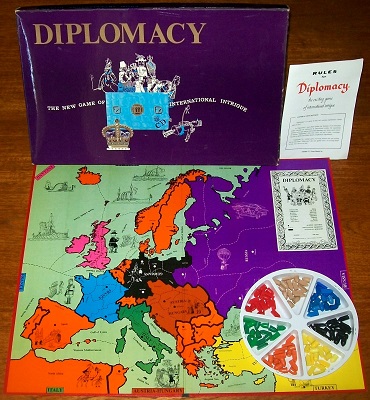
The Game is called Diplomacy and demands 4 to seven players and more time than sense. It's a very simple game which involves a large map of pre 1914 Europe - essentially a Europe of empires. The only random factor in the game is who gets which country. 

Each player is given two armies and a navy except Russia which is given an extra piece, and Britain which is given two navies and an army.

Each player is allowed a Spring and Autumn manoeuvre, which simply involves writing down which adjacent province or sea your piece is going to move to. The aim is to land on a vacant city of a neutral country, and if you retain it over the two seasons you to gain an extra army or navy --- and so on---and so on.  Now this in itself seems remarkably boring, childishly simple but I have seen marrages strained and staffrooms split in opposing camps, each accusing the other of lies and betrayal.  

Why? 

Because before each move you make secret but 'sincere' alliances with one or two of the other players in the game. For example if German moves westwards, France will obvious seek an alliance with Russia. The whole thrust and momentum of the game is either fooling or being fooled in the matter of who promises what; negotiations, firm but secretive handshakes, followed by inevitable betrayal.  

The beauty of the game is how closely it matches the European flashpoints of the Edwardian era. Austria, Russia and Turkey both seek the Balkans, Italy will ally with anyone to stop France, Turkey or Austria from dominating the Mediterranean. Britain, Germany and France seek to control Holland and Belgium. But then France is also tempted by neutral Spain, Africa, the Mediterranean.... Can it trust Germany not to attack it from the North?  Britain and Russia seek to dominate Scandinavia. Germany feels surrounded!  Alliances are everything and so too double dealing and treachery. So much to promise. So much to gain.

It is only when the written orders are read out that you find who has betrayed who. Some alliances are unexpectedly built on rock, others on sand, and empires and relationships founder on the basis of promises not kept.

This then was the context of the Head of Biology bursting into my lesson with urgent whispers that a British - German attack on Russia would prove overwhelming. He didn't know that only an hour before, the Head of English had slipped into my Year 2 lesson on the Angevin Empire urging me to attack Germany. I think I said yes to the two of them. 

We were all grown men, professionals who had become so addicted to Diplomacy (the board was hidden in the Janitor's cupboard) that it began to take precedence over everything else. My firm conviction is that a bit of lunacy is absolutely essential in teaching, but they don't tell you that in College. 

PS The game is also a wonderful adjunct to teaching Modern European History.

Thursday, 2 July 2015

Flags of Convenience


'Patriotism is the last refuge of the scoundrel,' Samuel Johnson wrote. He might have added and 'the flag is his weapon.'


So how do we judge the Confederate Flag in relation to others?


Under the Cross of St George Anglo-Norman Crusaders waded in blood following the fall of Acre. They waded in blood at every opportunity


Under the same cross and the Royal pennant, English armies devastated France during the Hundred Years War. English armies fanned across the countryside, raping, pillaging and killing all those who had no monetary value. It was total war, depriving French armies of manpower and food. After Agincourt, Henry V ordered the massacre of French prisoners because he feared they might regroup and launch a counter attack. Many were burnt alive.


Righteous murder continued in different guises and all under a flag. In 1649 the  massacre of Drogheda saw three hundred women and children burned alive in a church, Oliver Cromwell informed Parliament that: "That I am persuaded that this is a righteous judgment of God upon these barbarous wretches."


And after Ireland, the world. Shaken by the Boer revolt in South Africa, the British invented the concentration camp where 10% of the Boer population died in one year. 
In Amritsar, 1919 British troops opened fire on a dense crowd of peaceful protestors and kept firing until they ran out of ammunition. In ten minutes they killed between 379 to 1000 protestors and injured many others. Though the officer in charge was censured, the British public labelled Reginald Dyer a hero and raised £26,000 for "The man who saved India."


The French and their flag are also associated with oppression and atrocity.Napoleon has many admirers but perhaps not in the Middle East and among Haitians. In 1800 Haiti, producing two thirds of the world's coffee and almost half of its sugar was one of the world's richest colonies. It belonged to France and was dependent on slave labour. Black slaves were lashed, and beaten to work and forced to wear tin muzzle to stop them eating the sugar cane. There were instances of rebellious slaves roasted over slow fires or filled with gunpowder and blown to pieces. And when they eventually rebelled under the brilliant and charismatic Toussaint L'Ouverture, Napoleon savagely crushed them and restored slavery.


The list goes on. Choose a flag. Where do we start?
Mao's great leap forward caused 45 million deaths in four years


Leopold II of Belgium was responsible for 8 million deaths in the Belgian Congo
between 1886 - 1908


And then we come to the big boys, and surprisingly Hitler comes out quite modest in comparison with Soviet Russia and Mao's China. Admittedly Stalin killed only 7million people between 1932 - 39, but Russian Governments between 1917 to 1987 murdered nearly 62 million in all.


Hitler murdered a mere 20 million.In this respect Mao wins the cigar


Though not on the same scale as Mao successive American governents did a pretty good job in depriving Native Americans of their land. That was done under the stars and stripes not the flag of the Confederacy, and so, too, were the massacres. Even today, rightly or wrongly, there are many places in the world with much the same feelings towards the American flag as Liberals have for the Confederate flag.


Historians quibble over figures and context so that it's matter of ideology and choice when it comes to disentangling 'heritage' from crimes committed under any particular flag. We forget some things and remember others. Every nation has its massacres - as well as its heroes. Scoundrels exploited flags and the naïve followed their spell, whether the so called 'White Trash' that fought for the Confederacy, or the 'Scum of the Earth that fought with Wellington at Waterloo. 

And over time flags lose their potency. The Union Jack that once flew over large parts of this planet is now largely tourist kitsch and this, I feel, was the way the flag of the Confederacy was heading, whether in terms of Southern Rock albums or TV programmes like The Dukes of Hazard. Its more negative connotations being lost in the anodyne wash of commercialism. 

Now however, and perhaps unwittingly, the flag has become potent again. In the early 1960's it achieved brief potency because of how racists used it to justify segregation. It was a dark rebellion. It has become potent again but for the opposite reasons. Driven from the mainstream it will achieve a dark glamour it hasn't seen for years and become a focal point for the aggrieved. There are parallels in Britain, where the Flag of St George was very nearly appropriated by by the far right. Might that have been commercially banned too?

Finally, and with every respect, I'd argue that the whole Confederate flag controversy is pretty convenient 'Displacement Activity.' It has proved an easier target in terms of 'doing something' than the powerful and organised gun lobby. It's an easier target than the big drug companies. The number of lone wolf killers who have been on various medications, legal or illegal should be provoking more thought than focusing on a flag.


Friday, 26 June 2015

Everything Goes!

It's a salutary thought when you realize you know more people who are  dead than those living and breathing. (Though FB friends may skew the figures a little). But what also marks the passage of time are familiar buildings demolished almost as quick as you pass them. Time is totalitarian, erasing history in dust. 

Below is Father Hill Junior boys. (I'm the extra from Woodstock) I was there a year, and then Pow, it was gone!

 An earlier blog post marked the demolition of my next school, St. Josephs. No sooner had I left it, then pow it was gone. I like to think it was some superhuman quality on my part, but I fear not.

Now another landmark has gone. St.Bonaventure's Secondary Modern School. Fair enough, it had undergone a name change some years after I'd gone, but knocking it down…I'm sorry, but that was a step too far. The pictures below show some of my old school friends when I was there.
They are holding my project on Greece and Rome. My first book, you might say. I enjoyed drawing the bronzed and heroic figures - everything I wasn't. 
Above is the school uniform. Below is the reality

 Everything else, in melancholy colour, gives a blow by blow account of its demise. I shall raise a glass to St. Bonnies, tonight: the school that made me the man I am today….hmm, maybe first I'll assess the man I am today...and toast that too :)
Nothing if not thorough - the Demolition Plan.

The school awaiting its fate.


Munching away

Corridors we once ran along when teachers weren't watching.


If you look carefully below you can just see the remaining flight of stairs. A snack for the 'Muncher'


Almost Gone


Gone!


Just goes to show, you should never take things too seriously

Friday, 19 June 2015

Sugar Butty


When we were very young we played in gangs, each seeking their place like young planets finding their orbit. Occasionally we'd find someone who didn't fit in. Looking back I think this was what William Golding had in mind when he wrote Lord of the Flies. 

In our case it was a young boy who earned the name of 'Sugar Butty' because he made the mistake of confiding that bread, butter and sugar was his favourite sandwich. His other mistake was to have been born a bit simple-minded and tragically trustful. 

It brings tears to my eyes now, along with a deep sense of shame, when I recall how we treated him. We'd circle the house, cat-calling 'Sugar Butty,' and renounced every overture from him or his mum. Only as a parent can you appreciate the full horror of what we were doing. 

You'd be right in saying that we were only eight or nine year olds, and though our acts were ugly, the damage hideous, we had a lifetime to mature and understand what we'd done.

Which is why I found interesting an article claiming that left-wing people are on the whole more intelligent than right-wing people. Though my politics are somewhere between Bakunin and Atilla the Hun, I'd argue the article misses the point. As a keen reader of both left and right wing blogs, the real contenders for the lower IQ stakes are to be found in the comments that follow an opinion piece of either wing.

Reading them, it becomes clear that being leftwing or rightwing is neither here or there. It's more a case of  'tribal' politics the 'mature' equivalent of eight year olds seeking security in gangs and damning outsiders. If I was to offer a leftwing opinion in a rightwing blog, or a rightwing opinion in a leftwing blog there'd be howls of 'Sugar Butty' or something equally mature. And that is how Twitter-mobs, and political blogs increasingly work, ie  self-selecting gangs for the insecure. At least we were eight year olds and knew no better.

Friday, 12 June 2015

By Royal Appointment


Last night I discovered that if you ate roasted vegetables with feta, followed by a lump of dark chocolate and hot milk you dream of the Royal Family, better, you become intimate friends with them. I'm chopping the vegetables now because the dream was so good and I want to go back there. Prince Phillip himself escorted me through brightly lit woods up a hill to a palace never shown on TV. 


Princess Margaret was a hoot, and the Queen enquired as to what books I enjoyed reading. We became such good friends. I felt almost part of the family, and best of all a royal equerry in a green tweed jacket enquired after Clay Cross. He dropped heavy hints. Did I have a spare copy of the book? I told him I did. He took it from me with a promise I couldn't refuse: 'Clay Cross by Royal Appointment.' He whispered it earnestly and I woke up with the determination to roast some more vegetables. The only problem is I have no Feta. Might Wenslydale do?

Saturday, 6 June 2015

I slept on the train


I still remember fondly past twenty-mile hikes, walking down and, more importantly, up the Grand Canyon, but age is catching up on me, I fear. We recently returned from a visit to my beautiful daughter in London, who has inherited my passion for walking. (Be very careful what you wish for) And the point of this rambling start is that we averaged a mere seven miles a day across the metropolis - and I was exhausted. 

The excuses tripped readily to mind, and yes, I'm a master of the self-exculpatory excuse, or so I'm told: I was breathing stale air and exhaust fumes, the overwhelming and ceaseless noise, the sheer pressure of people. Whatever. At the end of the day I was tired. And I hated it.

On that first day we walked from South Kensington to Fulham, across Putney Bridge, and almost as far as Wimbledeon Common. 
Below is the Gatehouse to Fulham Palace and Gardens. Past Bishops of London used to live in the far grander house beyond, but it hit me again how in such a vast city  little gems like this cling on. The gardens once extended to 136 acres. Now a mere 13 acres survive.


The 'Bishop's Tree' Peering from the top is Bishop Beilby Porteus. He was a man of strong moral principle,  concerned with what he saw as the moral decay of the nation during the 18th century. He campaigned against the wickedness, immorality and licentious behaviour at such venues as pleasure gardens and theatres.When the Thames froze over in 1789, the Bishop and his wife walked over the river to Putney. If we are to believe legends he also liked to climb trees, and is the supposed prototype of Mr Collins in Jane Eyre's Pride and Prejudice.


 Looks more like Friar Tuck

                                                               Into the knot garden


 Putney Bridge taking you from Fulham to Putney and Wimbledon Common. It's also the place where Lady Gwyneth Morgan in my novel 'The Gift' confronts her demons. My demons were minor - an overwhelming desire for a stiff drink and a couch


Another day we walked to Holland Park and then on to Kensington Palace,  down Millionaire's Row, collapsing at last on Kensington Roof Garden over a very large Tankeray Gimlet. There I considered how green are large swathes of London...and how many more I had to walk through.

The view from Kensington Roof Gardens. In the distance you can see the Shard, Albert Hall and various other landmarks


 Don't ask

It was a short respite before the final walk to Notting Hill. This involved walking through
the very weird 'Millionaire's Row'. As soon as you pass through the gates, and the warning that no photographs are allowed, you enter a different world. It's like Diagonal Alley for the very rich. You are aware of the silence, the large white mansions to either side. Many but not all are Embassies. I imagine in time these will be replaced by some of the richer Charities.  There is no life or joy here, instead a sense of oppressive wealth and all the silence money can buy.

 On the other side we walked as far as Notting Hill then retraced our steps to Moscow Street and the fabulous Santorini Restaurant, where we were served by a waiter who spoke seven languages but English less so.

Our final day saw us walking through Brompton Cemetery where we were caught up amongst thousands of celebratory Chelsea fans. We struggled through to Brompton Oratory, which was wonderful because I could sit down there, eyes closed, pretending to pray. A drink at the wonderful 'Wine Sampler' revived me. This is a very neat idea. You put x amount of money on a card, and then sample as much wine as the card allows. I sampled stuff I'd never be able to afford in normal circumstances - and realised what I was missing. Then it was the final tramp through Hyde Park, Paddington Station, and home. 

I slept on the train, dreaming of a man blowing fire from a tuba