Friday, 14 January 2022

Fluff

I hate the lateral flow test. My wife has to prepare everything for me before leading me to the innocent looking twig you stick up your nose and throat. In the abhorrence stakes, the mask comes a close second, put on dutifully where required and ripped off as soon as my feet hit the pavement. They may or may not be useful in blocking an aerosol of covid, but I go along despite steamed up glasses and severely reduced vision and an irritating cough I get sometime later. On balance, I'm willing to accept they may have some use, especially on the London Underground. Have you ever blown your nose and examined your handkerchief after some time there?) But despite all that,  I will throw something out here: a word—phthisis or if you wish—byssinosis. 


In the early 1830’s Dr James Kay noticed cotton workers complained of bad lungs: 

“Entrance into the atmosphere of the mill immediately occasions a dry cough which harasses him considerably during the day, but ceases immediately after he leaves the mill….these symptoms become gradually more severe.” He coined a new word for it ‘spinners phthisis’ and indicated it could be fatal.


By the 1850’s the condition was well known. Elizabeth Gaskell wrote about it in ‘North and South.’ In fact one of her characters, Bessy Higgins dies from it. The manufacture of cotton released ‘Fluff . . . little bits as fly off fro’ the cotton when they’re carding it and fill the air till it looks like fine white dust. They say it winds round the lungs and tightens them up.’ Eventually (people fall) ‘into a waste, coughing and spitting blood, because they’re just poisoned by the fluff.’ 


In 1863 the Lancet noted ‘A carder seldom lives in a cardroom beyond forty years of age.’ Some factory owners put a fan in the room in order to disperse the ‘fluff’. Other factory owners objected to the expense. The workers too had their reservations noting the fans made them more hungry. Fluff had become part of their diet! As the unfortunate Bessie Higgins explained: ‘They’d been long used to swallowing fluff …and that their wages ought to be raised’ if forced to work in non-fluff conditions. 


A fluff diseased lung.


The problem persisted. As late as 1908 a study into the health of Blackburn cotton workers found that almost 74% of them suffered from asthma as a result of inhaling cotton dust. 

Spinners phthisis, later called byssinosis was recognised as an industrial disease under the 1946 National Insurance Act. Despite improved ventilation, a study in 1948 revealed that out of 103 men with at least ten years exposure to cotton dust, 52% showed symptoms of early onset byssinosis, and 10% had been disabled by it.  

Yes, the mask may on balance be necessary, though there is something abhorrent in the idea of children being forced to wear them in schools, but unless you see them as a useful appetite suppressant absorbing fluff as a dietary supplement, it may be well to recognise that not all good things come in small packages. 


The post originated from having taught factory conditions in an earlier life and speculation based on a rambling mind. Further research highlighted the possible danger, though again, too, they may have an axe to grind, whereas I just hate masks

. Link  https://eluxemagazine.com/culture/the-dangers-of-face-masks/

Thursday, 6 January 2022

Thomas a' Kempis


In 1471 Edward IV became king of England ending the War of the Roses—for a time. In 1471 Thomas a’ Kempis died in the monastery of St Agnes aged 92. Thomas a who? 

Thomas a’ Kempis belonged to the school of mystics scattered along the Rhine from Switzerland to the Netherlands. He wrote many devotional works, copied the Bible by hand four times, but his great claim to fame is a small book ‘The Imitation of Christ’ referred to as ‘the pearl of all the writings of the mystical German-Dutch school of the fourteenth and fifteenth Centuries.’ Along with St Augustine’s Confessions, and Bunyan’s Pilgrim’s Progress it is one of the great devotional works. General Gordon even took a copy of it with him on the battlefield—though it proved of little use at Khartoum. 


I inherited the book, a memento from a force of nature who recently died.


I was reading the Imitation of Christ during Advent and got a lot from it. It was, to the modern mind, inspiring and chilling in equal measure, an authentic window into the late medieval mind.  What struck me most powerfully was how wonderful it was to  hear the voice of someone who had died in 1471. Some written records by their nature are impersonal, and even the personal can be masked by self-censoring and buffing. Thomas a’ Kempis, however speaks from the heart, one that stopped beating five-hundred and fifty years ago—possibly in his coffin—for it seems likely that poor old Thomas was buried alive.


 From that moment on, he has become a bit of an anomaly in the Catholic Church. Two hundred years after his death, moves were afoot to make him a saint. Part of that process involved exhuming the body to see whether corruption had set in. When they opened the coffin, they found scratch marks on the lid and wood under his fingernails.


A cynic might laugh at the idea of a man who’d spent his entire life looking forward to union with God should have fought so desperately to delay things a little longer even though he was by this time 92. The Church though was not amused. Precisely because he’d fought for those few extra breaths instead of being reconciled to God, sainthood was denied the poor man.


 I’ve read some interesting counter-theories, such as for example the devil entered the coffin and was responsible for the scratchings and the incriminating wood under the fingernails just to deny Thomas sanctification. Another theory I read was that Thomas did it deliberately in order to deny himself sainthood because he was such a humble man—though that theory is basically illogical for only pride would have suggested he might be made a saint in the first place. 


The whole business illuminates the dross that can adhere to organised religion – rather like barnacles on the most glorious of ships. There is no doubt though that Thomas a’ Kempis was a deeply holy man and his voice rings clear today. He is also an anomaly: Though not a saint, he has his own feast day, and nuns scattered across the world  have assumed the name Sister Thomas a’ Kempis, and as we have seen, Gordon of Khartoum rode to battle with his book tucked under his chest. 

Tuesday, 4 January 2022

Thursday, 30 December 2021

Saturday, 18 December 2021

Lydney Harbour


Some places have greatness thrust upon them, the Jurassic coast for example, just by being there and occasionally falling down on people. Others struggle to earn greatness, places like Lydney Harbour. 

There, the greatness lies in people with vision — how to make a tourist attraction from tidal mud and the occasional Severn bore of varying intensity. The bores are actually starred and graded, according to height and velocity: a two star, three star, five star bore.  “You’d be a five star bore,” my wife murmured. She was probably right. 

Lydney Harbour. First impressions

Lydney itself boasts the remains of an Iron Age fort, the ruins of a Roman temple built upon it, and the memory of the Beatles playing there in 1962


When we were on the Jurassic Coast, the impulse to take a photograph or three was overwhelming, especially since a day or two before a great chunk had just fallen off into the sea. I’d just finished taking my shots when a little man in pink corduroys, waistcoast, tweed jacket and matching cap marched up to me, addressed me as ‘my good man’ and called me an ‘idiot.’ He drew my attention to the previous fall, some distance away. 


The rock fall some days before

The gorgeous complexity of ancient rock— I stress, some distance away


I listened in silence, remembering when as a teenager I’d gone on the railway line, passing our house, for the perfect night-time shot. A train ran every two hours and one had just passed, so I wasn’t unduly concerned, less so on the Jurassic coast where geological time is even more leisurely than British Rail and runs to no known schedule. There was no point in arguing. The man obviously felt compelled to impose health and safety on me, just as I had felt compelled to take a photograph. But, by heavens, he’d have felt right at home at Lydney Harbour, in fact, he may have even been responsible for these


They were all over the place, wherever we walked


Lydney Yacht Club


Lockgates and mud, lots of lovely, hypnotic mud


Given time, a million years or so, mud becomes rock through lithification. Mud is wonderful stuff.


And out on the Severn Esturary


The Lydney Harbour project will involve cafes, landscaping and flower meadows, but for me, it has to be mud.


What? No warning signs


Peepholes aligned to places of significance on the other side of the Severn.


Imaginative and attractive, though a telescope might be of more use, especially 
since the view in many cases were blocked be brambles on the other side. 


Mind you, the peepholes might look quite fearsome in the dark, a monument to the Celtic god Nodens?


Ah, good, another warning sign. I was beginning to feel neglected, nervous even.


Berkeley Castle on the other side of the Severn (focus lost via zoom, but a nice pattern.)


And to end—my favourite horror story of the Middle Ages, where there were no warning signs and little health and safety:

 When Edward II was deposed by the future Henry IV he was imprisoned in Berkeley Castle where he was meant to die from hunger and privation. Showing no consideration whatsoever, he remained in reasonable health, so they decided to kill him in a way that left no mark on his body. The legend has it that one night, a hollow bone was rammed up his bottom and then a red hot poker was inserted through the bone leaving no charring as evidence. His screams could be heard from over five miles away - presumably from Lydney - a town that next heard loud screaming in 1962 when the Beatles played. 


The Severn Bore in action. 


Friday, 10 December 2021

Maiden Castle


When I was a very small boy, I loved drawing and (even better) colouring in pictures of Iron Age Celts with their splendid helmets and shields, their baggy tartan trews, long moustaches and braided hair (and they were just the women) Later I developed a passion for drawing Roman soldiers; and when the two came together in the Roman invasion of Britain, my joy was unbounded. 


You need to understand this to appreciate my feelings for Maiden Castle. I took several parties of twelve-year-old children there longer ago than I care to remember. One bunch got carried away and charged down into a cornfield pretending they were Celts. The school received a complaint from the farmer the following day. 


Maiden castle taken from the air. Like other Iron Age Hill forts those ramparts would have been even higher, topped by wooden stockades.

Vespasian did more than complain when he razed Maiden Castle in his 43 AD campaign. Its inhabitants were forcibly removed to what is now Dorchester about 2 miles away, and apart from a Roman temple of which only the foundations remain, Maiden Hill remained unoccupied, a mute reminder to a magical past—a bit like the Colosseum  built by Vespasian when he later became emperor. 

As it was then:


As it is now:

As you approach, it seems so much part of the landscape as to go almost unnoticed.


The name Maiden comes from the Celtic ‘Mae Dun’ or ‘Big Hill,’ and at the time of the Roman conquest was controlled by the Durotiges, a confederation of Celtic tribes.  It had a much longer history before that, its early development beginning around 3000 BC. The present hillfort was built during the Iron Age between 450 – 300 BC.  The fort area was extended to cover an area of 47 acres, equivalent to 50 football pitches. Its defences consisted of  deep ditches – the earth removed and used to build the ramparts. A wooden stockade would have been erected on these ramparts which were already high enough—today about 20 ft high, then though much higher. 


There is a weird, almost alien air as you walk through and between the maze like ditches.


 Ramparts now guarded by sheep


against well disciplined cows


I wish the weather had been better, the light more evocative because, to be honest, the photographs don’t evoke the experience of actually being there. Walking through and between ditches in a maze-like ascent to the top, brought with it an other-worldly experience— something never felt all those years ago with fifty school children in tow. 


From the top, you appreciate how vast it is. No photo does it justice. 

And from the edge you can see distant Dorchester where the original inhabitants were moved. No hills to climb, straight roads, and public baths. Luxury. 


If you look closely, you'll see a green figure. I blinked and it vanished. Spooky. 


It would be a wonderful thing to wander here at night or in mist. There are ghosts here, I’m sure, certainly there are bodies. Fifty-two burials were excavated in the late 1930’s some with horrifying war wounds, others buried in state complete with jewellery, weapons, and the occasional joint of meat. 

Speaking of which, we had a cottage to go to, beer to drink, and something to eat. 

Friday, 3 December 2021

Be British


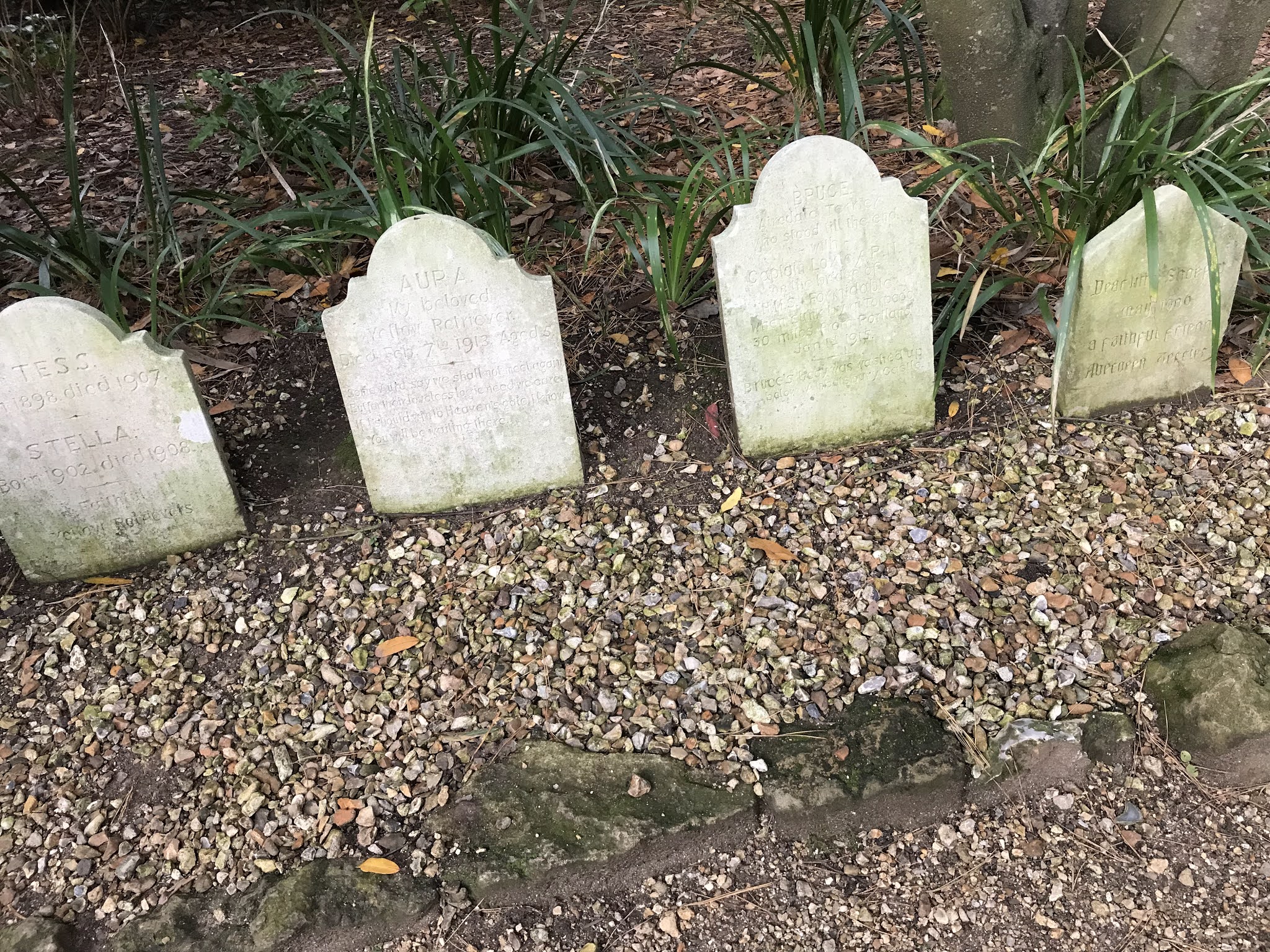
Mysterious graves, one in particular


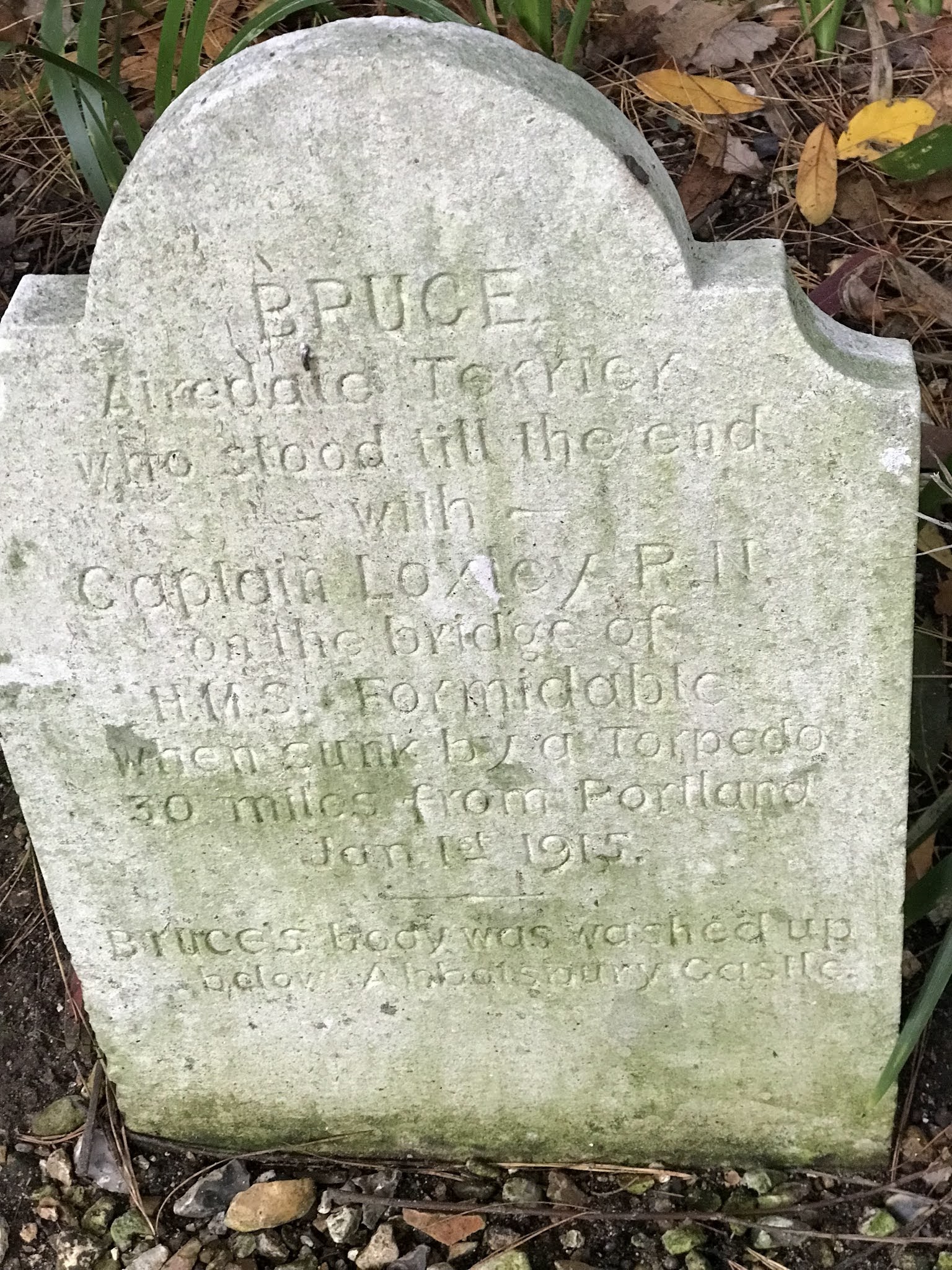
Bruce


Fascinating bit of dog history


It’s strange how some things snag the mind. We were walking through Abbotsbury Sub Tropical Gardens in Dorset. They were beautiful but not particularly relevant to anyone with a small garden dominated by damson trees. However, I came across this—a tiny door, which led me down an Alice in Wonderland tunnel into a fascinating incident that took place during World War I. It brought back a bygone world with its cruelties and dangers but also chivalry, honour and reckless courage. 


Captain Loxley was in charge of HMS Formidable, taking part in in gunnery practice just off Portland in the English Chanel. She was supported by Diamond and Topaz, two light cruisers under the overall control of Sir Lewis Bayley. As night fell and with the exercise done, Bayley ordered the 5th battle squadron to remain at sea, steaming in line formation at 12mph. German submarines had been reported in the area, visibility was poor and the sea increasingly rough. Formidable was the last in line, unaware that U-24 was stalking her in search of a good attack position. 


On January 1st 1915, at around 02:20 U-24 launched a torpedo at Formidable striking her starboard abreast of the forward funnel. Loxley fought to save the ship by bringing her close to shore. Unaware of what had happened, Topaz saw Formidable leave the line and speeded after her to see what was afoot. 

By the time she reached the stricken vessel twenty minutes or so later, Formidable was listing 20 degrees to starboard and Loxley had issued orders to abandon ship. Some stayed on board and through ‘counter-flooding' managed to reduce the list, though by then the whole ship was  very low in the water and facing thirty-foot waves. 


Just then (i.e., 03:05)  U:24 launched a second torpedo hitting her again on the starboard side close to her bow. Topaz and Diamond began the rescue effort in storm force waves, but it was only a matter of time. Formidable remained afloat for another hour and forty minutes. At 04:40 minutes it began to capsize and sink by the bow. She remained afloat with her stern in the air for a few minutes more and then sank. 


Captain Loxley was last seen on the bridge calmly overseeing the evacuation of the ship. Alongside him was his faithful dog, Bruce.  One of those saved recorded Loxley’s last known words: “‘Steady men, it’s all right. No panic. Keep cool. Be British. There’s life in the old ship yet!’ Captain Loxley’s old terrier ‘Bruce’ was standing on duty at his side on the fore-bridge to the last.”


Of its time


Diamond picked up 37 officers and crew from the water. A trawler from Brixham picked up a further 37, and Formidable’s pinnace rescued another 47 men ploughing through mountainous seas to Lyme Regis and safety. It took them 22 hours - not surprising; they had only one oar in a storm and were sculling water with their boots.


35 officers and 512 men were not so lucky, all of them killed in the sinking. 


Aftermath

An Admiralty enquiry laid the blame on Commander Bayley for conducting exercises without Destroyer protection. He was relieved of command for a short period, soon after cleared of negligence and continued his career in the Navy.

Bruce was washed ashore, his body taken to Abbotsbury gardens and buried with full honours. Captain Loxley was never found.


More info here

And details of less distinguished but equally important casualties here if you scroll down,