Friday, 25 November 2022

Tragedy and Opulence: Waddesdon Manor


It was a wet late afternoon when we visited this imitation of a French Chateau: Waddesdon Manor.


The Rothschilds bear the brunt of many conspiracy theories, but the builder of Waddesdon was a remarkable man. Ferdinand de Rothschild, born in Paris in 1839, married his second cousin, Evelina de Rothschild, and assumed British nationality in 1865. On December 4th, 1866, Evelina gave birth to a son, and one can only imagine Ferdinand’s happiness—and despair when mother and child died the same day. Ferdinand himself died on his 59th birthday, thought to be the result of a cold caught when visiting his wife’s tomb. 


Ferdinand Rothschild, a reminder that the rich are equally human when it comes to pain. 

There is evident melancholy in the face, and in conjunction with the quote at the very end of this post, you wonder how much of this was displacement activity. Years later he was to remark: "I am a lonely, suffering and occasionally very miserable person, despite the gilded and marble rooms in which I  live."

Even so, a marble Conservatory must compensate to some extent, along with the rest of this Ali Baba's Cave.


An organ clock portraying Orpheus with internal mechanism that plays tunes circa 1785


A small study in opulence


Followed by a big study in opulence - the Dining room from various angles.


Close up of one corner of the dining room


From the Breakfast Room above, you can see the entire length of the house to the Baron's Room. Male guests would have had their breakfast here. Ladies had theirs in bed. Food was brought in through a pair of small doors in the corner panelling. 


The Red Drawing Room
The Red Drawing Room was the main reception room for up to forty guests. The carpet was commissioned by Louis XIV and dates from 1683. The table was made in Augsburg between 1710 and 1720. The walls are littered with Gainsboroughs and Reynolds, and you can probably spot the Sèvres porcelain.


The Grey Drawing Room was where the ladies would withdraw to, while the men enjoyed port in the Dining Room. Sufficiently tanked up, they would rejoin the ladies for conversation, cards and sometimes dancing.

Walking along the West Gallery to the West Hall below you will see:


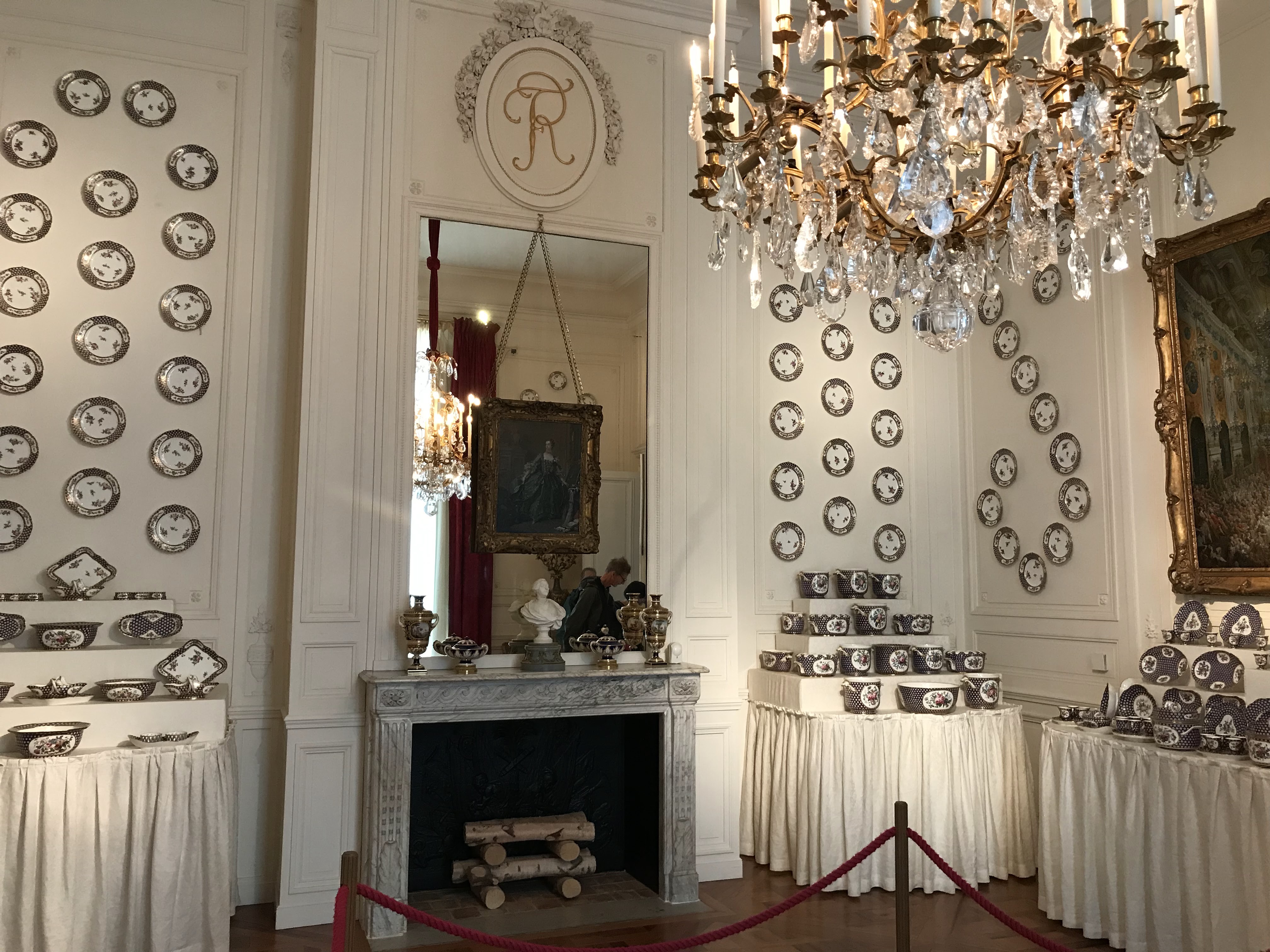
More clocks and Sèvres porcelain than you can shake a stick at, treasures and tapestries galore.


Ferdinand, I think, illustrates a life well spent. In memory of his wife’s death, he endowed the Evelina Hospital for Sick Children in Southwark, pursued other works of charity and became an obsessive collector of art. As a Trustee of the British Museum, he bequeathed his ‘Renaissance Collection’ to the institution on his death.


In 1874, he bought land in the village of Waddesdon from the Duke of Marlborough, levelled a substantial hill, and built Waddesdon Manor in order to house his collection. Built between 1874 and 1889 its design was based on Chateau de Chambord in France. It was very much a labour of love—as it was for us traipsing round room after opulent room.

 A bathroom with its own fire


The State Bedroom where Queen Victoria didn't sleep but rested her small weary body
. No doubt over-excited by seeing the electric lighting in the dining room which she insisted on switching on and off.


Another bedroom 

an indoor Sedan Chair for the infirm.


How successfully did a Jewish financier fit in the largely antisemitic English culture of the time? 

It’s likely Trollope borrowed aspects of Ferdinand Rothschild in his creation of his fictional financier Melmotte, in The Way We Live Now, a man who comes to a sticky end when trying to establish himself as a landed gentleman. But the brunt of Trollope’s attack – as it is on Ferdinand Lopez in The Prime Minister—is not on their ethnicity but on the character's lack of roots—the foundation stone of Trollope’s world. In all his books, the villain, irrespective of religion or race is the one who lacks or undervalues duty and a rooted community. 


For those who go for the knee-jerk reaction that Trollope was anti semitic, it's worth pointing out that Rothschild was a close friend of Trollope, along with  John Everet Millais, Sir Arthur Sullivan (of Gilbert and Sullivan fame) Robert Browning, and the American Ambassador in London. He was friendly with Gladstone and Disraeli, and also the Prince of Wales. In other words Rothschilds were accepted—money perhaps—but in Ferdinand’s case because he hunted, put down roots and accepted the concept of duty. 

Towards the end of his life, he became keenly aware of dying without a male heir, and bequeathed his estate to his younger sister, the formidable Alice who had no hesitation in telling off Queen Victoria for stepping on one of her flowers. Well worth reading about, here and here. As I said, formidable and would have seen off Harvey Weinstein.


 Lady Alice


 Lady Alice's spectacular collection of arms and armour. She positioned it here to create an appropriately masculine approach to the Smoking and Billiards Rooms used by male guests.


The Bachelor's Wing has ten bedrooms for single male guests, 15 bedrooms for permanent male staff and visiting servants and two rooms dedicated to masculine pastimes of smoking and billiards. The leather coated sofa is on a raised platform, incorporating heating grills, for better viewing of the game.


Covering the billiards table is a large mid C19th spread from Rasht, Iran.

And finally, and possibly of less interest to hard smoking, hard drinking bachelors, other treasures of Waddesdon. Raffles, eat your heart out.




The melancholy returned with a vengeance a year before his death:

‘...future generation may reap the chief benefit of a work which to time has been a labour of love, though I fear Waddesdon will share the fate of most properties whose owners have no descendants and fall into decay. May the day yet be distant when weeds will spread over the garden, the terraces crumble into dust, the pictures and cabinets cross the Channel or the Atlantic, and the melancholy cry of the night-jar sound from the deserted towers.' Ferdinand Rothschild, 1897.


I think he would have approved of how his descendants have maintained it by sharing the building and its contents with the nation in an intelligent arrangement that benefited both family and country. He may even have approved of its use as a film location for the likes of the Carry On film 'Don't Lose Your Head,' 

'The Mummy: Tomb of the Dragon Emperor,' 'Frankenstein,' and Sherlock Holmes.'

If this is an overlong post, it was harder on our feet, minds, and iPhone batteries, but worth it, I hope.


Saturday, 19 November 2022

Walsingham

Cambridge and Norfolk come into their own at twilight. The air is soft, outlines blurred, the countryside crossed by sly and winding lanes; nothing quite as it seems. It may be the reason recusants and spies are associated with the area—along with mystics. I’m not so much thinking of Julian of Norwich, rather the mysterious Richeldis and the great shrine of Walsingham—its peace disturbed by Henry VIII. The whole shameful story can be read here. 


The full story of Richeldis and the visitation of Our Lady in 1061 can be read above and below. One thing for sure, the saintly Richeldis and her heavenly friends would make short work of the housing crisis.


I confess, shrines and pilgrimages hold little appeal for me, Lourdes, especially so. I have no rational explanation for this, then again rationality isn’t exactly a factor in religious experience. Perhaps it is the kitsch I associate with Lourdes: coaches, souvenirs and gift-shops; then again, having never been I may equally be missing the point: a religious experience.


The point was made apparent on our third day in Norfolk, when we visited Walsingham. First, a warning: other than the shrine, what you see in this photo is pretty much what you get in Walsingham. 


There is one pub. There is a bookshop that sells tea and sandwiches, light lunches. And there was the curse that dogged much of our trip: everything was closed in one form or another. The shop that sold books and light lunches closed at 4.30. The pub we’d counted on eating in served food two days a week, and they didn’t on the day we were there. On an empty stomach, beer and a packet of crisps held little attraction. These were material shortcomings, and having initially groused about coach parties, souvenir shops and kitsch, I suppose I shouldn’t really complain. 


What Walsingham did have was an atmosphere that slowly seeped into the bone. The largest of the two shrines was the Anglican which was more ‘High Church’ than the Pope. It was beautiful inside and is built within and incorporates much of the original medieval monastery.


The Catholic Shrine is housed in the smaller ‘Slipper’ Chapel just over a mile away at the other end of the village. It derives its name from the medieval custom of pilgrims housing their ‘slippers’/shoes in the chapel and walking to the shrine in bare feet. And presumably back again to retrieve their shoes. Bit like a bowling alley where you exchange your shoes for bowling slippers, but with the disadvantage of a two mile walk in between. 


We walked the ‘pilgrims’ way, with our shoes on. The track was straight and looked medieval. It was in fact a decommissioned rail track but did the job. 


A prosaic but informative board 


 Slipper Chapel exterior

The Slipper Chapel attracted me most strongly. It had a great sense of peace, an atmosphere you could cut with a knife. Totally unworldly. In truth, I could have stayed there much longer. The peace and sense of something other was probably magnified by being out of season. In Pilgrim season, packed with coachloads of the devout, I may have had a different experience. Then again, it may be ‘the sense of peace and an atmosphere you could cut with a knife’ was the residue of others’ religious experience. 


Walsingham was quiet but we did bear witness to a shadow of the medieval pilgrimage, two cheerful but skeletal Catholics proudly displaying their bare feet having done ‘the walk,’ and a chubby Anglican cleric with a small entourage of  'eager souls' who we kept bumping into. 

An interesting day but one that left us with an appetite, a craving for food.

Friday, 11 November 2022

Blickling Hall


On the third day in Norfolk the heavens opened and as a result every man and his dog—and us tagging along—decided to visit Blickling Hall, a magnificent house and most importantly dry. We decided to forgo a walk in its 5,000 acres of parkland in favour of the house and its remarkable history. 


Built on the ruins of a much earlier building, the present house was designed by the Jacobean architect Robert Lyminge who, in the hope of a long life, I wouldn’t have asked to design a kennel.

 His two most famous clients were Sir Henry Hobart who commissioned Blickling Hall, and Sir Robert Cecil, 1st Earl of Salisbury who had him design and build Hatfield House. 


The unlucky Earl never got to live in his new home, dying of cancer in the spring of 1612. The house was only finished later that year. 


Henry Hobart did at least get to live in Blickling Hall, but for less than a year, and he’s haunted the place ever since; his dying groans are still heard in the West Turret bedroom—usually on the anniversary of his death; getting value for money, I suppose. No, a long life for me; spare me the curse of Lyminge.


The main stairway from the hall. At the top, it branches out on to two landings, and two funky statues of Anne Boleyn and her daughter Elizabeth I, both women supposedly dancing. Anne grew up somewhere else, but she was reputedly born here. 


The long gallery and library with its magnificent Jacobean ceiling, 12000 books, and refugees from the rain.


Halfway down the gallery, because it can get a bit chilly, a hearth but no fire


And at the far end of the gallery:


The State Chair that held the bottom of James II at the state opening of the Irish Parliament.  We were not allowed to sit on it. I wasn't too impressed. It looks like something from a charity shop. 


The Chinese Bedroom with its handprinted wallpaper showing scenes from Chinese life.


Blickling has other ghosts, too. Anne Boleyn’s great grandfather, Geoffrey Boleyn bought the original house from Sir John Falstaff, the knight that Shakespeare popularised as a drunken buffoon. The real Falstaff was a more substantial figure.  Whatever the case, Falstaff clearly regretted the sale because he also haunts the place, probably lamenting what Robert Lyminge did to the old house. 


Anne Boleyn too is a regular visitor, usually on the eve of her execution (May 19) Can’t miss the woman, dressed in white and carrying her dripping head on her lap—usually in a coach driven by a headless horseman and four headless horses. Talk about attention seeking, or maybe just revisiting the place of her birth and wondering where it all went wrong. 


The portrait of the lady to left is that of a remarkable woman, Henrietta Countess of Suffolk. Henrietta exemplifies the indomitable spirit. Born in 1689, she lost her father in a duel when she was twelve, and her mother to illness. Faced with mounting debts, perhaps even having to sell the house she married Charles Howard the younger son of the Earl of Suffolk, who proved a drunk and abusive husband. Did that deter her? No. The story continues 


To our relief the deluge enjoyed a short tea-break so we wandered outside—not far—the tea-break didn't last long and we scurried back inside—to one of the great second hand bookshops - more like a well equipped library. 


We were put on to it in the gardens by two passing strangers. The husband carried a bag full of books, and it is my experience that book lovers enjoy a universal language and love to share their enjoyment. We began talking, and to our delight both had considered living in Monmouth, had family there, and enjoyed a curry in the Misbah, an old and established Indian restaurant in the town. We enjoyed their company, the book shop even more, where I bought a rare Anya Seton, Harrison Ainsworth's Old Saint Pauls AND . . . A BIGGLES BOOK! All for under a fiver. Thank you Blickling Hall.


5,000 acres of parkland. Hard to fathom. Harder to walk

                                                            The house from behind


Friday, 4 November 2022

The Wrong Side of History


Oxburgh Castle was completed in 1482 for Sir Edmund Bedingfield, and the family have lived here ever since surviving civil war, periods of near dereliction, and, in the C20th, the threat of demolition. The Bedingfields are an object lesson in loyalty and on being on the wrong side of history, but throughout imbued with the will to survive. 


Lovely Tudor brickwork and you can see where there have been repairs and modifications.


And in the woods, 


their own private chapel


In 1951, the end appeared nigh when, with mounting debts and taxation, the house was sold to The Eagle Star Insurance Company, which planned to resell house and estate in lots.


 Lot one, the house and gardens, attracted the interest of a developer who planned on knocking it all down, salvaging the oak in the roof and surrounding trees and demolishing the beautiful Tudor brickwork for use as hardcore. The house’s contents had already been sold. Prompted by an uneasy Eagle Star, Lady Sybil Bedingfield, her daughter, Frances, and a niece scraped the money between them to buy it back again, intact but without fixtures and furnishings. Somehow, scraping more money for its upkeep, they persuaded the National Trust to take it on and replace what they could of its former furnishings.


Ornate hearth with portrait of Sir Henry Bedingfield who somehow kept his head.


Having sold everything, and with nowhere else to live, the family were allowed to inhabit a wing, a far cry from their glory days.


Wonderful Jacobean carvings and two very weird children


The Bedingfields rose to prominence during the War of the Roses, when the victorious Yorkists rewarded them for their loyalty. Edward IV granted Edmund Bedingfield permission to build Oxburgh, and Richard III knighted him. 


After Richard’s defeat at the battle of Bosworth, Sir Edmund switched sides, supporting the new Tudor dynasty. He hosted Henry VII and his wife Elizabeth of York, and the king’s mother, Lady Margaret Beaufort. At this point, they were on the ‘right side of history.’


Edmund’s third son, Sir Edmund Bedingfield 1480–53, had fought for Henry VIII in France, and after the king’s divorce, Catherine of Aragon was placed in Sir Edmund Bedingfield’s care. Similarly, Edmund’s son, Sir Henry, offered loyal support to the new protestant boy king, Edward VI, and in 1549 helped suppress a rebellion against the enclosure of common land. Up until this point Bedingfield loyalty to the reigning monarch had been both astute and pragmatic. 


Then events took their course. When the Catholic Mary Tudor ascended the throne, Sir Henry’s loyalty to the reigning monarch proved disastrous, largely because of Mary’s short reign 1553-1558. He suppressed a rebellion against her, was placed third in command of royal forces, and became the effective gaoler of the Queen’s half-sister, the future Elizabeth I. This was peak Bedingfield, Sir Henry achieving the giddy heights of Lieutenant of the Tower of London. 


How the mighty fell. Elizabeth had a long memory, and when she came to the throne, Sir Henry lost favour, was removed from the court and lost his position as Lieutenant of the Tower of London. Though still referred to in letters as her ‘trusty friend,’ Sir Henry retired to Oxburgh in disgrace—made worse when he refused to sign the Act of Uniformity, a key pointer of loyalty to the new regime. Like many  old Catholic families, the Bedingfields resorted to building a 'priest hole' to hide visiting priests from the authorities. The first link is brisk and informative. This link is more atmospheric and with some lovely music


From this time on the Bedingfields were linked with Catholicism, and after Elizabeth’s death, the new Stuart dynasty. From now on it became very much a game of Snakes and Ladders. They prospered during the reign of Charles I—then the Civil War ruined them. Oxburgh was ransacked and partially destroyed by the Roundheads.


At the Battle of Marston Moor in 1644, the Bedingfields miraculously escaped when out of 18,000 Royalist troops, 4,000 were killed and 1,500 were taken prisoner in just two hours. The painting shows the crowned Virgin Mary sheltering Sir Henry and Lady Margaret Bedingfield and their family beneath her blue cloak.


It was all change again after the Restoration, when Charles II became king. He awarded the new Sir Henry Bedingfield a Baronetcy—which cost nothing—and failed to compensate the family for all they had lost. Things became worse after the Stuarts were driven from England. Under successive Protestant regimes, to be a Catholic was akin to being a jihadist today—in this case with some justification. For much of the C18th the family remained firm Jacobites, funding rebellion and secretly plotting to overthrow the Protestant Hanoverians. 


Those who supported James III would raise a toast to the king while passing their special drinking glass over a bowl of water to symbolise the king in exile in France. The glass is engraved with secret symbols of their loyalty. The rose and twin buds represent the 'Old Pretender' and his son, Bonnie Prince Charlie. Fiat means 'let it come to pass.' The oak leaf was a Stuart symbol from the Restoration. 


  The family was on the edge of ruin. Eventually, Oxburgh was leased, whilst the Bedingfields lived abroad. The castle was used for hunting parties, even leased out to a fashionable Bond Street hatter, and fell into disrepair. 


In the C19th it enjoyed one final flare of glory. The Sixth Baronet, Sir Henry Bedingfield, married Margaret Paston, the last in line of a rich and ancient Norfolk family. Her wealth transformed the Bedingfields, and Oxburgh was restored to all its former glory—until 1951 where this story begins but not necessarily ends. 


The heir to the baronetcy is now a priest – one suspects a pleasant posting rather than a parish in Blackpool. There remains a younger son, the new heir and begs the question, where will the Bedingfield story end?