Thursday, 15 February 2024

Mr Sludge


The following short passage  is taken from one of my ghost stories set in late Victorian England. All of the characters but one are fictitious. The ‘reveal’ directly follows:


…. Miss Fiske nodded her head as one accustomed to doubt. “Ah we have a Voltaire amongst us; and yet had you been privileged to witness, as I have, the incomparable Daniel Dunglas Home floating from an upper-story bedroom window, passing with complete equanimity across a street seventy feet above—he raised his hat, sir, before re-entering his house by a sitting-room window.” Miss Fiske stared at each of them in turn. “A mystery most profound as is the Lord who allows such things.”

“The problem is, which lord?” the bishop muttered in an audible whisper. Eleanor sighed, sensing

another sermon coming on. 

“This restless doubting; this endless search for meaning in a world capering on the edge of lunacy, truly reflects the emptiness of our Godless time. Where has our puerile faith in technology, progress and profit for profit’s sake left us? Our sweet Lord who for our sins died on a pagan cross is to be replaced by…table rapping?" The bishop sighed deeply.  “This Gaderene rush towards that bleak precipice called progress…how many poor souls have been left behind, crushed beneath the wheels of mammon? How many souls, of the lower orders now find themselves embracing any and every ideology that may alleviate their situation…? How…” 

Laura cut him off. “I have always tended to side with Mr Scrooge on such matters. It was he— correct me if I am wrong my dear Septimus— that dismissed the spirit of poor Marley as a piece of undigested beef.”

The bishop considered the theological implications for a moment and allowed himself a tolerant smile. 

“Is it only through trance that the spirits can be contacted?” Eleanor asked. 

“The less gifted can of course avail themselves of the Planchette.” Miss Fiske shuddered delicately as if to suggest that such devices were little more than ethereal carving knives. “They are I believe quite popular amongst those for whom the other world is but a parlour game. Indeed, I do believe that there is now published ‘Spirit Rapping Made Easy.’” She shuddered again. “Can you imagine?”

            “Consecration in Five Easy Steps, perhaps?” Eleanor smiled sweetly at the bishop then turned again to the still shuddering medium. “Yes, indeed I do sympathise, Miss Fiske.”


Miss Philippa Fiske, though I wish otherwise, is fictional. Daniel Dunglas Home is not fictional, neither by all accounts was his ability to levitate at the drop of a hat.


An intimate account of his powers was given by Princess Pauline Metternich  in 1863 when with fifteen guests they sat around a table in a richly furnished room. “He was very pale,” the princess later wrote, “with light china-blue eyes, reddish hair thick and abundant but not inordinately long.”


Sitting on an armchair, someway from the table, Home sank into a trance. Soon after, taps were heard, sounds came from the chandelier and a chair moved across the room. A posy of violets drifted across the room from the piano and landed on Princess Pauline’s lap.

Some guests felt unseen hands and sensed movement beneath the table. The lights were switched on, the tablecloth removed, and table and floor thoroughly examined. Nothing was found. Suitably impressed, they adjourned for afternoon tea. 


Daniel Home came from a family of seers but as a small boy emigrated to America in the care of his uncle and aunt. His gifts were quickly recognised, so much so he was kicked out of his aunt’s God-fearing home and thereafter spent his life moving from place to place. In August 1852, at the home of a Connecticut silk manufacturer, he levitated several times during a séance, on one occasion touching the ceiling. 


Shortly after, he moved to England where he became a sensation. Lord Brougham, a former Chancellor and the scientist Sir David Brewer, witnessed a table lifting off the floor, an accordion and a handbell sounding without being touched. Despite a thorough investigation no trickery or rational explanation was found.


Between 1871 – 1873 the British scientist Sir William Crookes investigated Home’s ‘powers.’ On one occasion, he placed an accordion within an electrified cage to prevent tampering or fraud. The accordion sounded without Home touching the keys, and Crooke concluded that Home had genuine power.

Charles Darwin, too, was intrigued by Daniel Dunglas Home but was content to sit on the fence: “I cannot disbelieve Mr Crooke’s statement, nor can I believe in his result.”


One of his earliest fans was the poet Elizabeth Barret Browning. Both she and her husband, Robert Browning attended one of his seances in 1855 where ghostly hands placed a wreath of clematis on her head. Robert Browning, on the other hand despised the man, forbidding “this dungball” from his house and later writing a poem about him: “Mr Sludge, ‘The Medium.’”


Despite Robert Browning’s disapproval, Daniel Dunglas Home was famous throughout Europe, conducting seances for Napoleon III of France, Tsar Alexander II and a ‘veritable who’s who of Victorian society.' He died in Paris in 1886 and was buried in the Russian cemetery in that city.


Friday, 9 February 2024

Burford. Ghosts and Saints

The A40 is one of my favourite roads, based in parts on an old Roman road and once the link between London and Fishguard. The stretch I find most attractive cuts through the Cotswolds en route to Oxford. 

We travelled it often and were always intrigued by the village of Burford twenty miles west of the dreaming spires. Recently, we took the left to Burford and spent an hour or two exploring it. 

The village is typically Cotswold, one long street with some interesting pubs (could spend a happy day there) gift shops and tea rooms. Off the main street are several interesting lanes, a car park that floods when the river Windrush overflows, and a very impressive church: St John the Baptist.


Inside the church is a tomb, which illustrates the beautiful complexity of history—that of the 'establishment'  as opposed to folk history. 


 The picture below shows St Peter's Chapel, once the private pew of the local Tanfield family. 


here hosting a Christmas Nativity scene


A close up of the chapel altar, 


                           And a  fascinating history of St Dorothy, whom I'd never heard of before.


For me, the centre piece of the church was not the high altar or the strangely arranged  chairs in place of pews


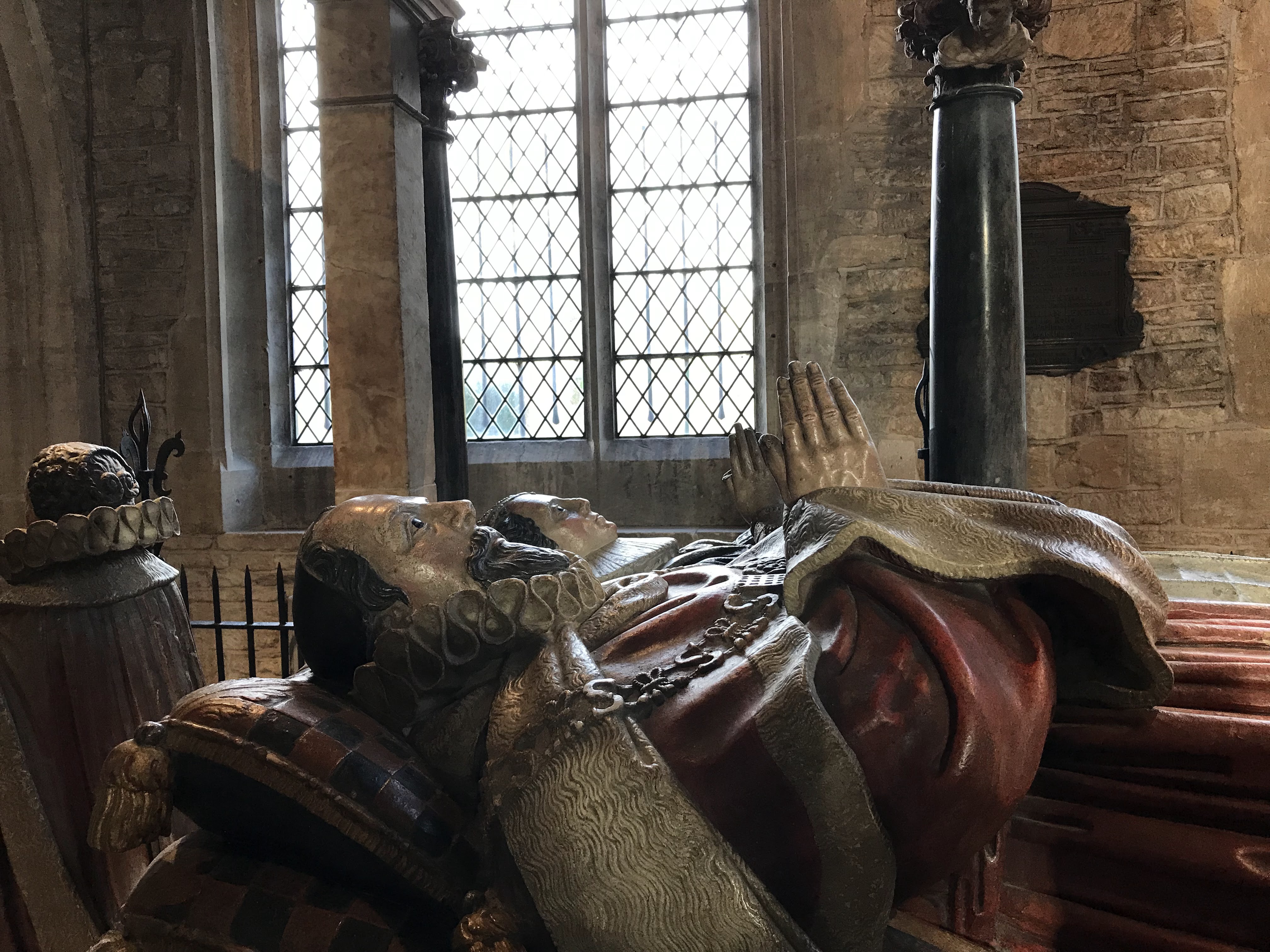
but the gorgeously ornate tomb of Lord and Lady Tanfield. 


At the head of the tomb is a coloured sculpture of their only child, Elizabeth Tanfield. 


At the foot of the tomb is Elizabeth's son, Lucius Carey


And here is what the tomb says of  Lawrence Tanfield


Clearly, the man was a saint—an establishment panegyric that would however cut little ice with St Peter. In reality, as a leading Treasury official, Sir Lawrence Tanfield was notoriously corrupt, and both he and his wife were hated as harsh and exacting landlords. Not a whiff of that here.


Soon after their demise, according to local folk lore, a fiery coach carrying the two of them could sometimes be seen flying through the streets and lanes of Burford—those unfortunate enough to see it cursed on the spot. The legend may have arisen years after an earlier tradition that began after their death—the burning of their effigies by the local people. Mercifully, the curse of the fiery coach carrying the two malevolent sprites ended after an exorcism. During it, the local vicar captured the ghost of Lady Tanfield and placed it into a bottle, which he promptly corked and threw into the river Windrush. During droughts, so desperate were the locals to prevent the bottle ever surfacing, they would attempt to fill the diminishing river with buckets of water.  The question though arises, what recourse did they have when the river flooded?


As it did when we were there. Our car is out of picture to the right, and we had to paddle out of the carpark.


Not everything about the family was bad. 


Their only child, Elizabeth, was something of a prodigy, her talent nurtured by her parents. She was forbidden candles, unless it was to read by night; a French tutor was hired when she was five years old and in just over a month she was speaking fluent French. From there she went on to learn Spanish, Italian, Latin, Hebrew and Transylvanian. At fifteen, she was contracted in marriage to Sir Henry Carey, and when her new mother-in-law told her she was not permitted to read, she developed a gift for poetry instead—in between having eleven children. When, in Ireland, her eldest daughter Catherine saw a vision of the Virgin Mary on her deathbed, Elizabeth converted to Catholicism shortly after. As a result she was banned from court, her father disinherited her, her husband tried to divorce her, and when her four daughters also converted to Catholicism, they were taken from her. Elizabeth however fought back. The boys had been put in the care of her eldest son, Lucius, a staunch protestant. She instigated their escape and led by example. By the time of her death in 1639 six of her children had followed her into the Catholic Church, four of them becoming nuns. 


Elizabeth's  son, Lucius was a gifted intellectual who took an active part in the turbulent politics of the day. He fought for the king, whilst despairing at the intransigence of both sides and was killed at the battle of Newbury. There, his body was stripped and left until recognised by a servant and taken home and buried in an unmarked grave in the village church yard of Great Tew—which we have yet to visit.


Friday, 2 February 2024

'I am marrying a womb'

Josephine appeared in Napoleon’s life in 1795 when he was starting off as a soldier. Six years older, she was looking for a man with prospects. It’s fair to say she struck gold with Napoleon; the future Emperor of France, perhaps, less so. It was, in the early days, a love match—for Napoleon at least. 

Separated by his invasion of Italy, Napoleon makes his feelings clear: “Since I left you, I have always been sad. My happiness consists in lying with you. I constantly recall in my memory your kisses, your tears, your kind jealousy.”


During their marriage, and in between conquering most of Europe, Napoleon wrote 265 letters to Josephine. Josephine’s letters are in single figures—perhaps because as some argue, she was never in love with the man. Having got what she wanted, Josephine was too busy enjoying life, whilst her husband was fighting for the glory of France. 


Eventually Napoleon suspected that all was not right:

 “I had hoped to receive a letter from you, and your silence plunges me into a horrifying uneasiness. I beg you, do not leave me any longer in such uneasiness . . . How can you forget the one who loves you so ardently? For three days, I am without a letter from you, and yet I have written to you many times. The absence is horrible, the nights are long, tiresome, and insipid.”


Discontent turns to anger. 1796:

 “I no longer love you. On the contrary, I detest you. You are a wretched, clumsy, rude woman. You do not write to me . . . you do not love your husband. What do you do all day, Mademoiselle? What important business takes up your time to write to your good lover? What affection suffocates and makes you forget the love, the tender and constant love that you have promised him. Who can be this prodigious new lover who absorbs all your moments?”


Campaigns in Europe and Egypt saw them drift farther apart. Josephine continued to ignore him, and Napoleon’s love turned to indifference. When Josephine realised she had all but lost her meal-ticket she sought her inner ‘Stepford Wife;’ it was too late. 


Josephine, looking less than happy with her new title of Empress. 
The tragedy behind the expression is that by this time, she couldn't  have children andgive Napoleon the all important child. In 1796 she contracted either chlamydia or gonorrhoea and developed salpingitis which led to infertility.


Irrespective of fertility, Josephine's behaviour as  described above gives context to Napoleon's rather cold letter shown in the previous post, and possibly  shows Napoleon in a more sympathetic light. Having said that, Napoleon  sacrificed both Josephine and the Countess Maria Waleskwa in the interests of real-politick. 


In 1810 he divorced Josephine and put Maria on hold in Italy—in some degree of luxury—in the interests of a dynastic and more ‘respectable’ marriage. In his own words, 'I am marrying a womb.' 

The lucky woman was Marie Louise, daughter of the Holy Roman Emperor and, ironically, the great niece of Marie Antoinette. Napoleon proved an attentive and considerate husband but the marriage was relatively short.


 The wedding of Napoleon and Marie Louise

Marie Louise, Duchess of Parma after Napoleon's exile, with her son. He had 'married a womb' and she had delivered, and thereafter had a better life than Napoleon.


When her family saw which way the wind was blowing after his first exile to  Elba, they made every effort to separate them. His defeat at Waterloo clinched the deal. Marie Louise, daughter of the Holy Roman Emperor and great niece of Marie Antoinette, did not accompany him in his St Helena exile. Her family made sure of it.  Husband and wife never saw each other again. 


For me, the end of a journey from a random page in The Letters of Napoleon The rabbit hole continues, if you find yourself intrigued by the relationship between Napoleon and Marie Louise.  Alternatively try here. Wishing you a safe and happy journey. 

Friday, 26 January 2024

Not tonight Josephine

I was dusting some books and, as though mysteriously directed, pulled out an old Everyman edition of the Letters of Napoleon bought in a Swansea second hand bookshop some fifty odd years ago. 


I turned a random page and was hooked. Is it just me, or does is this small sample make for compulsive reading?


To the Empress (His wife, Josephine)

Warsaw23rd January 1807

I have received your letter of 15 January. I can’t possibly allow a woman to undertake the journey here. The roads are too bad —unsafe, and deep in mud. Go back to Paris; be happy and cheerful and perhaps I will come soon. Your remark that you married a husband to live with him makes me smile. I thought, in my ignorance, that the wife was made for the husband, and the husband for the country, the family, and glory. Forgive my ignorance. There is always something you can learn from the fine ladies of today. 

Good-by, my dear. Remember how much it costs me not to let you come. Say to yourself, it shows how much he cares for me.

N


There is so much to unpack in this letter, none of it entirely favourable in today's present climate. What do you get from it?


And  if you read this letter, written at the same time, you begin to understand Napoleon’s reasons for discouraging a marital  visit. 


To Madame Walewska

Warsaw Jan 1807

I saw no one but you, I admired no one but you. I want no one but you. Answer me at once, and assuage the impatient passion of

N


Didn’t you like me, Madame? I had reason to hope you might . . . Or perhaps I was wrong. Whilst my ardour is increasing, yours is slackening its pace. You are ruining my repose! Ah! Grant a few moments’ pleasure and happiness to a poor heart that is only waiting to adore you. Is it so difficult to let me have an answer? You owe me two. 

N


There are times — I am passing through one now—when hope is as heavy as despair. What can satisfy the needs of a smitten heart, which longs to throw itself at your feet, but is held back by the weight of serious considerations paralysing its keenest desires? Oh, if only you would!. . .  No one but you can remove the obstacles that keep us apart. My friend Duroc will make it quite easy for you.

Ah! Come! Come! You shall have all you ask. Your country will be dearer to me,  once you have had pity on my poor heart. 

N


Marie, my sweet Marie, my first thought is of you, my desire is to see you again. You will come again, wont you? You promised you would. If you don’t, the eagle will fly to you! I shall see you at dinner—Our friend tells me so. I want you to accept this bouquet; I want it to be a secret link, setting up a private understanding between us in the midst of the surrounding crowd. We shall be able to share our thoughts, though all the world is looking on. When my hand presses my heart, you will know that I am thinking of no one but you, and when you press your bouquet, I shall have you answer back! Love me, my pretty one, and hold your bouquet tight!

N

Maria Walewska


Maria Walewska was the young wife of an elderly Polish noble, and in some lights, she  might  be seen as a sexual pawn. After the death of her father, Maria’s seven debt-ridden brothers along with their mother faced poverty and ruin. At eighteen, she was persuaded into marriage with the 68-year-old Count Athanasius, Count Colonna-Walewski and all was well, prosperity was restored.


Napoleon 


She met Napoleon for the first time in 1806  – a brief encounter during a change of horses at a coaching inn. So impressed was he with her conversation, he engineered a reunion at a Warsaw ball.


History then repeated herself, perhaps more significantly. This time, instead of seven cash-strapped brothers to help out, it was the future of Poland—depending upon who you believe.  Certainly, a section of the Polish aristocracy, seeing Napoleon’s growing attraction for her, encouraged Maria to play along. Within weeks she was all but his mistress, was with him at Finckenstein in 1807, Paris in 1808 and 1810, at Vienna in 1809, and she even visited him in his first exile at Elba. The two were blessed with a son, Count Florian Walewski,  born May 11th, 1810. 


After Napoleon’s exile to St Helena in late 1815, she married her lover Count Philippe Antoine d’Ornano in 1816 


and died in 1817 after kidney complications following the birth of their son. 


In her memoirs, she sought to put the record straight and thus restore her respectability. Writing about her relationship with Napoleon: ‘The sacrifice was complete. It was all about harvesting fruit now, achieving this one single equivalence (convincing Napoleon to support Polish independence) which could excuse my debased position. This was the thought that possessed me. Ruling over my will it did not allow me to fail under the weight of my bad conscience and sadness.’ 


Being a romantic, I’m persuaded it was more than that. She wasn't just lying back and thinking of Poland.


Even so, it adds weight to Napoleon’s observation …. ‘Battles against women are the only ones that are won by running away.’


 Josephine coming up next week.

Thursday, 18 January 2024

The Prisoner


The Old Woman and the Mystical Whale did me precious little good in Saguenay. It was there I came down with Covid. I tried to brush it off, I’ve had worse – a small, dry cough and an over-moist nose: irritating but that’s all. Yes, okay, tired too. But the brains of the outfit insisted something was wrong when she noticed I had lost my appetite, too. I bent to her instincts and more to prove her wrong than anything else, contacted the medical centre.


Within moments I was diagnosed and the ship went into security over-drive (with one obvious weak link.) Our cabin door was sprayed from the outside, mercifully no cross daubed with dripping red paint. The Prisoner in Cabin X. If there had been an iron mask somewhere, I'd have been in it. 


There was a thin silver lining: free wi-fi and a vague promise that I might be allowed out for a spot of fresh air if masked and properly supervised. Little did I know what that entailed.


The day following, I had something worse than Covid: cabin fever. I was drowning in prison movie cliches, pacing my cell to maintain optimal fitness, doing press-ups, shaving my head, investing in tattoos, practising hard stares and the occasional dead-pan snarl. Gradually a more chilling vision dominated. This is what a care home would be like, an elderly Keyton responding with Pavlovian eagerness to room service bringing in food. My worst fears came true when I found myself watching a Spice Girls documentary on TV without knowing why.


I tried the stiff upper lip thing— “Worse things happen at sea, as my dad used to say.” —only for my wife to point out that we were at sea. I’m still trying to think of a rejoinder. 


A day later, my wife who up until then had been allowed her freedom (the weak link mentioned earlier) also came down with Covid. 


More forceful than me, she demanded access to fresh air. Hours later there was a furtive knock at the door. Two masked men stood outside, one with a disinfectant spray and a large cloth. We were ushered out into the corridor, one leading the way the other conducting a bizarre balletic dance behind us with spray and cloth. It put me in mind of ‘Curling’ — the back to front version. 


They led us to an empty luxury cabin with its own balcony where we were allowed to breath in buckets of North Atlantic air, as we headed for Belfast and ultimately home two or three pounds heavier.

Thursday, 11 January 2024

Myth and Religion


The St Lawrence was beautiful. Squint and you might glimpse red coats and blue coats still fighting it out.


But we were about to enter Saguenay Fjord, and the weather mysteriously changed. 


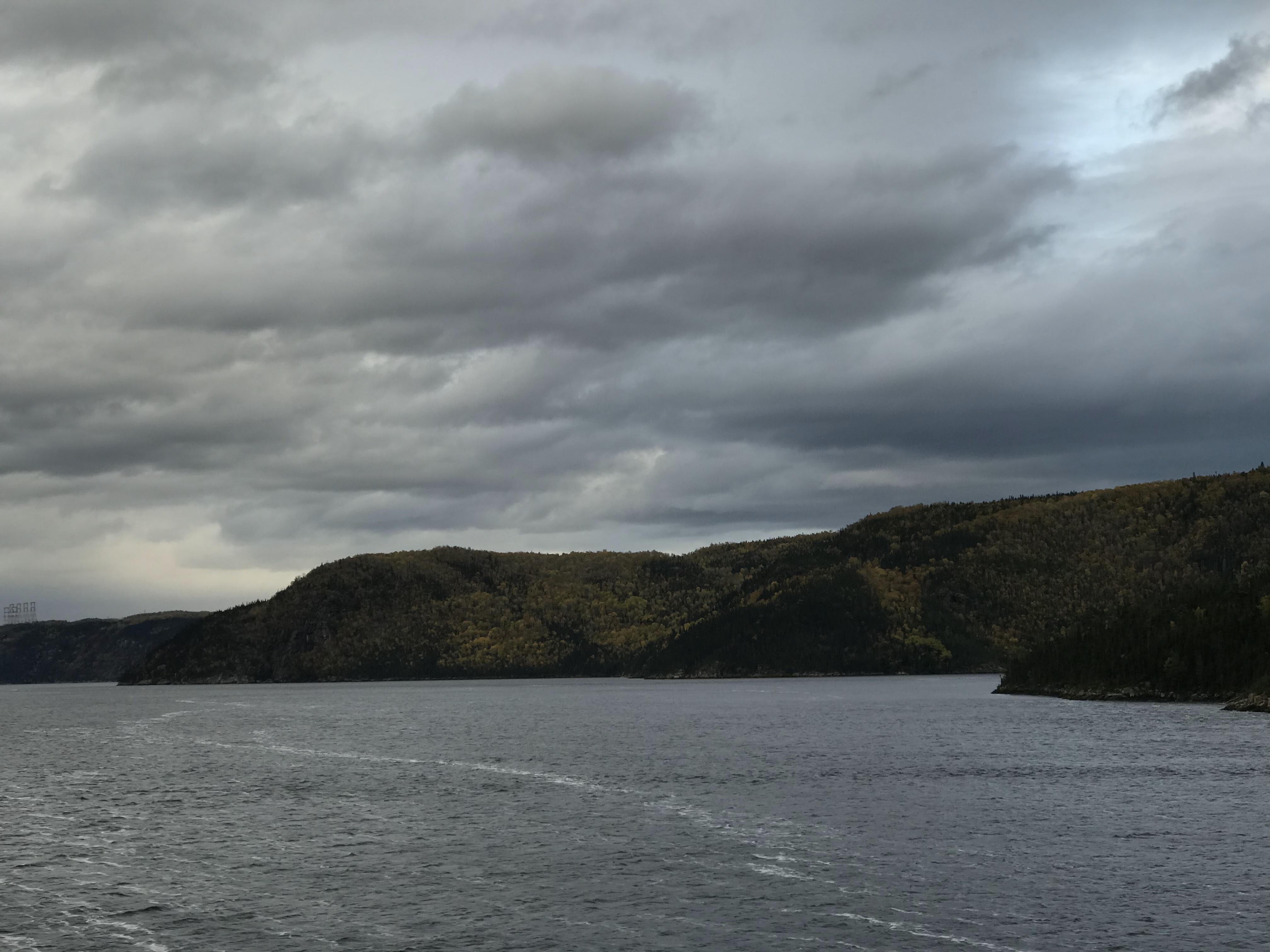
As we sailed along Saguenay fjord, which is just off the St Lawerence,  I was struck by its emptiness, even monotony. How many photos can you take of forested cliffs with no differentiating features? I tried and was each time disappointed. None would pass muster in an identity parade. 


Below, I tried to convince myself that the water in someway mirrored the rock


Port or starboard, the same overwhelming emptiness.


And yet.


Nature abhors a vacuum, as  does the human spirit. The Saguenay fjord  teems with fish, its shores densely forested and rich in game, but the overwhelming impression is of a vast and virgin wilderness – one filled with native myth, overlaid later by French colonisation and an imported religion.


An early native legend is that of the White Whale, one that housed a powerful and benevolent spirit. Those who reported seeing  it talked of a majestic and otherworldly creature, serene and pure white. For them, it was the spirit guardian of the river and surrounding forests. It’s been seen many times over the years, each sighting supposedly marking a significant event.


Here was  a likely spot for a whale, even an old woman in a canoe


A related spirit is that of the ‘Old Woman of the Fjord,' depicted as a wise and elderly woman who, like the whale, guards and preserves the purity of both wildlife and wilderness. Both myths reflect the native reverence for a natural world that sustained them.


Some years after the French arrived the tradition was continued, though in religious form and epitomised by the Statue of Our Lady of Saguenay. 


The statue is over thirty feet tall and shows Mary embracing the valley with her arms outstretched. It’s both religiously important as well as a tourist attraction, and has the added advantage of being more accessible than the Old Woman or the Whale. I saw it at least, but not, alas, the Old woman or the Whale.


Just lots of trees


Friday, 5 January 2024

Life and Death

When I was a child I remember going to Blackpool on a number of occasions. To our left, as we walked along the front, was sky and sea, invariably drizzly and grey. To our right were long terraces of old-fashioned Boarding Houses, all with big windows. One in particular I remember. It revealed a cosy breakfast room and tables clothed in white linen and silver. The lighting was subdued, pink; and it appeared truly magical, like nothing I’d ever seen before. And it was this lure, I’m sure, that attracted ‘regulars’ to Blackpool, year in and year out. It was perhaps a northern thing, dating from a time when factories closed for holiday weeks; there were special trains, and holidays were almost a communal activity. 


I was reminded of this on the ship with the realisation we had become part of a cult. The ‘cruise cult.’ There are cults within cults, in this case that of Fred Olsen or ‘Fred’—referred to in reverent whispers. 

People spoke in quiet pride of the number of cruises they’d been on, some happy to stay on the ship having been to these places before. Like the northerners that once flocked to Blackpool, they liked what they already had. Why change a good thing. We’re talking about people on their fifteenth or eighteenth cruise—far better than any care home alternative—speaking of which, they should just give the care home franchise to Fred. He’d make a far better job of it. Assign their pensions to Fred and be done.


It's foolish to generalise or cast judgement. Every person has their own story. One lady in her eighties ruefully described her knee and hip replacements and upcoming shoulder surgery, the amount of metal in her, and how airport security alarms bleeped from a mile away. She’d booked five cruises for the upcoming year. In her case the impetus to cruise was not just making the best of things, before she became totally immobile. It also reflected a lifetime of  adventuring. As a child she’d experienced the Liverpool blitz and grown up amidst bombsites. In 1957 she bought a Vespa and with a friend drove all the way to a Paris largely untouched by the war. The beauty of a foreign city had proved an eye opener and prompted a life-long wanderlust. Age shouldn’t, and in her case hasn’t ended an adventurous spirit, even if cruising is now the only way it can be released.


Another lady, from Kenya, had travelled all the way from Africa to Liverpool for this particular cruise because she had always wanted to cross the Atlantic to Canada. This lady came from what you would call ‘good stock.’ She had a thousand-yard stare, the kind that examined your soul as you talked. It’s one the of secrets of the Royal Family and the aristocracy in general, an ability to rivet you with a gaze as though what you were saying was the most important thing in the world at that moment. It’s a neat trick, even if at that particular moment we were talking about chocolate eclairs. 


I’ve mentioned the feuding ukulele players, but I mustn’t forget the Irish travellers. They constituted of a patriarch who spent most of his time in the bar getting drunk, and glammed up young ladies, one of whom had a baby in tow. They never got farther than Newfoundland. One account has it that at St Johns they went on the rob, stuffing their loot into the baby’s pushchair. The police were waiting for them at the port and the ship sailed off without them.


And then there was Fred Olsen himself—the actual Fred—a thin ninety-two-year-old man walking with the aid of sticks. He was on board, but I failed to spot him amidst the multitude of elderly gentlemen leaning on sticks. Even so, it was interesting that the owner or other members of the family regularly sail on their own ships and so sample customer experience first-hand.


Our final passenger was ‘Death.’ The first indication manifested itself in two nurses rushing a bent-up figure in a wheelchair down a long corridor enroute to the Medical Centre. We were enroute to the restaurant and our evening meal. A moment or two before dessert—pavlova, my wife had the apple tart—a tannoy switched into life, along with a sombre request for ‘a stretcher party’ to attend the Medical Centre. Speculation was rife, but we had seen the first manifestation, and there was of course only one destination after the Medical Centre when a stretcher is called for.


Being a simple soul, I assumed they’d commandeer a fridge and imagined how over the next few days they keep pushing the ice-cream and sorbets to make space. Later I discovered cruise ships necessarily have their own morgue capable of carrying up to three bodies, more on the very large ships. A cheery thought. 


Though usually close to the medical centre, some can be situated near food fridges as the photo below shows. 


There was of course life outside the ship—and also an absence of it. Whether it was Baie-Comeau, Trois Rivieres,  or Saguenay, we were struck by the absence of traffic. Normally you have to wait some time before you can take a photo without the ubiquitous white van. Here you can almost walk on the road with your eyes shut, assuming there's room in the ship's morgue.