Friday, 7 June 2024

Westminster Abbey and a Mouse in Bethnal Green

Our four days in London was a military operation centred around our daughter, and all the places we had never been to before and likely never would again. It was planned to the last minute, but I hadn’t anticipated the walking: six miles or so a day. I enjoyed our end of day pints, believe me, even if the pub in Bethnal Green had a mouse gambolling between the pumps and the toasting machine. 


Our second adventure was Westminster Abbey, and it was the most dismal day you can imagine, dull and grey, miserable in rain. With 90 minutes to kill before we could get into the Abbey, we found a damp Pret a Manger and stared from the window with our sandwich and coffee. 


Before entering the Abbey itself we nipped into the adjoining St Margaret’s Church, because being an unashamed geek, I’d heard Sir Walter Raleigh was buried beneath the Altar. Why he wasn’t buried in the Abbey, I have no idea. Pique on the part of the King who executed him perhaps. Cancelled.  At least, though, we had the church to ourselves and with it a great sense of peace.


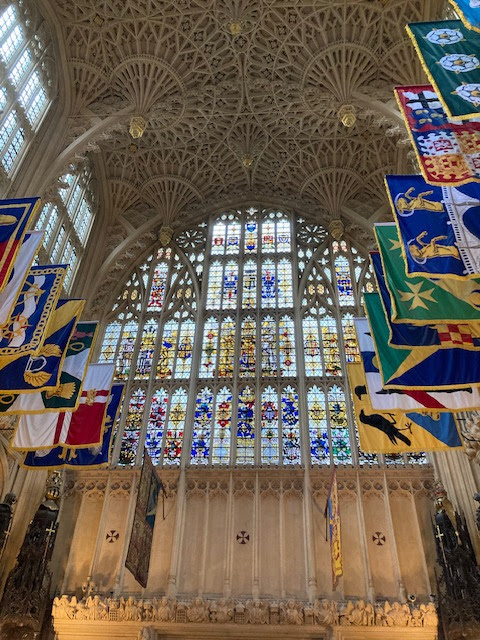
Westminster Abbey was entirely different, an ornate mausoleum to the great and the good—and the not so good. A shrine to British history, and rich hunting grounds, no doubt, for those who would like to rewrite it.


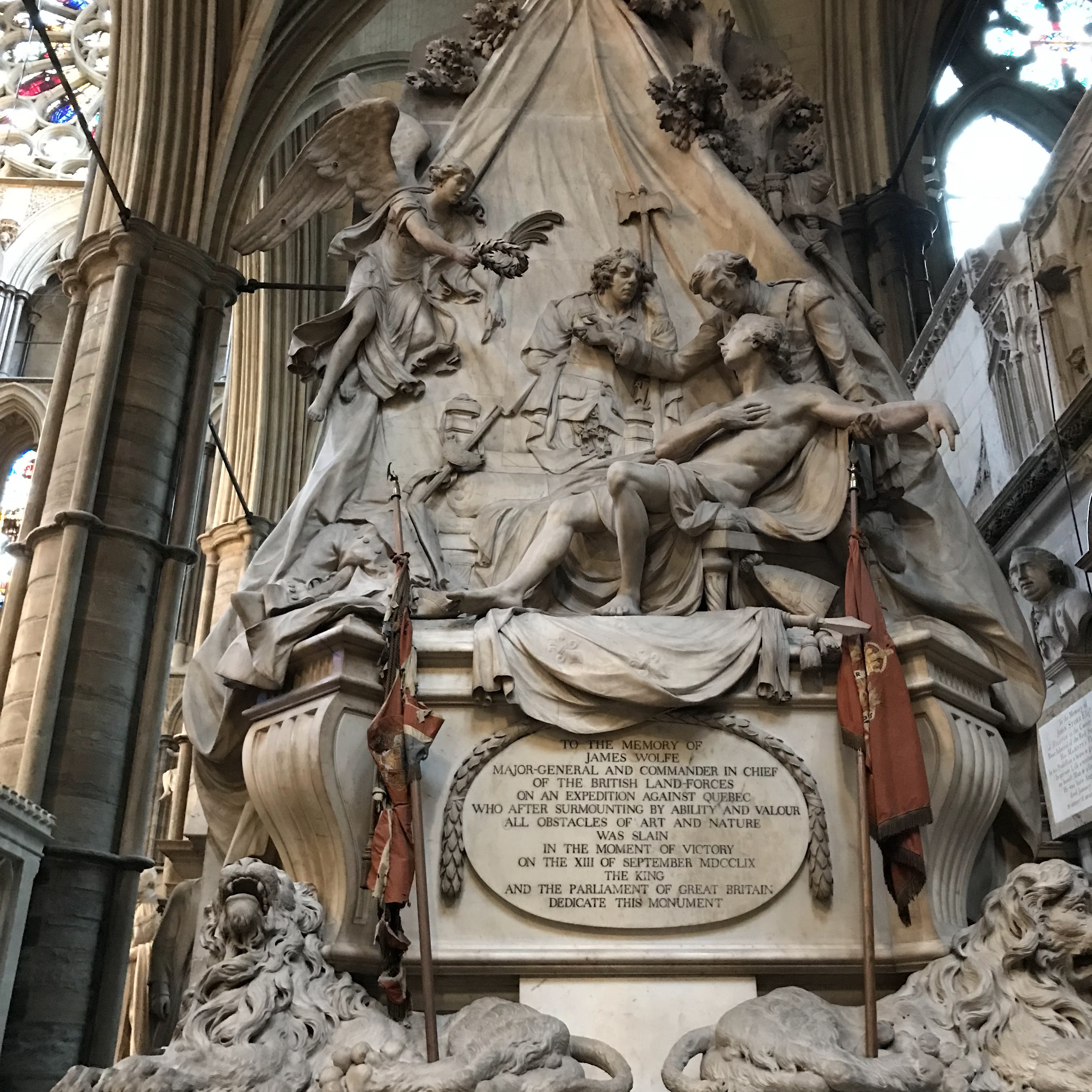
The East India Company's shrine to Sir Eyrie Coote


Unlike St Margarets, it was packed and as we shuffled along I felt very much like the barbarians who sacked Rome might have felt, staring and craning in awe at the richness around us. 


At this point, I’d champion the much-maligned iPhone snapper. It is a considerable achievement, choosing your moment and going in for the kill before a shoulder, head or whole body gets into the shot. You’ll notice I failed several times. The point is, of course, is that it allows you the time afterwards to study the tomb, carving, or inscription in more detail. There was no time for reflection amidst so many people. In an ideal world, I’d book a night to myself in Westminster Abbey surrounded by the living dead, and walk around it slowly at dawn, camera at rest.  Then again, maybe I'd just stand there and let that great assembly of ghosts pay tribute to me, or in the case of Dickens and Trollope give me some writing tips. 


There was the obvious thrill contemplating the tombs of the great Medieval Kings and warriors. I'd spent my childhood fighting the French with Edward III and the Black Prince, spent much of my career teaching  students—not to fight the French, that's no longer allowed—but the intricacies and excitement of the Hundred Years War. And now here they were, their tombs at least, along with their bones. 


The tombs of Edward III and his son, The Black Prince


It was equally moving to be standing before the tomb of Edward I (though perhaps less so for the Welsh or the Scots). Close by was the tomb of his wife, Eleanor of Castile, one of the great love stories of the C13th. 


Edward I and Eleanor of Castile

And the tomb of  Henry III


Passing through the Lady Chapel, you are immediately struck by the windows and delicately ornate roof, as well as the 95 Tudor carvings of saints adorning the walls. Such beauty is merited by the presence of  'The Tudors,’ One can, perhaps, imagine the horror of  Elizabeth, Mary, Mary Queen of Scots and Margaret Beaufort having their rest disturbed by the gawping of respectful tourists. 


Credt BK


Above and below credit BK


Mary Queen of Scots in a 'One more thing!' pose.


Elizabeth I


Margaret Beaufort


Above and below, the founding Tudors: Elizabeth of York and Henry VII respectively. Credit BK.


Amidst all the pomp and pageantry, this was my favourite shrine. It has an air of quiet mystery. Real sanctity.


But now we come to the main nave and High Altar, behind this ornately carved archway


The ornate arched entrance to the nave and main altar


Here the Queen sat alone—'covid rules' —during her husband's funeral.


And to end with some curiosities, the tomb of Sir Richard Vere, Elizabethan and Jacobean soldier.


Another soldier Robert Thomas Wilson. Incredible life. Incredible wife (13 children in 15 years)


Sir Isaac Newton

Stephen Hawking


David Livingstone


And finally, Poet’s Corner


By this time my wife was losing patience as you must be, so despite a hundred more photos, I’ll stop before I exhaust myself and you.


Thursday, 30 May 2024

The Temple Church: Lawyers, Warriors and Saints


Hidden in the side lanes of Fleet Street and Chancery Lane stands The Temple Church, built by the Knights Templar in 1163 and regarded for much of the Middle Ages  as ‘London’s Jerusalem.’   


The Temple Church was built at a time when Jerusalem was seen as the ‘centre of the world,’ and the most sacred place in Jerusalem was the round church of the Holy Sepulchre built over the empty tomb of Jesus. Pilgrims flocked to Jerusalem. For those who couldn’t, London now had an almost perfect copy. To be in the Templar ‘Round Church’ was to be in Jerusalem.     

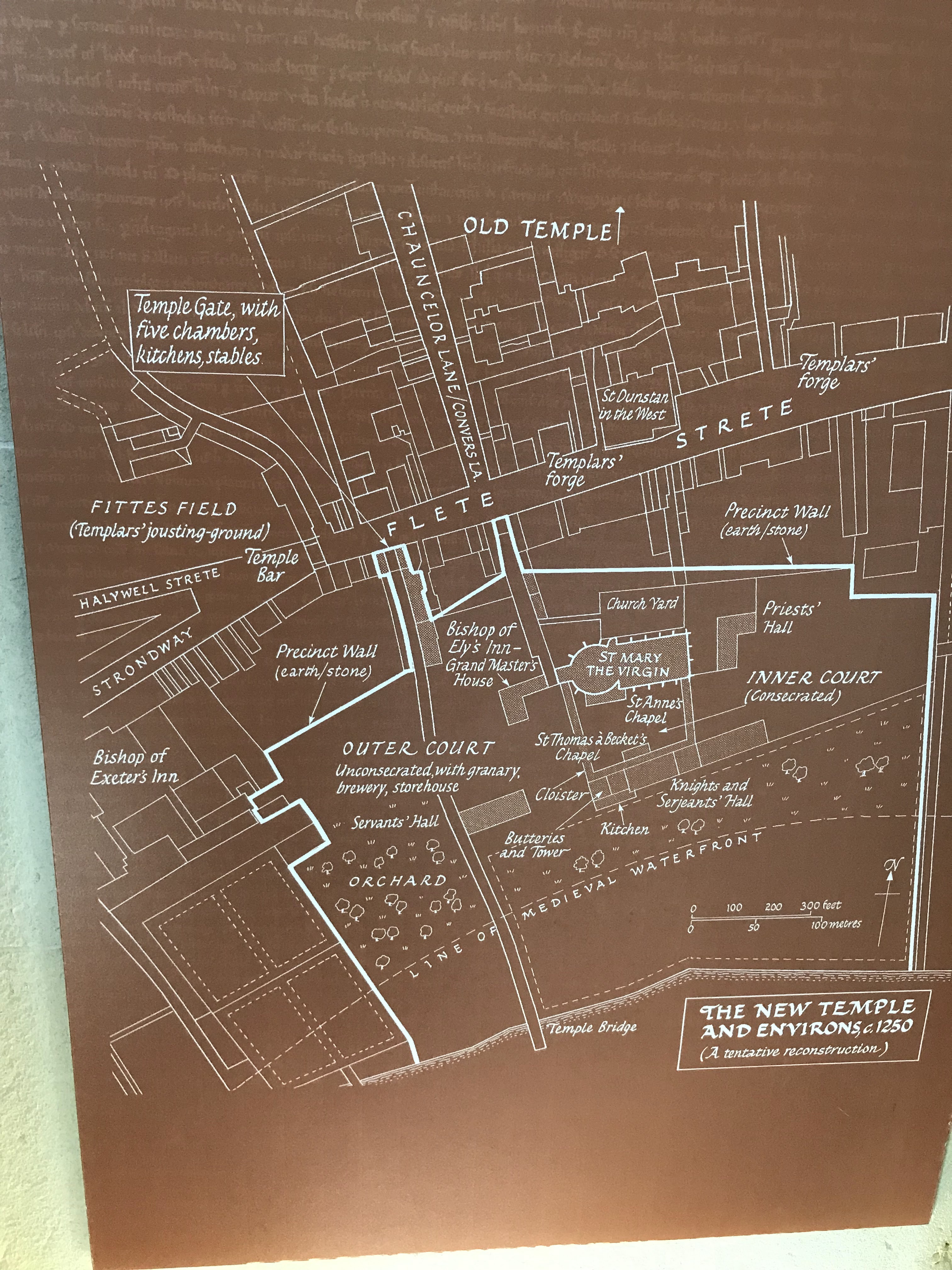
It's hard to visualise or overlay the extent of the Templar complex onto the roads and streets of modern London, but the  map below may give you some idea.


And despite the Reformation, the Templar Church  is still a substantial landmark in Abraham Hondius's Frost Fair on the Thames 1684.  The Temple Church is on the right,


The Templars supported King John, and the Temple became John’s London headquarters 1214/15 during the Magna Carta crisis. Though it was signed at Runnymede, it was here he was advised to accept the Magna Carta by the powerful William Marshal I, his son William Marshal II and Brother Aymeric, Master of the Temple. A pivotal moment in English and American history and the first encounter between the Temple and the Law. 


Above and below: William Marshal I


William Marshal I and William Marshal II

Father and Son


The Earl of Winchester. Easy to see why John was persuaded to sign the Magna Carta. Confronted with him, I'd have signed anything.


Above and below: Henry III. 


At the grand old age of seventy, William Marshal came to the rescue again, saving the young king from a French invasion. William's son, William Marshal II, married Henry's sister, and Henry so loved him, he wanted to be buried next to him in the Templar's chapel. The cast of his effigy is here, but in fact the body was buried in Westminster Abbey. 


Once a sacred site, the Temple Church is now a 'Royal Peculiar' and the preserve of lawyers—who may one day suffer the same fate as the Templars for much the same reason. In 1314 the Knights were suppressed. In 1608 James I gave the Temple to two of London’s ‘Inns of Court’ on two conditions: they would use it for the education and accommodation of lawyers and maintain the Temple Church in perpetuity. In fairness, they have done a remarkably good job. 


The Temple was almost destroyed during the Blitz, but on the basis of numerous photographs and paintings, it was lovingly restored in fine detail. The bronze  effigies of the Marshals, Kings John and Henry III are taken from casts made before the originals were destroyed by German bombs.


A forest of pillars, the Altar in the background


The roof of the rotunda, the circular balcony

and Altar in background


Steps to the balcony


Walking the balcony


Looking down at the effigies


The Altar's stained glass


The Church was refurbished in the Classical Style in the late C17th, in Gothic style in the 1840’s and in its present form after World War II. This may account for a feeling we both shared, that we were in a loved institution, a museum more than a church. For me it lacks spirit and soul, a sense of the sacred. Once ferociously religious, it has become opulent and sleek. 


Friday, 24 May 2024

No Ears in Aspic


We recently went to a ‘Selfie’ exhibition at Cardiff Museum centred around one of the many wonderful self portraits of Vincent Van Gogh. We even treated ourselves to a ‘High Tea’ at the museum that came as an optional extra with Van Gogh. The tea was nice but we both felt it could have at least made some kind of nod to the star of the show. Not necessarily an ear in aspic, that would have been full Tate Modern. And a Sunflower would have perhaps been too big, dwarfing both us and the food. A dandelion might have been nice, there being only one Vincent Van Gogh on show.


That fact alone illustrates the ingenuity of the ‘Exhibition.’ With only one painting —a temporary swap for a Renoir—how best to maximise interest? Thus the concept of ‘Selfie’ was born, the gallery bringing together a collection of self portraits ranging from Francis Bacon to Rembrandt, Angus Bean to Edna Clarke Hall.


I enjoyed the comparison between Van Gogh’s portrait, his face daubed with vivid red and green lines and Bacon’s, to my mind, more sinister portrait. “Bacon challenged the idea that portraiture should offer a direct likeness, aiming instead to capture the essence of his sitters.” 


The trouble for me was however hard I squinted or angled my head, near to or far the essence eluded me for a time. Eventually, and whether that was Bacon’s intention or not, I sensed something vaguely bestial, porcine perhaps, no pun intended. 


Van Gogh was a much more enjoyable challenge. From a distance the face bursts from the canvas with a vibrant purity. Close too, the green and red lines tend to startle and yet vanish as you step back. I advanced and retreated, a cultural yo-yo, finding the exact spot where the red and green vanished into luminous flesh.


I also learnt something knew, an artist I’d never heard of before, and a story that illustrated suffocating limits on women of brilliance. Kent born, Edna Clarke Hall, was a child prodigy, winning a scholarship to the prestigious Slade at fourteen.


 Her tutor, and eventual saviour was Henry Tonks, a man that terrified many. Tonks took no prisoners. As the artist Paul Nash remembered: 

'Tonks cared nothing for other authorities and he disliked self-satisfied young men…his surgical eye raked my immature designs. With hooded stare and sardonic mouth, he hung in the air above me like a tall question mark, moreover of a derisive, rather than an inquisitive order. In cold discouraging terms he welcomed me to the Slade. It was evident he considered that neither the Slade, nor I, was likely to derive much benefit.'


Another described him as ‘a towering figure, almost 6ft 4 inches tall. Lean and ascetic looking, with large ears, hooded eyes, a nose dropping vertically from the bridge like an eagle’s beak and a quivering camel-like mouth.’


Edna should have been terrified, but Tonks recognised her brilliance, especially impressive considering she was painting alongside the likes of Augustus John.


And then, aged nineteen, she married.


Her husband. by the standards of the day, was a kind and good man but Edna found wifely duties and motherhood an oppressive prison. Her great talent was now limited to what she could fit in—drawings of her children and illustrations for Wuthering Heights. 


Henry Tonks continued to encourage her, persuading his former pupil to hold a one woman show at the Chenil Galleries in 1914. 


In 1919, the tension between family duty and her need to create resulted in a nervous breakdown, and again Henry Tonks came to her aid—as did her husband, who set her up in a studio near Gray’s Inn. From 1922 until 1941 when the Blitz destroyed much of her work, Edna Clarke Hall’s talent at last found the outlet she’d craved since her wedding vows of 1898—after twenty, not wasted, but thwarted years.

The story is reflected in these two portraits, one of the young girl with the world at her feet, 


the other sadder, trying to deal with her world slipping away.