Friday, 25 February 2011

A hot day in Texas

Wednesday 4th


Houston was hot, hot, hot! We toured NASA and to my shame, I couldn’t have cared less. I was poaching in my own juices, basting in sweat. I was hung-over and jaded. Apollo’s could have been launching in rapid succession, like a flight of expensive darts, John Glenn could have been dancing Bojangles, and I’d have exchanged it all for a beer and a cold shower.

The whole complex gleamed white in the sun; it was beautifully landscaped and so monotonous. All I can really remember are three primary colours, white, blue and green geometrically aligned. But I walked, even kept up, and noted all there was to see.


To illustrate the full effects of a dehydrated brain, that evening I passed the chance to go to Gilley’s ‘The World’s Biggest Bar’ as it was then.* Shows you the state I was in. Dehydration clouds judgement. Another interpretation might be my Guardian Angel was concerned for my health. The bar had mechanical bulls that guaranteed a ‘Rodeo Experience’. I can’t think of anything worse, six or seven pints down and riding one of those things: vomit and broken bones, maybe both. But one thing for sure, I’d have been daft enough to give it a go.


Instead I stayed at the camp with Daphne and Laura.

And my Guardian Angel came up trumps again.

A travelling blues man set up in camp and made everything worthwhile. His caravan opened out down one entire side, and revealed an ‘Uncle Tom’s Cabin’ interior. His name was Abner Jay, and it was only much later I discovered how privileged I was to have seen him. He was brilliant. The night was brilliant, sitting under Texan stars in an audience of the largely unemployed, the so called ‘white trash’ you read about in glossy magazines. They were friendly and generous to strangers. We drank beer and sang with Abner Jay, and the night went by.

Someone called Matt chatted up Daphne and Laura – as though having trouble which one he liked best. I could have advised him but instead went to bed.

(The second link best illustrated Abner Jay's style. He does, eventually break into song.' Don't mess with me, baby'. Imagine it with a cold beer on a Texan campsite)

*Austin Chronicle

In its prime, however, way before John Travolta uttered "up ya nose witta rubba hose," Gilley's had a reputation as the mother of all Texas honky-tonks. The Gilley's logo adorned everything from cans of beer (brewed by the same Spoetzl brewery that brings us Shiner Bock) and belt buckles to women's silk panties. Texans and tourists alike would cram in by the thousands to see top country music stars like Willie Nelson, Loretta Lynn, and George Jones, while a hardy, colorful crew of regulars (known locally as "Gilleyrats") showed up every night to drink, dance, fight, flirt, make out, bullshit, shoot pool, and see who got their nuts cracked on El Toro, the club's famed mechanical bull.

Friday, 18 February 2011

The Jitterbug in San Antonio, and one angry moment

Wednesday August 4th.


That evening we went to a club alongside the river that runs through the city. Enflamed by drink and unaccountable recklessness, I unleashed my dancing daemon. Well, actually Kim unleashed it. She persuaded me to jitter-bug. It seemed simple enough. She persuaded me it was. Luckily there was plenty of space.

Soon I was jitting and bugging with the best of them: Kim’s hand sometimes attached to mine, my other arm around her waist, occasionally in the air pulling imaginary bows. I pulled her from this side to that, once or twice between my legs. I imagined I had rhythm: hips swaying, knees bending, fingers trembling, tickling the spirits gathered around us. I was in heaven.

It was over too soon – or perhaps not soon enough for those close to us.

Later, back in the camp, another Aventours coach pulled up. At first I thought it was on fire. The door opened and more smoke came out, and I heard military style music, anthemic. You could sing to it; march, but not jitterbug. From the smoke emerged the first of the Israelis.

They proved an unpleasant bunch, intolerant and racist, and just so bloody certain they were right. And yes, they were young and might now be benevolence itself. But I had only the one Israeli in our group to go by, Doritaa. She was young too, but generous and absent minded and easy-going.

I listened to them talk and thought of Einstein, Maimonides, and had I known about him then, the wonderful Howard Jacobson. Okay so all these are high falutin exceptions. I thought of Dr Rosenthal who brought me into the world, who pressed my head into shape and was the touchstone of all that was good in Walton Vale, his partner Dr Young who brought be Beatrix Potter books when I was hospitalised with rheumatic fever.

In fact the only time I ever doubted a Jew could be fun was when I was forced to watch a BBC production of St Paul of Tarsus as a child. A Sunday treat. On a small black and white TV. I watched men haranguing each other in small rooms, men with long beards, furrowed brows and long stripy robes; earnest coves the lot of them. But then my mum explained they were the Christians.

These Israelis didn’t wear long stripy robes but they knew how to harangue. They harangued me. One of them had made a series of racist remarks about Arabs and I went to walk away. They must have seen my face. Two of them followed me. Like Mormons but fiercer.

And then something in me snapped. I don’t like to be badgered and bossed or harangued. I told them that they should know better than to force people into ghettoes. They argued back, one of them referred to Arabs as animals, and I became angrier still. Blame it on the Boogie…the whisky… the jitterbug. People gathered round and we were eased gently apart.

Muttering continued over the campfire, but I was in my tent. Early next day their coach pulled away, blue smoke spilling from its windows.


Me and Kim in recovery mode.

Wednesday, 9 February 2011

Remember the Alamo - but don't push your luck

Tuesday 3rd


On Tuesday, August 3rd, I walked to the Alamo with two Australians, Mark and Bret. We were 140 years late, but I was still excited to be there, having been brought up on tales of Davy Crockett and gone cat hunting as a kid because Liverpool had no raccoons.

The over-heated patriotism I found a little disturbing - like the Women’s Institute in Britain recounting Dunkirk and the Battle of Britain to tourists; a tale where British pluck and German villainy remained pickled in aspic. It would be bizarre when you consider The Battle of Britain was over seventy years ago – even more bizarre considering The Alamo took place over 140 years before we got there.

Almost as bizarre as John Wayne playing Davy Crockett. I found that a bitter pill to swallow.

We were shown round by a white-haired woman with a face like rawhide and a voice to match. Her scorn could wither at ten paces, and much of it she reserved for Moses Roses, a much maligned Frenchman. A very much maligned Frenchman when you consider his ‘cowardice’ was still being invoked during the recent Iraq war. He was the original ‘cheese-eating surrender monkey’.

As the story goes, Jim Bowie offered everyone in the doomed fort a chance to escape before they were completely surrounded. No one availed themselves of the offer except one man: Moses Roses. He took one look at the forces arrayed against them and made an instant decision.

My heart went out to him. Moses Roses was the most experienced soldier there. He was a veteran of Napoleon’s Grand Armée that had conquered most of Europe and a good chunk of Russia before things went terribly wrong.


This man had survived the Battle of Borodino – the largest and bloodiest single day of action in the Napoleonic wars. 250,000 men died in that one battle, and then there were the 70,000 casualties. Moses Roses must have thought himself a very lucky man as September 12 1812 drew to a close.


He would also have counted himself lucky to have survived the retreat from Moscow when almost half a million French soldiers perished along with 200,000 horses.


What a sensible decision it must have seemed: retirement in the American sun-belt, away from the blood and glamour of European wars.

God has a wonderful sense of humour, and why Moses Roses decided to enlist in the Texas militia, God only knows. But one thing for sure, Roses knew bad odds when he saw them, knew that even his luck couldn’t hold out on this one: fewer than 300 men against over 2,000 Mexicans? He mightn’t have been big on Thermopylae, but no way was he going to be one of those 300 Spartans.

I’m glad I didn’t know all this at the time. That Texan woman looked the kind that could detect dissent. She’d have fixed me with her squinty eyes, bull-whipped me with her rawhide tongue.

In the Museum, I discovered a fair number of English and Irish had died in the battle; also one Welshman: Lewis Johnson – but like Welsh consonants, things are not always what they seem. He was in fact Virginian. The Welsh hero was a pretender, an inaccuracy.

On the way to the museum we saw a battalion of Twirlers – earnest seven year olds practising their twirls beneath a baking sun. Santa Anna would have minced them. Time for a drink. To night we were hitting the night life of San Antonio.

Thursday, 3 February 2011

Ciudad Acuna

Monday 2nd August


The night before we’d camped at Lake Amistad on the border between Texas and Mexico. We dove from low cliffs into deep blue water, paddled about and played pirates on air-beds. In the evening we partied on Lone Star beer and other stuff. Tomorrow we’d be in Mexico – only a day – but Mexico.


Walking across the International Bridge – about a mile long – felt like walking through a furnace. Below the Rio Grande looked narrow, shallow and completely unimpressive. I noticed it cost only a dime to walk into Mexico and there was no passport check. No hassle then – except when you hit the streets of Acuna. There the shopkeepers accosted you in the streets and within minutes I was the proud owner of three puppets and an inscrutable Aztec mask.


There was only one answer to this. A bar. There I drank an ice cold beer and then felt guilty. I had to see more of Mexico. I walked about for another half hour and when suitably baked returned to the Toltec Bar. What a name. There, an equally hot engineer from Madrid was slowly cooling down after being out for much the same time. We compared notes. Ramon from Madrid said he was used to the heat.

Everything changes. Acuna has become a little more dangerous since.


Coming back into the US we were subject to stringent examination by border officals. My inscrutable Aztec mask stared back at them blankly, and then it was off to San Antonio and bliss in a cold camp pool. Later we played some strange game that involved hitting a bag of sweets from a tree whilst blindfolded, either that or we’d been drinking too much beer.

Tuesday, 25 January 2011

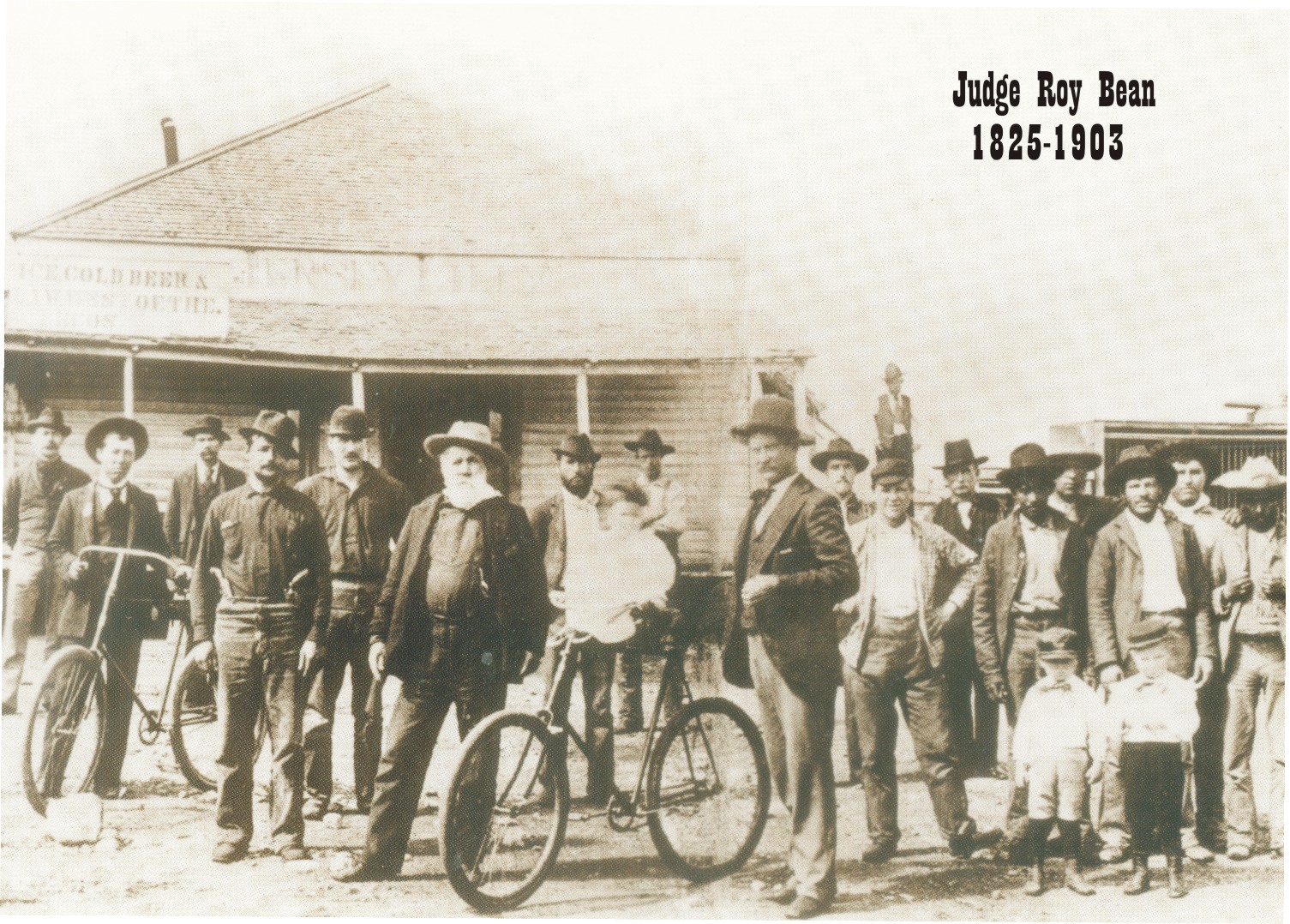
Roy Bean

Sunday August 1st


We reached Langtry, Del Rio, home of the famous Judge Roy Bean. There we learnt about unrequited love. An Old West legend had a thing for Lily Langtry - star of English Music Hall.

Some spoil sports suggest that Langtry was named after an obscure railway engineer, but why spoilt a good story? What is true is that the saloon from where he operated his own peculiar form of justice was named in her honour, ‘The Jersey Lily.’

It is a very small saloon, dusty and hot and smelling of past times. Strange, the past has a smell and the future doesn’t. Scope for an entrepreneurial perfumer perhaps.

There seemed little to Langtry. One dirt road led to a ruined house, then desert and sage brush. Little seemed changed since 1880. Time to wander about and find out more.

What can you tell from a face? The photo stared back at me, equally puzzled. What memories lay hidden beneath behind those eyes?

Like all tourists I grasped and retained the bizarre and most interesting: How he used to sell milk and increased his profit margins by diluting it with creek water. A nice scam until customers started complaining about the minnows swimming in it, an even nicer reaction from Roy Bean who pretended equal surprise. ‘By Gobs, I’ll have to stop them cows from drinking in the creek.’

What fired my imagination the most was that his life exemplified everything I’d ever dreamt about as a child in a hospital bed. He was born in Kentucky – so almost a neighbour of Davy Crocket - around about 1825.

When only fifteen he followed his two older brothers west, seeking adventure. He joined a wagon train into New Mexico, crossed the Rio Grande and set up a trading post in Chihuahua, Mexico. There he killed a man and fled just in time to California, where he stayed with a future mayor of San Diego (In fact the first mayor of San Diego) his brother Josh.

Josh believed in family. He appointed Roy a lieutenant in the state militia, and bartender of his Headquarters the family saloon. There, Roy lived the Wild West life. He drank and bragged, gambled on cockfights, and in 1852 was arrested for wounding a man in a duel.

Never mind, Roy had another brother – Sam – and so Roy fled again and took refuge in Sam’s saloon where he smuggled guns from Mexico through the Union Blockade. The only moment of domesticity he seems to have enjoyed (for a time at least) was when he married a Mexican teenager and settled in San Antonio, where, in quick succession he propagated five little Beans.

When the railroad came to Texas he seized his chance, deserting his family and in 1882 settled in Vinegaroon.* The railway was to link San Antonio with El Paso and crossed 530 miles of scorching desert. There, Roy Bean served railroad workers whisky and shade from his tent, and was often as drunk and disorderly as those he served.

Which says something about the Texan Rangers.

In 1882 they appointed him Justice of the Peace for Pecos because in their opinion he ‘had what it would take’ to bring law ‘West of the Pecos’.

With the nearest courtroom a week's ride away, the Rangers might have been more pragmatic than wise, and Roy Bean ‘just crazy, or drunk enough to accept.’

Bean was no Solomon. His justice, like those who’d appointed him was pragmatic, brutal, and sometimes eccentric. When an Irishman was brought to him, accused of murdering a Chinese worker, Bean was surrounded by an angry mob of workers demanding the accused be acquitted. Others threatened to burn down his saloon if he didn't.

Bean scanned through the one law book he possessed and delivered his ruling: 'Gentlemen, I find the law very explicit on murdering our fellow man, but there’s nothing here about killing a Chinaman. Case dismissed.'

Bean enjoyed the reputation of ‘the hanging judge’ though he hanged few if any, and made little use of the penitentiary. He preferred instead to find ‘work’ for them in the locality, and when there was none, staked them out for a time in the sun.

His kindness he kept hidden. Many of the fines he gave to the poor and destitute but never advertised the fact. Even some of the profits from the Jersey Lily bought medicine for the sick and poor in the locality. His rationale was prosaic and real. ‘Well…I haven’t been any gol-dang angel myself and there might be a lot charged up to me on Judgment Day, and I figure what good I can do -the Lord will give me credit when the time comes’. The rationale of a Norman warlord.


This photo was made, about 1900, and shows Judge Bean holding court, trying a horse-thief. Left of the picture is the stolen horse. On horses, guarded by officers are the two other horse thieves, supposed partners of the one on trial.


Roy Bean died on March 19th 1903 following a heavy drinking spree in Del Rio. He returned home at 10 a.m. and died that night at 10.03. It is said that he’d simply lost the will to live, that he felt out of place in a West he no longer recognized.

What precipitated that final binge was the construction of a power plant on the Pecos River. He claimed more than once that times were changing, and he was being left behind.


Bicycles are bad enough but a goddamned power plant!


If only he’d held on that little bit longer. Roy Bean and Lily Langtry never met despite his many letters to her. She is supposed to have written back, even sending him two pistols which he treasured like the Old West romantic he was.

Ten months after his death the train stopped at Langtry and Miss Lily herself stepped out. Enroute to San Francisco, she’d decided to take up the old Judge on his invitation to visit him. Unfortunately her most ardent admirer was dead. Instead she visited the saloon named in her honor and listened to the stories. ‘It was a short visit, but an unforgettable one’ she wrote in her diary. Tactful, but no doubt true.


Hmm, a mighty fine decolletage


*Apparently named after the scorpions that infested the place. When stepped on they emitted a vinagary smell. Almost a ready-made snack food.

Friday, 21 January 2011

My Doggies have been wailing since I sang my latest song


I've included this picture because it's the only good thing about this post. It's a derelict building just across the road from the saloon of Judge Roy Bean. I loved the C18th 'feel' to it, and its isolation. Far more interesting than Roy Bean's saloon, authentic though it's supposed to be. Whether the cottage still stands, I don't know.


The context to this song is very simple, much like the lyrics. A multinational group, with unlimited beer set themselves the challenge of writing the ultimate cliched country and western song - each of us had to contribute a line - some discarded - and then as the beer flowed the verses were refined and sung with gusto. I still remember the flames of the fire, golden sparks and the immensity of desert and sky as we howled to the moon.

My Doggies have been wailing since I sang my latest song

I was a lonely orphan down yonder by the old corn patch.
My tobbaccy’s wet and mouldy, and I ain’t got no match.
Sammy Jo milked the cow while her skirt was swaying.
Mama and the preacher man were inside busy praying.
But the preacher man was playing hard to catch.

Chorus

Mama loved too well, too long and got me for a song
Me and my guitar have been so lonesome since you’ve been gone
My honey rolled the dice and lied
She said she loved me as she rolled the dice and smiled
She’s the only one I need
Yippee Yay Tumbleweed.

My cow she was in labour while old Doris did the washing
My heart was torn between the cow and watching Doris washing
Well honey kiss my grits and howdy do
For my cow has had a calf called Betty Lou
But calf love don’t fire a cowboy’s passion.

Chorus etc

I left the farm and broke my heart to ride them country roads
Sammy Jo, the cow and Ma reckoned up the rent I owed
The preacher-man then gave these parting words:
‘You can be a cowboy, son without ever wearing spurs.
So off I went to the land of the long horned toad.

Chorus

Sitting high in the saddle whilst the sun sets sweet and low
I moseyed on down to Calico to meet my future beau
Biscuits and gravy make my heart go boom
Saloon girls, liquor – but not a single room
A girl named Maria saved me from the snow.

Chorus

Maria was like a desert rose blooming once a year
Don’t shoot me with that gun she cried so I drowned her in my beer
Oh Baby you went and let me down
I like blue eyes but yours were truly brown
Virginia sat on a cactus and got the prick of her life…oh dear.

Chorus

One empty bottle, one broken heart, time for a brand new start
I left Maria for my pardner’s wife and the ire of one-eyed Bart.
Oh, I don’t care that I’m still single
Cos I’ve got spurts that jingle jangle jingle
And I’m with my pardner’s wife behind the cart.

Chorus

But I keep thinking about my babe, way home on the mountain range
Doris, Virginia and Ma can go hang, cos I’m going back to my cow again
It’s been so lonesome out here on the prairie
And I can’t stop thinking about a cow called Mary
Wimen and cows they aint just built the same.

The last line of the sixth verse was when it all began to go wrong - if it was ever right. I think that was the Australian contribution :)

Friday, 14 January 2011

No mermaids in Carlsbad

At Carlsbad we crashed out and slept till midday. In the afternoon we explored the Caverns

During the last ice age this desert was covered with dense pine forest.


This is the Chihuahuan Desert in Southeastern New Mexico and West Texas. We walked gingerly having been told that immediately below the surface were more than 300 known caves of gigantic size. It was the unknown caves we were worried about.

It was hard to believe that a mere 250 million years ago this had been an inland sea dominated by a 400 mile long reef bursting with sponges, algae and seashells. Maybe, too, mermaids with Raquel Welch figures…and tails

Only scientists tend to get excited over more prosaic marine fossils, ammonites, crinoids, snails, nautiloids, bivalves, brachiopods and the occasional trilobite. I say they haven’t looked hard enough!

But the tour guide wasn’t interested in my theories. He wanted to tell me about the passing of the Permian age, when the reef was covered by thousands of feet of newer sediments, burying it for tens of millions of years. Stresses in the earth’s crust, especially over the past 20 million years, uplifted these reef sediments almost ten thousand feet. Wind, rain, snow and time eroded away the overlying younger sediments and now the ancient reef is exposed once again as the Guadalupe mountains and deep caves below the desert floor.


We explored.


Duly impressed


And afterwards went back to camp and drank beer. There, a most unusual event occurred. Beneath the stars, and influenced by good beer, we wrote a song – essentially Eurovision Country and Western. The idea was to utilize every Country and Western cliché as seen through French, German, British, Australian, Dutch and Spanish eyes. Everyone there contributed a line or two. There was a tune there too, of sorts…and a mouth organ.

The song was called:

My Doggies have been wailing since I sang my latest song, but the lyrics will have to wait for a subsequent post.