Friday, 28 July 2023

Strong, sweet tea

A few days ago, we were drinking tea at the Runcible Spoon in Newent—a less attractive venue than a pea green boat but nice enough.  It was there I added one more thing to my bucket list: ‘strong, sweet tea.’ 


It’s a British film cliché peculiar to Blitz movies, emergencies at sea, natural disasters, death, fire and shock. Strong sweet tea. Lazarus wouldn’t have died in the first place had he not refused strong sweet tea. 

And I had never had it. Add it to my bucket list, I thought, and I might not even need a bucket list.

I’d been given weak sweet tea as a very young child, but early on had noticed my dad drank his without sugar, and I followed suit and have done ever since.


Over very strong unsweetened tea, I shared this new idea with my wife. The sooner the better, we agreed. But not now. This was exceptional tea. Very hot— (our tea pot never retains heat. Memo to self. Investigate)—strong and full bodied. No, definitely not now; sugar would ruin what we had. But this was clearly the tea to buy for the experiment.


 I asked the nice lady running the Runcible Spoon, and she offered me a sleek colourful packet. The price made me wince but there was no going back; a treat for the weekend and with it a chance to recklessly add four teaspoons of sugar. 


I shall report the results.


Behind the Runcible Spoon is an interesting arcade housing, amongst other things,  a ‘Museum of Board Games.’ A small window display gripped me. Not on the scale of Egyptian tomb paintings or the frescos of Knossos, perhaps,  but still weirdly evocative.


Update. Maybe I needed to be in severe shock. A strong, sweet tea is not very nice. Lazarus might have chosen the better option. 

Saturday, 22 July 2023

Life sets its own rules


Aintree Institute


One night, my uncle John (Birch) was walking past the Aintree Institute and noticed some lads struggling with equipment, carrying it into the club. He came to their aid, struck a rapport and they suggested he might be their roadie. He declined the offer and he and the future Beatles went their separate ways. 


Beatles at the Aintree Institute


He never said whether John (Lennon) was drunk or not. Beer refreshed, gave energy, and Dutch courage, though at a price. Once when playing at the Stanley Abattoir Social Club the early Beatles were booed off the stage for being over-refreshed. 

Stanley Road Abattoir


And yet life sets its own rules. These early  posters are  a fascinating reminder of those far off  days— the second one especially. 


Bribing  'ladies'  to see the Beatles. 


Unbelievable.


Especially when contrasted with this two years later.


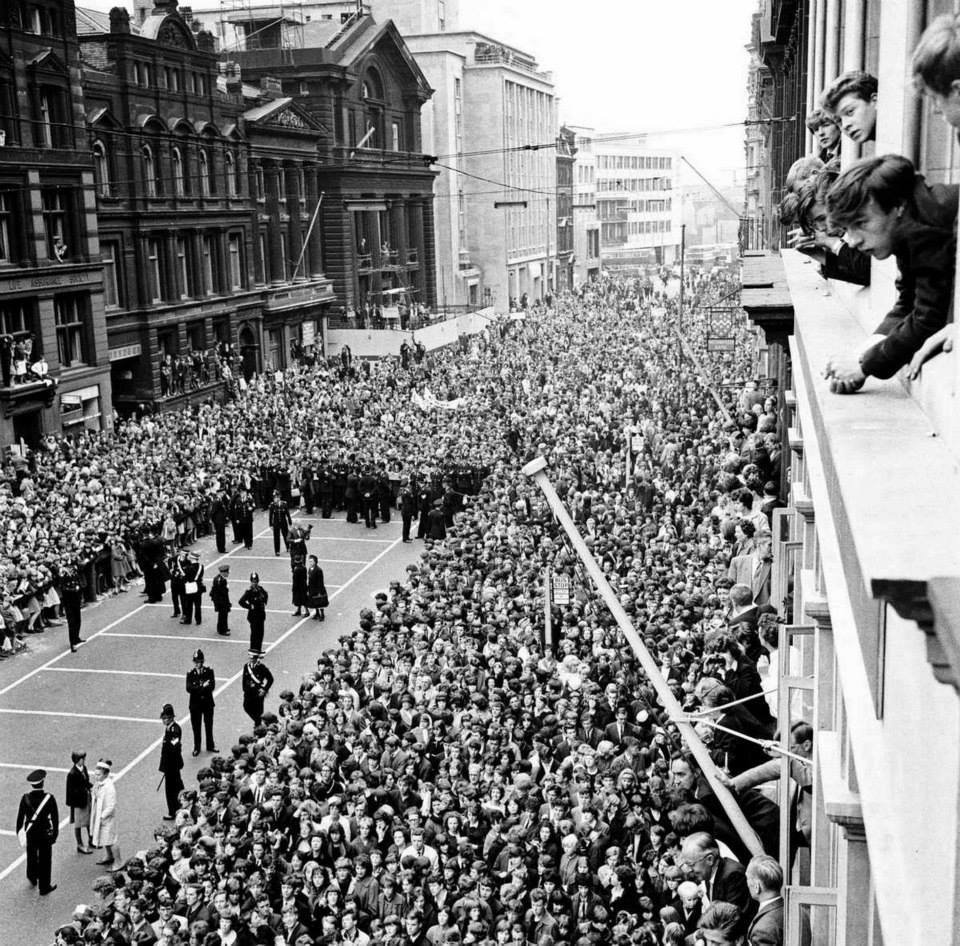
Castle Street Liverpool. And no free gifts


Nothing ever stays the same. The Beatles are no more.


Neither is the Aintree Institute, knocked down making space for housing that never materialised. It's now a carpark.


But on a lighter note, a gentle reminder of Liverpool's weirdness.

Morris Dancing policemen


Friday, 14 July 2023

Out Now!

 In all its glory


Buy here. Quick, before you change your mind.


It’s easier writing fiction than telling the truth, but as the devil knows, one blurs into the other with remarkable ease. A Liverpool Childhood came with three problems— apart from living it—most of them coming from the abundance of photographs: copyright issues, permissions and in some cases payment; formatting headaches, and above all the embarrassing cost of the paperback. The eBook is priced at £5, still cheaper than a London pint; it also gives me a decent royalty. Normally, the paperback would be in the region of £10. But times have changed. 

Paper and printing costs have gone up. The book has an abundance of photographs in high resolution which have added further to the cost. And so, the paperback is an unbelievable, £25, which in the UK gives me a 70p royalty and nothing at all in other parts of the world. I know which one makes more sense, and which I’d recommend, but for those who prefer a real book, I wince and apologise. 

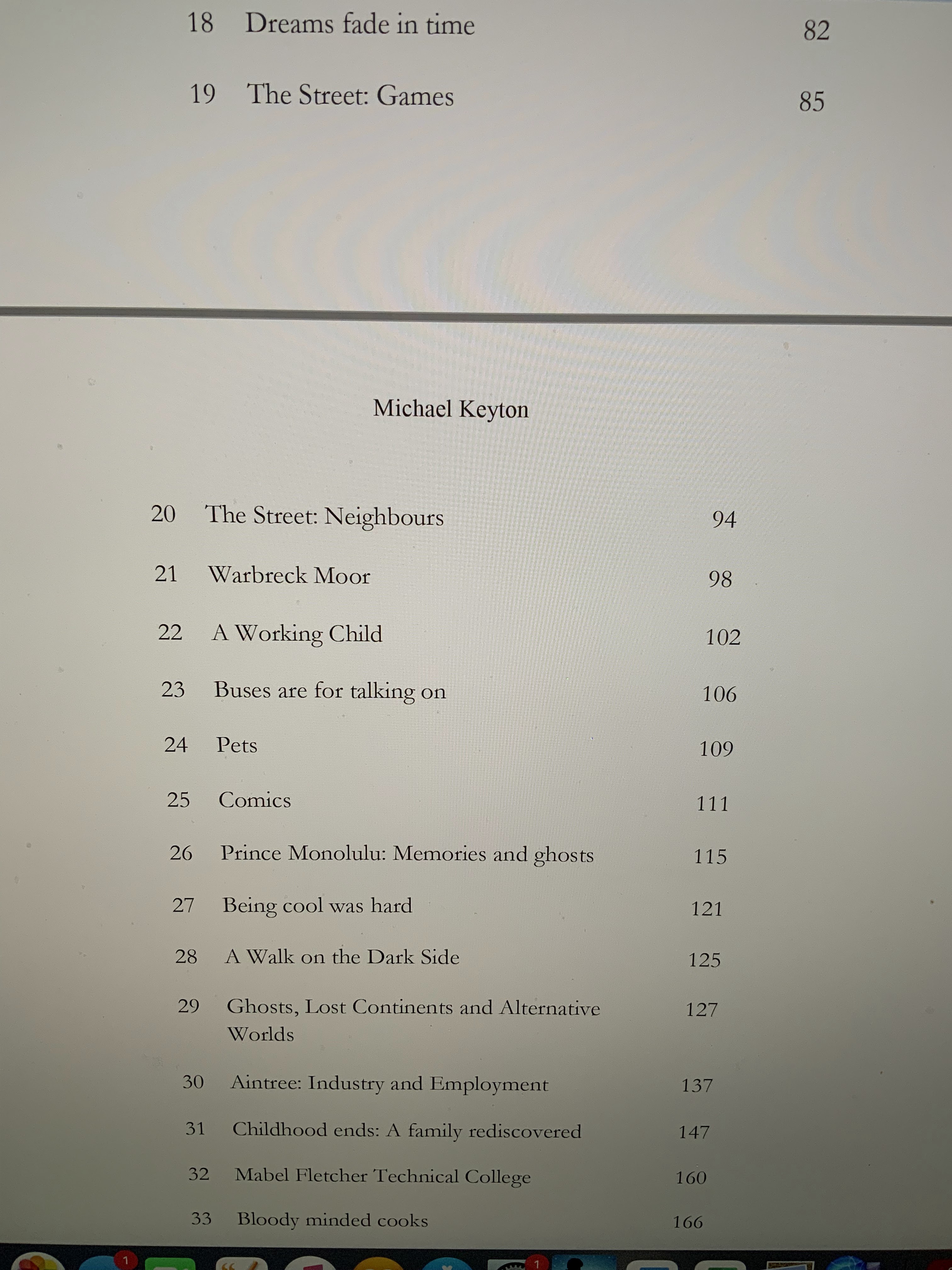
The contents shown below are interspersed with photos that didn’t make the final cut but are beauties in their own right. Many more photos in kindle and book.


Friday, 7 July 2023

Coming soon


Record of a Baffled Spirit: A Liverpool Childhood, traces the history of Liverpool from ancient Pangea, skims through the ‘Dark Ages’ and what followed before the arrival of two families, the Keytons and the Parrys. It’s an exploration of ‘slow time,’ impermanence, and the importance of memory. It’s a testament to the family—not just ours—and a culture. It’s a testament to Aintree.


Below is a short extract. I believe it's  called marketing.


 The most important feature of Ribblesdale Avenue was the brick power station at its end. Beyond that was ‘Wrights', a small haulage yard, a few apple trees, and the railway embankment. The power station had a decorative feature on either side of it: red brick protrusions, half an inch thick that allowed us access to the top. The building dominated much of our childhood. It doubled up as the Alamo, countless US Cavalry outposts, Spanish galleons, pirate ships, pill boxes against hard faced Germans, or creepily ferocious Japanese. We never ran out of ammunition for the top of the power station was deeply gravelled, which made excellent grapeshot. Sometimes we would carry up our own stones, when the conflict was serious or the Germans more hard-faced than usual. 


Our usual weapon was the invisible gun— two fingers and a whistling cluck; sometimes the invisible rifle, an extended right arm supported by the left, and two rigid fingers you sighted down. On each corner of the building were the machine gunners who’d erupt in loud staccato hiccups when the fighting got tough. We saw off Comanche, Apache, Arapaho; Mexicans charging across endless red plains; we saw off rustlers, Confederates, Japanese, SS, the Afrika corp. Our guns were most effective. The other side dying spectacular deaths, only to get up again after a decent interval, brush themselves down and continue the fight. It was a child’s Valhalla. 


When the battle was over, it was time for tea and then bed. And the following day, it started all over again.

How did our neighbours cope? They’d just fought World War II. We were small beer. Once, when pursuing a Mohawk Indian, I hurled a spear (a broomstick handle) which missed but smashed through our neighbour’s window. I was punished, the window fixed, and it was over. 


When I think of it now, our neighbours were all remarkable people bound together by remarkable events. All of them had either fought at sea or on land, and those too old to enlist had manned the anti-aircraft guns positioned on the railway embankment just behind the power station. For years after, we scavenged shells, cartridge cases, helmets and gasmasks discarded in bramble and fern. These became part of some quite surreal games of ‘cowboys and Indians’—the latter in gasmasks and feathers. As I remember they looked pretty fearsome, though their whooping was muffled.

Saturday, 1 July 2023

A Tribute to Henry

When I was young, a thousand years or so ago I played mandolin in a folk/ceilidh band called Devil’s Elbow, fairly well known in the Newport area. Its driving forces were Henry and Lorraine Lutman. 

Henry Lutman died a little while back. Though we’d seen each other infrequently over the years, the shock was immense. He was a great musician, and more importantly a good man.


My overriding thought, other than for Lorraine and his family, was what a waste, and my gaze turned to instruments I’d barely touched for almost forty years. They stood gathering dust in the corner, a reminder that life is short and a gift from God, a standing reproach: use it or lose it. The resolution developed gradually. I’d play them again, a tribute and a reminder of Henry and of days gone by.


Muscle memory is a wonderful thing; callouses re-emerged on my fingers. At the same time it seemed kind of fruitless. Then one day the Holy Spirit in mischievous mode prompted me to approach Tony, a fellow parishioner, a fine musician and one who played guitar at church services. (The precondition was that there was no way I was going to be involved in them.) Even so, I caught a visionary look in his eye which gave me a flicker of unease.


Guitar and mandolin. Each lifted the other. I suppose in my mind I hoped we’d find a fiddle and perhaps a flute. It didn’t quite work out that way. Instead, we attracted singers and the collective or group is heavily influenced by the Fureys and the Clancy Brothers with instrumentals included in the mix.


Truth is, I don’t like singing. Years of enforced hymns in school. And, heresy, I’m not over keen on Irish songs. That’s not a judgement. People like what they like. But the bottom line is music is music, and it served as a reminder of the peculiar alchemy—the give and take amongst musicians. I learnt a skill I’d never used before: the mandolin tremolo and learnt to like some Irish songs; I also got to play what I wanted to play in-between them.


To cut the story short, last night we performed our first concert before 140 people. And when I stood to play the first set of instrumentals, just me and a backing guitar, it was with a peculiar feeling of resignation and dread. In the past, there had been Henry, Lol, Reg and various guitarists to carry me. I’d been one amongst many. And not a very confident one. There’s that moment of vulnerability before plectrum hits string and there’s no going back. 


I like to think Henry was with me that night; he’d  have recognised the seventeen tunes in my five sets. To my relief they went down well. People probably had low expectations and the tunes were well chosen:


Rakes of Kildare

Athol Highlanders

Soldiers Joy

Staten Island

*

Liverpool Hornpipe

Manchester Hornpipe

Fairy Hornpipe

The Red Haired Boy

*

Tobin’s Favourite

Merry Miller

Mason’s Apron

*

Cook in the Kitchen

Gary’s Tune

Boys of Blue Hill

*

Geese in the Bog

Repeal of the Union

Pugwash.


They brought back happy memories

Thursday, 22 June 2023

Frankenstein Pears


A few weeks back, we bought some Waitrose pears. It was an impulse buy. Four pears, each with that coy blush hinting at ripeness, and a warning that they had to be eaten within six days. Problem was, the were still hard, and what impulse hadn’t factored in was that we were going to Portugal in three days.


I shrugged. Win some, lose some. They’d either ripen before we left, or they wouldn’t. And if we came home to fruity necrosis and those small pesky flies, it wasn’t exactly the end of the world. 

Portugal was great, airport security less so, but we made it home safely, one thing on my mind. 


The pears. 

Yes, I know, I should have put them in the fridge.


You could imagine my puzzled relief that the four pears were where I’d left them, obdurately intact—more than that—marble hard. Not a fruit fly in sight.


I ate one of them. Tried to. Nearly broke my teeth. A week later I tried again. Same result. From then on, it became an obsession. Each morning I’d check the remaining two pears, convinced there must be some arboreal attic with a portrait of mould and decay, pears festering in an obscene grey fuzz. What we’d inadvertently brought into our house was something satanic despite their pristine appearance. I wondered about the two I’d already eaten. Were they still there, in my stomach, rock hard and impervious, too large to pass through?


I was reminded of the satanic pears when we dropped into the Cotswold village of Broadway, pretty beyond words but essentially soulless. It makes Disney World edgy. 


Photos or Broadway credit: BM Keyton.

Places like these have manifold ‘portraits’ found in the back streets of Salford, Glasgow, Birkenhead. We live in a Dorian Gray world—but the remaining two pears no longer. Two days ago, I came down to find one of them slightly discoloured at the pointy end.


 Carpe Diem!


 I washed them, cut out a nugget of something squishy and brown, and ate them before they had time to change their mind.


Friday, 16 June 2023

The Convent of Christ

As a reward for regaining  territories seized by the Muslims, the Templars were offered a vast territory dominated by their newly built castle. Following the extinction of the Templars, the Portuguese king founded the Order of Christ. Later, Manuel I and his son Joao III ordered the construction of the convent and the six Renaissance cloisters built around the original Temple chapel shown below


This many-sided tower  looks stark and forbidding, but hides within it a treasure chest. 


Called the Charola, the round church built by the Knights Templar in the C12th was a conscious imitation of the Holy Sepulchre of Jerusalem. From the outside, the church is a 16-sided polygonal structure. Inside, the round church has a central octagonal design, connected by arches to a surrounding gallery or ambulatory. 


Legend has it that its distinctive shape allowed knights to attend Mass on horseback. In those early days, worship would have been stern but devout. By the end of the Renaissance, everything had changed. 


Now you find yourself  in a religious kaleidoscope of colour, ornamentation and gilt; your eye is drawn up to the crucified Christ and then upwards to the ceiling and a riot of colour. It’s in marked contrast to the stark but tasteful simplicity of the rest of the convent, most of it Renaissance added onto the original, less ornate church of the Templars. No apologies for the profusion of photos. They are worth 'blowing up' and exploring. 


The capitals on the central columns and the painting on stone alluding to St Christopher date to the early Templar period.


Four chapels on the ambulatory walls were built. They faced northeast, northwest, southeast, southwest respectively. 


The Portocarreiros Chapel. 

I couldn't record all I saw in the chapel but for those interested
the decorative details - especially the wonderful tiles see  here


Castle and  convent are now  surrounded by the convent wall, an area with 34 hectares of flower and vegetable gardens, and beyond, the great forest Mata dos Sete Montes. Water was supplied via a masterpiece of engineering, a 6km aqueduct extending through the valley of Pegoes. 


Some of the six cloisters for walking in prayer and peace. I found it peaceful but couldn't avoid the irreverent comparison with Gormenghast. 


The Main Cloister was built during the C16th and inspired by Italian architecture.  In the early C17th (1619) the fountain was connected to the Aqueduct. 


Then there are the endless corridors


You wonder who the mysterious figure in the distance is. As a monk, you'd know and likely be contemplating your sins as you approached.


The Suffering Christ


 I loved the way the window frames the garden like a painting.


The Crossing is in the geometric centre of the Convent, where the three corridors that make up the main dormitory meet


You can see the dormitory cells lining the walls. In the half light, it's easy to imagine tourists as monks.


One of the many dormitory cells.


The Refectory


We argued whether these were toilets or washing up facilities. 


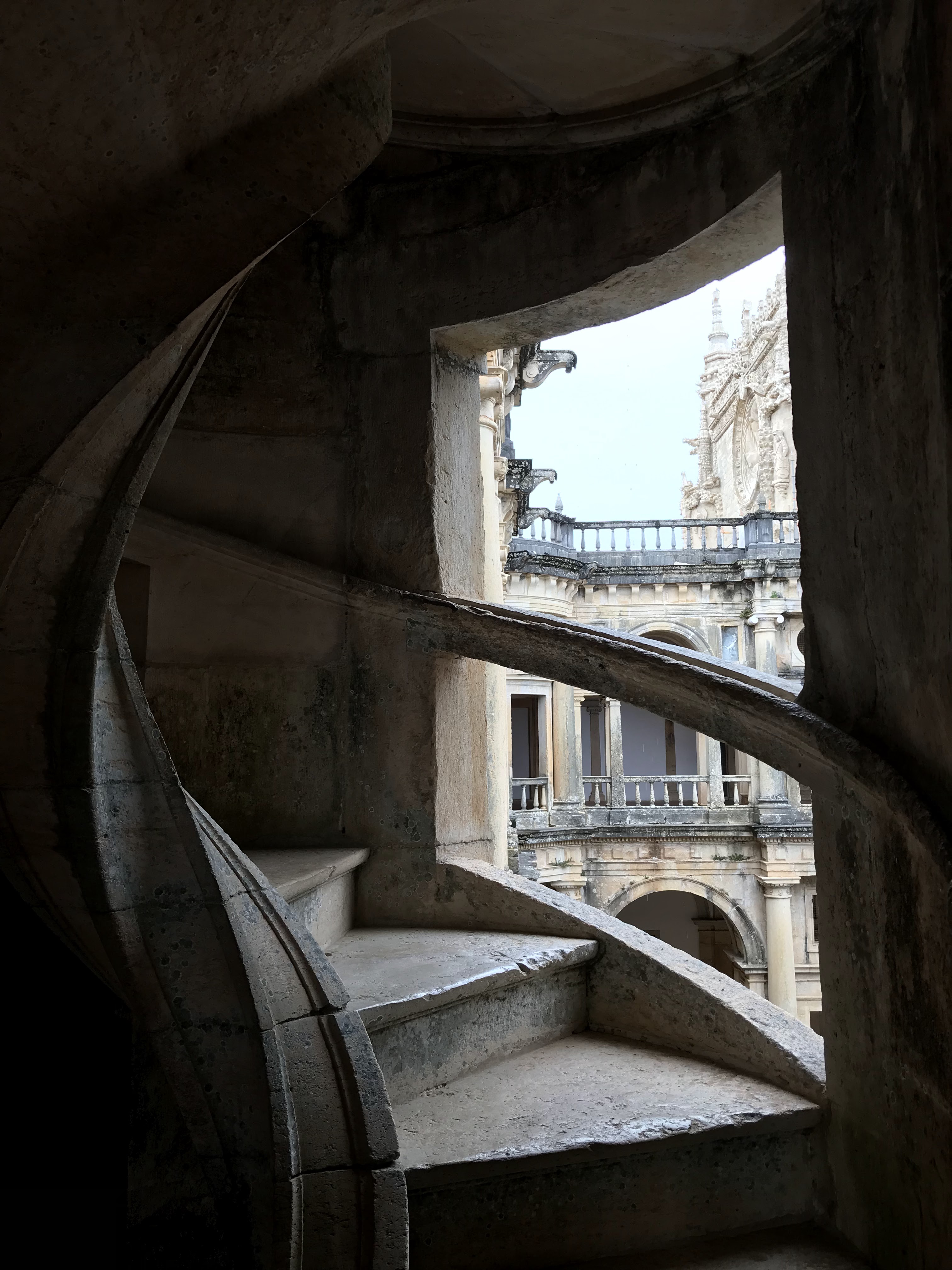
And then of course there were steps, lots of them in every shape and form. These monks were fit—


—but enjoyed wonderful views between Heaven and Earth