Showing posts with label Swansea. Show all posts

Friday, 14 July 2023

Out Now!

 In all its glory


Buy here. Quick, before you change your mind.


It’s easier writing fiction than telling the truth, but as the devil knows, one blurs into the other with remarkable ease. A Liverpool Childhood came with three problems— apart from living it—most of them coming from the abundance of photographs: copyright issues, permissions and in some cases payment; formatting headaches, and above all the embarrassing cost of the paperback. The eBook is priced at £5, still cheaper than a London pint; it also gives me a decent royalty. Normally, the paperback would be in the region of £10. But times have changed. 

Paper and printing costs have gone up. The book has an abundance of photographs in high resolution which have added further to the cost. And so, the paperback is an unbelievable, £25, which in the UK gives me a 70p royalty and nothing at all in other parts of the world. I know which one makes more sense, and which I’d recommend, but for those who prefer a real book, I wince and apologise. 

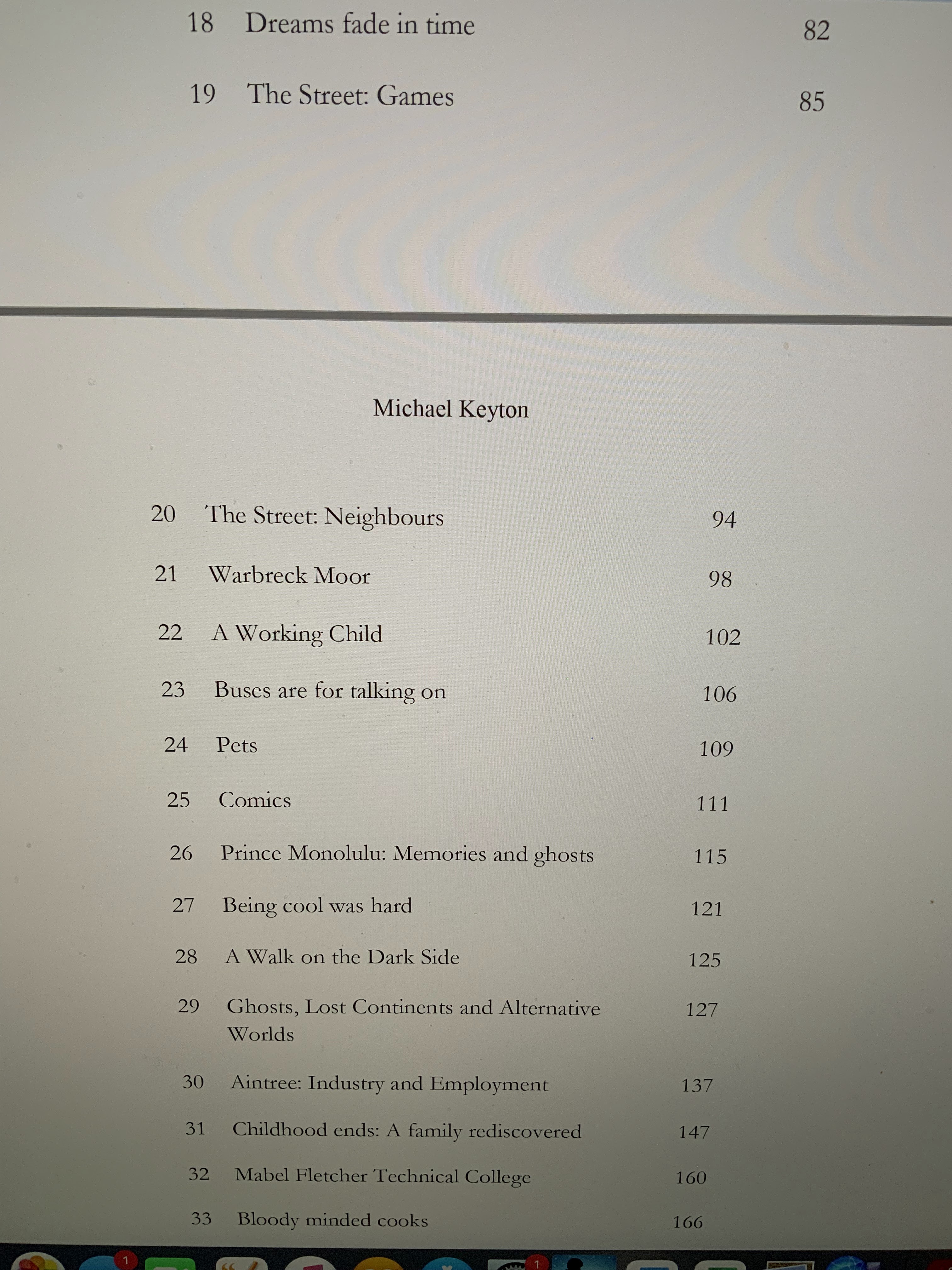
The contents shown below are interspersed with photos that didn’t make the final cut but are beauties in their own right. Many more photos in kindle and book.


Friday, 12 October 2018

The Old Devils


Kingsley Amis, one of the great comic novelists of the C20th, was reputedly in terminal decline by the mid 1980s, his faculties blunted by alcoholic abuse. To show there was life in the old dog yet, he won the Booker prize in 1986 for his book, ‘The Old Devils.

The story focuses on old friends from Wales, all of them retired and with little to do but start drinking soon after breakfast—usually in seedy pubs, none of them pleasant. They moan and bitch, are outrageously rude and wouldn’t know political correctness if it hit them flat in the face. ‘Show me a Welsh Nationalist and I’ll show you a cunt.’

But over the course of the book, they forgive each other’s faults and past betrayals. They show tolerance, indeed tenderness for Dorothy, an uncontrolled alcoholic who will talk nonstop on New Zealand tribal customs—given the chance. The trick lies in keeping the conversation going, for should there be a lull the task would be akin to starting  'a motorcycle in the path of a charging elephant’

The warmth and wisdom lies in the exploration of mutual infirmities, bowel movements and farting, and the ever-deepening shadow of approaching death.

Why has this book come suddenly to mind?

Well, this weekend I’m off to a reunion of some old and special friends from the deep past. In those days you made your own way to University carrying what you might need in a single large suitcase. 
 It was a dark Swansea night, and I had just wandered off from the train trusting in the assurance that the university had found me accommodation. Before I knew it, I was bundled into a white van like a Hezbollah hostage and there met the bunch of people I’d spend most of my university career living, working and drinking together.
We ended up in a strange boarding house, later found a large house overlooking a park, and developed  a friendship that, however loose, has lasted for decades. Life is a vigorous bagatelle, and I doubt not we’ll be split on politics and the Brexit chasm currently splitting the country, but real friendship transcends trivialities.
So, the OldDevils  are descending on Swansea. No doubt some beer will be drunk, but I have no intention of discussing bowel movements unless the others do first.

Below are three old photos that, for me, capture the unworldly magic of Swansea University and where we occasionally swam.


Thursday, 10 April 2014

Snapshots in time. Misspent days in Swansea


Three glorious years in Swansea many years ago. No names here - to spare the innocent guilty - but you know who you are. The two rather tasteful 'drag' photos are more in the spirit of British pantomime than anything erotic; even so a price was paid. The Pyjama  Ball was held in the Top Rank Llanelli some twenty miles away but the bus left early and left many stranded there. Students in their respective partners' night-gear had a wonderful time hitching back home.


MK


SG


SG

 
SG

MK

MK
 

MK


SG


SG


SG


SG


MK
MK

MK

I don' t know who these last two are. Memory fails. Can anyone help?


SG

SG


(Initials refer to the photographer)


Wednesday, 31 December 2008

St Josephs Junior High School for Boys

So many things I missed about Swansea:

Richard Skinner who didn’t know you needed water to boil an egg but got a First in Russian, learnt Welsh on principle, went on to teach English in Sweden and became a doctor in Sweden through the medium of Swedish. Mercifully he regarded my more puny wit with amusement and a degree of benevolent tolerance, even though I was the one who taught him how to boil an egg.

Richard and Ruth Lewis who showed me that life could be comfortable and introduced me to Newport, a pint of Stella at the Green-man on the outskirts of Cwmbran followed by Sunday dinner, and, sometime later tea, with Paul Murphy, a future Secretary of State.

Peter Lloyd, now a script-writer, then an academic pursuing a PhD in Tudor History. I know he introduced me to Edward Hall’s Chronicle and a phrase that has lodged itself indelibly into my head. ‘History is the sucking serpent of ancient fame.’ Though, if you don’t have fame to begin with, you’re unlikely to be bothered by sucking serpents. Maybe the odd slow-worm.

Nick and Ness who showed me how rich life could be in a damp labourer’s cottage and later a caravan.

And last, but not least, Swansea University’s Refectory, its lamb curry, and spaghetti bolognaise. I sometimes dream about them at night and wake up hungry.

When you leave university it’s very much like jumping off from a fast moving merry-go-round. If you’re lucky you remain standing but most definitely disorientated. Certainty evaporates.

All I was certain of was an urgent desire to live in or near Swansea. Fate buggered things up a little.

A half-hearted application for a teaching post in Newport met with a polite rejection, until, a week later, the young woman who’d got the job discovered she was pregnant and withdrew. A polite rejection letter was followed by a swift request – we want to see you.

And so, despite mistaking the Head Teacher for the caretaker, and speaking with a still thick Liverpool accent, I got the job.

I’ve always been lucky in loving the places I find myself in. Aberystwyth was perhaps an exception, though the perpetual rain, a knife-wielding psycho, and a teaching course that bored me silly might have had something to do with that. But now I was in Newport, a vital, seedy place with its own dark magic. It suited me down to the ground.


The elegant hippy to the left is me. How on earth did I get this job?
To my right are: Alan Hicks, Mike Farley, Alan Kethro, Andy Phipps, Peter Williams, Mr Norville, (the real caretaker)and Danny Flynn, someone else with a Liverpool accent. Front row are: Mrs Oakley, (known as Annie) Judith and Judith (forgive me). The man sitting in the middle is Bernard Dunne, (Head teacher, not the caretaker,) Gerry Drewett, Paddy Landers and Mia Richards. Behind us is the school, now demolished; and behind that is the famous Newport Transporter Bridge, not yet demolished, hopefully never.

Thursday, 27 November 2008

And yes, I love Anthony Trollope

Dylan Thomas country


It’s strange what lodges in the mind. One of the happiest periods in my life is encapsulated in just four things: a flat in Uplands with the window open, a sunny day, Joni Mitchell’s Blue album, and me lying on the bed reading W. H. Ainsworth’s ‘Rookwood’. It helped that there was a pub nearby, an Indian restaurant, and the café where I played chess with Sally Percival.

The road to this glimpse of Nirvana had some twists and turns. I’d wanted to go for an MA but failed to get a grant. In a fit of madness I applied to McGill University in Montreal, and in an equal fit of madness they offered me a place with a full grant. It was, unfortunately, a door too far. We were too poor as a family to afford the plane-fare along with other sundry expenses. I remember talking on the phone to an earnest and very friendly Canadian voice, exhorting me to come, but we were flat stony broke and so I said no. It’s perverse to feel regret because I’ve acquired what makes me happy on a different path, but part of me feels regret, the greedy part that would like to open every door simultaneously.

The problem was what to do? I’d never expected to get to University in the first place, never mind get a degree, but what to do with it? I pondered two options: University librarianship or teaching. The former appealed to the scholar in me…the latter, well it didn’t really appeal at all except in one respect. I’m a solitary animal with the social skills of a bear in hibernation. Skulking in the stacks of a University library posed the danger of reinforcing those traits. Teaching on the other hand offered the possibility of developing what I didn’t naturally possess, an extrovert nature.

I was pondering such things on a train to Swansea after an interview at Liverpool University library. It was then that God or the Devil intervened. A materialist would say it was momentary madness and a low afternoon sun.

An elderly man sat in the seat opposite. Passing Shrewsbury he began talking to me in a strong Welsh accent, and I confided my dilemma, teaching or librarianship. He became as one possessed. Perhaps he was. Leaning over, he positioned his face close to mine. At that precise moment the sun came out from a cloud. It shone fiercely on his gold-framed spectacles so that his eyes seemed to catch fire.

“Teaching my boy. Teaching. It’s God’s own profession.”

I felt strangely weak – like Isaiah after a visitation and three pints of beer. And so my fate was sealed. No McGill, no cool academic library. Teaching it was.

Only Swansea’s Teaching Department rejected me, confusing my Liverpool accent with a speech defect.

But the old man had spoken.

I tried Aberystwyth and toned down the accent. The good news was they accepted me; the better news was Swansea unexpectedly offered me the chance to study for an MA with a full grant. The bad news was their ‘suggested’ topic. ‘Anthony Trollope and English Landed Society.’ His mother, Fanny Trollope – bless her – had made pots of money by being rude to Americans.

In her Domestic Manners of the Americans, She criticised the mistreatment of Indians, corruption, the banality of American women, the hypocrisy of American men, “…one hand hoisting the cap of liberty, and with the other flogging their slaves…their loathsome spitting…the frightful manner of feeding with their knives till the whole blade seemed to enter their mouths, and the still more frightful manner of cleaning the teeth with a pocket knife.” She hadn't seen Swansea University's refectory.

Written in 1836 just fifty years after Britain had lost her colony, the book was a guaranteed best seller, and helped finance her son’s education. She was a smart woman, knew what she was doing, but what about Anthony and his seventy or more books/stories/articles. Would he be near as interesting?

What can I say? He grows on you.

I spent a year in the basement of Swansea University library. In front of me was Peter Traves, studying the sermons of Lancelot Andrews, and in an adjacent desk was a Raphaelite brunette called Jane, who I lusted quietly after in between books.
Yes, there would be teaching…eventually. Aberystwyth was holding my place. But in the meantime Nirvana, Blue, Rookwood, and sunny days in Uplands.

My flat was somewhere top left in the picture

Thursday, 20 November 2008

An explosive Christmas


I dream vividly and in colour and, however weird, they always follow some kind of plot, a story that I never get to complete because, so far, I always wake up. Many of my dreams involve buses, usually green ‘Atlanteans’, and they often end with a journey past familiar landmarks that take me through Walton, then Aintree and the red-brick terraced house I grew up in. I never get there.

The dream probably reflects years of traveling from Wales to Liverpool, and journey’s end, my mother waiting for me with a plate of bacon, egg and chips. Four slices of bread.

She was always pleased to see me, on only one occasion was she worried.

It was Christmas in 1972, at the height of the IRA’s bombing campaign on the British mainland. The journey started off well. At Hereford, soldiers on Christmas leave burst into my compartment and shared round bottles of a peculiarly yellow drink – a kind of alcoholic egg-nog called Advocaat, It was interesting. I’d never try it again.

Some time after Shrewsbury the soldiers left, and an elderly woman took their place. She was looking forward to seeing her daughter and grandchildren in Liverpool, and as the evening drew in she itemized each present in her suitcase and her various bags.

“A ham for Julie because she never has enough meat and I don’t like to go into a house empty handed; it’s not nice is it. Then there’s Darren, always difficult to buy for. I always find men difficult. Settled for a shirt and some aftershave. I thought about a tie but then I saw some miniature whiskies – the kind they serve you on planes…What else…? Christmas pudding. They probably have one but you can never get enough of Christmas pudding…” And so it went on. She was a lovely lady, and I was about to ruin her Christmas.

We arrived at Lime Street Station and she was struggling with her two bags and suitcase even before she’d left the compartment. Yes, I offered to help, an unwitting tool in some demonic joke.

I staggered off the train with her suitcase and mine, a rucksack hanging from one shoulder, and joined the eager crowd straining for familiar faces on the other side of the barriers. I wished her a Merry Christmas, told her Darren was sure to love the shirt, and that she was right about never having enough pudding for Christmas. At the barrier I released the suitcase and darted off for the bus – which, as usual, I missed.

An hour later I was home. An anxious mother wrenched open the door.
“Thank God. I thought you were blown up,” she said.
“Why, what’s happened?”
“Bomb scare at Lime Street Station. Suspicious suit-case. There’s a police cordon.”

Over my egg and chips we got the late news. There had been a controlled explosion revealing not a bomb but what was left of a shirt, ham, Christmas pudding and various presents.

Poor lady.

I’d assumed she’d been behind me. Now I wondered who I’d been chatting to, staggering along the station platform, carrying her suitcase. Maybe several different people each getting a part of the conversation and thinking I was mad.

Recently I’ve been wondering whether she’s behind those dreams about green buses, and whether, should I ever reach my destination, she’ll be waiting for me, a grim expression on her face, brandishing a bottle of Advocaat.

Thursday, 6 November 2008

Paint it Black

The room was quiet. Candle-flame makes little noise. In the darkness we imagined the sound of itching. The landlady had psoriasis. In the morning we avoided the cornflakes and rarely looked at her legs.

“I got you babe,” whispered Mick.

“Love in vain” I said.

Mick persisted “Honey just allow me one more chance.”

“You can’t always get what you want.”

“Got to get you into my life,” said Mick.

"You never give me your money," I grumbled.

"You got the silver (man)" he added.

I gave him a severe look. Extra words were not allowed.

“Monkey Man” He hissed. “You got the silver…Monkey man”

“I get around,” I said, smugly.

“And your bird can sing,” he said

“For no one.” That earned me an approving look.

“Because…”

“Girl from the North Country,” I sighed.

“Polythene Pam?”

I shook my head. “Suzanne.”

“Good vibrations?” (We were on a roll)

“I want to tell you.”

“Somebody to love.” He nodded - a mixture of regret and approval.

“Satisfaction,” I allowed.

“Something.” He paused. “Tomorrow never knows.”

“Tumbling Dice” I agreed.

The End…? He said hopefully.

“Golden Slumbers.”

The Miners strike of 1972 had reduced us to this. No television, no radio. Blackouts. Drinking bottled beer because beer pumps didn’t work. You sat in darkened pubs given a medieval gloss in candlelight. Girls somehow looked more beautiful and you stumbled home in a pitch black world. Played word games because that was all there was to do.

The rules were simple: maintain a conversation for as long as you could using only song titles. (For the purist the above come from The Beach boys, Beatles, Stones, Dylan, and Jefferson Airplane) In the pub we played using Book titles. The problem with songs titles is that they’re over dependent on sex. You don’t want to be whispering ‘I want to hold your hand’ to your mate unless you want ‘Hard Times’ and go back to a ‘Bleak House’.

At least now, however, I know what to do when the lights got out and Armageddon comes. You'll find me muttering in the dark...'I want to teach the world to sing.'

Thursday, 30 October 2008

She looked nothing like Yoko Ono

“Boom avast!”
Or some such salty gibberish.
“Boom avast!”
“What the fuck?”
Crack! A great chunk of wood smacked against my head. The wood was attached to an over-excitable sail and nearly knocked me into the sea.
Why didn’t he just say “Duck?”
Or “Fucking duck!”

I knew why. He was Dave, and I was going out with his girl-friend – Kay Chestnut. She’d quarrelled with him, made a beeline for me at a University disco and set fire to my heart. Eventually she went back to him, and in time played international hockey.

In the meantime we had a pleasant few weeks, sometimes playing chess in a small café on the Uplands Road. The proprietor had chess boards hidden under the counter and would hand them out like they were illegal drugs. He’d look at us fondly, having no idea – like me – what it was all about.

I took Sally Percival there but I noticed the proprietor looked on her less fondly. He’d already worked out a future for Kay and me and saw Sally as some kind of Yoko Ono.


She looked nothing like Yoko Ono. She had a dirty chuckle and came from Polruan.
We moved on from chess to darts. She moved on to Liverpool and the last time I heard of her she was working as a criminal psychologist…hmm, that’s ambiguous.

There were other girls, all of them more beautiful than I deserved: Elaine John, who made me feel giddy; Sally Tovey, tall and blonde. She came from a Welsh family who were prone to singing around the piano; Kate (for once my memory fails me) was also blonde but shorter. She spoke with a clipped, slightly upper class accent, and her wealth and background worried me slightly. But then I was stupid.

We all moved on...debris on the shores of google. To this day I’m convinced all of us are guided…if we listen; but then I’m not just stupid but egocentric, too.

Friday, 10 October 2008

Morris Cerullo

It was a meat and potato pasty, two pints of beer, rainy day. A Swansea day. And we were walking past a barely visible Brangwyn Hall. Strange, I thought. All these coaches, all these cars, what’s going on? We drifted up the steps, much like the rain, and found ourselves in an alternative universe. It was Morris Cerullo and a brand of charismatic evangelism I’d never come across before. His sunny face beamed down upon us as an irresistible current of the converted pushed us along into the main hall. We sat at the back. Behind us sat a three generation family from the valleys: grandparents, parents and two children eating crisps and chewing gum. They were relaxed, expectant, happy. We wondered what we were doing. A swelling of chords brought almost immediate silence. A little man, plump and dressed in a blue suit, strode on stage and seized a microphone. He looked like Napoleon and spoke with a Brooklyn accent. Like a gangster from God. The technique however was exhilarating and mind-blowing. His trick was to speak earnestly in a low, intimate but amplified whisper, gradually building up in volume and repetition to a roaring and passionate frenzy. He spoke for two and a half hours orchestrating emotion like some celestial alchemist. He was no longer funny. My friends I have seen the devil in a woman’s ankle, the curve of her knee. I have seen the devil in a woman’s thighs, her hips. I have seen the devil in a woman’s smile, the lascivious glint in an eye. The devil is amongst us my friends, waiting his chance…waiting his chance. Are you with Satan, or are you with Jesus? Are you with Satan, or are you with Jesus? Are you with Satan, or are you with Jesus? The auditorium crackled in his screaming and an entire mass stood up thrusting their arms into the air: Jesus! Jesus! Jesus! Jesus! It was like a Nuremburg rally. The children behind us were also shrieking the Lord’s name…and so were we - bemused - wondering at what might happen if we didn’t. Prove you love Jesus! How much do you love Jesus? The devil is in a man’s wallet my friends He’s in there telling you all the things you can buy with that money. Do you love Jesus? Audience response: Jesus…Jesus…Jesus… Well prove it, prove it my friends. Prove you love Jesus. Cast Satan behind you. Now! Cast Satan behind you! Cue men with baskets at the front of the stage. Cue men and women, capering down with notes in their hands, Cue us slipping out the back. Time for one last pint.

Friday, 3 October 2008

If he wants to piss in your sink, it's all right by me!

I owe Mick Grey a big favour. It was, in my opinion, his finest hour, but not mine.

We’d been invited to Sue and John’s flat warming party. Sherry was on offer at the supermarket so we bought two large bottles. There were two or three hours to kill before the party kicked off, so we decided on a brisk pub crawl. It was my idea to sell the story that we were visiting our brother at university - that he’d gone off to some posh dinner leaving us…and we knew no one in Swansea. Drink flowed, life stories exchanged. Swansea was and is a warm and generous place.

We arrived at the party late but merry as hell.

Time for the sherry.

There are only two things I remember:

Bouncing off walls that, in a peculiarly Welsh way, defied known physics. (Maybe Cerne will figure it out) The walls sucked you in like rubbery cardboard and then at a whim bounced you across the far end of the room. People made way for me as I headed for the bathroom.

That’s the second thing I remember.

I climbed the stairs using the banisters like a rope ladder. Unfortunately I walked up one flight too many and landed in the bathroom belonging to the apartment above. I was peeing into a suspiciously high toilet – physics playing tricks again – when a woman screamed behind me and piss flew up the wall.

“He’s pissing in my sink!”

I turned, confused. This wasn’t Sue, definitely not John. “It’s all right. I’m sorry. I’ll clean it up. I grabbed at a cloth and began scrubbing.

“My face cloth!! A low, despairing wail.

At that moment Mick appeared, breathing heavily. He stood, legs apart and put the woman right:

“Listen, I have known Mike Keyton for three years…And if he wants to piss in your sink – it’s all right by me!”

Thank you, Mick, wherever you are.

The only other time I reached anything approaching that level of inebriation was after my final exams. I wish I could remember the name of that wine bar, which served only port, and made you sit on high stools that became more unstable as the evening progressed.

I do remember head-butting parked cars all the way home. (Had I been really drunk I’d have been head-butting the moving kind.) We were accompanied by two pleasant policeman, enjoying the spectacle, and probably concerned for our safety. Or maybe I imagined them.

There’s one thing about my drunkenness, I’m always benign – puzzled more than anything else and I lose any sense of direction – like a wobbly Sat-Nav. On arriving at our flat I staggered into the wrong room and collapsed on the bed. It was hard as hell and things fell on the floor. Again the shocked scream… and then laughter. It wasn’t the woman bemoaning her face-cloth then.

When I looked round I saw Mick Grey and the land-lady’s daughter staring down at me. I was in her room, lying on her dressing table, which by an act of divine mischief was positioned where my bed should have been.

I recount these stories now, with neither pride or shame. I’m describing a different person…I think.

Friday, 26 September 2008

Which bloody pedal?

Adrian Jones was a revolutionary socialist. He later became a union official, a hotelier in Scotland hobnobbing with lairds, and now possesses a golden chain as Lord Mayor of Wallasey. He was always a gentleman, partial to hunting dogs, Barbour jackets and Welsh choirs. Despite a broad, rolling Monmouthshire accent which gave gravitas even when ordering ice-cream, Adrian came from Newport, which has never been famous for its gravitas, only a mole-screw wrench and a Transporter Bridge.
Adrian had a passion for argument, books and good beer. He was also an idealist in that he thought he’d be able to teach me to drive. The first and only lesson took place on Mumbles car-park, dangerously close to cliffs and sea.

Everything started well. The door opened as it should and the steering wheel was in the right place. Adrian’s voice was measured and calm as he took me step by step through preliminary maneuvers.

The trouble started when the car began to move…at about ten miles per hour – too fast for me. I froze as we headed straight for the cliff and disaster. I knew a pedal accelerated, and another one braked, but which bloody one? The cliff hurtled towards us at – I know – 10mph – so close now that a wrong choice in pedals would see us in casualty.

Adrian’s face, too, was frozen in disbelief. I imagined the obscenities racing through his head, but his voice remained calm. “Middle one …hard, Mike.”

We stopped just in time.

I never drove again. Ever. But we both retained a strong interest in politics and beer.

At a Swansea Young Socialist meeting we were discussing Marxist dialectics; I attempted to explain ‘thesis, antithesis and synthesis’, and the limited role of individual choice in the historical process. I used the analogy of two caterpillars looking up at the sky as a shadow passed over them. It is a butterfly. One caterpillar turns to the other and mutters: ‘You’ll never catch me up in one of those things.’ It got a laugh. Only later did I realise that a person of faith could have used the same analogy, and may have got an even bigger laugh.

Saturday, 20 September 2008

Anarchist Dogs


1968 has been called the Year of Revolutions. We had riots in America and Paris, a Spring in Prague, mass demonstrations against the Vietnam war. 1969 saw the ferment continue…in Swansea at least. Swansea students had mass sit-ins, and marches across a stretch of the Mumbles road. We fought for a pedestrian bridge and mixed sex Halls of Residence. Europe trembled.

There were stirrings in the Anarchist camp too. Ian Bone had an anarchist dog accessorized with a small red and black flag around its collar. The image may have sparked the idea, that or the beer. Why do we fight for the liberation of man…what about dogs?

Comrades, what about dogs?

Rhetoric turned into action.

Singleton Park encircled much of the University. Behind it was a compound for unwanted dogs. One dark night the compound was raided and the dogs released. Singleton Park resounded to the eager barking of dogs, packs of them roaming through bushes and trees searching for bones and Bakuninist truths. Not exactly Reservoir Dogs but a victory of sorts.

(With thanks to Rick Lewis)

Friday, 12 September 2008

Gendarmes and Anarchists

Red Star over Leningrad


Politics on campus was dominated by the Socialist Society or Soc Soc, a broad church of the left but in reality riven in faction. RSPGB fought IMG; both despised IS and all three despised the PLP. The initials say it all. There was also a thriving Anarchist Society dominated (if not led) by Ian Bone. He at least has remained true to the principles he espoused in 1969. Whether that is meritorious or sad is open to debate, but I doubt many other members of Soc Soc can make the same boast.

There was a difference between them and an old trade unionist I met in Liverpool. He had been a boy during the Russian Revolution and in 1926 experienced the General Strike. Later on in life he made his first visit to St. Petersburg (Leningrad). He described approaching the city by night, the bus hedged by forest to either side. Then, in the distance, he glimpsed a red star twinkling from the highest building in the city. As he told the story, his eyes became visibly moist, the image and symbol still so potent in his memory. I doubt former Soc Soc students will ever experience the same emotional response on seeing the Lewis Jones Hall of Residence peeping over the trees of Singleton Park.

Trotsky was asked what went wrong with the Russian Revolution. He answered in a parable. When there’s a shortage of bread you have bread queues. When you have bread queues you have police controlling them – and the police take the bread. One wonders what kind of Gendarme Trotsky would have made had he not been forced into exile by Stalin.

Anyway, the plum wine is strong tonight. Hmmm…sounds like a cold war password

Saturday, 6 September 2008

Anthony Wedgwood Benn

Sometime around 1969 / 1970 Anthony Wedgwood Benn who was then Minister of Technology, spoke at Swansea University. He was a man enthused, a man with a mission, possessed with the answer to everything: Technology. The Buzzword then was the ‘white-hot heat of technology.” Technology was the Alchemist’s Stone that would transform society, revitalising wherever it touched. Technology would dissolve class, or at least make its inequalities more bearable.

At the back of the hall was Terry Harrison, a Militant Activist from Liverpool, and a Cammell Laird’s Shop Steward at a time when Merseyside still built ships. He listened attentively, and when the talk opened out into questions raised his hand. There followed a searing analysis of the Minister’s idealism (or crap), its contradictions and flaws, and how it bore little relation to the daily life of working men. He concluded with how Britain was essentially dominated by 300 monopolies (A Militant slogan at the time) and how technology would primarily be used to exploit labour with greater efficiency. There followed a deadening silence and a subdued response from Anthony Wedgwood Benn. More of a burble than a response.

Shortly after that Anthony Wedgwood Benn became Tony Benn, a lucid leftwing firebrand, and in time, a ‘National Treasure’* - the status acquired when one is deemed no longer a threat. Mick Jagger is one, along with Cliff Richard – but I digress.

I like to think that Tony Benn experienced a Damascene moment when Terry Harrison spoke, and know it for conceit. We’d all like to think, that at least once in our life, we’d been touched by history. In the words of one who could turn the Lords Prayer into a soundbite "A day like today is not a day for soundbites, really. But I feel the hand of history upon our shoulders. I really do.” (Tony Blair) In my case it was probably dandruff.

Benn was, no doubt, blissfully unaware of Terry Harrison. He attributed his radical shift to his experience as a minister in the 1964–1970 Labour government. In his words:
As a minister, I experienced the power of industrialists and bankers to get their way by use of the crudest form of economic pressure, even blackmail, against a Labour Government. Compared to this, the pressure brought to bear in industrial disputes is minuscule. This power was revealed even more clearly in 1976 when the IMF secured cuts in our public expenditure. These lessons led me to the conclusion that the UK is only superficially governed by MPs and the voters who elect them. British Parliamentary democracy is, in truth, little more than a means of securing a periodical change in the management team, which is then allowed to preside over a system that remains in essence intact. – Which helps put the Palin Mcain/Barak Obama and Joe Biden hoopla’ in perspective.

* A list compiled by the New Statesman in 2006, voted Benn twelfth in the list of "Heroes of our time"

Saturday, 30 August 2008

King Crimson


You could transform Swansea into anything you wished. Here I like to think of myself as a Russian nobleman silently contemplating his estate. In fact it's a view from the college building overlooking the Mumbles Road and the sea.


The soundtrack to my years at Swansea was dominated by King Crimson, and their album‘In the Court of the Crimson King’. It seemed to be on every night, the soundtrack to endless games of ‘Sweaty Betty’ and tea when the beer ran out.


There was other music, in particular Hendrix’s version of ‘All Along the Watchtower’, which can only be really appreciated heard at sunset in Three Cliff’s Bay. There is no logic to that. Nor need there be. It just is. The Gower was rich in magic: hidden coves, ancient barrows, and soundtracks heard in the head without an IPod in sight.


I saw Love Sculpture performing Sabre Dance in a pub; saw a drunken Kevin Ayers fall off the stage. I stood between the two speakers as Wishbone Ash duelled guitars in the Junior Common room, and remember feeling puzzled when Paul McCartney’s Wings pulled up for a quick drink in the Woodman’s hotel, prior to playing a surprise gig at the University. We were so intent on arguing whether it was or it wasn’t ‘him’ that we missed the gig entirely. Story of my life, really.


The Woodman where an encounter nearly took place. Behind is the 'world famous Rhododendron Garden'...apparently.

The last Swansea gig I went to was in the Top Rank in 1972, but that was far from joyous. Stone the Crows were playing and midway in the set their guitarist Les Harvey began a frantic dance – or so it seemed to the semi-pissed standing far to the back. In fact he was being electrocuted live on stage. I never went to Altamont, but I imagine there was the same horrible, sour taste that would never entirely go away.

Next post will be on Swansea politics.

For anyone interested in rock trivia you may have to wait for a bit to find out Cher’s opinion of Cardiff (overheard in the toilets.)