Showing posts with label America. Show all posts

Thursday, 7 March 2024

Gallup.

I’m a sucker for old English churches, villages and folklore. I’m also in love with the Old West and the technology that allows me to explore it from home. In a previous book, Phage,  I became an expert in navigating myself around Phoenix and the surrounding mountains via Google Earth to the extent I wanted to go there and drop in to two or three of its more interesting bars. 

Gallup New Mexico is currently exerting a similar hold and for the same reason, a book—tentatively named Final Battle— that will hopefully surface in two years’ time. Set some time in the 2030’s, it features John Grey and Elizabeth McBride, first seen in the Gift Trilogy. Along with Elizabeth’s dark sister, Elsie they are characters too good to waste, and as Adepts with abnormal lifespans they allow me considerable scope to play with time. 


So why Gallup, New Mexico? A minor character is Chenoa, a Navajo* Shaman who leads a double life as Gill Darrat, a renowned psychotherapist, who for obvious reasons operates from the Navajo nation. On any map, Gallup stands out as the only serious contender, and that was where the fun began. Research is a compelling black hole, and I now know more about Gallup than most people—at least those living outside of it. 


There were three essential things I had to work out. Where did Gill Darrat live in Gallup? Where was her office? And where would her alter ego, Chenoa, be based?


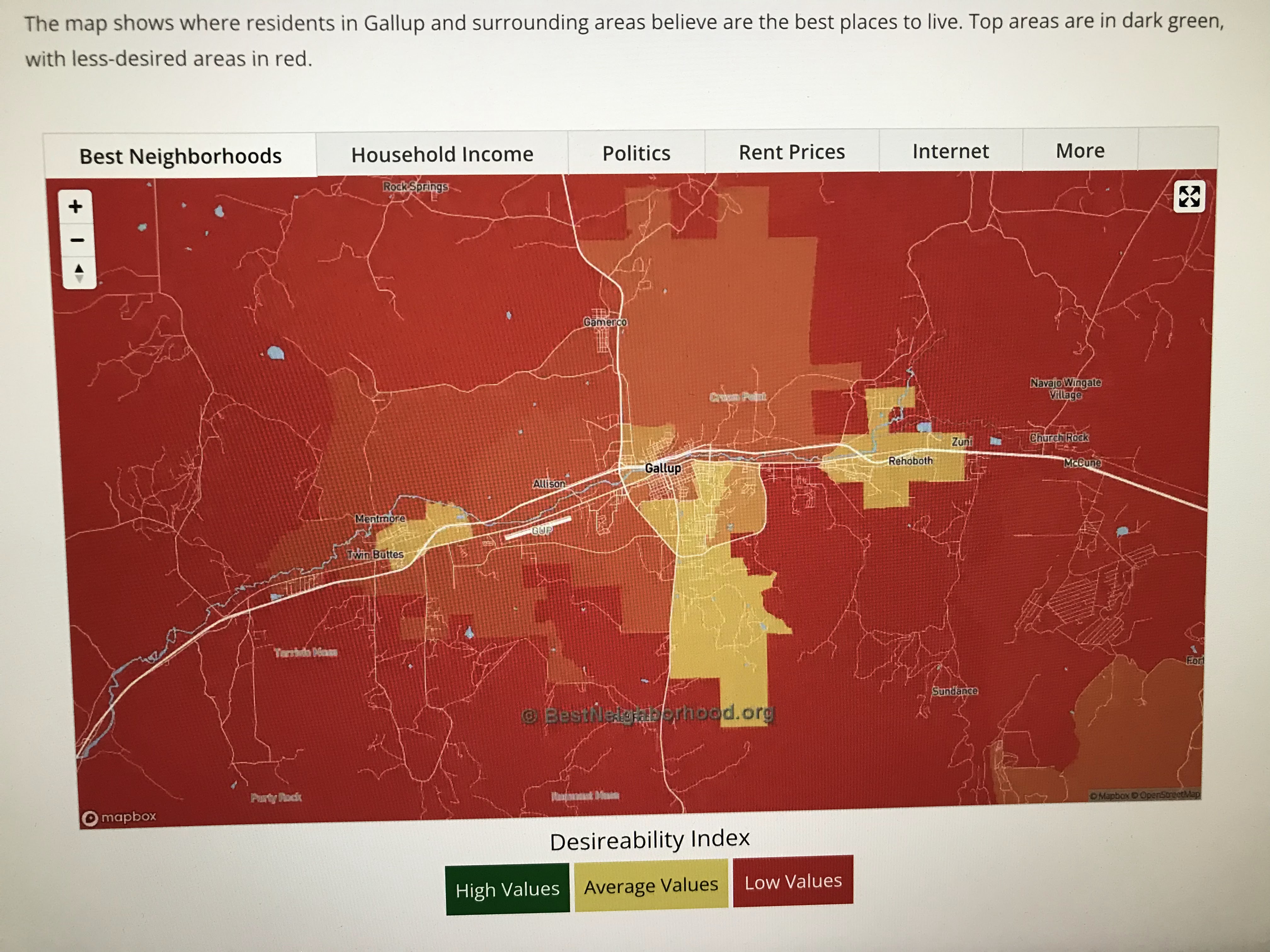
The first question was answered by researching local estate agents, scanning charts showing the good and bad neighbourhoods, demographic profiles and crime statistics. Estate agents proved wonderfully compulsive, allowing me to wander through the interiors of their videoed properties until I almost became a serious buyer—like someone in the TV programme ‘Escape to the Country’—though a far cry from the bucolic English countryside. 


Does Gill Darrat live here?


Or here?


Google Earth allowed me to prowl the streets of Gallup in search of office space. I eventually settled on somewhere along the NM 610 between a Taco shed and an Indian Cultural Centre five miles farther down the road.


Highway 610 and things to see


And finally, Chenoa, her sanctuary—a far harder call. I had a cave in mind, its walls filled with ancient petrographs, but where? Two obvious contenders stood out: Pyramid Rock and Church Rock; not too far away from Gallup, but perhaps too close. Surely there’d be a convenient cave there, one that Chenoa could call her own? There was though the further problem: tourists, too many of them.


Church Rock


Pyramid Rock


The search continued deeper into Navajo country along Indian Route 12 which snaked into Arizona.  I glided over such evocative names as Window Rock, Fort Defiance, Sawmills, Wheatfields until finally I came across it—Lukachukai. By this time, I was Chenoa. This was my home.


But what about the extraneous, the research not used but tucked in a folder  just in case? The fact that Route 66 passes through Gallup. That Errol Flynn once rode into one of its bars for a drink—I’m guessing whisky, and water for the horse. The event is now part of Gallup folklore and advertised on Route 66 as you approach the town.


Driving through Gallup


El Ranchero with an inviting pool but no mounted Errol Flynn


 By this time I had become acclimatised, memories of the New Mexico I’d visited many years ago flooding back—deserts, mountains and sky, dry and invigorating heat. There are few architectural gems in Gallup, but several interesting bars, some of which I might be wise to avoid. But do I want to go there? You bet—especially Lukachukai. 


* The Navajo refer to themselves as 'The People' or Dine. 


Friday, 1 March 2024

The Mad Gasser of Mattoon


 The Phantom Raspberry Blower of Old London Town. (complete story at the very end.)


In the process of writing about Spring Heeled Jack, I discovered America was also haunted by the weird and absurd. Eighty years ago (1944 for the mathematically challenged)  the small city of Mattoon in Cole County, Illinois was subjected to a deadly peril, a Mad Gasser or to be exact, the ‘Mad Gasser of Mattoon.'


It began in September  when Aline Kearney noticed a ‘sickening sweet odour.’ Within moments her legs became numb and then paralysed, her throat abnormally dry.  Alarmed, her sister Martha called her husband who saw a man outside lurking near a bedroom window. The brother chased the man away and later described him as tall, dressed in black and wearing a tight cap.  Within the hour Aline’s legs returned to normal. 


The following day the local paper reported the incident with the headline ‘Anaesthetic Prowler on Loose’ and thus launched a flood of other stories. Orbon Raef and his wife reported a similar thing had happened the day before the Kearney incident. Both had been asleep but had awakened to a strange and noxious smell. Both were paralysed for an hour and a half.


Olive Brown claimed she’d been attacked even earlier, she too experiencing a dry throat and temporary paralysis. On the same night as the Kearney attack,  Mrs George Rider recorded a similar experience.  For whatever reason, she’d been up late that night drinking ‘several pots of coffee.’ She heard an unexpected ‘plop’ followed by a noxious smell that made her dizzy and tingle all over.  A neighbour reported a strange smell that made her children vomit. 


On September 5th  Beulah Cordes picked up a small piece of cloth from her porch. For some reason, she sniffed it, staggered, and screamed.  She reported ‘a feeling of paralysis like an electric shock’ and was sick for two hours.


Not to be outdone, Edna Jones, a local fortune teller, smelled something suspicious in her boarding house. On running out, she saw an ‘ape-like man with long arms reaching out, holding a spray gun.’ He fired three rounds of gas at her causing her to go numb all over. 


Hysteria set in. Armed vigilantes roamed the streets hunting the ‘Mad Gasser.’  A woman loading her gun in readiness for the Gasser accidentally blew a hole in her ceiling. Chemical experts suggested a popular rat poison—chloropicrin, a sweet smelling poisonous gas but the symptoms didn’t match and no actual traces of it were found. Police theories ranged from a rogue chemistry teacher, Japanese terrorists, an escaped or recently released lunatic. A town had become unhinged. 


When no culprit was found, other theories came to the fore. The Chief of Police suggested it was chemical run-off from a local factory: the Atlas Imperial Diesel Engine Company. The company made the obvious point that none of its employees experienced any kind of symptoms. 


The final, most popular theory was that it was a classic example of mass hysteria. A similar incident in 1972 amongst data workers in a Midwest university was similarly dismissed as a manifestation of generalised discontent. 


No conclusive evidence was ever found for a similar incident in Springfield Missouri. In 1987 Springfield was terrorised by ‘Ether Eddie’ who broke into fifteen homes, knocking out women with a formaldehyde cloth pressed to their noses. None of the women ranging from an eight-year-old girl to a mature 56-year-old were sexually molested and nothing was stolen. Even so, the town went berserk, few walked the streets alone at nights, and shops sold out of deadbolts. The following year a woman shot a burglar prying open her window. The wounded man was arrested and served ten years but police found no direct link between him and ‘Ether Eddie.’


I won’t go into the Hopkinsville Goblins. Time doesn’t allow. But for those who enjoy anodyne explanations for the weird and peculiar, it’s hard to beat the American government’s explanation for recent ‘attacks’ on U.S diplomats summed up in the term ‘Havana Syndrome,’ where it was first experienced. These unexplained symptoms are now officially classed as AHIs or Anomalous Health Incidents.


For any who wish to enjoy or endure the full story of the Phantom Raspberry Blower of Old LondonTown.

Friday, 14 August 2020

A life in twelve pictures


I’ll likely die baffled, but I’ve learnt a few things along the way:

Accept what you were

Accept what you are

Accept what you’ll be

And be grateful.

Enjoy life.


Baffled from an early age but pugnacious


First Communion


Here, most definitely grumpy. I’d convinced myself I was

wearing girls’ sandals. Probably was.


Here, the bleak visionary


Father Hill Junior High School for Boys


My first job. An iconic school and an iconic community.

It was a strange twist of fate that changed my life. I ‘failed’ the interview and the job went to a young lady who realised she other priorities, a baby was on the way.  A short and courteous phone call and I was on my way. So much fell into place after that. Every so often I think of that baby and thank him or her.


“I was so much older then, I’m younger than that now…”


My first Form. Their characters shine through. Some are unfortunately dead. Others will surely end up as grand old men terrorising nursing homes.


Seattle airport. Christmas 1981. Meeting Kathleen, my distant American cousin, for the first time. We’d only seen each other for a minute or two and already she was mocking me – pushing her imaginary glasses up her nose – a mannerism I didn’t know I had.


How I got to America, you can read here and here


Taking pictures of America. Camera white hot.


Swimming in the North Pacific on New Year’s Day – as one does.


Somewhere in New Mexico. Travelling America took its toll.


But America liberated me.  I came back with a new name and a new smile. It didn’t last long


Somewhere between 'Dark Fire' my ‘dirty’ book, published by Red Sage and my second book,
 Clay Cross.


Still trucking


Playing silly buggers with trees


Age gets us all. Time to grow a beard.


(OK Pedants, 14 pictures)


Thursday, 23 October 2014

A spiritual Journey


 My brother is a man of strong opinions and impeccable taste so when he urged me to see ‘In to the Wild,’ and when, by pure serendipity, it was on television the following day….well, I had little choice.
It was an interesting experience because, like him no doubt, I was immediately seduced by the American wilderness and was – for a very brief time – body and soul with the protagonist Christopher McCandless – or as he preferred to call himself – Alexander Supertramp. 

For those new to the story the film is based on the life of Christopher McCandless who graduates from Emory University to please his dysfunctional parents, then abandons all his possessions and donates his life savings - $24,000 – to charity. He hitchhikes across America with the ultimate aim of living in the ‘pure’ wilderness of Alaska. Along the way, he meets so many generous souls who in their very different ways befriend and try to reach out to him. He rejects each of them and by now I’m realising I don’t like him very much. I think this is what makes the film so good. Like all great tragedies, it allows the viewer to reach their own conclusions. 

I confess I had my doubts about him when he gave his money away, which gets close to the heart of the issue. For where your treasure is, there will your heart be also.. Matthew 6:21 His champions might see my reservations as the typical materialistic response of one trapped in the shallows; snuffling for  treasure amongst the cockles and whelks. For Chris McCandless the awe inspiring beauty of 'Nature' was his treasure, something to be sought at any and every cost.

 Even so, as the film progresses, you’re struck by how – well – unlikeable he is. This may be a trait of all monomaniacs – revolutionary, political, creative, or scientific. There is little or no room in their hearts for anything that might dilute the grand passion and Christopher McCandless has no room in his heart for anyone who might step in his way. He’s never rude or ungracious but he has a callow and Teflon coated soul. This of course is just one response the film allows, along with an overwhelming sadness that he realises on his last breath what he has lost.


Nature might be a random construct of consequences, a reflection of God’s creativity, or both. Whatever the case, nature makes for mind-blowing magic, but in itself nature is also uncaring. It is beautiful, but just like fine whisky it is not the answer to everything, as Chris McCandless tragically learnt too late when he recorded that true happiness was only found when shared with others

Before Chris McCandless entered Alaska he weighed a hundred and forty pounds, or ten stone. When found he weighed sixty seven pounds or just under five stone. He paid everything in search of his 'treasure'. Was it worth it? It might have been, though not for his family. In that respect 'the wildnerness' proved a false god.

What’s really fascinating is how many different responses there are – to the original book by Jon Karakauer and to the film. Romantics and rebels can see in it ‘a rites of passage in our culture.’  They can empathise with his hatred of modern life and its easy pleasures. An earlier generation got off on the film Easy Rider. Most returned to their studies or mortgage. Some drifted into a similar monomaniac quest for an alternative, more meaningful life style – aided by drugs. What unites them is how ‘idealism’ segues into selfishness.

I belong in the less sympathetic group. I respect his resourcefulness and sense of adventure, and wince at the ‘spoiled white brat’ tag some have labelled him with. We’ve all been through that phase in our lives. Well, many of us, and on their deathbeds some may wish they'd had a more Janis Joplin/Hendrix kind of life, and judge McCandless differently.  But why does the ‘mystery’ of his flight to the wild and ultimate death intrigue so many people? We seek explanations. One writer discerns OCD in his actions, another Aspergers. Why not go for aToxoplasma gondii?

For a fine and interesting analysis of  Christopher McCandless's death (and it wasn’t a simple case of starvation) go to the New Yorker article by Jon Karakauerwho highlights Ronald Hamilton’s research on Vapniarca and the seeds of the grass pea Lathyrus sativus… Read it to find out more. And to the person who led me on this journey - thank you.

He had these books with him:
Tanaina Plantlore' by Priscilla Russel Kari
'Education of a Wandering Man' by Louis L'Amour
-Crime and Punishment (Fyodor Dostoyevsky)
-Death of Ivan Ilych (Tolstoy)
-Call of the Wild (London)
-White Fang (London)
-Moon-Face (London)
-Brown Wolf (London)
-To Build a Fire (London)
-Doctor Zhivago (Boris Pasternak)
-Terminal Man (Michael Crichton)
-O Jersualem! (Larry Collins & Dominique Lapierre)
-War and Peace (Tolstoy)
-Walden (Henry David Thoreau)
But took only a small caliber rifle, no map and no axe. For some this reveals a spiritual journey. Ray Mears he wasn't. 


Thursday, 21 February 2013

The Big Trail


 The first ‘talkie’, the Jazz Singer, came out in 1927. Just three years later came The Big Trail’ - a masterpiece and a landmark in film history. It lost money at the time and since then has been largely forgotten. 

The plot is straightforward. A young John Wayne is seeking two murderers, ‘Red Flack’ played by Tyrone Power senior, and his henchman the villainous Lopez. All three become involved with a large California-bound wagon train. There follows murder and romance as the pioneers conquer blistering deserts, fierce snowstorms, rivers, forests and huge cliffs over which wagons, horses and oxen have to be lowered by rope. 

The story then is simple and by our standards predictable; the acting, too, is haphazard. Tyrone Power senior, as the murderous Red Flack, is ham to the bone, bellowing and growling like a wounded bear or Neanderthal. There is a lovely documentary feel to scenes showing the Indian encampment, but then this is spoilt  when the same Indians attack the wagon train The train is drawn in a tight, protective circle and the Indians just ride round and round it shrieking but doing little else until half of them are shot and the rest still shrieking retreat. It’s a visual cliché but perhaps first shown in The Big Trail.

 But there is much more to the film than story or acting. It’s the sheer scale of Raoul Walsh’s ambition that takes the breath away. Each scene was filmed twice first in 35 –millimeter for general release,  and then in 65mm. This was the ‘Fox Grandeur’ wide-screen process that would not be replicated until 1953 with ‘The Robe’. Just to make things that little bit more expensive, each scene was filmed in French and German with totally different casts. It makes Michael Cimino’s flawed masterpiece ‘Heaven’s Gate’ modest in comparison. 

There is also the ‘miracle’ factor that led to its rediscovery. Miracle factor…perhaps not. Ingenuity and human will sums it up better. When, in the 1980’s, the Museum of Modern Art in New York thought of preserving the one remaining 65mm copy they found the negative had shrunk and was too fragile to copy. Film labs told them it was an impossible task. One man, Karl Malkames, thought otherwise, building a specially designed printer that copied it at one frame a second. It took him a year, and it is due to Karl Malkames that the film now exists in CinemaScope.

 
When you consider that ‘talking pictures’ were still in their infancy, and that the film was shot on location along much of the old Oregon Trail, the feat is amazing. And there are so many layers in the film, so many things to admire. Landscape dominates, frame after frame bringing images of the old west into C21st homes. Raoul Walsh also pays meticulous attention to composition, every scene a Breughel with a western twang and swagger.

There are a few saggy moments, frames showing suckling babies, suckling foals, suckling cats, suckling pigs - the fecundity of life despite every hardship kind of thing. And then there are the captions, defining key moments in the film:

Dedicated to the men and women who planted civilization in the wilderness and courage in the blood of their children.


Prairie schooners rolling west, praying for peace - but ready for battle.


The last outpost, the turning back place for the weak; the starting place for the strong.


They have not turned back, those who died; they stay and yet they go forward. Their spirit leads.

And my favourite:
Ten weary miles a day. There is no road, but there is a will, and history cuts the way. 
 
…And history cuts the way? Oh please. Even so they add a certain period charm you might find in any British, Nazi or Soviet propaganda of the time. 

Transcending everything however is the luminous photography, the balance between  composition and apparent randomness that gives the film another layer: the documentary. And this I find most fascinating of all: the overhang of history. Damn it all I’m speaking in captions. 

The film was made in 1930, celebrating the centenary of the opening of the Oregon Trail. But consider the age of many of the actors. William Phillips who played Zeke, a coonskin wearing grizzled old scout was born in 1864. Another actor, Chief John Big Tree, was born in 1877. Tyrone Power Sr. (admittedly English) 1869. Charles Steven who played the villainous Lopez was a spring chicken born 1893, but then again, he was a grandson of Geronimo.

And of course, Raoul Walsh - born 1887 - and who worked for a time as a cowboy. These were filmmakers born as the Old West was coming to an end, but with parents and grandparents who remembered it well. And that is the authenticity you see in the Big Trail; and the image of the Old West Liverpool kids clung on to as we played cowboys and Indians with catapults  and gas-masks salvaged from World War II

Friday, 20 May 2011

And so it ends.


I’ve often wondered what I would choose for my last meal if I knew I was dying later that day, either by order of the state, (Socrates was un-ambitious sticking to a drink) or by more natural means. It felt like that as we hit Washington, the last day of our tour. In this case it was a bit of a set menu, but I dutifully revisited every monument, garden and statue, and remembered that this had been my first experience of America only a year before.

I hate anti-climaxes, the neither-here-nor-there interludes between major events. If I could have done a ‘cut and paste’ job I’d have zipped back to the inevitable in the blink of an eye. Unfortunately there was another night to endure in New York.

What a strange thing to say. But it wasn’t much fun, packing, looking round Ron’s apartment for one final time, saying goodbye to Bob and Tom and everyone else who’d made me so welcome. I met up with Roland at a similar loose-end, and together we crawled the bars of Greenwich village with Carol Bezvidenhoot. I said goodbye to her with a chaste kiss and walked from the Village to Jackson Heights. New York at night is always an interesting experience.

America was a great adventure, but there was a bigger one to come.


One Adventure ends, another begins. I hope this has proved interesting to my beautiful daughter

Friday, 13 May 2011

Nearing the end


I’m finding it harder to write as this particular phase in my life comes to an end. It’s like a man approaching death, and before you say, ‘Michael, you are far too young to be thinking of such things,’ (I hope you all do) I’ve had a morbid mind since the nuns were unleashed upon me in Primary school.

But America was coming to an end, for me at least; you guys still have some way to go. Our next stop was Williamsburg and very beautiful it was too. I remember the long walk from the Information Centre to the ‘Village’, a walk that allowed you to muse on the information imparted by a very professional orientation film shown at our arrival.

Three and a half hours, the time allotted to us, wasn’t nearly long enough, The William and Mary College alone was worth an hour or two. Now it’s a visual snippet lodged in the brain: America’s oldest educational foundation, Christopher Wren inspired architecture, and the alumni of both Washington and Jefferson.

Speaking of Washington


Next we were whisked off to Mount Vernon - Washington of the wooden false teeth fame – his old place. And there I emotionally and physically collapsed. Emotional, not in a blubbering sense, but the realization that I’d become emotionally drained. I couldn’t take any more.

I have no objection to any sober or orderly person's gratifying their curiosity in viewing the buildings, Gardens, &ca. about Mount Vernon.’ Washington wrote in a letter* which was very nice of him.

I was sober and orderly but curiosity was gone. If I saw one more costume, one further piece of bone china, even Washington’s reputed false teeth I’d have hugged my sides and screamed. I’d seen too much…and the curry was having its effects too.
I went to where I always go in periods of great angst, a bar. And afterwards slept on the grass.

Tomorrow, Washington, New York and then the plane home.

*letter to William Pearce (November 23, 1794

Sunday, 8 May 2011

Jack Daniel's or Jim Beam? A sober reflection


Friday 13th proved uneventful, though Kim was still not speaking to me. Having just passed through Tennessee and Kentucky, Roland and myself debated the merits of their respective bourbons and decided there was only one real way to find out. A bottle of Jack Daniel’s and a bottle of Jim Beam, were duly purchased, and we spent much of the afternoon beneath a shady tree.

First we examined the colour. Jim Beam in sunlight looks like piss, the kind that would earn an approving nod from an urologist but not perhaps from a drinker. Jack Daniels is darker, only slightly so, but sufficient to give that same urologist a degree of concern.

The smell we found difficult to differentiate and we spent several precious minutes sniffing and swirling before finally agreeing that although both shared a similar sweet and sour aroma, Jim Beam’s had the sharper edge. Was that a good or a bad thing? Did sharp mean thin? Further discussion ensued but with no definite conclusion.

Preliminaries satisfied it was time to exercise palate and tongue, teeth relegated to filtering as we sucked and swilled and nodded our heads.

Roland suggested a spit bucket as though we were testing fine wines. He was getting above himself and I reminded him gravely that instead of tasting eight or nine separate and distinct wines, ours was the less onerous chore of sampling just two bourbons. A spit bucket would not be called for though if Roland wanted to spit his out on the grass – away from me – well that was his democratic right.

The afternoon passed quietly other than the occasional clink of bottle on glass, the considered slurp, and every so often an appreciative ‘ummmm’. We drank slowly, sound judgement being the ultimate arbiter.

Hours passed, as we irrigated mouth and throat, savoured that slow, final trickle from oesophagus to stomach until a decision was at at last reached. It was unanimous. Jack Daniel’s was sweeter. And there the discussion continued. Did sweeter mean fuller? Which was the superior drink?

If either distillery would like to sponsor a rematch, this could be arranged, though we draw the line at a Pepsi Vs Coke challenge.

That evening I made curry for the group, with unfortunate consequences.

Saturday, 30 April 2011

The beer was strong and Kim was upset when I poured a jug of it over her head


Thursday 12th

We spent the day driving to Chesapeake Bay where we took the ferry across. I tried to interest those around me in the exploits of British troops who having sailed up the Chesapeake in the war of 1812, went on to burn the Capitol and large parts of Washington. They were polite but were clearly more interested in oysters and the promise of strong beer, and I don’t say I blame them.

We spent the evening in a ‘Colonial Tavern’ and here my diary goes awry. I can’t for the life of me remember the name of the tavern, and though I retain a very vivid picture of it in my mind, I can’t for love or money find it on Google. The mind is a wonderful and complex thing but it cannot, as yet, transfer an image through cyberspace. So you’ll have to imagine us sitting at trestles on the Tavern’s green, drinking strong ale and being entertained by jugglers, wigs and fine dresses, and jaunty Colonial airs.

I’m told there are asteroids that pursue long and peculiar trajectories through space, appearing once every ten thousand years or more and then disappearing again. Neurons are pretty much the same. That evening a random neuron ripped through my brain and caused me to do something I still puzzle over all these years later. I poured a jug of beer over Kim Haslinger’s head.

It wasn’t in malice or anger. I think I must have thought it funny at the time. Kim was more puzzled than angry and I sat there, not drunk, but bemused. My only defence was that such behaviour was par for the course on that long, long journey across America, where shaving foam-fights were a nightly routine. And perhaps I was sad…at the burning of Washington…at the fact that my journey across America was coming to an end. It was like the worst ‘frat-pack’ movie gone wrong, and I didn’t have Owen Wilson’s charming smile to make everything right. Worse, it was a waste of good beer. I think Kim and I remained friends…but I haven’t seen her since.

The neuron has yet to make a comeback but I’m afraid it’s probably long over due.

Friday, 22 April 2011

A hat at last in Cherokee

Wed 11 August


Cherokee is nestled deep within a thickly wooded valley and sadly seemed little more than a tourist centre replete with tack. We walked through a Snake Zoo. . . and wondered why. But Cherokee had one trick up its sleeve. Lurking in the shadows, and waiting for the one who was about to release it was a hat.


Throughout my entire time in America, I’d tried Baseball Caps, Panamas, Stetsons, even a Fedora, but none fitted my strangely shaped head; somehow or other beneath a hat my face resembled an ambiguous after-thought.


And then, in a Cherokee store, I found it: - a 70’s Black Pimp’s brown suede cap; all baggy and malleable. A sheep, even an orangutan would have looked good in this hat. I tried it on and posed; an extra from Shaft. I fell in love - with the hat.

I took it to the counter, hat and wallet in hand. The owner of the shop, a Cherokee Indian, stared at me and then at the hat. He shook his head. Who did he think he was – my style counsellor? I opened my wallet:

‘How much?’

His face remained stoic, impassive, not even a blink. He shook his head again and then pointed at the hat.

‘Mine,’ he said.

‘But it was at the very bottom of a big pile of hats.’

‘Lost,’ he said, ‘until now.’

I stared at him with all the resolution of a nineteenth century land-grabber. He stared back with the resolution of one who played poker. We haggled, me oscillating in uncertainty: was I being obsessively greedy in wresting ‘his hat’ from him – or was he taking me for a fool? We haggled some more, his face barely twitching a muscle, until my want and his price eventually approximated.

It’s a fine hat, but my wife refuses to let me wear it.

South African Roland (as opposed to Austrian cocktail champion, Roland) joined me in a seven mile walk back to the camp. Kim, less nature-loving but more astute, hitched a lift. Perhaps in ecstasy at having at last found the perfect hat I seriously over-partied that night, and in consequence was unable to enjoy a view of the Blue Ridge Mountains the following day.