Friday, 30 August 2024

The Colour Blue


Friends we haven’t seen for years bought us an intriguing present for our Ruby Anniversary. A superficial mind might consider a ruby red bottle might be more fitting, but who could drink gin from a red bottle? Are there any alcoholic drinks in red bottles? No, blue is the perfect colour whether Gunpowder Gin or Bombay Saphire. Green works too ie Tankeray, Gordons too if you’re on a budget.


I spent some time admiring the colour, unwilling to break into it too early. The small piece of cardboard around the neck of the bottle provided further distraction, especially when I opened and read it. 


Who was P J Rigney? And what a journey!  And all in search of botanicals. I felt vaguely transgressive. Was he another imperialist I should be ashamed of, plundering other cultures and nations for unknown and exotic plants? My imagination took me back to ‘The Great Game’ when the Russian and British empires vied with each other for influence in Central Asia. 


Men  like Colonel Charles Stoddart, British officer and diplomat active in Central Asia, and sent on a mission to the Emir of Bokhara in 1838. 


Colonel Charles Stoddart


He went with two aims: persuading the Emir to free some Russian slaves, and to sign a treaty of friendship with the British Empire. Stoddart was promptly arrested by the Emir and languished in a hot and dusty cell. In 1841 Captain Arthur Conolly arrived in Bokhara to negotiate Stoddart’s release. 


Captain Arthur Conolly


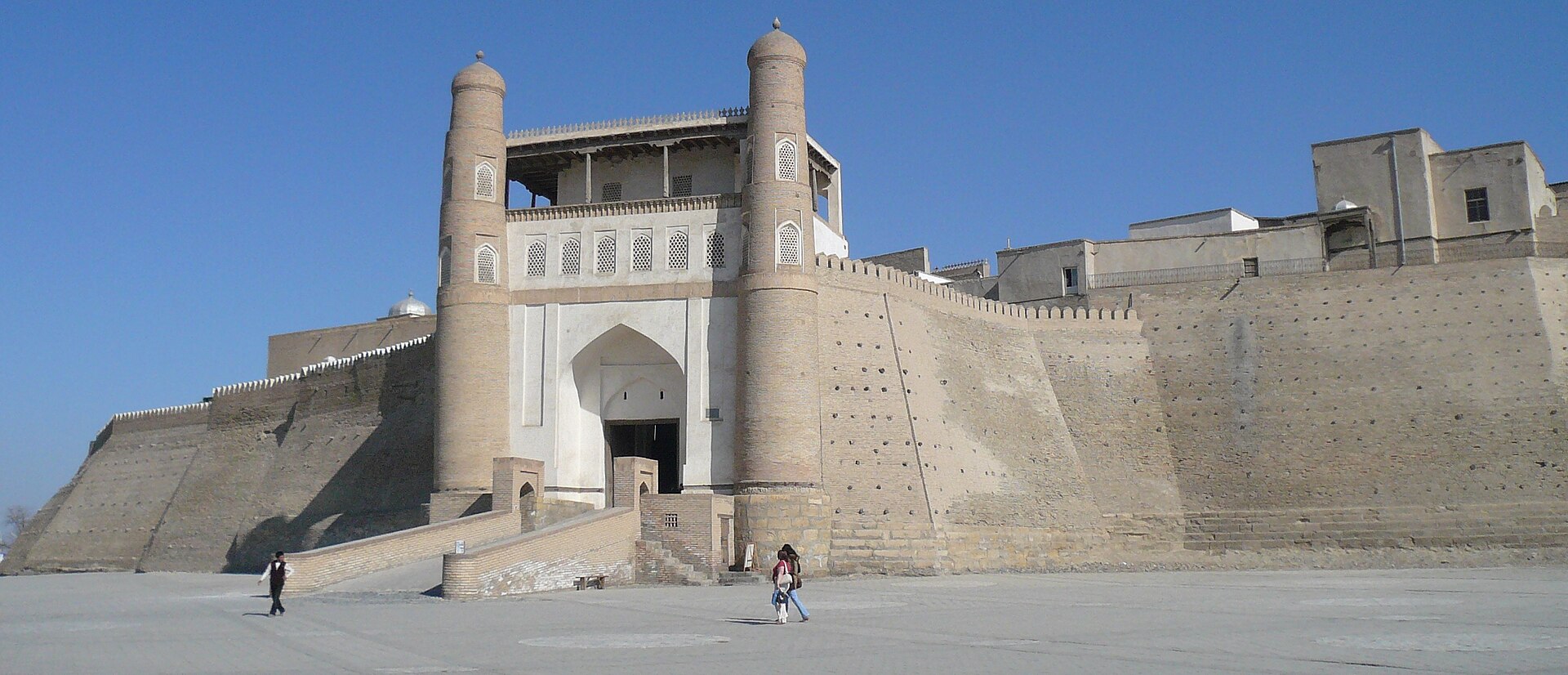
The Ark Fortress Bokhara


This was stressing the Emir out and the two men were beheaded the following year on the square in front of the Ark Fortress. Was JP Rigby cut of the same cloth—an imperialist adventurer, his obsession with botanicals his cover in the Great Game? I lived in hope, but alas no.


P J Rigney is alive and kicking, an Irish distiller who has been in the drink  industry for well over twenty years and was for a time associated with Bailey’s Irish Cream. He may not be an adventurer in the Victorian mould, but an entrepreneur he most certainly is—with an interesting taste in botanicals:


 “kaffir limes from Cambodia, Chinese lemons, and gunpowder tea from China, Orris root from he mountainous regions of Morocco, as well as juniper berries from Macedonia.”


I think it’s going to take several bottles of Drumshanbo* Gunpowder Irish Gin for me to detect the full range of his botanicals. More additions to the bucket list. 


*Gaelic for old sheds on the ridge. A town in Leitrim, Ireland. 

Friday, 23 August 2024

Campylobacter

 One of the most exciting and unsettling things about Monopoly is picking up a Chance or Community Chest Card – perhaps the only exciting or unsettling thing about Monopoly other than winning or landing on a Mayfair with a hotel on it.


A few weeks ago, instead of winning a Beauty Contest, £50, facing a medical bill, or Going to Jail, I caught a stomach infection which introduced itself two weeks before our Anniversary.

 I’m an astute cove and knew something was wrong when I went to urinate and erupted front and back.  Bit like a sympathy strike—bowels and bladder unite! One out. All out!


It was horrible, like pale, lumpy tea but less fragrant. 


The doctor requested a sample, a reasonable enough request but not so easy to oblige, a bit like bottling Krakatoa in full flow. Now all I had to do was wait. The doctor might not cure it, but she’d tell me what it was. Comforting.


The historian in me half-hoped it was dysentery, putting me at one with the medieval archer at Agincourt. There, the English army was outnumbered by two to one. The outcome was grim. Dysentery was rife and the English archer fought with his pants down, torrential diarrhoea below, a torrent of arrows darkening the sky above. As the French knights charged, the archers stoically dipped arrowheads into their poo before letting fly. A nice touch. Altruistic too; what is ours is yours.


Dysentery also entered the Corn Law debates of 1846, Sir Robert Peel fighting to allow cheap corn into Ireland to offset the effects of diseased potatoes and famine. 


There is a passion and poetry here you don’t find in modern political debate:

“Are you to hesitate in averting famine because it possibly may not come? Good God…how much diarrhoea and bloody flux and dysentery (must) a people bear before it becomes necessary for you to provide them food!” 

Robert Peel pushed through his repeal of the Corn Laws and in doing so split his party, keeping them out of power for over twenty years.

For me then, dysentery has ‘bottom,’ history, a hinterland, but I didn’t have it. Three days later the results came back. Campylobacter


It was known in late Victorian times as cholera infantum —stool specimens of dead babies being a major source of study.  It can't be denied that Campylobacter has history, but one less adventurous, poetic or dynamic than dysentery. 


Saturday, 17 August 2024

Anniversary Weekend


This weekend is our ‘Fortieth Anniversary Weekend.’ I didn’t realise I was so old. My wife on the other hand enjoys eternal youth. 

In consequence it’s a weekend of celebration. No time for a blog. 

Normal service will be resumed.

Friday, 9 August 2024

Lions, Monkeys, and Old Martin

In 1609 a bear ate an unattended child. As punishment, that noble and sage king, James I, ordered that the bear should be made to fight one of the royal lions.  However, much to the king’s chagrin, neither animal showed any inclination to fight. and so the offending bear was instead baited to death by large hungry hounds. Tickets were sold and the grieving mother of the careless child was offered a cut of the profits in recompense. 


The menagerie grew larger with the addition, in 1622, of three eagles, two pumas, a tiger and a jackal. This on top of the obligatory leopards and lions. The diarist, Samuel Pepys, was very fond of one old, very tame lion called Crowley. Not every lion was so tame; lions have their ‘off days.’ In 1686 a servant of the Keeper, Mary Jenkinson, stroked one of the lion’s paws and her arm was torn off:


 ‘Suddenly he catched her by the middle of the arm with his claws and mouth and most miserably tore her Flesh from her Bone, before he could be unloosed, notwithstanding that they thrust several lighted torches at him.’ The unfortunate girl had her arm amputated and died two days later. 


The Monkey House was lampooned by the brilliant C18th cartoonist, Thomas Rowlandson. I love the ambiguity of who exactly is imitating who?


By the C18th the Menagerie had become a major attraction, the ‘Monkey House’ in particular—until a boy was mauled by an over enthusiastic ape and, in consequence, the monkeys were put back in their cages. 

After years of decline, the Menagerie enjoyed a final but brief flare of popularity when in 1822 an able and enthusiastic zookeeper was put in charge. Alfred Cops had a mission, immediately setting upon a programme of expansion, even travelling the world himself in search of new and exotic species. Within six years 300 animals from 60 countries were housed in the Tower’s Menagerie. 


The kangaroos were a huge success, as too was Old Martin, the Tower's first Grizzly Bear donated by the Hudson Bay Company in 1811. It was a gift to George III who graciously said he would rather have been given a new tie or a pair of socks. Old Martin died in Regent's Park Zoo in 1838, presumably miffed that the king would have preferred socks. It is interesting to note though that his ghost still lingers in the Tower, along with that of Anne Boleyn, presumably appearing on different nights. 


Though Cops was both knowledgeable and kind, the animals remained housed in cramped conditions – with sometimes unfortunate results. An inquisitive secretary bird had its head torn off when it peered into a hyena’s cage. 


Other significant changes took place in the 1820s. The RSPCA, founded in 1824, highlighted some of the cruelties long taken for granted. In 1826, the Duke of Wellington, hero of Waterloo, was appointed Constable of the Tower. Being a military man, he couldn’t be doing with animals. For him, the Tower was a military operation. He was a soldier, not a zookeeper.  In 1828, 150 of the animals were rehoused in the new zoo at Regent’s Park.


A desperate Cops reduced the entry fee for his now depleted menagerie, but fate took a hand again. An escaped wolf almost devoured a child, and a monkey bit a guardsman’s leg. In 1835 King William IV closed the Royal Menagerie for good.


Now, as a reminder, a few sculptures peer menacingly at visitors, and there are the ravens of course, a far cry from the Menagerie’s golden age. 

Saturday, 3 August 2024

Brutality and Glee


I think this clip embodies much in my own life. 


It also reflects similarities between us and  much of the animal kingdom, similarities  we are increasingly sensitive to as extinction threatens what we’ve belatedly learnt to value. A far cry from the C12th with its early child-like glee in the exotic. Glee, brutality and ignorance equally mixed.


Henry 1 began with a private menagerie in his Woodstock palace. Lions, tigers, leopards and camels—quite a novelty in early C12th England. The collection increased soon afrer King John lost Normandy, acquiring by way of compensation crates of assorted wild animals. John now had an important decision—other than the Magna Carta—where to put them?


He decided upon the Tower of London, and the royal menagerie became even more firmly established by his successor Henry III.  In 1252 Henry received the gift of a ‘pale bear’ from the King of Norway which became an instant sensation, especially when the Polar bear was encouraged to fish its own food in the relatively clean Thames. Chains and ropes were employed for its keeper’s protection and also that of the crowd. In 1253, London saw its first elephant, a gift from the king of France. Where he got it from. I don’t know, maybe an unwanted Christmas gift.


Unfortunately, the poor beast died within two years and was buried in the Tower complex. Waste not want not. A year late its corpse was exhumed, its ivory used for various reliquaries in Henry’s newly rebuilt Westminster Abbey. 


Edward I rehoused the entire menagerie in what would be called the ‘Lion Tower.’ It guarded the north gate and was for a time the only way into the Tower of London; a fearsome, perhaps intimidating experience for those passing through.


In the C14th and late C15th the animals were used for entertainment eg the baiting of lions with large and vicious mastiffs. Henry VII, no stranger to blood himself,  was ‘deeply displeased’ on witnessing such an event and had the hounds put to death.


Not every king was so fastidious. James 1 revelled in watching animals tearing each other to pieces. In fact, he built a viewing platform the better to observe. On one occasion, the sport proved disappointing.  In 1605 he ordered a live lamb to be winched into the lions’ den. Against all expectations, the lions ‘very gently looked upon him and smelled upon him without sign of further hurt.’ The lamb was winched back without hurt but was likely eaten for dinner soon after.

To be continued.


Friday, 26 July 2024

Poverty is a great preservative


The beauty of Chastleton House is that it has remained within the same family for much of its existence, and because for much of that time family fortunes varied – usually for the worst – its upkeep suffered and improvements were few. So what you see is a perfect Jacobean house albeit shabby. When the National Trust took over, they decided the tradition would be maintained. And so, you walk through its faded glory expecting ghosts at every corner. 


The house was built between the years of 1607 and 1612 by a prosperous wool merchant, Walter Jones. He had high aspirations, but his descendants blew it, going against the grain of history and taking the losing side on every occasion. Royalist or Jacobite, it didn’t matter. They went for it. The owner of Chastleton in the 1930’s and 40’s, Irene Whitmore Jones, would tell visitors that the family had lost all their money ‘in the war,’ referring not to the First World War but the Civil War 300 years earlier.


A corner of the Long Gallery

Long Gallery and hearth


long Gallery


Close up of hearth

Walter Jones’ grandson, Arthur, fought for the king and was nicknamed ‘the Cavalier,’ after  one particular event. Pursued by Roundheads after the Battle of Worcester, he fled to Chastleton pursued by Cromwell's men.  Arriving twenty minutes or so before them, he hid in a secret closet adjoining his bedroom. The pursuing Roundheads found Arthur’s winded horse in the stables, knew its rider must be about, but couldn't find him. To the horror of his wife, Sarah, they based themselves in the bedroom where Arthur was hiding. That night she offered the soldiers beer laced with laudanum, allowing Arthur to escape. A great and romantic story which did little for the family fortune as they lived through years of punitive fines.


                                                                           The bedroom


                                         The location of  secret closet lost during later renovations


Arthur’s grandson, Walter Jones III inherited the house in 1688 aged 14. As an adult, he made some much-needed improvements with the help of his wife’s dowry (Anne Whitmore) and the financial support of his wife’s brother, Sir William Whitmore. Even so, when Walter died in 1704, he left Anne, four children, and an estate heavily in debt.


                                                           Wonderful panelling 


                                               A particularly ornate bedroom ad magnificent tapestries


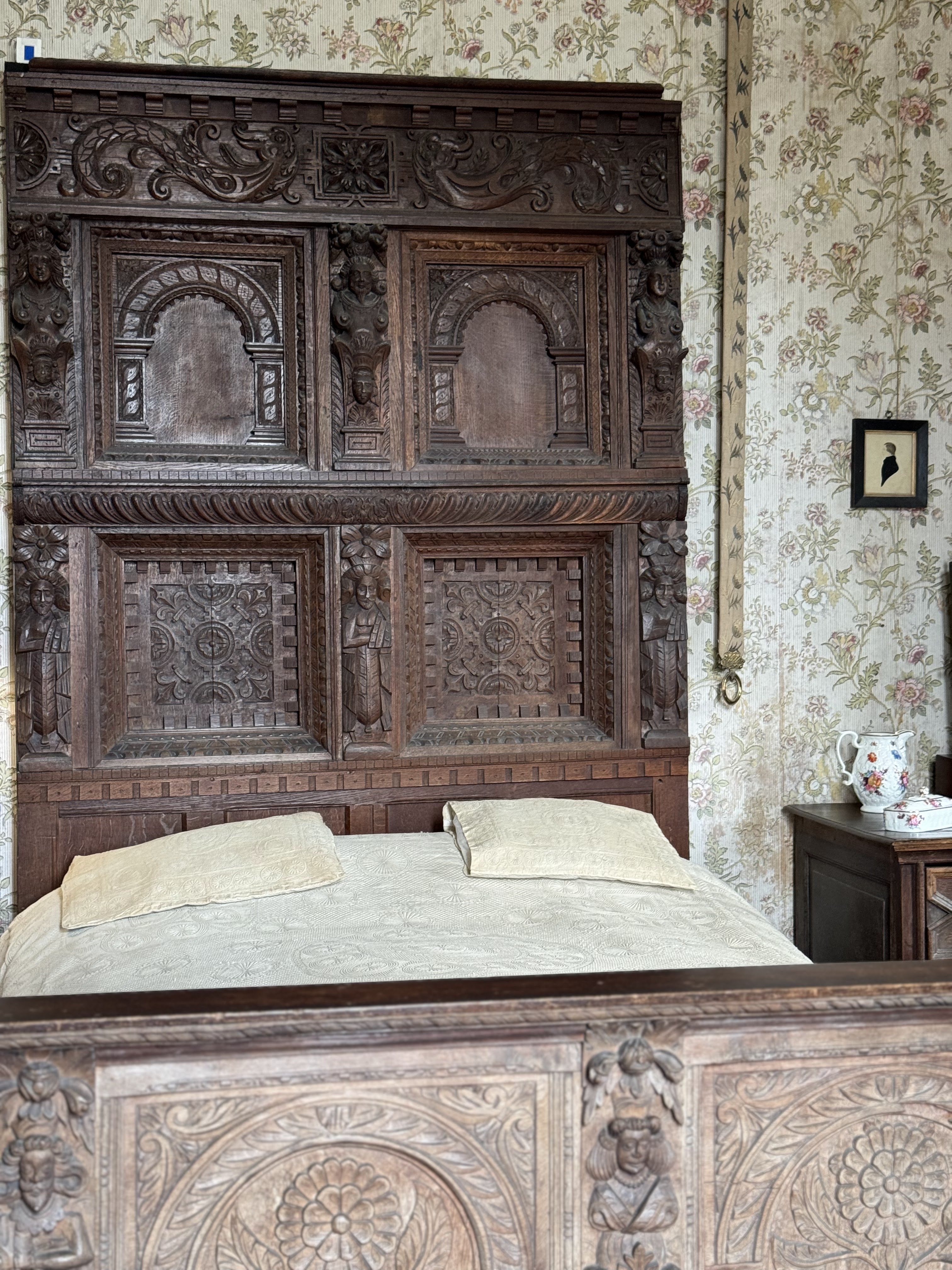
Make do and mend. The end of this bed is part of a re-purposed door. The sharp sighted might even discover the keyhole.


His heir, John Jones was six years old so Anne ran the estate for him and returned it to solvency – which he had blown by the time he died in 1738.


The next heir, Henry Jones was imprisoned in Oxford gaol for debt. His successors, John Jones II and Arthur Jones II made stalwart efforts to make much needed repairs and on Arthur’s death in 1828, the estate passed sideways to a distant cousin, John Henry Whitmore-Jones.


I was struck by the small glass goblets used to sip strong beer!  Seems a bit weird to me. 


                          But beer in small goblets is compensated by this wonderful C17th tapestry.


The story of bad luck and ne’er-do-wells continued in the C19th, with the women, by and large coming to the rescue. For much of this time, the house was rented as money ran short. Irene Whitmore Jones became sole custodian in 1917 after the death of her husband. By 1936 she had been forced to sell the entire estate of 1,250 acres and five farms, leaving just her and a butler called Wing, and a maid called Old Sarah. In the 1940s she was reduced to opening Chastleton to paying guests. 


In 1954  Barbara and Alan Clutton-Brock inherited Chastleton, the latter being a distant relative of the Whitmore-Jones family. The couple were energetic bohemians, hosting the likes of George Orwell, E.M Forster, and fringe members of the Bloomsbury Group. They embraced the nature of the house they’d inherited, Barbara pointing out that ‘Poverty is a great preservative.'


After the death of her husband Barbara stayed, refusing to abandon the house. She lived alone but for her 20 cats and a parrot, inhabiting a few rooms on the ground floor and a bedroom. Her allowance was supplemented by the occasional paying visitor. The lady was indomitable, wiring part of the house herself and chivvying her daughter to get up there and repair the roof when occasion demanded. It took its toll upon her, once admitting she had never been warm in her life.


These rooms have been preserved as they were when the Clutton-Brocks lived there.


One of the rooms Barbara lived in after her husband died. I loved the small period details.


                                             Her bedroom with its 1590's tapestry


 After fifteen years of living alone in this large, freezing cold house, wandering around like a pea in her Jacobean pod. . . 


                     The kitchen's smoke stained ceiling and rack for hanging bacon etc
                                                                  Original implements
 
                                       Jacobean hearth with the later 'modern' cast iron range


The wine cellars

Barbara Clutton-Brock finally admitted defeat, selling it to the National Trust and being taken in by her daughter. She died in 2005 The house lives on, as do the gardens


Friday, 19 July 2024

Love’s Labours Lost

In primary school we had a teacher called Sister Kevin, a sweet, elderly nun who was generous with sweets. Henry VIII brought out her dark side. It may have been the only history lesson she gave, but one I never forgot. She was talking about the death of Henry VIII, and she spoke with vindictive passion as she described his distended belly bursting in its coffin, its stench driving people out from the church. She may have been mixing up the story with a similar story referring to William the Conqueror’s funeral; it’s possible she would have told the same story when talking about Oliver Cromwell. But this small boy didn’t give a fig. The story made history interesting and has done ever since. 


Years later, I too taught Henry VIII with, I hope, more accuracy and with different stories. Having explored the Reformation, the Dissolution of the Monasteries and the execution of Thomas More, some light relief is called for, and I found it in the love letters from him to Anne Boleyn. 

The man was besotted, a lovelorn loon in heat. 


These snippets from letters writing between 1527-28 indicate the power of his passion, one that would destroy the English Catholic church along with much stained glass.


(I wish) ‘truly to honour, love and serve you . . . praying you also that if ever I have in anyway done you offence, that you will give me …absolution …. henceforth my heart shall be dedicate to you alone, greatly desirous that so my body could be as well, as God can bring to pass if it pleaseth Him, whom I entreat once each day for the accomplishment thereof, trusting that at length my prayer shall be heard, wishing the time brief, and thinking it but long until we shall see each other again. 

Written with the hand of that secretary who in heart, body and will is

Your loyal and most ensured servant,’

H. autre  AB  ne cherce R.’


Like a little schoolboy, he drew a heart around the letters AB.


When Anne falls ill, he is distraught. His gift to her is robust as befits an Englishman.

‘I send you this letter, praying you to advertise me of your well-being, the which I pray God may endure as long as I would mine own. And to the intent what you may the more remember me, I send you by this bearer a buck, killed by my hand late yesternight, trusting that as you eat of it you will have in mind the hunter.’

She may have preferred chocolate.


‘News has come to me suddenly tonight, the most displeasant that could be brought, for the which of three reasons I must needs lament. The first, to hear of the illness of my mistress, whom I do esteem more than all the world, whose health I desire as much as mine own, and the half of whose malady I would willingly bear to have you healed thereof…..’

H  AB  R


‘The cause of my writing now, good sweetheart, is only to understand of your good health and prosperity……and seeing my darling is absent, I can no less do than to send her some flesh representing my name, which is hart flesh for Henry, (promising) that hereafter, God willing, you must enjoy some of mine, which…I  would I were now.’

Perhaps a little kinky.


‘…. wishing myself (especially an evening) in my sweetheart’s arms, whose pretty dukkys I trust shortly to kiss.’

Written with the hand of him that was, is, and shall be yours by his will. 

HR

Dukkys . . . interesting  term and clearly impeccable when one considers the trouble they caused.


Six years later a different passion took hold. 


A small but tasteful monument on the spot where Anne was executed. The flowers are a nice touch.

It was gossiped that Henry may have been an unobtrusive witness from a nearby window, and that Anne may have even at that moment been hoping for a reprieve.


Her words were recorded by Edward Hall in his Chronicle The Triumphant Reign of Henry VIII:


‘Good Christian people, I am come hither to die, for according to the law, and by the law I am judged to die, and therefore I will speak nothing against it. I am come hither to accuse no man, nor to speak anything of that, whereof I am accused and condemned to die, but I pray God save the king and send him long to reign over you, for a gentler nor a more merciful prince was there never: and to me he was ever a good, a gentle and sovereign lord. …And thus, I take my leave of the world and of you all, and I heartily desire you all to pray for me. O Lord have mercy on me, to God I commend my soul” And then she knelt down saying: “To Christ I commend my soul, Jesu receive my soul” divers times, till that her head was striken off with the sword. And on the Ascension Day following, the king wore white for mourning.’


And thinking of someone else's  dukkys.