Saturday, 17 December 2011

Plonkers


Wonderful picture from the New York Times. But oh for an Heironymus Bosch to do it full justice.

Sunday, 11 December 2011

Black pudding in Aberdeen


Black pudding is a visual feast. It glistens and crumbles on the fork. A single mouthful justifies the millions of years that have led to perfectly formed mouths and taste buds.

The one served at the Ardoe house hotel sat on the plate between the bacon, sausage and fried egg. It looked inoffensive. I savoured the moment before cutting into it and raising it to my lips.

It was like chewing pulped cardboard with the faintest aftertaste of manure. Must be some mistake. Nothing can go wrong with black pudding: a savoury mix of barley, pig fat and blood. I left it for a bit and attacked the egg; went back to the black pudding. Dry. Definitely something wrong. Manufactured slurry. A normal person would have left it. The world is full of black puddings.

I tried again, caught by obsession, a history of childhood rationing and just plain stupidity, until the damn thing was gone.

What was I doing at Ardoe House glooming over black pudding?


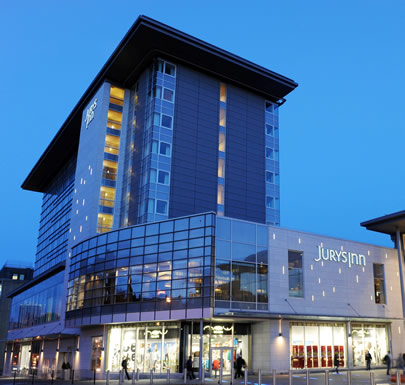
We had gone to Aberdeen for our son’s graduation and arrived at Jury’s Inn hotel just after midnight. This was after a ten hour journey by train which involved a 90 minute wait for our final connection on a freezing Edinburgh station. Arctic winds screamed through flesh and bone and precipitated hallucinations. How else could I explain the vision of a man with a Desperate Dan chin, clad only in red T shirt and knee length shorts? He stood arms folded, oblivious to the polar weather. His legs bulged in a Macdonald tartan of varicose veins, the only hint of discomfort. And then he vanished.

Eventually we stumbled into the foyer of the Jury Inn, seeking a warm bed and looking forward to breakfast. Unlike the Holy Family, we had booked our rooms weeks ago and confirmed it earlier that morning, warning them that we would be late. ‘No problem’ we were assured.

Only there was. The young male receptionist told us we didn’t have a room. His tone of voice suggested mild displeasure, as though we were somehow to blame for him being in this embarrassing situation. The mild displeasure turned to puzzlement when we didn’t turn cartwheels of joy on finding out that they had found another room for us in a hotel, which involved a ten mile taxi-ride.

Voices were raised, and then a young Irishman emerged and did brilliantly what the young receptionist should have done in the first place. He once again explained they were victims to a double-booking made by a central computer and that as a result the hotel was full and then, instead of just making the best of a bad situation, he exceeded anything we’d anticipated: The alternative hotel was superb (apart from the black-pudding, but I absolve him from blame for that) Our night there was at a discounted rate and our second night at the Jury’s Inn, for which there was a room available would be complimentary – breakfast included.


The following day a free taxi took us back to the original hotel. We were treated like VIP’s and I realised for the first time what the very rich take for granted.

The lesson is that most cock-ups can be resolved through charm – being Irish helps – and daring to be generous. I feel now like some kind of unpaid ambassador for the Jury Inn chain. Ardoe House too, though my stomach is preparing a Minority Report on the Black pudding.

Friday, 2 December 2011

Closing Doors


My motto has always been to open doors; kick them if they’re stiff. But what if there are no doors? My son achieved A* at GCSE A level in subjects such as maths and physics, Latin and Greek etc. He has an Oxford degree and an MSc in Library and Information Studies. And like a million others is now on ‘Jobseekers Allowance.’ The point is not that my son is particularly hard done by but that the phenomenon is so widespread.

The New York Times tells the story of: Willie Osterweil who graduated magna cum laude from Cornell and found himself sweeping Brooklyn movie theatres for just over seven dollars an hour. Rebecca Chapman who has a master of arts in English and comparative literature from Columbia University, and the previous summer was unable even to find a non-paying job.

As galling was the lack of courtesy shown by prospective employers who couldn’t be bothered to email or otherwise inform her she hadn’t succeeded this time. My son has had similar experiences from institutions that no doubt have a shiny little logo to advertise that they are ‘Investors in People’.

But what I love about New York is its energy, along with its ability to turn problems into solutions…of a sort.

They, along with other ‘over-educated’ and unemployed graduates, meet in a pokey, book-shelved apartment on the Upper East Side. They meet under the banner of ‘The New Inquiry’ edited by Rachel Rosenfelt, and with such a diverse and multi- talented, but unemployed group, the discussion is by turns frivolous and deep. The magazine has no end of contributions – though I must confess little enthusiasm for ‘Kanye West’s effect on the proletarian meta-narrative of hip-hop’.

The novelist Jonathan Letham refers to them as ‘…the precursor of this kind of synthesis of extra-institutional intellectualism, native to the Internet, native to the city dweller.’ Sounds grand. I would call it old fashioned savvy and ‘get up and go’.

Ambitious members of ‘city’s literary underclass’ ignored by the publishing establishment have gone out on a limb, emulating the literary salons of the 1920’s.
The New Inquiry is now planning to print a quarterly edition along with an iPad version for two dollars a month – and doors are starting to open. People are taking notice.

They may have not so much found but created a door that will lead to great success. Equally it may turn out to be a short-lived dead end. But, importantly, it is keeping the spirit alive.

“This is my fantasy: a room full of books, people talking about books — it smells like books,” says Ms. Chapman, the journal’s literary editor, though she also points out that at twenty five and with a good degree from Cornell, a master’s from Columbia, its galling to be unemployed and living at home with your parents.

Similarly, Tim Barker enjoys discussing ‘…ideas at an extremely high level, without worrying about status or material support of traditional institutions: publishing houses or universities.’ But he too points out that his ambition had been to be a history professor – and those doors are closing fast – not just sticky, but bolted and barred.

To paraphrase Earl Grey on the eve of the Great War ‘The doors are closing all over Europe. Who knows when they will open again?’

Saturday, 26 November 2011

Peter Cheyney


I have always argued that to get under the skin of a past culture you have to read its pulp and dreams. All the biographies, political histories and the scholarly works derived from them will tell you the view from above, the sanitised self-exculpatory icing on a dark and fruity cake.

Within the whitened sepulchre lived those who left few written accounts, and the letters and diaries that have been unearthed are subject to the same conscious or unconscious self-censorship.

No, it is in the books they read, and later, the films they saw, that reveal with blistering accuracy the fears, fantasies and unvarnished prejudices of an age.

Edgar Wallace and Sax Rohmer brilliantly conjure up the paranoid fears of a Britain caught between wars; a sense of skating on dangerously thin ice in a world full of shadows.

Peter Cheyney, too, caught the zeitgeist of an age, reaching his peak in his ‘Dark Series’ that shows what a nation with its back to the wall wanted to believe: that its secret agents, though brutal and flawed were the best in the world and keeping the shadows at bay.

Peter Cheyney wrote thirty five novels and over 150 short stories in the space of fifteen years between 1936 and 1951 when he died aged fifty-five. Some writers have little or no literary merit but ride a short-lived wave. Cheyney’s books would never be accused of literary worth but his wave was more substantial and lasted longer than most. His books portray a world that has long gone, along with the dreams and prejudices of those he wrote for.

It is a world of smoky bars and clubs, stylish apartments, country houses, and more mean and squalid streets. It was also an age of austerity, during the war and in the years immediately after.


Aspiring writers, check out this link and weep

Cheyney may have been subliminally influenced by the fact that his mother lived above the corset shop she owned, or perhaps by the fact that, in 1923, he briefly became involved in a dress making company. His brother, Stanley, stuck at it and earned some success in the field of haute couture, and this is reflected in every novel Cheyney wrote.

When ever a character is introduced for the first time, for the second time and for every time after that, minute attention is paid to what they’re wearing. The action stops until we know almost down to their underwear how the character is dressed. Freud or a cynic might wonder whether Cheyney enjoyed dressing up dolls as a child, but I suspect the answer was more rational. Not only did it add to his word-count, it also pandered to the aspirations of a readership deprived of luxury. In an age before Dynasty and Dallas, big hair, and glossy lipstick, padded shoulders, his books did the trick. Murder and retail therapy.


In ‘You Can Call It A Day, (1949) Johnny Vallon:
‘He wore a dark blue, double-breasted suit that had been cut by a good tailor, a cream shirt, a blue tie.’ (It continues) .....is observing Querida Gale:

‘She had what it takes in a very big way, Vallon decided. She was wearing a navy blue suit with a skirt fitting so well it looked as if it had been painted on her. Under her coat was a blouse that came out of France – a fine hand-made georgette in a faint lemon colour with hand sewn tucks. Her shoes were hand-made and the seams of her stockings were dead straight up the back of her calf.’ Most men would be hard pressed to recall in detail what their wife is wearing but this is a hard-boiled private eye who drinks whisky before breakfast, smokes for England and who, unbelievably, even recognises the name of her perfume.

The Fashion show continues:

'Mrs Gale was standing in front of the fireplace. She wore a superbly cut black velvet dinner gown with a square cut neck; a dog collar of pearls. There were two diamond clips at her neck. Vallon looked at her with approval from the top of her well coiffured head to her four inch-heeled sequin embroidered shoes.
Vallon helped himself to a whisky and soda'

The formula often ends with Vallon, or his equivalent in other books, dampening desire with a drink.

(Evangeline Roberta Trickett ) 'was sitting at the dressing table doing things to her mouth with a lipstick. She wore black lace underclothes, with a gold wrap, worked with black Chinese dragons, over them. She wore the sheerest silk stockings and black satin pumps spangled with gold stars. Miss Trickett was a ‘looker’ and knew it. Vallon poured out a drink…'

Sometimes the ritual has purpose, is insightful and acute.

'A girl came into the bar and sat on the high stool next to him. He looked at her casually. She was pretty and had a good figure. Her coat and skirt were well cut – even if the skirt was a trifle short. Her stockings were sheer and her patent pumps had been expensive. They had been. Now, he noticed there was a slight inclination on the part of the sole of the left shoe to part company with the upper. You could only notice this when she was sitting, as she sat now, with one foot tilted on the bar-rail at an angle.'

More often it reads like a fashion magazine inhabited by murderous models:

Kiernan stood in the doorway. He wore a short leather jacket with a dark fur collar. A tweed cap was pulled over one eye. A cigarette hung out of the corner of his mouth. He was smiling. (Dark Wanton 1948 1946)

'She stood motionless, one hand resting on the bottom of the balustrade, the other hanging by her side. She wore a long black velvet skirt with a white georgette blouse. The ruffles about her neck and the full sleeves at her wrists were caught with black velvet ribbons. One small crepe-de- Chine shod foot tapped impatiently on the floor. (Uneasy Terms 1946) As you can see, it would be quite easy to write a whole new novel from a fashion mash-up. Women could read his novels for fashion tips and, like the men who read them in bedsits or on the battle fields of France, indulge in mild eroticism.

There is so much more, but this is long enough. Too long. I’m sorry. Perhaps a posting some time on Cheyney and women.

Friday, 18 November 2011

Bottoms up

Oh for an apostrophe


This set me on a search for other London street names associated with the lower half of the body


So many of our old street names were direct and to the point; they literally cut through the crap. London's Sherbourne Lane has been bowdlerised from the more accurate Shittenbourne Lane of medieval times. The lane ran alongside the River Bourne, which was an open toilet for much of London.

But if you truly want to savour old English in all its crude vitality, you can do no better than explore the origins of the very respectable sounding Grape Lane. This blog is aimed at those who appreciate the minor currents of history, rather than the prurient, never the less I have drawn the appropriate veil via the link. I suspect many historical novelists also have veils which they dare not twitch, but what really interests me is whether other languages past or present were so unashamedly explicit.

Let's end on a more uplifting note


Saturday, 12 November 2011

The table remains


I was appalled to read that our politicians not only wish us to fund their lavish lifestyle, but also fund their parties to peddle their lies and half-truths. All we need now is legislation to compel us to vote and we’ll inhabit the seventh circle of hell.

Give me the good old days. I want to sell my vote for a barrel of ale. I want to be cooped, gathered up from the street dead drunk and locked away until voting day. I want to belong to a small union of voters who’d sell their seat to the richest in exchange for a tangible reward. And don’t tell me that was because only a small proportion of people then enjoyed the vote. A majority today don’t vote. Why should they when the choice is between Punch and Judy, Tweedledum and Tweedledee? We have made a country ‘Safe for democracy’.

I know we now sneer at the rotten boroughs of old England, those boroughs so small their votes could be bought. A source of corruption we say. Colonial nabobs, invariably red-faced and corrupt, buying seats like Russians buy football teams. The reality is that many of these ‘Nabobs’ self-made men, proved to be the most capable and independent-minded men in the political system.

I know we now snigger at those electors who, allowed for the first time to vote in secret, would approach their patron or lord and ask them which way they would want them to vote. Such servile deference. Not like constituencies today so enthralled by ‘culture’ and party machines that they’d vote for a pig if it wore the right colours.

In a previous age English aristocrats had pedigree - brands if you will. You knew who you were with a Salisbury, a Russell or Grey, much as you do with a Toshiba or Sony, a Pepsi, or Coke. Pedigree or long established brand; both take the long view or perish; both factor in historical and cultural accountability. Which aristocrat or indeed the next head of Microsoft or Apple want to see their brand perish?

An aristocrat was born, not voted for, but imbibed a sense of public duty along with a degree of historical and cultural accountability. Can that be said of the faceless men who rule us now? They come and go having sucked the trough dry and accountable to none. We’re ruled by leeches sensing the banquet is nearing its end.

Democracy in prosperous countries is like a finely laid table, with its creamy linen and silver tableware, its floral arrangements, decanters and gleaming tureens. Whip away the cloth and the table remains, privilege and power.

And if that power, in whatever country, faces serious challenge, the table cloth with its fables and pretence, is the first to go. In that sense we should wag the finger lightly at the Chinese, Syria, and those other regimes who cannot afford or who have not yet bought the tablecloth.

With Greece denied its referendum and, with Italy, ruled by unelected technocrats, it is clear that democracy has a set price, and in uncertain futures, the contours of power will reveal themselves in other countries across the world.

The status quo knows what it wants, knows what it doesn’t want. And protest which knows only the latter foams against it like surf against rock. Sometimes ‘great changes' occur - captured on camera and media tagged. But nothing really changes, not for long. Even when Lenin’s preconditions* for a successful revolution occur, the new status quo follows the contours of power with fractal inevitability. The table remains.

*

• A ruling class that is split or has lost its nerve
• An unreliable military
• An underclass at the end of its tether
• A disciplined, revolutionary leadership.

Friday, 4 November 2011

Life at sea

This blog began as a cyber-fire around which a very large and scattered family could sit, and, to mix metaphors, dip into.

This is a heartfelt rant from my cousin, Michael McDonald, in his own words: 'currently knocking round Newfoundland on a big, rusty, metal mental asylum....'

It's long but instructive and will leave you wanting to down a can or two of strong ale. Maybe five or six...ten, twelve... Over to you, Mike.


Wellservicer Simulation

I'm frequently asked by friends and family back in Liverpool what it's like to be on this ship. So to allow them to share in the experience I have devised a little simulator. Now they, too, can have their very own offshore Wellservicer experience from the comfort of their own homes.

First of all, you need to simulate the unit, i.e. the room you'll be spending 12 hours a day in. Choose the smallest room in your house and divide it in two (a blanket or some bits of board should do the trick.) Half a typical small room is about the size of a typical unit. Remove anything remotely decorative or comfortable, and paint what’s left into this weird beige colour; throw in an off-cut from the 70's style Indian restaurant carpet knocking round the attic. Find yourself a metal desk, perhaps a filing cabinet too, and then a chair, although you first need to break the chair and attempt to fix it, just make sure you can't sit back and relax.

Set up a laptop and other random bits of electronics, install a phone that has no outside line, and give yourself an intermittent internet connection. Better still, have no internet at all. If you have intermittent internet, make sure all sites remotely interesting or useful are blocked by the company’s access policy, in fact just cut and paste the following screen as your pc screen saver screen.

The website you have attempted to access has been blocked.
This is in accordance with the Technip Internet Access policy.


After all this make sure you get fleeced good style by someone: any treats for yourself to take to your set up simulator room must come from an old cupboard; the sweets will not have seen the light of day for at least 14 months and all sweets must be unnervingly close to the sell by date. Write camp boss on a family members T shirt and get that person to sell you some sweets for seven times the price. This is important: make sure you have no other option.

Get them to also sell you a phone card that pertains to be for 2000 minutes but actually only giving 2 minutes 22 seconds. Remember this is your only possibility of contact with the outside world, but switch it off when you really , really, really need it.

keep all your important numbers on the wall, then spend 2 minutes keying in 24 numbers before dialing the one you actually want, whilst anxiously looking at the keypad hoping you inputted fast enough and correctly whilst looking at the number on the wall, then when you think you have cracked it, cut the phone dead and start again....do this several times... take more minutes off your phone card each time.

Now put a TV in the corner somewhere, so when you sit back, you can’t really see it. Hook up a video with a 5 minute recording of sky news and play over and over again , all day in fact; you must ensure the remote control does not match or control your particular TV set; open up the remote and bite the batteries so they contain teeth indents and place back, put black tape round the battery compartment to hold it together...ensure you have no other channels....pay thousands for the installation of the satellite and at yearly intervals have someone come round and dismantle the dish and put it back together. You must pay obscene amounts for this, but make sure it’s still not working. Shrug your shoulders and do not complain, just accept it.

So we have now our basic cabin and workspace, but the ambience is all wrong. Crank up the heat to an unbearable level, and install a gigantic air conditioner/fan in the room. Ensure it doesn't work. Allow it to switch on and blast air around very noisily, but make sure it isn't remotely cooling. Just outside of the room/unit, you need to create a source of noise. Perhaps 2 to 3 Hoovers might do the trick. This is mere background noise,

To accurately simulate the agonising blowing of the foghorn we regularly endure, you may need to borrow a Newfoundland seal and have it tortured at two minute intervals. Really, really hurt this seal, over and over again. In fact, put it in front of a megaphone as you do so.

You may close the door to soften the noises (a little), but if you do so, you must increase the heat greatly.

To simulate the PA system, simply turn on your radio, find a grainy piece of static, and put the volume to full blast at random intervals.

Ensure there is no intelligible content within.....get a recording of some Pole or Pilipino trying to make an announcement in broken English...make sure you can’t understand it...

If you choose to simulate dayshift, your hours are 6am to 6pm, with meals at 5.00am, 11.30am and 5.30pm: and nights opposite. Meals should consist of 9 year old steak from the back of the freezer, or anything from the pound shop that they cannot sell in Turkistan, and some mystery meats in wraps or anything hiding beneath a layer of cheese or powdered mash to cover up the poor quality. Cheese must be the processed cheap type, if you’re feeling particularly adventurous chop spam and sprinkle on top! (don't attempt to eat unless your teeth are in A1 condition.) Safest option is chips.

You are perfectly entitled to go outside at any time, but must wear luminous coveralls, a hardhat, gloves and safety glasses, given to you by a ‘safety man’. Find a member of the family to simulate him, one that has failed in every other walk of life, preferably someone that has had a few accidents, can talk down to people and disappears the first sign of trouble, and talks constant rubbish. You must ensure he is trained in the art of deflecting any responsibility or common sense, and likes the sound of his own voice! If you have such a person in your family - one who usually lives in the Far East somewhere with shady tendencies for young women.

Whilst outside listen to ugly men swear. (find a large family member that can take off a north east UK accent, preferably from the Newcastle area, and make sure they look particularly scary) All communication must be grumpy. Humour is only allowed in small and very bitter doses. Do not smile. Do not be nice. Do not talk about your emotions. Remind those around you how miserable conditions are. If you have a full blown conversation, ensure it is about mechanics, football or engineering or bits of pipe, and do not try and understand it...just nod and smile to them, they will eventually go away when the mystery meat curry is being served up in the galley.

To accurately simulate sleeping conditions, find a single bed too short to stretch out in. You may turn off some of the Hoovers, but keep the seal torture up. Remember every two minutes!

Every couple of nights, simulate the steward by having a friend open and close your door just as you’re nodding off, and sometimes turn the light on and off. Don't say much to him/her, or he will talk to you usually about sex or if in foreign waters "jiggy jiggy" Get your friend to ask you if you have any of them "decent" DVDs for him...or about if you know when the next port call is.

Here comes the key part of this simulation: it must last for weeks...no, months. In fact, when you begin, try not to even know how long it will last. Have a friend roll a dice in secret, and then have them tell you an entirely different, lower number. It is vital you begin your simulation believing it to last three weeks when in fact it will last six.

The good news: when you finish your Wellservicer ship simulation you are allowed - nay, obliged - to drink very heavily for weeks and weeks. DO NOT STOP.

And then, just when you've spent your final penny on your final bottle of Stella, crank up the Hoovers, borrow the seal, and plunge yourself into another month or two of sensory shutdown. You are now ready and primed to embrace the offshore existence aboard the Wellservicer.