Showing posts with label St Josephs. Show all posts

Friday, 14 July 2023

Out Now!

 In all its glory


Buy here. Quick, before you change your mind.


It’s easier writing fiction than telling the truth, but as the devil knows, one blurs into the other with remarkable ease. A Liverpool Childhood came with three problems— apart from living it—most of them coming from the abundance of photographs: copyright issues, permissions and in some cases payment; formatting headaches, and above all the embarrassing cost of the paperback. The eBook is priced at £5, still cheaper than a London pint; it also gives me a decent royalty. Normally, the paperback would be in the region of £10. But times have changed. 

Paper and printing costs have gone up. The book has an abundance of photographs in high resolution which have added further to the cost. And so, the paperback is an unbelievable, £25, which in the UK gives me a 70p royalty and nothing at all in other parts of the world. I know which one makes more sense, and which I’d recommend, but for those who prefer a real book, I wince and apologise. 

The contents shown below are interspersed with photos that didn’t make the final cut but are beauties in their own right. Many more photos in kindle and book.


Saturday, 8 April 2017

When I breathed I clinked

How I drifted into teaching, how I stuck with it for thirty years, still remains a bit of a mystery. Perhaps I just liked teaching history – working with young silly buggers, and on bad days—inertia, the feeling that there wasn’t anything else I really wanted to do.
Marking a register for the first time was an exercise in poetry. Names like Giovanni Ambroselli… Bruno Romola, Rudolpho Velluchi, Mauro Zannotti  rolled off the tongue like incantations, putting me in a good mood for the rest of the day.
Father Hills was a nice entry into teaching and I taught some remarkable boys who’ve gone on to do great things. Things became more challenging when, a year later, we all decamped to the spanking new school adjacent to Tredegar House. The spanking new soon becomes old and it was knocked down some thirty years later.


When I got there I found I’d been given the wildest Form in the school - ‘to break me in’ - an elderly teacher told me in a mournful voice . . . 
It was Christmas, the last day of term. The weather was wintry, the schoolyard crusted in a thin skin of snow. I was on break duty, looking forward to the holiday starting in two hours, twenty-one minutes, and ten seconds time. A member of my Form came up to me. ‘Merry Christmas, sir,’ he said. He thrust a small bottle of whisky at me. My spirits rose. Just Two hours, eighteen minutes and twenty-one seconds to go— and a bottle of whisky!
In the next ten minutes my spirits rose still further as one by one the boys in my Form came up to me, each offering me various alcoholic drinks, each wishing me a Merry Christmas. Teaching wasn’t so bad I decided.
The bell went and we trooped into the final assembly of the year. The hall was freezing, the central heating having been switched off in readiness for the holiday ahead. I stood there in my woollen greatcoat, its many pockets bulging with bottles. When I breathed, I clinked.
My Form was positioned as usual in the front row - staring up at the stage with their usual intentness. In my first week, I’d assumed they were just keen, inspired perhaps by Mr Witherington’s various homilies. In my second week, as I came to know the Head and my Form, I realised this couldn’t be so. In my third week, I discovered the truth. My Form had a sweepstake on how many times Mr Witherington rocked on his feet as he spoke. Real money changed hands. (An interesting side bet was how many times he said ‘umm’ between words.)
But on this occasion the Head had something serious to say and my heart sank. Boys had brought drink into the school. A boy had been caught sick in the caretaker’s cupboard. Everyone— he stared at my Form in particular— would be searched.
The staff swung away from the walls with the same menacing smiles I remembered from when I was a schoolboy. I tried to ensure they wouldn’t be directed at me and so walked very carefully, aware of every tiny clink. I felt like the Tin Man. My Form stood up, impassive, obedient, their gaze fixed intently on the Head’s shoes.
 I patted them down, avoiding their eyes, aware of the smirking behind blank faces. No matter, just over an hour to go.
No drink was found, and I returned to the wall, contemplating an unexpectedly rich and exciting Christmas. The Lord works in mysterious ways. As I walked to the bus stop there was movement behind me, a furtive touch on the shoulder. I turned.
“Can we have our bottles back, sir?”
The optimism of youth.
"What bottles?"  I said

Thursday, 9 July 2015

Diplomacy


I was teaching the Schleswig-Holstein question to a bunch of New York Sophomores, who liked much about me, especially my accent, but couldn't get their heads around this weird little quarrel between the German Confederation and Denmark in the mid C19th. They brightened up when I quoted Lord Palmerston:
 “The Schleswig-Holstein question is so complicated, only three men in Europe have ever understood it. One was Prince Albert, who is dead. The second was a German professor who became mad. I am the third and I have forgotten all about it.” But by the time I'd finished explaining it half of them wished they were dead, or at least mad, and eitherway all of them forgot about it as soon as the lesson ended. 

It's a tough call teaching Schleswig Holstein on a hot June day in New York, almost as tough as trying to teach it in Newport and trying to ignore a Head of Biology  urging me vehemently to attack Russia; all this in front of some very bemused students. I know it sounds like a nightmare, or at least a very bad dream, but this was what a game had reduced us to.

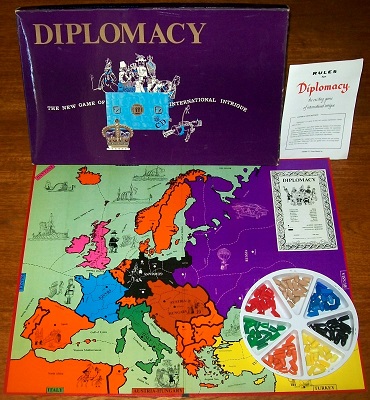
The Game is called Diplomacy and demands 4 to seven players and more time than sense. It's a very simple game which involves a large map of pre 1914 Europe - essentially a Europe of empires. The only random factor in the game is who gets which country. 

Each player is given two armies and a navy except Russia which is given an extra piece, and Britain which is given two navies and an army.

Each player is allowed a Spring and Autumn manoeuvre, which simply involves writing down which adjacent province or sea your piece is going to move to. The aim is to land on a vacant city of a neutral country, and if you retain it over the two seasons you to gain an extra army or navy --- and so on---and so on.  Now this in itself seems remarkably boring, childishly simple but I have seen marrages strained and staffrooms split in opposing camps, each accusing the other of lies and betrayal.  

Why? 

Because before each move you make secret but 'sincere' alliances with one or two of the other players in the game. For example if German moves westwards, France will obvious seek an alliance with Russia. The whole thrust and momentum of the game is either fooling or being fooled in the matter of who promises what; negotiations, firm but secretive handshakes, followed by inevitable betrayal.  

The beauty of the game is how closely it matches the European flashpoints of the Edwardian era. Austria, Russia and Turkey both seek the Balkans, Italy will ally with anyone to stop France, Turkey or Austria from dominating the Mediterranean. Britain, Germany and France seek to control Holland and Belgium. But then France is also tempted by neutral Spain, Africa, the Mediterranean.... Can it trust Germany not to attack it from the North?  Britain and Russia seek to dominate Scandinavia. Germany feels surrounded!  Alliances are everything and so too double dealing and treachery. So much to promise. So much to gain.

It is only when the written orders are read out that you find who has betrayed who. Some alliances are unexpectedly built on rock, others on sand, and empires and relationships founder on the basis of promises not kept.

This then was the context of the Head of Biology bursting into my lesson with urgent whispers that a British - German attack on Russia would prove overwhelming. He didn't know that only an hour before, the Head of English had slipped into my Year 2 lesson on the Angevin Empire urging me to attack Germany. I think I said yes to the two of them. 

We were all grown men, professionals who had become so addicted to Diplomacy (the board was hidden in the Janitor's cupboard) that it began to take precedence over everything else. My firm conviction is that a bit of lunacy is absolutely essential in teaching, but they don't tell you that in College. 

PS The game is also a wonderful adjunct to teaching Modern European History.

Thursday, 8 October 2009

Tamagotchi

Greg Thomas reminded me of a boy we both taught, Darren Jones. Young Darren got very excited over the fact that he wasn’t yet old enough to vote. He thumped the desk, his voice resounding through the classroom. ‘It’s a disgrace, a disgrace I tell you, an infringement on our human rights. Thirteen year olds should be allowed to vote! We have rights!’ He got more and more excited. Out of curiosity and perhaps to calm him down, Greg asked him who he would vote for if he was given the right. ‘I wouldn’t vote for any one of them. Bunch of crooks, that's what they are.’

We talked of others we remembered: Jack Hobbs who walked the corridors looking morose, sometimes ecstatic, but always puzzled. Occasionally he would leave the classroom to smoke his pipe, and towards the end of his teaching career, if rumors are true, had to guided into his coat and gently pushed out the door by a loving family who understood his reluctance to go. My favorite memory is bumping into him on only the second day of a new school term.

“Don’t you find term’s beginning to drag, Mike? I do.”

We talked of the short-lived but intense Tamagotchi craze, and the mayhem it caused in the classroom as kids who had never fed a dog before became enslaved to their new digital pets. They had to be watered and fed, played with on a regular basis. Failure meant death or starvation in less than half a day. These were not wholesome or healthy pets. These were digital divas and kids found themselves enslaved.

The school responded slowly at first, insisting that each of these egg-shaped monsters had to be handed into the Office at the start of the day. The problem was merely transferred as office staff became embroiled in the digital will to survive.

Typing would be punctuated by urgent but surreptitious sessions of feeding and playing, none of the women willing to confront a tearful child at the end of the day with the news that their pet had been translated into greater glory. In a Catholic school one wondered whether there was a digital heaven and hell, but there was most certainly a digital god. Its name was Tamagotchi and before him all bowed.

This was the school I was soon to leave - a year in America. My ship had come in.

Monday, 13 April 2009

Juggling Children


The founding Head Teacher of the school was Joe Witherinqton, a red faced Yorkshire man who hid a warm spirit behind a stern, uncompromising exterior. He surrounded himself with a praetorian guard of the academic - and Northerners. This was at one time a striking feature of the school. When you consider it was a Welsh school, the amount of Northern accents about the place was quite frankly bizarre: a bit like a school in Boston staffed by Texans, I guess.

Also bizarre was the record of work. Each member of staff had a large green diary in which you had to write the objective and method of each lesson in a two inch square. Every week these were collected by Joe and signed, sometimes with a comment.

Neil Campbell, not a northerner, more excitable, taught science in a wooden cabin where the less able children had their science lessons. One week – Friday, Period 3 – he wrote ‘Einstein’s Theory of Relativity’. On Monday he got it back signed. The following Friday he wrote ‘Einstein’s Theory of Relativity – Practical Demonstration.’ This was also signed, which shows that Joe didn’t always read what he signed, or like all good teachers tolerated the eccentric.

And he did tolerate the eccentric. There was Mike McGowan who dressed as an Arab sheik, and who later had the good sense to leave teaching for the more fulfilling job of driving trucks, JB Blisset who looked like an anaemic Charles 1st and spoke in a worry-some bleat. Another man who only spoke one word in his lessons: Quiet…Quiet…Quiet. It was said in the strained, desperate tone of a Dalek who couldn’t pronounce exterminate.

And despite all this Joe Witherinqton ran an ideologically contentious but well managed school. It was a true comprehensive. Being the only Catholic school for miles it attracted every kind of child from every kind of family, and these Joe rigorously streamed. The academic, irrespective of money or class enjoyed a ‘private school’ education that allowed many to escape their roots. As a result the middle class and those wealthy enough to send their children to Private School but preferred not to waste their money, sent their children to St. Joes. The Middle streams did okay too.

The casualties were the non academic who – even with the best of teachers – saw themselves as the bottom of the heap, and behaved accordingly.

Problem was, when the system changed to loose banding and mixed ability a lot of the highly academic went elsewhere. Juggling is difficult. Juggling children, interesting - especially when they're not your own - but hard to keep in the air for any length of time.

Parents always put their own children first, and schools, like oil tankers, take some time to turn around.

Thursday, 2 April 2009

Staff-room ghosts Part One

'I told you we should have tunnelled.'


“I think she’s a witch. You can see it in her eyes.” So spoke an otherwise jolly, cheroot smoking magistrate. She was referring to Pauline Broadway, who was not a witch but a strong minded free spirit who had little time for fools. Both were colleagues, one teaching Domestic Science, the other Embroidery, later called Textile Art.

But a warning: This post will be of no interest except to ghost-hunters or the inhabitants of those houses now occupying where St. Joseph’s once stood. I calculate that the staff room – a large rectangular space in green carpet tiles – now cuts across several bedrooms, bathrooms and various en-suites. If vaporous figures disturb their sleep, an occasional ghostly bell, they have only themselves to blame for buying a house on the site of a demolished school.

The earth holds its treasures in fine discrete layers, so does a school, heavy in gossip and spite, endeavour and sacrifice, joy, bullying, and great swathes of stupidity.

The staff-room was divided into ‘islands’, made from tables and surrounding chairs. At one end sat the Maths Department, and various Heads of Year. The air there was sharp in smoke and difficult to breathe. It was however near the kettle and the toilets.

At the other end of the room sat Pat Thomas, a benign French Teacher who headed up the Language Department. She wore her hair in a substantial pig-tail, strong enough to decapitate a man with one swing of her head. It was a friendly department, all mildly eccentric, and all of them women, with the exception of the Latin teacher, Frank King, a gentle, academic man with a high polished head and gold glasses. When he died of brain cancer he was replaced by - yes - a woman, Margaret Lloyd, fierce, strong minded, and perhaps the most eccentric of all. In time another man did appear in the language department, Anthony Wilkinson. He didn’t die, but went off to Peru.

Facing the Language Department, to their right, sat the R.E Department headed by Bill Glynn, an ethereal, tweed-suited figure who fought to keep Religious Education an academic subject. If you wanted a seat, this was the ‘island’ to head for. People didn’t want to be seen as ‘God-botherers’ I suppose. As a result it was a very peaceful corner, much to the chagrin of several in that department.

I sat/stood midway down with my back to the time-table, my bum on a radiator. In winter you could smell burnt trouser and lightly cooked thigh. But it was from there you could glare at the Deputy Head as he added your name to the cover list, not that it did much good.

Adjacent to the Time-table and midway down the room, was the final ‘island,’ the largest, least heterogeneous and most radical. There the Remedial Department sat, dominated at one time by Jean Lewis, Pat Ahern and Barbara Prendergast; these melded with younger members of the English Department; but the Head of English, Maggie Kreuser kept her distance. She was a ‘Jean Brodie’ figure, perhaps more sexy, quite academic and who enjoyed hard-boiled crime novels. She focused on Shakespeare and the Sixth Form and had little time for the good-natured radicalism of those who taught the least able children in the school.

Any one of them, including me, could one day be sitting in your bathroom, ethereal presences but for the most part benign.

Friday, 27 March 2009

And so it goes


The Welsh Office gave the school a grant that could only be spent on a work of art. Eventually they settled on this, a monument that dominated the front of the school. The artist attended several assemblies explaining the concept, and of how, at certain times of the year, the sun would erupt from the monument's tip. 'Like bloody sperm' somebody muttered - a remark close to the truth. St Joseph's must have been the only catholic school in the world with a giant phallus guarding its entrance. This picture doesn't show it in all it's glory, but what we had was a slender stone spire with a central slit, and at its base two brick rings resembling testicles - oh, and every so often the sun erupting from its top.


Buildings have a habit of falling down after I’ve left them. The Junior Boys school was one, morphing first into a social club where I had the immensely sad experience of pissing in a classroom turned urinal. I think it may have been where Robert Chard once sat. A year or two later it was demolished more thoroughly.

St Josephs, a purpose built comprehensive suffered much the same fate. It epitomised 1970’s ‘cheap-build’ – a series of glass and aluminium blocks loosely linked with aerial corridors. Freezing in winter; in summer hot enough to grow peyote. Now that would have been a good idea.

It must have been chilling for those under Stalin who fell out of favour, and – if they lived long enough – found themselves written out of history, erased from photos, walking ghosts.

It’s much the same feeling when a building is erased in a moment. For neighbours it may have been just a landmark, a piece of street furniture. For those who worked there, something greater is lost but it is hard to put into words. All you have left is memories - the worm without its apple.

I think of the sweat and toil, anger, frustration, friendship, achievement, and joy. I think of countless assemblies, my back anchored to the same piece of wall, the never ending homilies that sometimes had a point, the badly sung hymns, and kids – faces I can never forget.

Everything is gone, even the ‘monument’ built in the style of a giant penis.

The new St. Joseph’s built less than a mile away is a more modern affair but lacks the windswept spaces and the gothic, unkempt grandeur of a building falling around you.

In its place stand some modern houses built too close together.

Friday, 20 March 2009

The Krogers and Dave Thomas - who was not a Russian Spy

“If I had to choose between betraying my country and betraying my friend, I hope I should have the guts to betray my country.” So wrote E. M. Forster and that is the heart of Hugh Whitmore’s Play – ‘Pack of Lies’.

The play is set in a London suburb and is based on something that happened in 1960. Bill and Ruth Search allowed their home to become involved in state security. From it M15 began monitoring the activities of their neighbors and good friends, Peter and Helen Kroger. They are told that the Krogers are in fact Russian spies.

From that moment Bill and Ruth Search are confronted with the choice of betraying their country or their friends. The play raises questions like whether an individual can be an ‘enemy of the state’ and at the same time remain a good person. For Ruth Search, who had established a very strong friendship with Helen Kroger, the strain becomes almost too much to bear as trust is destroyed by lies. Mind you, having to maintain a ‘normal’ conversation with a suspected Russian spy who unexpectedly calls in for a cup of sugar and a chat whilst policemen are eavesdropping in your toilet - enough to strain anybody.

I did face something similar on a much smaller scale and without policement in my toilet. I suspect many of us have, in one way or another.

Dave Thomas was an Oxford graduate, a gifted teacher, but one who cultivated a louche persona. He was also a friend, a gifted drinking partner when not in the classroom. Towards the end of the academic year, Mike Barry informed me that Dave’s contract was not to be renewed for the following year, but not to say anything for fear it might cause unpleasantness in the intervening months.

I rationalized it as best I could: Even if I told Dave he could do nothing about it, and the whole thing would sour his last two months to no good effect. Even as I rehearsed the argument so it became almost convincing, I was uneasily aware of less worthy reasons. If I told Dave, Mike Barry would know it had come from me. The choice was pragmatic. Dave was understandably bitter when he found out I’d known all along, and a friendship was lost.

As you get older bad memories like these emerge, like small islands, in the great flood of events, so if Dave Thomas ever googles his name in a spasm of narcissism or boredom, then here’s my apology. I’m sorry. (Dear me, a Gordon Brown moment)

Friday, 13 March 2009

Kojak and Kitty Fisher


Lucy Locket lost her pocket,
Kitty Fisher found it;
Not a penny was there in it,
Only ribbon 'round it.
(The tune for Lucy Locket was later used as the basis for Yankee Doodle. For more about Lucy Locket, see below - and eat your heart out Dr. Seuss.
)


The 1970’s was a decade of certainty. Dirty Harry was certain. So was Kojak. So was St. Joseph’s policy on school uniform. I’ll never forget a shy black girl with a lovely smile. Her clothes were sometimes shabby, and she sat near the back of the class. One day she came in resplendent, like a young lioness, her hair braided in multi-coloured beads. She looked six foot tall. She looked great.

All hell broke loose. This was not school uniform. School uniform was a dark jacket and a tie striped navy and pale blue, and…well…unremarkable hair. She was brought before her Head of Year and the law was laid down: the beads had to go.

And then in a weirdly triumphant spirit of compromise and fudge, the Assistant Head of Year came up with a - solution. She was so pleased with herself. The girl could return to school the following day, but the beads would have to reflect school uniform, beaded alternatively navy and pale blue.

Our new Head of Department, was someone else possessed of certainty. He dragged us kicking and screaming into the turgid wilderness of social and economic history, turnips and steam-engines. Other than that he was merry, almost bouncy, though not always careful with nicknames. One of our pupils, Catherine Fisher, he took great delight in calling ‘Kitty Fisher’ which she took in amused resignation. It was innocent word-play on Mike’s part. He knew who ‘Kitty Fisher’ was but probably not in great detail. (see below)

Catherine Fisher was a dreamy-eyed student who I didn’t inspire but from whom I learnt one of life’s great lessons. Yes, I too, was possessed by that dreadful sin of certainty – seeing her only in terms of how good or bad she was in ‘History’ and seeing nothing else. Catherine Fisher has since become one the finest YA novelists in the country. Her writing is lyrical - didn’t get that from turnips and steam-engines – and I ended up learning far more from her than she ever learnt from me.


Lucy Locket was a barmaid at the Cock, in Fleet Street, London, sometime in the 1700s. Lucy discarded one of her lovers (her 'pocket') when she had run through all his money. Kitty Fisher, a noted courtesan, took up with him, even though he had no money. It also taunts Lucy Locket because a "pocket" was what prostitutes kept their money in and would tie to their thigh with a ribbon.


When he visited London in 1763, Giacomo Casanova met Fisher and wrote:
... the illustrious Kitty Fisher, who was just beginning to be fashionable. She was magnificently dressed, and it is no exaggeration to say that she had on diamonds worth five hundred thousand francs. Goudar told me that if I liked I might have her then and there for ten guineas. I did not care to do so, however, for, though charming, she could only speak English, and I liked to have all my senses, including that of hearing, gratified. When she had gone, Mrs Wells told us that Kitty had eaten a bank-note for a thousand guineas, on a slice of bread and butter, that very day.[3] The note was a present from Sir Akins, brother of the fair Mrs Pitt. I do not know whether the bank thanked Kitty for the present she had made it.

Saturday, 7 March 2009

Peter Morgan Part 2

The pattern was rarely broken: three pints in the Albert after school – four on a Friday when I did my shopping and bought all manner of interesting things. The Albert served the finest Bass in Newport, the quality only diminishing when they changed the vats in the brewery sometime in the late seventies. We sat in the back room, surrounded by oak-paneled walls and small, round tables that looked like islands depending on how much you'd had to drink. And we talked some very important stuff, none of which I can remember now.

Two others sat with us, Merv, sharp eyes peering through spectacles, an opinion on everything, and now almost certainly dead, Mike, a shy hairdresser who looked like a boxer, and - holding court - Peter Morgan. Then, he had a sleek porcine appearance, jet black hair and neat mustache; ruddy faced, with blue hard-boiled eyes that stared at you from gold rimmed glasses. His lips were usually pursed, waiting for the cigarette held some distance from his face. He held a cigarette like Lauren Bacall.

Things changed. The Albert closed down and we moved to Conti’s (now also closed down) in Skinner Street. Damn it. I can’t remember the beer, I think it was Bass. I can remember Peter sitting between my brother and a very drunk Glaswegian, and trying to understand the conversation going on over his head. With the catarrhal consonants of Scouse, and the rapid guttural of the Glaswegian bouncing across him, Peter sat bemused and wreathed in blue smoke.

And then disaster struck. Peter fell in love. Now he and Aileen held court together, sitting on high bar stools, surveying the world. It should have been good – especially the birth of a daughter. Only two things conspired against him.
Drink is a dangerous friend. Even more dangerous are those anal Catholics who confuse rectitude with intelligence and compassion, the kind that make Pharisees look good.

Peter was a ‘divorcee’ – acceptable just so long as he didn’t marry again – not at least if he wished to retain his job in a Catholic School. This ironically did not apply to non-catholic staff. Peter was more than willing to give up his pastoral role as Head of Year but the millstones were grinding…Peter had to go.

The process was brutal and he began drinking more heavily than ever – especially when he was given a ‘non-job’ in Hartridge, a neighboring comprehensive. Soon after that his marriage broke up.

A fortnight after I’d bumped into him, holding my sweet-jar, he was dead.
Pete Morgan had loved St Josephs but it was one divorce too many.
The one lesson I learnt was to deal with institutions rather like you would dine with the devil thought perhaps with a longer spoon.

Friday, 6 March 2009

Peter Morgan Part I

The last time I saw Peter Morgan was a week before Christmas outside Lloyds Bank. I was carrying a 5lb jar of sweets, a stocking-filler for my wife. (Big stockings) and Peter, immaculate in brown shoes, sharply creased trousers and sheepskin jacket was on his way to a pub. We spoke a few minutes, his eyes watering in a cold east wind. It was the last time I saw him.

The first time I saw him I never realized how good a friend he would be, never suspected that I would remember him years after his death.

After the summer break three schools were merging into a purpose built comprehensive in Tredegar Park. Pete Morgan would be my Head of Department. I’d heard he drank in the Albert and determined to introduce myself to him over a pint. It was not an easy encounter.

He looked up from his beer, face wreathed in blue smoke, his eyes hard in an arrogant stare that said quite plainly ‘who the fuck are you’. He still wasn’t impressed when I told him.

Then, Peter Morgan was at his prime, a hard drinking bull-shitter who loved his subject (history) and lived for those he taught, (along with rugby and beer). I still remember the names of his favourite pupils – Paul…(Okay, so I can’t remember his last name) Liz Smitheringale, Mike Panting, Debbie Waters… There were more but the list would be too long.

I remember how he rescued me from a hot-tempered remark I made to girl from Pill, a rough end of town, and smoothed things over. The one piece of advice he gave, worth more than a year of teaching practice, was ‘Sell yourself, and you sell your subject’. Common sense really, but it had to be said.

There were many who disliked Pete Morgan; some found him crude, brutal with the truth; he prided himself on being a hard man. He was in fact a vulnerable man, divorced, cut off from his children, his world resting on work, friends and Welsh Rugby.

Drink was part of the mix. It was the essential lubricant of teaching, more important than chalk. If you see old episodes of The Sweeney, or the more recent ‘Life on Mars’ you’re not just watching the police force in action but much of the teaching profession.

The ethos was similar in many respects, a care for the good guy, cheerful brutality towards the bad, the grey, or those that didn’t toe the line - or couldn’t find it. Competence, commitment, professionalism, none of these things were worn on the sleeve or displayed in certificates. It was part of the package along with the confidence you were doing something important.

Pete Morgan was in his milieu but then the seventies ended.

Thursday, 12 February 2009

Jabberwocky


This was my very first Form. And my apologies to those whose names lurk in my mind but refuse to surface.
<From the back, Brendan Dowd, ?, ?,?, Anthony Woodley,?,?,Brian Fahey, Mark ?, Andrew Humphries, Russell Baldwin, ?,Chris Norville,
Middle row ?, ?, Brian Sims, Me, Kevin Obrien, ? ? Paul Tutton,
Front row Mark Walton, Mark Young, ?,? David Saunders, Stephen Batt, Gary Bird, Joey Mulchahy, Mark Madden. I love the Bash St. quality to this photo, and my expression -like what am I doing here?
The school can be seen here


St Joseph’s Junior High School for boys or Father Hill’s as it was more commonly known was the perfect school for someone who hadn’t the faintest idea what he was doing. The previous History Teacher, John Davies, made my life easy by having blue laminated handwritten history cards (with pictures) which the boys copied out or answered questions from. The entire Year 7 and Year 8 syllabus was there. All I had to do was tell a good story and make sure the cards were filed away in the right order, in the right cardboard box.

The school was subject to the benign and enlightened despotism of Bernard Dunne who, as long as order was maintained and the boys were enjoying themselves, left you pretty much alone, though he was always there if you needed help.

The Christmas term ended with a film hired by Alan Kethro and shown in the largest classroom where everyone somehow managed to squeeze in – much like the staffroom which was about the size of a large shoe-box and where you sat in each other’s pocket.

There was also a Christmas concert where I was inveigled into being ‘Uncle Bulgaria’. Someone, Peter Williams I think, had acquired genuine costumes, and four of us dressed up as Wombles and mimed to ‘Wombling Free’. For the nostalgic, or those of an adventurous disposition you can hear it here.


The school had a certain cavalier attitude towards Health and Safety, though the dinners were good. On one occasion I was teaching an English class the joys of Jabberwocky. Unfortunately no one told me, or the class, that on this day four windows were being replaced in the classroom and no other classroom was available to us. Moreover it was raining hard outside.

It was pure but dangerous magic, largely because it was the Seventies, a dumb but happy decade.

Twas brillig, and the slithy toves Crash! A pane splintered. Glass on the desk.
Did gyre and gimble in the wabe, Crash! Crash! More glass.
A shard of glass pirouetted across the room.
Beware the Jabberwock, my son!
The jaws that bite, the claws that catch.

And there I stood ‘in uffish thought’ thinking ‘God, haven’t they finished yet’ as another sliver of glass ‘came whiffling through the Tulgey wood’ and went ‘snicker snack’ on the floor.

The boys, stoic to the end finished the poem, occasionally ducking, but keeping rhythm. Then the men stopped. They hadn’t brought the replacement panes, and they’d heard the poem before so they went and left us in a classroom with four windows open to the elements and a small gale blowing outside.

We roared the final verse:
"And hast thou slain the Jabberwock?
Come to my arms, my beamish boy!
O frabjous day! Callooh! Callay!"
He chortled in his joy.


The Junior boys was a happy school, but all good things come to an end. A new purpose built Comprehensive – St Joseph’s at Tredegar Park had just been built, and there three schools would be combined.

A month or two before hand Sister Pauline, the new Deputy Headmistress came down to the boy’s school to fit pegs into holes, round or square, or any damn shape at all - as the Timetable dictated.

This worried me. I was a History Graduate – happy enough to teach some English, but who taught Religious Education through gritted teeth. There was little choice in a small boys’ school where there wasn’t enough History to go round. What I dreaded was being lumbered with it permanently as a timetable convenience.

Sister Pauline was (hopefully still is) a lovely woman. She solicited my views on Religious Education and I enthused on the Old Testament, Jezebel, Baal, child sacrifice and the insatiable appetite of Moloch. ‘The boys really appreciate the historical background,’ I finished. And I watched her eyes glaze and knew that whatever else I did, I wouldn’t be teaching Religion in St. Josephs.

Wednesday, 31 December 2008

St Josephs Junior High School for Boys

So many things I missed about Swansea:

Richard Skinner who didn’t know you needed water to boil an egg but got a First in Russian, learnt Welsh on principle, went on to teach English in Sweden and became a doctor in Sweden through the medium of Swedish. Mercifully he regarded my more puny wit with amusement and a degree of benevolent tolerance, even though I was the one who taught him how to boil an egg.

Richard and Ruth Lewis who showed me that life could be comfortable and introduced me to Newport, a pint of Stella at the Green-man on the outskirts of Cwmbran followed by Sunday dinner, and, sometime later tea, with Paul Murphy, a future Secretary of State.

Peter Lloyd, now a script-writer, then an academic pursuing a PhD in Tudor History. I know he introduced me to Edward Hall’s Chronicle and a phrase that has lodged itself indelibly into my head. ‘History is the sucking serpent of ancient fame.’ Though, if you don’t have fame to begin with, you’re unlikely to be bothered by sucking serpents. Maybe the odd slow-worm.

Nick and Ness who showed me how rich life could be in a damp labourer’s cottage and later a caravan.

And last, but not least, Swansea University’s Refectory, its lamb curry, and spaghetti bolognaise. I sometimes dream about them at night and wake up hungry.

When you leave university it’s very much like jumping off from a fast moving merry-go-round. If you’re lucky you remain standing but most definitely disorientated. Certainty evaporates.

All I was certain of was an urgent desire to live in or near Swansea. Fate buggered things up a little.

A half-hearted application for a teaching post in Newport met with a polite rejection, until, a week later, the young woman who’d got the job discovered she was pregnant and withdrew. A polite rejection letter was followed by a swift request – we want to see you.

And so, despite mistaking the Head Teacher for the caretaker, and speaking with a still thick Liverpool accent, I got the job.

I’ve always been lucky in loving the places I find myself in. Aberystwyth was perhaps an exception, though the perpetual rain, a knife-wielding psycho, and a teaching course that bored me silly might have had something to do with that. But now I was in Newport, a vital, seedy place with its own dark magic. It suited me down to the ground.


The elegant hippy to the left is me. How on earth did I get this job?
To my right are: Alan Hicks, Mike Farley, Alan Kethro, Andy Phipps, Peter Williams, Mr Norville, (the real caretaker)and Danny Flynn, someone else with a Liverpool accent. Front row are: Mrs Oakley, (known as Annie) Judith and Judith (forgive me). The man sitting in the middle is Bernard Dunne, (Head teacher, not the caretaker,) Gerry Drewett, Paddy Landers and Mia Richards. Behind us is the school, now demolished; and behind that is the famous Newport Transporter Bridge, not yet demolished, hopefully never.