Friday, 19 December 2014

Drogo Castle


 On a Sunday in Allington “One walked over the brass plates of dead Dales in the village Church.” Roger Carbury is Carbury of Carbury parish, Ralph Newton heir to Newton Priory within the bounds of Newton Peels, and the Greshams are Greshams of Greshambury. These are fictional portrayals of a real world and found in the pages of Anthony Trollope.
For Trollope a hierarchal society was humanised by mutual duty and respect and found its purest expression in the countryside, in particular the landed estate.
The most direct relationships were those existing between master and servant and Trollope delighted in the mutual loyalties encouraged by custom and tradition. Squire Vavasour has an old butler who is so rheumatic the rest of the household now care for him. Roger Carbury’s butler had never lived anywhere else. And for Hopkins the gardener the nooks and crannies of his master, Squire Dale, are as well known to him as those of the apple trees he has nurtured for over forty years.
In contrast to my previous post, which focused on decadence and froth, Trollope’s world was very much in the Downton tradition, or should that be the other way round. What is significant however is that this was a very real world. Trollope was an acute and sensitive observer of Victorian landed society and how it changed over forty years.
I was reminded of this when we visited Castle Drogo a month or two back. The name enchanted me, its location, too: Dartmoor, Game of Thrones country. The reality was almost as weird and, initially, disappointing. Not only was this a castle built to order by a rich tea magnate in late Edwardian England, it was in such a state of disrepair it was covered in Perspex as builders strove to restore it – something less than a hundred years old.


 Julius Drewe, a man contented with life, as well he should.

Julius Drew made so much money from tea imports and his incredibly successful grocery chain ‘Home and Colonial’ he was able to retire at just thirty three and spend the rest of his life hunting, fishing and looking after a wife and five children. What he aspired to however was to be a country gentleman – a country gentleman that could fit happily within the pages of Trollope. He added an ‘E’ to his surname to reinforce a spurious link to the noted Elizabethan Devon family - Drewe. And he built a granite fortress, designed by an initially reluctant Sir Edward Lutyens. Lutyens may have been persuaded by £60,000 to play with – in today’s money £30 -40 million. 
On one level you might see Julius Drewe as a man with more money than sense, but dig beneath the surface and you quickly detect a warm and generous spirit. His workmen were treated kindly and with the utmost consideration. His wife (Frances Drewe, nee Richardson) personally vetted the plans for the kitchen, making sure it was well lit by a glass domed roof, and spacious enough for the staff.


Castle Drogo was started in 1911, but the family were only able to inhabit it in 1925, and it wasn’t completely finished until 1930. A year later Julius Drewe died.  During 1939–45, Frances and her daughter Mary ran the house as a home for babies made homeless during the blitz. One of the mothers ran back to London in disgust with the lack of shops on Dartmoor.

For any who doubt Trollope’s world or even that Downton Abbey existed in different forms, read this short extract from the WadhurstHistorical Society. This was a self made man revelling in and continuing a Trollopian tradition. The link to the whole article follows it. 

 For those who don't want to read on but would like some idea of the setting, here be pictures. Article and link follow. And this will be my last blog post until the New Year. I hope you all have a really happy Christmas.


This table had electric fittings so that electric candles could be discreetly inserted in place.


A purpose built and designed work table for kitchen staff - positioned under the glass domed roof.


"Life there seems to have been blissfully happy. Frances (a daughter)  has given an account of her childhood, which reads like a fairytale; the sweet, kind parents with their five children, surrounded by friendly, devoted servants in the most comfortable and beautiful setting. She mentions many of the servants by name: Mr Waite, the butler, with his marvellous mutton-chop whiskers and his wife who made dresses; Mrs Stacey, the housekeeper, busy by the sewing machine in her work room; Mrs Chandler, the cook, who was chef-trained; the much-loved nanny Bernie Rickwood, nicknamed Bop; the second nanny Mary Jane Sharpe and the nursery maid Eliza Winch, who lived with her parents in Stream Cottages by the Miners Arms. Eliza’s husband worked in the kitchen garden. Her father prepared kindling wood in the cellar of Wadhurst Hall. There were White, the estate carpenter; Barnes, the sweeper of the front drive; Hutton and later on Grant, the coachmen; Mrs Bradshaw, the head laundress, married to the previous estate carpenter. There were the two drivers, Holter and Nethercot; Mr and Mrs Dunk - Mr Dunk nursing the Drewe boys when they got the measles, Mrs Dunk cooking for the unmarried men living in the Bothy. There was Mr Crawford at Scrag Oak, the estate agent, who every Christmas handed out turkeys and geese to the people working at Wadhurst Park. There were the under-keepers, Wickens and Everett; the latter reared the ducks at Doozes Farm. There was the charming Irish governess, Miss Jennie Griffith, known as Griff, and the Chaplain Leslie Stevenson at Sunset Lodge. He later became vicar of Wadhurst, then Canon and Dean of Waterford Cathedral. In the Entrance Lodge lived the Friend family, and at the Octagon Lodge by the back drive lived the Necklins. Mr Friend and Mr Necklin both served as night-watchmen.
"…..Morning prayers with all the staff were held in the dining-room. The family had many clergymen among their friends, Mr Drewe being the son of an evangelical clergyman himself. Sunday service was always in the Chapel; Mr Drewe taught Sunday-school to the senior boys, his daughter Mary to the smaller children. Elaborate Christmas tree parties were held in the riding school for all the people working on the estate, with heaps of presents and a huge tea to follow. !n the summer there were garden parties with pastoral plays and tea in marquees. There were shooting parties every Saturday during the season with enormous bags of ducks and pheasants, followed by tea in the hall, alternating with dinner parties with the children kneeling in the gallery to catch a glimpse of their beautiful mother going in to dinner. Occasionally balls took place in the huge Oakroom, where the orchestra sat comfortably playing in the ingle-nook. In the summer, lunches were served on the terrace with screens to keep out the draught and light shades to keep out the sun.


Friday, 12 December 2014

Not Behind Lace Curtains


I’m busy researching for a sequel to ‘The Gift’. It involves delving into the murky waters of the occult and sexual deviancy in the interwar years. Most would agree that homosexuality is not necessarily deviant – though it was then most certainly illegal. Most would agree that paedophilia is deviant and may not be legalised for some time. 

It was with this in mind I tracked down William Cross, author, researcher, and expert on Evan Morgan and the peculiar world he inhabited. A good two hours were spent in the wood panelled walls of the Murenger Inn. I drank more than he did and listened intently. 

William Cross is an exuberant man and his enthusiasm for the Morgans - Evan in particular - is infectious. He gave me two books: NotBehind Lace Curtains, and EvanFrederick Morgan: Viscount Tredegar: The Final Affairs: Financial and Carnal.
 In return, I promised to review them.

There are grammatical infelicities, and there is none of the gorgeous prose of a Macaulay or Gibbon. What you get instead is a potpourri of the decadent and seamy underbelly of the British aristocracy in the inter-war years. 

 
 The predatory and insatiable Evan Morgan, Peer of the Realm
 Reading the book is akin to pot holing with a strong torch and even stronger stomach, as the light bounces and plays upon misshapen stalagmites and strange, unwholesome fungi. They are books of rumour and gossip, and best of all a detailed and comprehensive index for you to check out the facts. These are books for those with Google and a craving to research more. 
 
 In the early C20th Eton was rife with what we would now call paedophilia. The picture above is that of the young Harold Macmillan, a future Prime Minister. The photo below is that of the Prince of Wales and his brother Prince George of Kent - known as PG to his friends and the police.
 
There were times when I felt like Alice in Wonderland, jumping from one tunnel to another. William Cross raises questions but provides few answers. He leaves them for you to work out as you follow the clues. It is probably a very wise strategy. The British Establishment is a master of the dark arts and suppression. Cover-ups are in its DNA. 


Robin Bryans wrote a series of books about the darker corners of the establishment, much of it malicious, much of it true. It may be coincidence that Robin Bryans’s books are now peculiarly hard to find. Then again, his most famous book, The Dust Never Settles - has been mysteriously removed from Scribd. Why? I’ve never heard of  digital books being remaindered before. 

So yes, it was a rewarding few pints in the Murenger. The books I’d recommend to any who like well researched gossip but who are prepared to go farther. 


Thursday, 4 December 2014

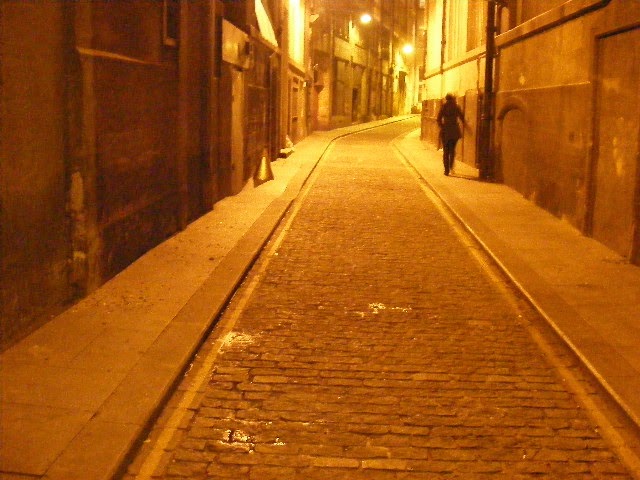
Ghosts walk the streets


Is it any wonder I like ghost stories. I grew up in a ghost-ridden town. Every corner, back lane and shadow suggested more than was seen. And if you grew up in the warrens of red-bricked terraces, in streets poorly lit and back allies not lit at all, your senses tingled in darkness and you ran for the safety of hearth and fire, and perhaps cheese and toast.


One of my favourite places is the Anglican Cathedral – the fifth largest in the world for those who like their statistics. It glows ochre in Irish Sea sunsets and broods over the city. At night, it comes into its own. 


 I mentioned in a previous post I studied in a pale blue Georgian building, an annexe to Liverpool Institute of Further Education. It was directly opposite the Cathedral on the corner of Duke Street. At lunch times I would walk with my first great love in the overgrown cemetery surrounding it. 

So much has changed and with it new ghosts. The last burial took place in July 1936 when the graveyard was declared officially full. The authorities waited until my back was turned and then they pounced. St James Cemetary was to be turned into a public garden, a more fitting setting for the fifth largest cathedral in the world. They cleared 90% of the gravestones in favour of a green, landscaped space. When I returned from University the job had been done.

Worse was to come.

The beautiful Georgian building, along with much else was also torn down to be replaced with a terrace of yuppie residences called Cathedral Gates. There are restless ghosts. You can sense them in the photographs. 


A little farther afield


By now, if you've looked carefully, you should have spotted one of the ghosts. A give away copy of Dark Fire to the first person to spot it.

The two last  photos are mine. The rest belong to the talented Ian Pendleton, Sharon Lewis and the equally talented and generous members of :

All these pictures have been taken from the talented and generous members of:
https://www.facebook.com/groups/friendsoforrellpark/
https://www.facebook.com/groups/waltononthehill/
https://www.facebook.com/groups/Liverpoolincolour/
https://www.facebook.com/groups/Photographsinliverpool/


Thursday, 27 November 2014

Rivers and ghosts


The Mersey broadly remains changeless


As does the sky


For much of the day


Seagulls do what seagulls do


And people stare as the Liverpool skyline slips in view.


And behind that skyline are streets and fine buildings.


Ghosts witness change more than those living it, and I always feel like a ghost when I come back to Liverpool. The streets remain broadly the same but everything has changed.
A case in point: Matthew Street:


And a club called the Cavern.


Ghosts caught in the present


Ordinary people in an extraordinary time.


All things must pass


If you look closely you can still see the remains of the cellar's arches.


                                                                      Now you can't


Tourists have taken their place


Friday, 21 November 2014

Earworms, maggots and bottoms


The word earworm is deservedly popular and refers to those tunes you just cannot get out of your head. One piece of advice is to hum God Save the Queen as a sure-fire antidote – like drinking from the opposite rim of a glass of cold water is a reputed fail-safe cure for hiccups. I’ve tried neither. 

There’s another word for the kind of tune that buzzes between the ears with no source of escape: Maggot. A seventeenth century word, perhaps older. It’s probably more accurate, too, because ‘worm’s are slow and tardy creatures. You’d probably have forgotten the tune before a worm had circuited your head. A maggot however turns into a fly that will buzz in your head until it drops from exhaustion. 

There are also visual maggots – one I cannot for the moment drive from my head. It’s KimKardashian’s bottom. And I don’t think singing God Save the Queen is going to have much effect.
 It’s everywhere, the meme of the moment, and peculiarly non-sexual. By that, I mean if Andy Wharhol had photographed and signed it – the image would probably fetch millions as art. And that’s how I see it – a product like Warhol’s soup tins, or four pictures of Marilyn. Soulless,(well that’s true of most bottoms,) a smart piece of design, and one firmly ensconsed in my head. 

Maybe, instead of singing God save the Queen I should try and intellectualise it – a sure kiss of death for almost everything.

 Maybe, in times of hardship and austerity, we are driven to the reassuringly large bottom – a kind of visual comfort food. That works for men perhaps, not too sure where it leaves women. Most men with fat bottoms are commonly called ‘lard-arse’.

 Nope, not working.

Carry on intellectualising. Is it a sin to objectify women or is it a recognition that women from prehistory have held men in thrall and awe? We objectify deities in stone and wood, limiting them in terms we can understand but nevertheless reflecting a need - here for example - the Kim Kardashian of its day.

Venus von Willendorf ; carved 24,000-22,000 BCE believed to have belonged to nomadic groups. Found near Willendorf, Austria and considered to be the earliest artistic form depicting the human body currently known to man
 Still not working. Kardashian remains. 

I remember when I was very much younger I had the same problem with Minoan women, where a different part of the anatomy was involved. That was easier to get over. You had to actively seek out Minoan art whereas Kim Kardashian is omnipresent, the Earth-mother of our day. Perhaps in time it will fade. I will give you progress reports. In the meantime I’ll pick out  Jack’s Maggot – a greedy and ruthless aural virus. It may mitigate the worst effects of Kardashian. And at least the dancers are dressed.

Thursday, 13 November 2014

A Spring Clean in November


The ultimate displacement activity: house cleaning – worse – the Spring Clean. Worse than that – a November Spring clean. Some of you will have already guessed it – yes - writing has hit a sticky patch. There is a hill of research to climb (to big to ignore) before I can go on. Nevertheless, I’m torn between the two competing impulses – to carry on writing, probably into a quagmire  – or stop and take stock. Research and think.

 I’d like to make this sound vaguely heroic using the metaphor of a traditional steppe torture:  tying the victim to two horses galloping in different directions. But in fact it’s pusillanimity squared, an indulgence, an effete quiver of the sensibilities. I could be in an office, down a coalmine - worse - teaching, or in Sierra Leone. And I’m worried about this? A module the size of a fridge has just landed on a comet 310 million miles away travelling 140,000 miles per hour. It puts my little hiccup into perspective.

But then, to be honest, I’m not worried. It’s a perfect excuse for a thorough spring clean, an approving wife and, biggest bonus of all Rock music in an empty house with volume right up to the ceiling. The house is shaking as I get to grips with duster and mops and various weird implements.

And, inadvertently, I’ve discovered the perfect play- list. No door or skirting board has been more vigorously washed than to the tune of Radar Love. Brushing proceeds at a frenzy to Hawkwind’s Silver Machine. Dusting demands the equally rhythmic but more delicate House of the king by Focus. Sweet Home Alabama is wonderful for toilets, The Sensational Alex Harvey Band’s Faithhealer - most excellent for windows. As the end approaches it’s one final strut to the kitchen to the strains of Tumbling Dice. I also hoovered the entire house but didn’t hear much with that. I think Rory Gallagher’s ‘Messing with the Kid’ was in there somewhere, but it doesn’t work with a Dyson - which is also rubbish for air guitar.

Now it’s back to the screen with an orange I’m finding hard to peel,  and a determination to write: a blog post. The sequal to The Gift can wait another day.