Friday, 16 July 2021

Rotten Boroughs or Rotten MPs

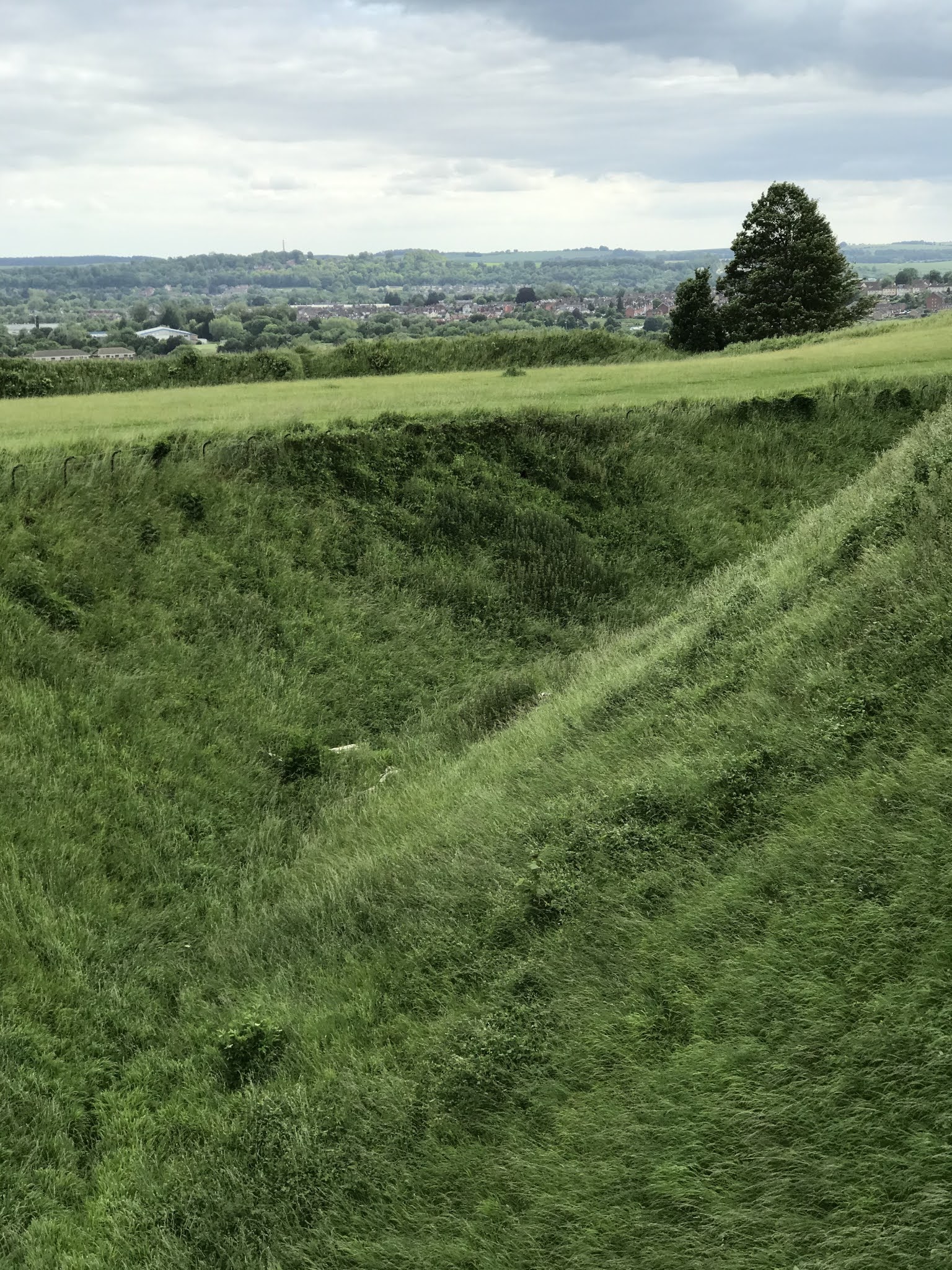
In the early C19th, Old Sarum was a long-deserted Saxon village. And yet, as late as 1832 it sent two MPs to Parliament. These two worthies represented a few fields and hundreds of sheep. 


What you see is what you get. Well, there's a little bit more but not much


The foundations of the original cathedral from the Castle Wall. Really very close.


It wasn’t always thus. The original village was situated at the junction of two important Roman roads and with its Iron Age hill fort was well defended against Viking raids.  The Normans built a castle there and later a cathedral. 


There's something so tactile about these old Norman walls. Up close you want to stroke them; a perfectly harmless past time. 


Although you may not want to stroke the walls below.


Hard to believe the castle was once a Royal Palace or that this was once a Royal Toilet. It couldn't be flushed with water; instead the waste fell into deep pits filled with straw and bark clippings. When the king was not in residence, someone would be lowered into the pit and dig out the contents ready for the next royal visit.  


In the C13th it was a prosperous borough and merited the two MPs it sent to Parliament. Old Sarum declined because of one man, Richard Poore, Bishop of Salisbury between 1215 and 1237. He wasn’t fond of Old Sarum, thought it squalid and blamed the exposed plain, its winds and rains for the rheumatism of his monks. He also detested the lord of Sarum castle as ‘an ungodly man who commanded a garrison of vile and rude soldiers.’ This town literally wasn’t big enough for the two of them.


Being a man of God, Richard gets a statue. The commander of the garrison being an ungodly man gets nothing, though I imagine him as Sean Bean or perhaps Ernest Borgnine


All that's left of the original cathedral.


 So, Richard Poore moved, taking the cathedral with him. Well, not literally. The new cathedral was built a bowshot away on the floodplain of three rivers. The  rivers made for easy transport of raw materials, and it was Richard Poore who was largely responsible for the layout of Salisbury as it is today. 


You can see the spire of the 'new' cathedral reputedly a bowshot away


The original settlement should have faded from history, but it didn’t. 


Fast forward to 1832 and Old Sarum remains in existence, a magnificent example of a rotten borough sending two MPs to Parliament even though no one officially lived there. Come election day, the forty or so electors were carted in, stayed overnight, and voted for the local landlord or highest bidder. 


Mind you, it wasn’t all bad. The old hill and its sheep elected William Pitt the elder (1708-1778, and his son William Pitt the younger (1759 - 1806) who between them ensured the world dominance of Britain and the decisive defeat of our only real  competitor, France. One might compare it favourably with our present electoral system which regularly provides moral grandees like Keith Vaz and Bob Roberts. Rotten Boroughs or rotten MPs. Take your choice. Irrespective of 'democracy' and the virtues of a represented hill, MPs tend to reflect their society

Friday, 9 July 2021

Some problems cry out to be fixed even by the terminally stupid.


One of the things I remember about America (and it is a generalisation) is that if there is a problem ‘fix it,’ which was in sharp contrast with a tendency on this side of the pond to ‘live with it.’ Both options have their merits and drawbacks, but two weeks ago I cracked having lived with this problem for almost two years. 


In 1982 I bought a then state-of-the-art High Fi. Technics with Kef speakers, and we lived happily together for many years. Five or six years ago, the sound became less hi fi and more hiss, and two years ago one of the speakers stopped altogether. As a result my once beloved Hi Fi gathered dust, I the philandering spouse lusting after strange women – in this case a Sonos Smart speaker and an Apple subscription. 


But what to do with my once prized possession, now gathering dust in the corner? Surely, I could fill the space with a small bookcase, sell the system and with the money buy a new Sonos speaker? 

I checked Sonos prices along with the rumour that they had limited lifespans in terms of necessary updates. I was good for five years at least, or so I was told—which didn’t impress. He also confirmed that though Sonos was good, the sound from a Kef speaker was far richer. Hmm. Had he heard my Kef speaker? I tried to remember when it had last sounded good. Next, I contacted a retail unit that dealt with second-hand Hi Fi. And my world came tumbling down. They were very, very sniffy. Didn’t want to know. 


What to do? I wasn’t going to give it away. The only option left was to fix it. I’m a mean-minded but impractical soul, logic kept at some distance. Still, needs must. Discover the source of the problem and work on from there. It seemed to me the problem lay either in the speaker or the amp. 


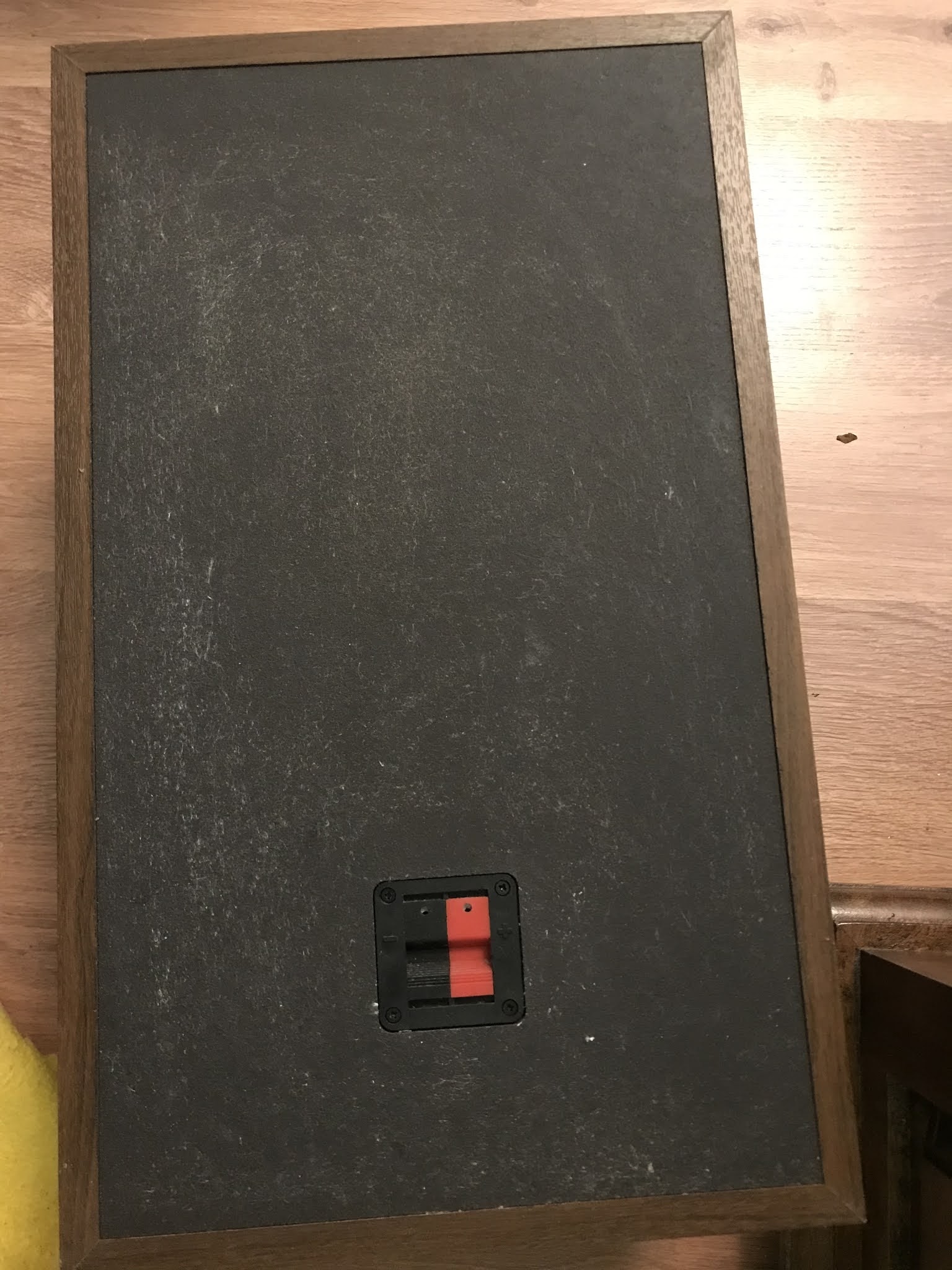
The naughty speaker minus wires.


And so, young Sherlock Holmes began his endeavours, swapping wires from one speaker to another—writing down the results—inconclusive. 


Sshh! Yes I know. They could do with some dusting.


Next, I attacked the amp, moving the two wires from the Speaker outlets to the two Auxiliary outlets. Again, nothing conclusive. Just a hiss and this time the other speaker not working. It was time to phone Hi Fi Western, the best retail Hi Fi in Newport. 

He listened and asked how long I had had the wires. 

Forty years, I said.

 There was a pause on the other end of the phone, which told me everything, including the fact I’m a fool

.

Suffice it to say, I have brand new far superior speaker wires and my system, like Lazarus, has risen from the dead. The sound is incredible. It’s like falling in love again. Some problems can be lived with, others cry out to be fixed.   

Friday, 2 July 2021

Some of my best friends are vegans


Earlier this week I was suspended by Twitter. The feelings were those of amusement, irritation. It was like being slapped by the damp hand of an elderly woman, and yes, I suppose, I was a little upset and surprised. Out of the blue I had become a rebel without a cause, minus the leather and bike, the naughty boy at the back of the class. Was this something to boast about, another item I didn’t expect to add to my bucket list? Was I now on a par with Nazis and Antifa? Part of the Orc deluge of hate and abuse you see daily on twitter?


Weird. With friends and family scattered across the world of all denominations and political hues – and every now and again trying to sell books—I go out of my way to avoid pointless squabbles.

I checked the tweet in question, a blog post, which you can see if you click on the link .


Nothing offensive there, I thought so I looked at the two options available to me. Accept my bad and recant—just a click of the button to delete the tweet—or appeal. The pressure was all one way; to appeal came with the warning it might take some time. The siren voice, recant. It reminded me of the benign authoritarianism of the late medieval church. The Inquisition has a bad rap but they too allowed heretics to recant to avoid a worse fate. In fact, the Inquisition was better in one respect. They engaged with the 'heretic,' explained where he/she had erred. 


I appealed, convinced I was the victim of a rogue algorithm. Two days later I  got this


As far as I can see, there are only three possibilities: 

1)    Twitter doesn’t understand the role of a question mark, irony or the point of a funny but harmless cartoon. Or maybe its confusing the question with the Australian/Californian inflexion where questions and statements become interchangeable.

2)    It has a beef against the Pope.

3)    It is offended by any criticism of the media, even from one mildly annoyed resident of Monmouth. 

One thing I don’t know is how these things work. Was it a rogue algorithm akin to those closely woven nets that catch fish they shouldn’t or had someone actually complained? If someone knows, please let me know. But then there's the fact that a moderator actually approved the algorithm or anonymous complaint, which leaves me dumbfounded.

I am annoyed even though it appears a relatively trivial thing. But harbingers by their nature appear trivial. 


I have recanted in order to tweet this. When I do I shall of course change the blog heading 'Hidden Agendas,' perhaps. I mean, nobody in their right minds would suggest killing vegans. 


Friday, 25 June 2021

The Black and White Trail


I’ve always been intrigued by the term 'Chocolate Box Art, not with regard to its origin; Richard Cadbury was the culprit. Son of the founder of Cadbury's chocolate he designed his chocolate boxes using his own paintings. The phrase then adopted a life of its own, coming to mean any painting critics labelled as kitsch.    

No, what puzzles me is its longevity as a phrase. Chocolate boxes haven't used scenic covers for years - you will find them on biscuit tins—but virus like the phrase has moved on from its original host and is currently residing in Herefordshire. 


Dilwyn

The Black and White Trail is a circular route, beginning and ending in Leominster and rivals the Cotswolds for picturesque villages. The term black and white comes from the manner of construction, ie timber frames from green oak, each beam cut to size were it was felled. The timber was numbered and assembled on-site. The space in between the frame was infilled with rubble or wattle and daub and whitewashed with limewash for added protection. The unseasoned oak eventually turned black with age, hence the black and white appearance of the houses. 


Dilwyn Green and main street.


On a fine summer’s day, we drove through Dilwyn, Weobly, Sarnesfield, Kinnersley, Eardisley, Kington, Lyonshall, Pembridge, and Eardisland. It was like driving back through the 1950s on empty roads and countryside bursting in green.


Weobley


Weobley is one of the best-preserved Tudor villages in the country and like Leominster, the ‘o’ is silent, so they are respectively pronounced Webbly and Lemster. (Just to confuse Americans and Scousers) The name comes from a Saxon chief ‘Wibba’ and ‘ley is a Saxon name for glade. So long ago, it would have been known as Wibba’s woodland clearing. It’s mentioned in the Domesday book as Wibelai held by an Eadwig Cild before it was granted to the Norman Roger de Lacy. South of Broad Street are the remains of a castle first recorded during the mid C12th civil war between Stephen and Matilda and, during a later civil war, Charles I stayed in the Unicorn Inn formerly sited on the corner of High Street and Hereford Street. 

A more permanent though less famous resident was James Tomkins. He had a cottage in the centre of the village. It was the C16th and he used his time wisely. Tomkins fathered 33 children by two wives and is remembered in verse

Babes thirty three did from two mothers spring,

To famous Tomkins, O, admired thing!

And may the loud resounding trump of fame, 

Proclaime great Tomkins for a man of men.

The two wives have left no comment. 


The Parish Church of St Peter and Paul. The building to the left was the rectory where Dorothy Wordsworth briefly drank tea. 


Yes, I'm a sucker for the peace of an English country church.


After Weobley, and having whipped through Sarnesfield*, Kinnersley, Eardisley, we were starving and needing liquid refreshment. Kington sounded a nice place to stop, but in this respect we were disappointed. Everything was shut or closing. 


Kington main street.


This soured things. It was all well and good being another village mentioned in the Domesday Book of 1086, all well and good being recorded as Chingtune from the old English Cyne Tun meaning royal manor and that the Normans built a castle on the high ground above the river and the town itself spread from its base. It was all very well that here lies the tomb of Sir Thomas and Lady Ellen Vaughan; that Thomas was known as Black Vaughan who died in the Battle of Banbury in 1469 and came back as the Black Dog of Hergest, the source of the Hounds of the Baskervilles. We cared not a fig. We eventually found food, in my case a cheese and pickle sandwich, and moved on. 


The last two villages are gems. First Pembridge built near a ford across the River Arrow—which supplied drinking water to the village. Drinking water wasn't put on tap until 1960.  Like the other villages on the black and white trail it predates the Domesday Book and was granted the right to hold fairs in 1239: the Cowslip Fair in May and the Woodcock Fair in November. Most of these timber framed houses date back to the C15th – Bishop Duppa’s Alms-house on Bridge Street being a C17th Johnny-come-lately 


Pembridge


As you walk from the car park


Full of interesting nooks and crannies


Main street.


Village shop


Bridge Street on the way to the river


                               The river Arrow which connects many of these villages


The parish church of St Mary has one of only seven detached Bell Towers in the county. Behind the church are traces of the castle owned by the powerful Mortimer family. When Edmund Mortimer died in 1435 the land was passed on to Richard Duke of York.


Bishop Duppa's alms-house on Bridge street. Zoom in on notice. 


Eardisland

The River Arrow


Eardisland was once a Bronze age settlement, later held by Morcar, the Saxon Earl of Northumberland, seized by William the Conqueror and given to Baron William de Braose  by the Conqueror’s son. It ended up in the hands of Richard Duke of York via marriage, forfeited to the crown and held briefly by Catherine of Aragon and her daughter Mary I.


We passed Parish volunteers  
weeding in silence on our way to the church


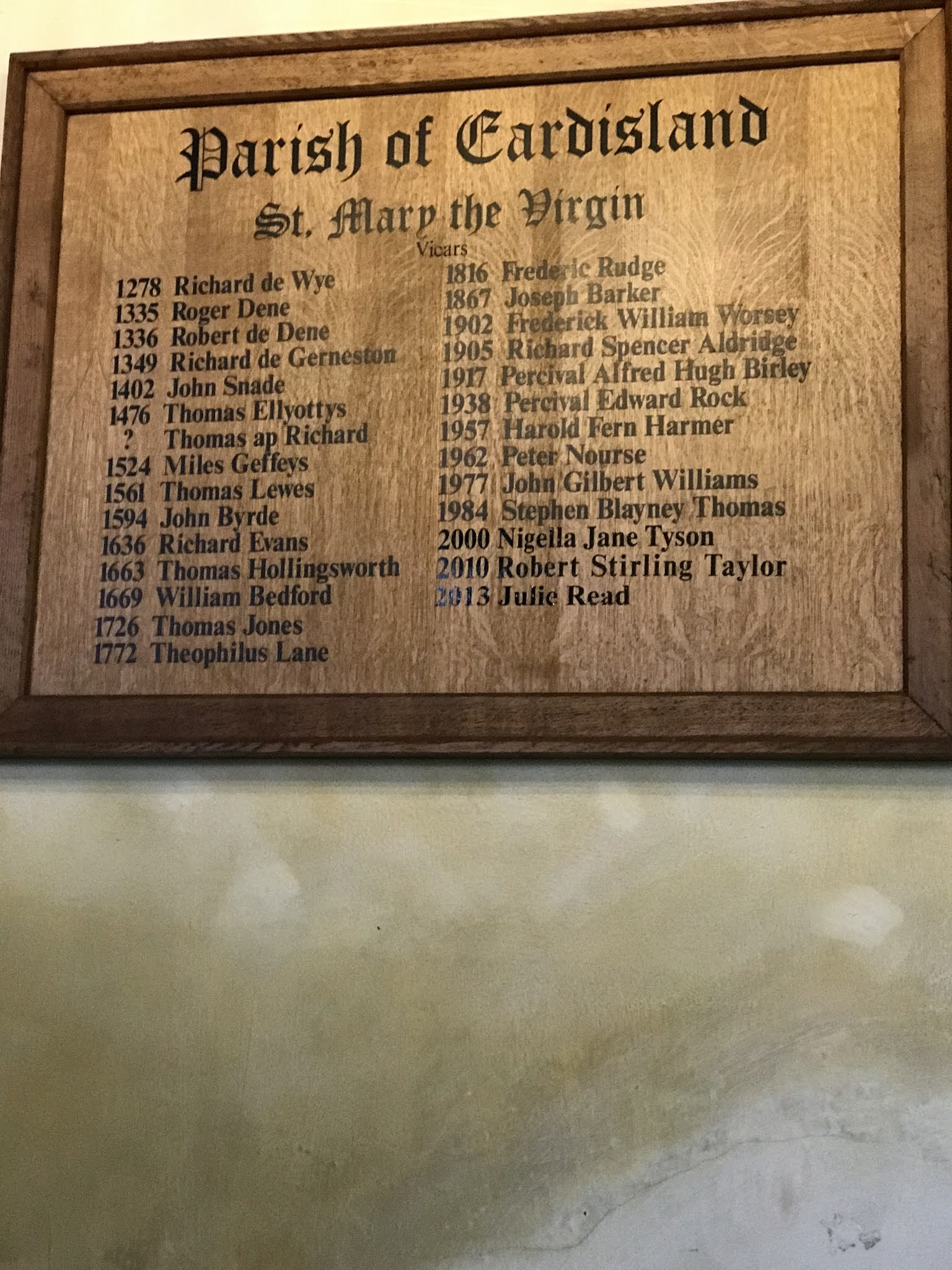
I was intrigued by the incumbent who obviously survived the turmoil of Henry VIII and beyond


Set farther back from the C13th Church is a moated motte, all that remains of a castle defending the land from the Welsh. Now visitors are provided with afternoon teas. 


At Sarnesfield is the grave of John Abel , Carpenter to Charles I. I wanted to pay my respects but time didn't allow. Retrospectively distraught. 

Friday, 11 June 2021

Clay Cross: The story continues


Clay Cross first appeared in 2015, the book making the point that pulp fiction is but a blink from reality. The original aim was to bring a 1950’s private eye into late C20th Newport; but how to do it? Eventually inspiration struck—expressed in the introduction to the original book, Clay Cross:

When James Finn ran down the priestess daughter of Ginny Mambo in a Louisiana bayou, he never imagined the consequences. 


When Laura Finn begins a search for her husband, the nightmare begins. Imprisoned in ‘soul bottles’ by the houngan, Ginny Mambo, they are inadvertently released in an inferno caused by one seeking to escape a similar fate.  


In what becomes a nightmarish blaze that sees the release of hundreds of imprisoned souls, Laura and James Finn are transformed into Djinn, creatures of fire and dust seeking form. James Finn finds himself trapped in the persona of Clay Cross, a cold war warrior and misogynist private eye, in fact, a composite of every pulp novel he’s ever read. 


The equally cultured Laura Finn has mutated into Sheri Lamour. Earthbound and heralding a new age of Djinn, both become the playthings of two competing Loa, Damballa and his brother, Baron Samedi. Clay Cross, now a noir Don Quixote out of his depth and far from his comfort zone, is pursued through time by a vengeful Ginny Mambo, horrendously changed in her quest for immortality. 

Clay Cross is a swirl of Voodoo and Noir, mangled metaphors, and flights of misplaced hyperbole. In it, comedy, horror and tragedy fused in a 1950’s private eye out of his time.


This collection continues the story, Cross and Lamour’s adventures ranging from the near to the far future with occasional forays into the past.  It is, essentially an ode to old time pulp fiction and noir  cliche.


But this is where I need your help. The back cover is as yet unfinished, the present text just a place holder for what is to come. Below are a few suggestions. Any feedback/preference for one or another would be most welcome. Currently the first one is my favourite, but its a moveable feast or, perhaps, amuse-bouche.


“Sheri, you ever think we’re in a goddamned comic book?”

“We’re all in a goddamned comic book, Clay. Some call it life.”

“Some call it lots of things.”


The Chronicles are an ode to pulp, the mangled poetry of noir cliché and two unlikely heroes, Clay Cross and Sheri Lamour 


OR

Sheri, you ever think we’re in a goddamned comic book?”

“We’re all in a goddamned comic book, Clay. We just turn the pages."

"Some call it life.”

"Some call it lots of things."


The Chronicles are an ode to pulp, the mangled poetry of noir cliché and two unlikely heroes, Clay Cross and Sheri Lamour


OR

Sheri, you ever think we’re in a goddamned comic book?”

“We’re all in a goddamned comic book, Clay. We just turn the pages until the end."

“We don’t have an end, Sheri—we’re Djinn.”


The Chronicles are an ode to pulp, the mangled poetry of noir cliché and two unlikely heroes, Clay Cross and Sheri Lamour 


Friday, 4 June 2021

Cats on a mission


Cover Artist: Gerard Whyman 


The Murenger sells a good pint of Sam Smiths. It also has stronger stuff under the counter judging by ‘Tails of Phoebe and Mags Worthington of “The Mew’s” Belgravia.Think Lucia and Mapp on acid, Hunter S Thompson’s ‘Fear and Loathing in Vegas’ channelling E. F Benson. It’s what I love about The Murenger, the eccentrics it attracts, (myself included) Within those walls there is something in the air, mercifully not covid, that sparks gentle weirdness.


As the Forward in the book states: ‘The ‘Tails’ originated in the period 2005-09,’ amongst a group of writers who enjoyed working together. The ‘Tails’ were later circulated via round robins, revived during lockdown and now finally published. I should add I had no part in this, a project begun before my time. In fact, until the book was presented to me, I had no idea of its background or how it was all put together. 

So, how best to describe it? First of all, it’s not a children’s book, not with lustful mice like Podge Ogilvy Innes III  or characters like Lady Leonora Cooperwhitty, one ‘of that class of women who enjoy being on top of men, women, children and elephants.’


Lady Leonora 


Not someone to trust with a gun


Think 'The Famous Five' meet ‘All Creatures Great and Small’ in a world that oscillates between Scotland and Belgravia; a world where cats, opera singers, Russian spies, gangsters, and feline family trees interact, a hallucinatory whimsy that needs to be read in a firm Scottish accent. 


Cats on a mission


Toffs up to no good

For Paval Zoubok, “Collage is the cut, the tear, the rupture and the overlay of our contemporary culture. It is the hybrid language of urbanity – the remixed, recontextualised, and wholly built from the fragments of daily life.” He was explaining a new school of art.


Lady Katrina Ogilvy Opera singer and cat lover

A disturbingly erotic cat


In this sense, ‘Tails of Phoebe and Mags Worthington of “The Mew’s” Belgravia’ is the literary equivalent but set in the interwar years. In this world, characters like Podge Ogilvy Innes III (a mouse) Dimples Dennistoun (a nanny,) Dame Sheba Gingers, Babs McTooth, and Phoebe and Mags Worthington (two cats) have a series of loosely connected adventures in the 1920s. Archive photos side by side with beautifully drawn Cats blur the line between different states of seeing: the mundane and the almost impossible. The book should be read with “Three bottles of 1907 Heidsieck Champagne Gout Americain,” the favourite tipple of Olga the White Russian cook.