Friday, 27 August 2021

Fungi Whisperers


This is one of the most exciting books I’ve read, and if anyone had told my fifteen year old self that one day I’d be extolling the virtues of fungi and have thought them mad. Mushrooms on toast were nice and that was it.


But within two pages of this book, I was hooked by mind-bending concepts. Plants would never have existed without fungi, the earliest plant prototype – algae only making it out of water 500 million years ago via the fusion/collaboration with fungi which served as their root systems for millions of years until plants evolved their own. The fungi didn’t go away. Plants still depend on mycorrhizal fungi as root extensions, but more about that later. 


But even before 500 million years ago— before the age of the dinosaurs—you had Prototaxites – living spires taller than two storey buildings, dotting the landscape and the home to insects chewing out rooms and corridors. This was before animals with backbones had moved out of the water and were the largest living structures on land for at least 40 million years— 20 times longer than our species has existed. Puts the pyramids, climate change and Afghanistan into perspective. 


Fungi holds the soil together and weave themselves through the gaps between plant cells in an intimate brocade and help defend them against disease—though they can also cause it.  Most fungi form networks of many cells known as Hyphae, fine tubular structures that branch, fuse and tangle into the anarchic tangle of mycelium. Water and nutrients flow through and within the mycelium networks. The mycelium of some fungal species is electrically excitable and conducts waves of electrical activity along hyphae analogous to the electrical impulse in animal nerve cells. 


Slime is not strictly fungi but like fungi and other so called ‘brainless’ organisms – a great problem solver. 

Slime, or Physarum are easy to study and reveal exploratory networks made of tentacle like veins. They have no central nervous system – or anything that resembles one. And yet they can make decisions by comparing a range of possible courses of action and can take the shortest path between two points in a labyrinth. Japanese researchers released slime moulds into petri dishes modelled on the Greater Tokyo area. Oat flakes marked major urban hubs and bright lights represented obstacles eg mountains – slime mould abhors light. After a day, the slime mould had found the most efficient route between the oats creating a network almost identical to the Tokyo rail system – the American road System – Ancient roman roads in central Europe – even IKEA. 


Because these organisms don’t look like us or have brains, they are placed on the very bottom rung of the chain of intelligent life. And yet they can solve problems, communicate, make decisions, learn, and remember—maybe pick up the odd GCSE.


For Sheldrake, Mycelium is the ecological connective tissue, the living seam by which much of the world is stitched in relation to everything else. Observed in laboratory conditions, it spreads radially in every direction forming a fuzzy white circle. Eventually the growing circle encounters a new block of wood. Only a small part of the body touched the wood, but the behaviour of the entire network changes. The mycelium stopped exploring in all directions. It withdrew the exploratory tips and thickened the connection with the newly discovered block. In the laboratory, the Tokyo experiment was re-enacted, using mycelium rather than slime – a soil sculpture of Britain with blocks of wood representing towns and cities. Pretty soon she had a facsimile of the motorway network.


And all of this is going on in the soil connecting trees and plants, insects and mammals.


He also makes claims I find hard to believe and yet, then again, I'm a man of faith, even when Sheldrake claims that: 'In one teaspoon of healthy soil there are hundreds of thousands of metres of fungal mycelium, more bacteria, protists, insects and arthropods than the number of humans who ever lived on Earth.' A trowel maybe. But zooming in on my iPhone reveals nothing. 😃


Sheldrake draws the analogy between people and plants. When connections are made between people, networks emerge. Fungal networks make connections between plants but with one crucial difference. It’s not a matter of having 20 acquaintances but having 20 acquaintances sharing a common circulatory system. 


He waxes lyrical on Mycorrhizal fungi prioritising, problem-solving, withdrawing or pushing resource distribution. Plants that share a network, he argues, grow more quickly and survive better than neighbouring plants that are excluded from the common network. 


Fungal networks provide highways for bacteria to migrate around the obstacle course of the soil. When broad-bean plants are attacked by aphids they release volatile compounds drifting out from the wound that attract predatory wasps. Sheldrake suggests the release of these info-chemicals are synchronised by fungal networks in the soil. Other examples include tomatoes attacked by caterpillars and pine under attack from budworm.


He asks the question: why should a single plant ‘scream’ when under attack by aphids? Is it a response without purpose or to warn its neighbouring plants, but then why would plants evolve to be altruistic? 


Cui bona? 


The answer for Sheldrake is the unobserved fungus sharing the positives and negatives of neighbouring plants. If a whole clump of plants moves into a state of high alert they will emit a larger plume of wasp-summoning chemicals than a lone plant can. Any fungus that can magnify the chemical beacon will benefit from this ability along with the plant. Similarly, when stress signals pass from a sick plant to a healthy plant, it is the fungus that stands to benefit from keeping the healthy plant. Walk in a forest and you tread a hidden world. Beneath your feet fungal networks are busy sharing resources between healthy trees and those not doing so well. 


Prince Charles got a lot of stick in the 1970’s for ‘talking to trees.’ It has now become both accepted and reasonably fashionable. I’ve been known to stroke them on occasion. But is the world ready for ‘fungi whisperers’ ageing hippies, their lips pressed close to the soil? Maybe it should since we carry more microbes than cells and have been on this earth a mere blink in comparison. 

Friday, 20 August 2021

Something in the wind.

The murderous pour petrol through letterboxes, occasionally post bombs. The vindictive may go for the softer option of poo in  or out of an envelope. Only the inspired eccentric would think of baked beans, in this case Heinz, though other brands are available.

In the medieval village of Wonersh,( pop 3000 )beans have been poured on doorsteps, through letterboxes and on cars parked overnight. The classic: The Phantom Raspberry Blower of Old London Town, immediately came to mind, in this case beans being the cause. 

NB if it starts mid way, run back to the beginning.


Yesterday, we discussed the issue in the Red Lion in the bean-free village of Long Compton. Over a few pints of Old Hooky, we considered motive, reluctantly discounting most of them as unlikely – but then again, beans through letterboxes? Does unlikely even come into it? 


So, we considered more seriously: The artist Banksie, moving on from wall murals to art installations. A new NHS initiative for the constipated.


A disgruntled Heinz employee, perhaps from their marketing department.  The discussion moved on to how it was done. Obviously, it had taken some planning. Would the perp have filled a shopping trolley with beans? No, he’d have been too clever for that. In a village of only a 3000 it would have been easy to discover who had bought so many beans. No indeed. This was planned, tins bought over a year or two, a few at a time. 


And how had he poured a tin of beans through a letter box? Not easily done, the tin being insufficiently flexible. He must have first poured the beans into a freezer bag or its equivalent and squeezed the goo through it. 


Some may be upset that I’m assuming the perp is a ‘he’. But in my experience men tend to be loopier than women, though I prefer the kindlier: eccentric. So, if a man, we've narrowed it down to approx 1500. Married, we thought unlikely. His wife wouldn't let him get away with such madness. So that narrowed it down still farther. Surely the police could take it from here?


The police put out a statement. ‘Local officers will be patrolling the area and keeping an eye out for anything suspicious.’ Pshaw! Call that a response?  Clearly their heart wasn't in it.


Who was best suited to solve the ‘Riddle of the Beans’? Poirot and Holmes would wrinkle their noses. There was only one contender, the mistress of village gossip and murder: Jane Marple. As soon as she got wind of it – case closed. 


No! Not that one! Margaret Rutherford was Agatha Christie's least favourite Miss Marple. 


It has to be the definitive Joan Hickson


No! Go away Margaret. Someone take her away.


What did I say about men being more loopy than women? I take it back.


Thursday, 12 August 2021

The Paperback is out, and so is Sheri Lamour


             Sometimes Sheri has her own pov.

I smiled at the skeletal face and the now expressionless eyes. I knew a man playing hard to get. I’d written the book on it along with its companion volume: Knee in the Groin. Samedi was pleased to see me. Caribbean deity or not, he knew a good thing when he saw it. Clay, on the other hand, he was looking even more troubled. 

“Why’s he here?” The two of them were staring at my legs. I crossed them out of habit more than anything else. Samedi’s cigar glowed as my skirt rose an inch. Creep would have combusted had the damn thing risen much farther. 

Samedi shifted the cigar to the side of his mouth. “We’ve unfinished business.”

“Well, we’re kind of busy,” Clay said. He was lying and I loved him for it but didn’t know why.....

Ginny mambo


Sometimes she comes to the rescue

A shadow blocked the lamp lighting the front of the alley, and I swiveled pumping lead into the pink, hairless bodies that ran at me. Two brought me down, and I gagged on their stench, desperately twisting my neck as fangs glistened drool. Two shots rang out. A manicured hand pulled off one of them. Pumps, with diamanté sequins and four-inch heels kicked the other away. 

She stood, silhouetted against the lamp on the corner, a shadow no longer, but Sheri Lamour. 

“I could have managed,” I said, pulling myself back to my feet.

“Sure,” she said. “Jacko would have put up more of a fight.”

“Jacko?”

“Thirteen-pound bull terrier. 1862. Kill 100 rats in five minutes, 28 seconds. He put up more of a fight.”

“You’ve just said that.”

“World record.”

Sheri knew about these things. When she wasn’t polishing her nails, she read or fixed her face. Penny Dime 


Sometimes she loses it.


    Sheri said nothing. She walked slowly towards him pausing once to pick up a cleaver from the long wooden table.  I glanced to where Murricane stood who shrugged and then nodded. McBride turned away. Thalsson’s followers did much the same thing, retreating to the edge of the unseen perimeter that currently bound them. Thalsson just stood there with that same stupid sneer. 

    The sneer lingered for a second and then vanished as Sheri lost it, hacking into his skull, his temple and throat. He raised his hands as some form of protection, and she hacked at them too. Then she aimed lower into his shoulder and flanks, Thalsson no longer human but meat to her rage. 

    After a time, he stopped squealing, and I heard only panting, the thudding of blade into bone as Sheri continued unable to stop. In the strobe-like flicker of lights losing power, she resembled a demon splattered in blood, the same blood that streaked walls and ceiling and covered the floor. Finally, exhausted, she stopped, stepped over what looked like minced meat.  Bunga Bunga 

But she is always Sheri Lamour


Saturday, 7 August 2021

We didn't meet Florrie

When I was a young teacher, I organized several school trips to Stonehenge, Avebury and Silbury Hill. Much can be said about the history and geology of these impressive monuments but what remained indelibly burned in my mind was the Red Lion Hotel skirting the Avebury stones. The days were always hot, the sky cloudless and blue, the sun burning strong. But, young and irresponsible though I was, with fifty odd twelve-year-old children to look after, common-sense told me I couldn’t slope off for a quick cheeky pint – or three.  


The Red Lion has history too. During the English Civil War, the inn was run by Florrie and her soldier husband. While he was away fighting, she took a lover – to her husband’s irritation when he unexpectedly returned home. He shot the lover and slit his wife’s throat, throwing her body down the well followed by a large boulder. Her ghost reputedly haunts the 400-year-old building, to the extent that some guests have refused to stay more than one night after seeing ghostly shadows in their room.


You can imagine my delight and my wife’s puzzlement when on a recent visit to the Salisbury area, I discovered the Red Lion was still there. Life, like the stones around us had turned a full circle and I had my long-delayed pint. I didn't mention the ghostly Florrie.


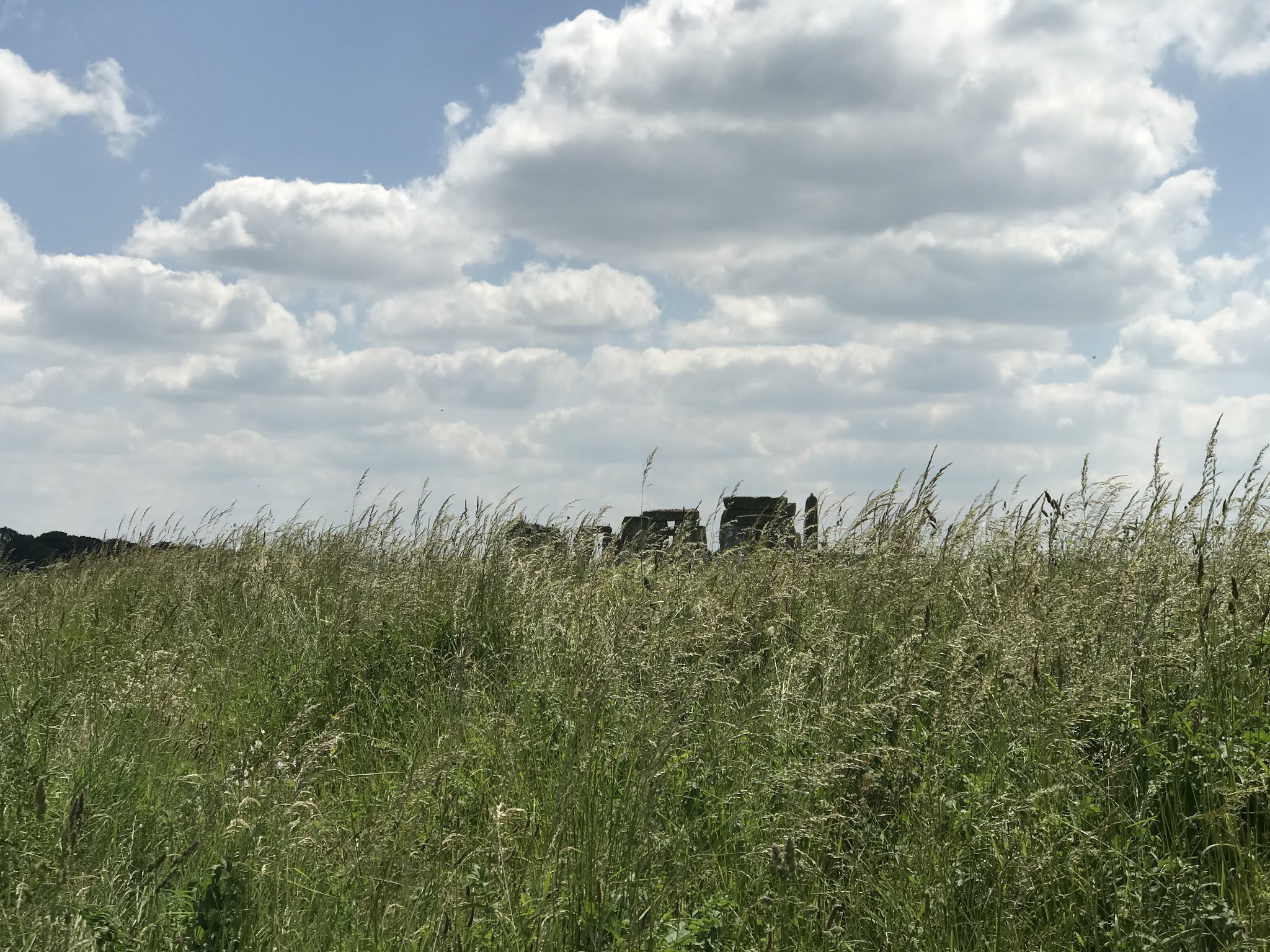
Stonehenge was also still there as it has been for the last four and a half thousand years, so too Silbury Hill, and my favourite, the Avebury Stone Circle which encloses an entire village. The village was less impressed. In the early middle ages, egged on by zealous clerics, the villages tried to get rid of what they saw as the Devil’s work. Unable to destroy the actual stones, they ceremoniously buried a good number leaving large gaps in the circle. The stones fought back, one toppling over and breaking a helpful stranger's  back. Three hundred years later the body was found under one of the buried stones, along with three coins dated 1320-1325,


 Despite the gaps there were stones remaining  to impress the antiquarian John Aubrey when he found them when out hunting. Writing in 1649 he compared Avebury with Stonehenge, the former being a great cathedral, the latter a mere parish church. He wouldn’t recognize it now with its manicured lawns, teashops, tourists and gift shops. He would though have made a beeline for the Red Lion.


Silbury Hill 


Our students loved Silbury Hill, a race to the top obligatory.  It had survived for four and a half thousand years and had once been a Saxon hill fort facing down marauding Vikings. Its purpose remains a bit of a mystery, as is the exact year it was built.  But if we’re vague about its purpose and the year the first clod was dug, we can possibly narrow it down to the month ie early August—the wings of flying ants having been found in its base. Others dispute this arguing that earthworm excrement is the key to accurate dating. What fun these fellows have. And why not add to the general merriment?  In terms of the volume of material moved—nearly 9 million cubic feet, it’s equivalent to the smallest of the three pyramids of Giza.


And so, to the ‘parish church’ – Stonehenge.


It's still pretty awesome, though now visitors are kept well away. To my mortification, glee, and embarrassment the commentary coming through English Heritage headphones informed me that visitors are now kept away because of past damage from school trips. Surely, they weren’t talking about me and St Joseph’s Academy of Young Ladies and Gentleman? 

Whatever the case, Silbury Hill and Stonehenge have become museum pieces sans uniformed guards. Avebury though remains free range. You can’t fence off a monument larger than the village within it. 

Avebury from the air showing how easy it is to walk around the village. 


A picture of the outer ditch and stones from ground level


Sheep and stones

It was a very hot day, sheep are intelligent and stones have their uses.


And at the risk of boring you silly, and because I'm now done with Old Sarum, Salisbury and Stone circles, four pictures to round it all off.


The inn we stayed in


Why it was called the White Horse


Even the fields are quite mystical


Friday, 30 July 2021

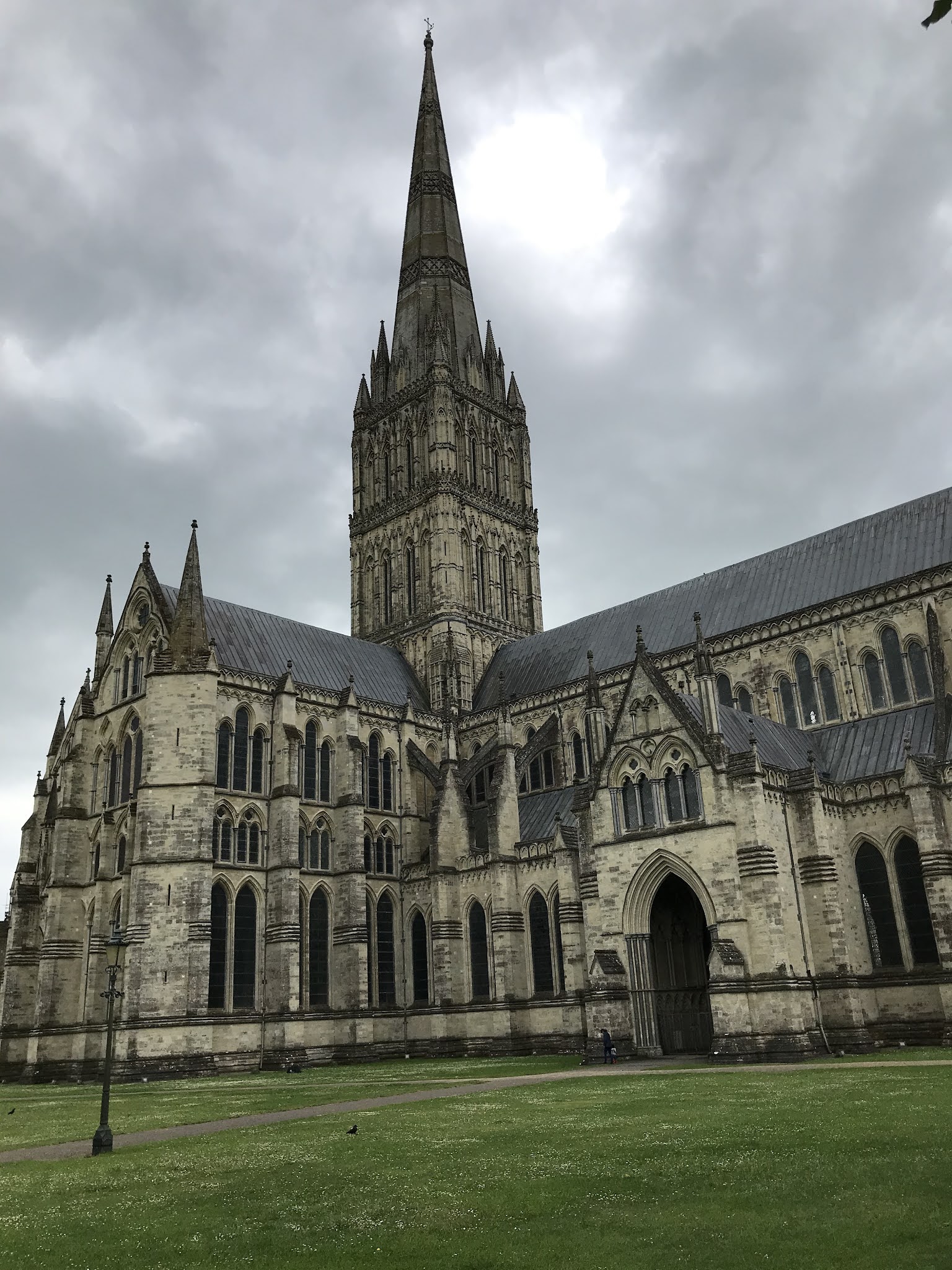
Salisbury Cathedral


The spire and tower at 404 ft high is the tallest spire in England and probably built between 1300 and 1330. The spire was seen as directing people towards God and can be seen from miles away


The cloisters and a view of the cathedral from the cloisters. 


This is the original cross mounted on top of the spire in the 1300s and the weathervane alongside – more modern at 1762 but with some nice World War II bullet holes to give that special contemporary touch


Tradition


According to military tradition, old colours are ‘retired’ in a special ceremony and left to hang until they fall apart. When this happens, they are taken down with their pike and a special service is held during which they are buried in an unmarked grave in sacred ground.  These particular colours are well on their way.


This is the world’s oldest working mechanical clock, made in 1386, possibly earlier. It told the priests when to pray and made sure religious services started on time. Unlike modern clocks it has no dial or hands but tells the time by striking the bell on the hour. The clock was originally kept in a separate tower with the cathedral’s bells. When the bell tower was taken down in 1790 the clock was moved inside the cathedral.  

The clock is still wound up every day and has ticked over 5 billion times. I thought you might want to know that.


Above is the font and below is the magic. The font gives a perfect reflection of the cathedral's roof.


Two pictures of the interior. Not reflections. 


St Osmund's tomb


Osmund was bishop of the first Salisbury Cathedral at Old Sarum, from 1078 until his death in 1099. He was first buried at Old Sarum but in 1226 his tomb was moved here. The foramina – holes in the sides of the tomb allow sick people to reach in and get closer to Osmund’s body, in the belief that this would make them well. Osmund was made a saint in 1457 and a magnificent shrine was built in his honour – destroyed during the Reformation when the worship of saints was forbidden. The Shrine contained so much gold and precious stones that it took a month to take it apart—which perhaps explains the real motive behind its destruction.


And a very special tomb from both sides. 


William Longespee, Earl of Salisbury (1176 – 12 26) was a bastard of Henry 11 and therefore the half-brother of King John who he remained loyal to until almost the end. He became an earl when his other half-brother Richard the Lionheart found a wife for him, Ela, a wealthy noblewoman with connections to Salisbury. A giant of a man with over-large weapons he fought across Europe but, according to the chronicler Roger of Wendover, was poisoned on the orders of Hubert de Burgh (note that name) Old Roger was a bit of a fantasist so many took the story with a pinch of salt until….. see below


Was Roger vindicated?


a small chapel for reflection. 


This shrine more than glorifies the Seymour family.


The Shrine should have an even larger placard ‘But I get up again!’ Though  this goes for the Cathedral too, when you consider it's history. But back to Edward and his splendid shrine.

Edward Seymour was the nephew of Jane Seymour, third wife of Henry VIII, so he knew what he was doing when he married Lady Catherine Grey in 1560 and had good reason to do it in secret. Catherine Grey was the sister of the unfortunate Jane Grey, Queen for nine days. As far as the new and endangered queen Elizabeth I was concerned, Edward was playing marital politics. Poor old Catherine was imprisoned in the Tower of London. Edward was imprisoned elsewhere in the Tower. Despite this, Catherine gave birth to two sons. In 1562 the marriage was annulled and the Seymours were censured as fornicators for their ‘carnal copulation.’ Edward was released from the tower when Catherine died, but the two children were now officially bastards. In 1582, Edward married again— in secret—and was arrested. And he secretly married once more in 1601, possibly on the basis that Queen Elizabeth didn’t have much longer to live. This glorious monument was erected in 1625. It shows Edward and Catherine lying together, and their two sons to either side.


Under the floor, the Cathedral’s foundations are only 4 ft deep which is surprising given the size and weight of the building. The foundations are made of flint stone held together with lime mortar. They are on top of gravel left by the nearby rivers. In 1915, the water came up through the foundations, flooding the cathedral.


Thursday, 22 July 2021

The Clay Cross Chronicles - Out Now!


 The ebook is launched - a snip at £3.  The paperback is pending, barcode to be attached.  There are eight  stories, some quite long, The great cover is the work of Maria Zannini

Penny Dime

Ginny Mambo

Vasia Verami 

Hecate

The Cagney Effect

Jinn Don’t Play Nice

Raising the Dead

Bunga Bunga


Below are a few random excerpts (easier than writing a blog post.) I hope you enjoy them, bearing in mind the opinions are not necessarily those of the author. 😎


"You got something to say to me, Sam? I think you have something to say to me."

He looked up, defeat scrawled on his face. There are six letters in 'defeat' and they don't look good on men with small faces.


 #


I put down the phone and stared. The request was nothing new, the oldest one in the book. It was one I’d done a thousand times before and likely would a thousand times more. A package had gone missing, and there was only one man who could find it. Clay Cross. He hadn’t mentioned Sheri Lamour. He hadn’t said what the package was—just that in the wrong hands it would change the world as we know it. 

I reckoned that might be a pretty good thing, but I hadn’t been hired to philosophize. I stared out the window and wondered where Sheri was, and why she was taking so long, and why I even bothered to ask. It was raining. Brown rain. And people scurried like ants on a honey-run. It was a damn shitty world and it seemed to me any change would be an improvement and that I could philosophize and crack a case all at the same time. I was a big boy. Sheri agreed when the mood took her.


#


Sheri was studying the papers. I was down to my last four fingers of bourbon. It was quiet in the office, the way I liked it—but for two small flies in the ointment. Sheri looked like she was itching to talk, and the bourbon was nearing its end. Work was slow, and the office needed cleaning—and one look at Sheri tells you it’s not something she does. 

“Anything interesting?” I was talking about the book in her hand, not the small screen permanently on mute. Screens are for stumblebums grazing on chicken fry or breeding the next feral horde. Give me a book I can open or close, occasionally burn. In my experience screens regurgitate lies and salacious tattle from broads with more silicon than brain. Jeez. I like a broad with something to hold. I just don't want to be knocked off my seat when they turn.


#


She’d been gone less than a minute when the air rippled and a skeletal figure in black sat in the chair she’d vacated. He wore a crooked stovepipe hat. A long cigar clenched between a skull’s teeth. 

Baron Samedi, the one who’d got us into this mess. The cigar swivelled to the side of his mouth. “And aren’t you the miserable fucker. What’s up?”

“Sheri just asked me that.”

“I know. I was there. So, spill. What’s crunching your balls?”

I said the first thing that came to my head and knew it didn’t make sense. “Midlife crisis.” Something a dame might say in between sobs. “Try that on for size.”

 “You have no mid-life, Cross. You’re fucking immortal. You’re Djinn.” 

“And whose fault is that?” For a time, there was silence, the kind that gives death a bad name.


        #


I was halfway across the room when the door opened, letting in a dim orange light, street noise, and a dame that’d make a corpse whistle. She wore a dress tighter than skin, a dress designed by Beelzebub and cut by Mephistopheles of Milan. She smiled, and my brains turned to ice cream, and I knew I was in trouble with a capital T and then more. One thing for sure, she was here for a purpose, and it had something to do with Jake and a leg that had gone walkabouts. Was she after it too, or had she come back disappointed, looking for what they hadn’t yet found?

"What can I do for you, kid?"

"It's what I can do for you, Clay." Her gaze flitted over my shoulder a moment before my brain turned to mush. I saw a shadow, smelled onion and garlic, and turned just a little too late. The cosh hit me hard, and a thousand lights told me the film had just ended.


        #


We found Nightingale Song easy enough. The streets were mean but there weren’t many of them.

Nightingale Song, yeah, I know, sounds like a ladyboy— only Nightingale Song was less classy. It was a club you'd be wise to avoid, one on its own, turning lowlife into specimens for the rich to shiver at as they sipped their overpriced drinks. You know the deal. Bring in a few 'characters', those without teeth or missing an eye, the broads with clothes too tight for bodies you didn't want to see. Atmosphere, they call it. I call it a not very nice smell. But it appeals to people who want to live 'dangerously' and hold down a 9 to 5 job.

Sheri spotted her first and led me across a room full of shadows that shuffled, shadows without faces. I wondered whether they'd ever had them or whether it was something they handed in along with their hats, along with their souls.


#

. . . The dame was unarmed. With breasts like those she didn’t need guns; she was packed with enough fissionable material to blow the place sky high…and she was looking at me. Maybe I should have been excited, given her some kind of dopey smile and whisked flowers out from behind my back, but this dame was trouble. A man had been beaten to death because of her and now her sights were on me. 

Me? 

I’m Clay Cross, with a nose for trouble and an eye for dames. And this was one broad I was going to follow wherever she took me if only to see how she looked from behind with her come-and-get-me-I’m trouble-boys sway.