Friday, 24 June 2022

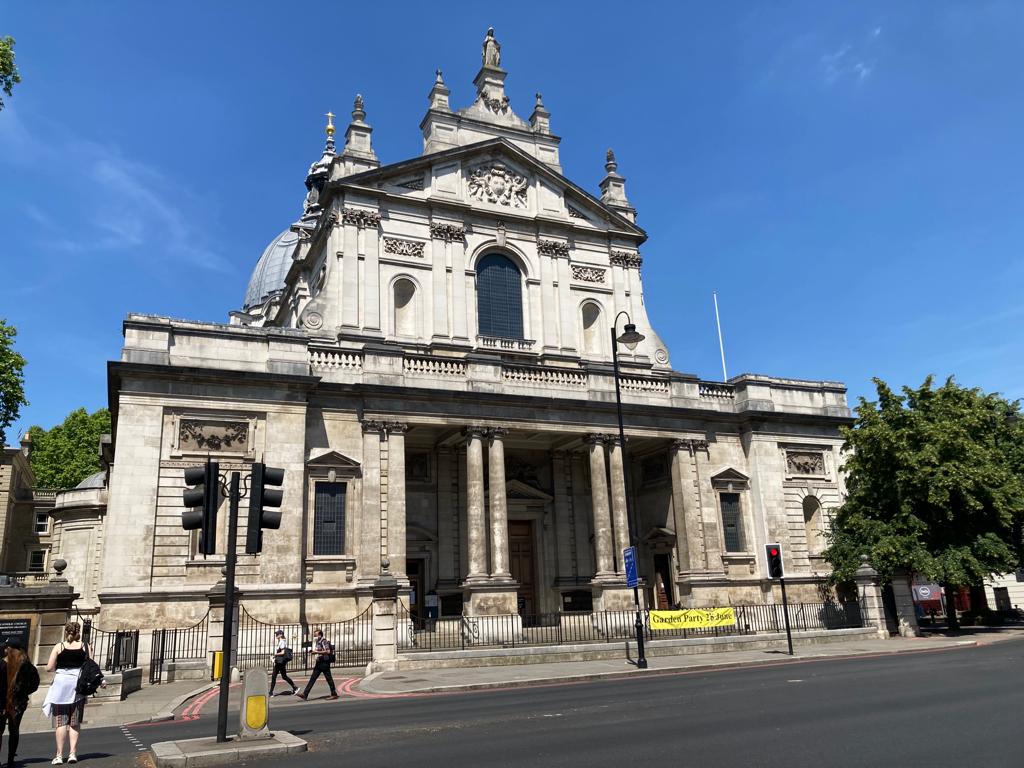
Brompton Oratory


Brompton Oratory 1880-1884. The second largest Catholic Church in London with a nave wider than that of St Paul’s Cathedral. 


I recently read a wonderful book, Notes from Deep Time by Helen Gordon. In it, she explores the nature of time through the medium of rock, comparing geology with the more shallow timespan of human history. It’s full of mind stretching wonder, but one chapter in particular, ‘Urban Geology,’ sparked an urgent desire to visit Brompton Oratory. 

In the chapter she rhapsodised on the subtle qualities of marble:

 ‘Wine-red Griotte d’Italie against moss-green Connemara marble. Dark green, smoky Verde Alpi serpentinite. Blue Belg, Belge Noir, pale pink Nembro Rosato the colour of an old-fashioned tea rose. Pillars of buttery gold Sienna Breccia, dove-grey Repen Zola, translucent, orange-tinged English alabaster. . .’ it rolled off the tongue. I wanted to read more. I wanted to see it! But until two weeks ago, alI I was able to do was read and imagine. I hope these pictures bring her words to life. 


There was an intensely spiritual atmosphere throughout, the central nave housing more intimate chapels to either side. I drifted ghostlike - okay, more comically furtive perhaps - between pillars so as not to disturb those quiet in prayer. 


More words:

‘ . . .  shining piles of marble and alabaster turned into columns, panels, altars, fonts and sepulchres. Stilled swirls, branching veins, jagged stripes and smoky clouds of colour.'

It reads like Keats on LSD but Keats would also also have appreciated the science behind it,

marble being a by-product of physics and chemistry. Intense heat and pressure on sedimentary limestone allowed a complex ingress of mineral rich waters, creating both colour and pattern. But somehow the science gets lost in the vision unless you make a conscious effort to see it. 


 As the French philosopher Roger Callois argued ‘We find marble beautiful because the marble itself, far older than human civilisation, has taught us what is beautiful. The stones themselves have shaped and guided human aesthetics.’ No doubt Keith Richards will live long enough to do the same. 


Saturday, 18 June 2022

Painting the town red


We spent four nights at the Shepherd’s Bush Hotel on a bustling and vibrant Uxbridge Road. Walking against the stream of pedestrians walking with urgency purposeful strides enroute to the Underground was a far cry from Monmouth and caught you unawares in the morning. Syrians, Iranians, Arabs, Rastas, Lebanese, harassed mums in burkas or hijabs chivvying children to school, all of them  in smart school uniform. 


And when everyone's gone to work, peace—and a promise to treat ourselves to a meal in this restaurant. It promised 'Damascene' food, but the cuisine was that and more and very reasonably priced. Advert over.


As faces streamed past, I caught glimpses of the ancient Sumerian, an ‘Immortal’ from the army of the emperor Darius, faces from the New Testament, all of them overlaid with London stress. The vibe was very much family and work, a thousand and one eateries and green grocers bursting with every kind of exotic fruit. Not the culture of the ‘old Bull and Bush’ but cities change and so do we. 


We were there for a Raphael exhibition at the National Gallery and to see our daughter. In fairness, I opted out of the Raphael Exhibition in favour of meeting up with an old university friend. I’m a mean old soul and begrudged the price, and old friends are cheaper, better value all round. A good friendship transcends politics, perhaps even a Titian.


The National gallery, looking very photogenic this day. My wife's excellent photo 


Speaking of better value, don’t be seduced or ‘guilted out’ by the ‘card-readers’ in the Gallery's foyer. These have replaced the large glass bowls where you were formerly invited dropped in coins or notes. In my view, the National Gallery make sufficient money from their captive audience in need of a drink or refreshments. By the time I reached the till, I was trapped by the queue behind and paid with a smile that gave me toothache. For what was on my tray: two small pecan cakes, a tea and two coffees I could have bought a small Botticelli.


Unless you are there to see something in particular, the secret of walking around an art gallery is not making the mistake of seeing too much and end up with a blur that means nothing. I was more than happy to see one or two pictures—an exaggeration—probably fourteen or fifteen—and then sit in a corner with my kindle. Occasionally, I peopled watched, and people watched me and cast judgement. A thin, middle-aged lady in a deerstalker paused and looked down at m. I might have imagined the sniff. A kindle in the National Gallery. Not even a book. 


No reason for choosing this painting other than that one of the monks bears a startling resemblance to Boris Johnson. Well, he is a catholic now, and the Renaissance church would have suited him down to the ground.


Okay, call me Mr Trivial, but I couldn't get over these two horses grinning at each other as if they've just met at a cocktail party rather than participating in the battle of San Romano in 1432. Lorenzo de Medici loved the painting so much, he stole it from its original owner and installed it in his palace. He clearly had a thing about grinning horses too. 


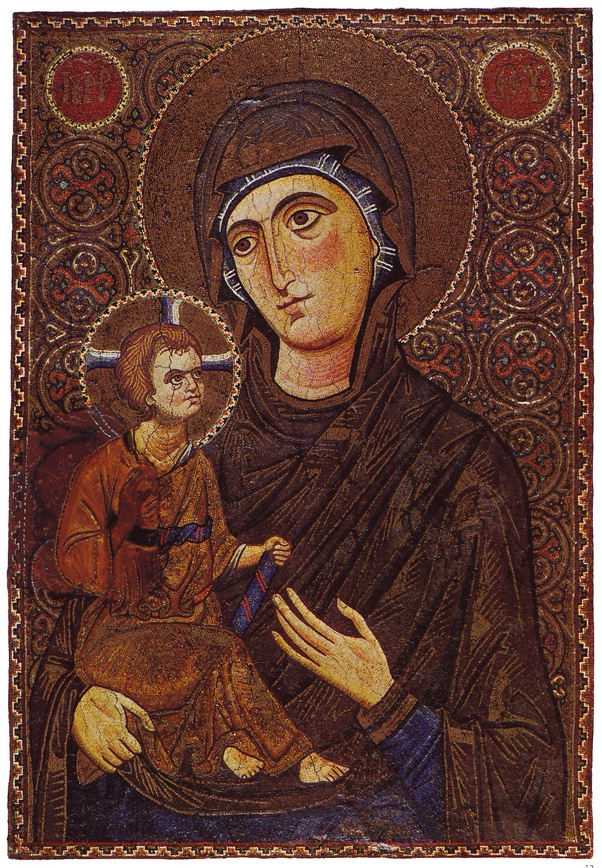
I've grown so used to medieval artists painting the baby Jesus as a weird little middle-aged man. I appreciate that they were making a theological point ie God is immutable and therefore Christ as the Son of God must be equally immutable hence his features remain unchanging from childhood to death. Got it? Still weird and not a little unsettling. So, after all that you can imagine the startled reaction on turning a corner and seeng this Titian. I't's not just the colour. The baby looks real!


The Holy Family with a Shepherd 1510


My, these look a well fed pair. Even the parrot looks morbidly obese. 


Portrait of Cornelius van Diest and wife wife Lucretia Courtois by Jacob Jordaens. For those who can't be without their symbolism, the dog, parrot and vine symbolise fidelity. Adultery presumably making you thin. 


On first seeing this from a distance, I thought it was a woman exploring her military side, an eighteenth century dominatrix. Disappointment was bitter. It's a Joshua Reynolds of Colonel Tarleton - more familiar to patriotic Americans perhaps. Banastre Tarleton, wearing the cavalry uniform of his 'Tartleton's Green Horse,' fought in the American War of Independence and later became a Liverpool MP where he argued against the abolition of the slave trade. Not only was he on the wrong side twice, he also lost two fingers 


Lord Ribblesdale by Singer. 1902. Riveting for two reasons, Lean and tall, hand on hip and top hat at a rakish angle, he's screaming 'Me! Me! Put me in your next book. Anti-hero, I don't care.' And of course, Ribblesdale Avenue is where I was born. 


A Bellini—the artist, not the cocktail. I was standing at the back of a guided tour, listening in as it were. The sitter is the Doge Leonardo Loredan. All very good. But it was when the guide pointed out that he had two faces, seen if you separate his face with a raised hand. On the one side a distinctly dour expression, on the other a Mona Lisa smile. I waited until everyone had gone and tentatively raised my hand. It was true. You can try it from the privacy of your own living room with no risk of appearing stupid. 

And finally the Victoria and Albert. By this time I was almost losing the will to live. It wasn't just a surfeit of art,  it was also a very hot day. But the V and A was at least cool. 


I was particularly struck by the vivid complexity of this C14th tapestry released to the Treasury by the Duke of Devonshire in lieu of taxes. The tapestry illustrates a bear and a boar hunt. Specially bred hounds were used for both. It was also a very upper class sport where the participants dressed for the occasion. One of the women shown is wearing a miniver lined cloak, which would horrify the anti fur lobby of today. Miniver is  fur derivedfrom the belly of the Baltic squirrel, in this case hundreds of them. I think there was a film called Mrs Miniver but she wasn't a Baltic sqirrell.


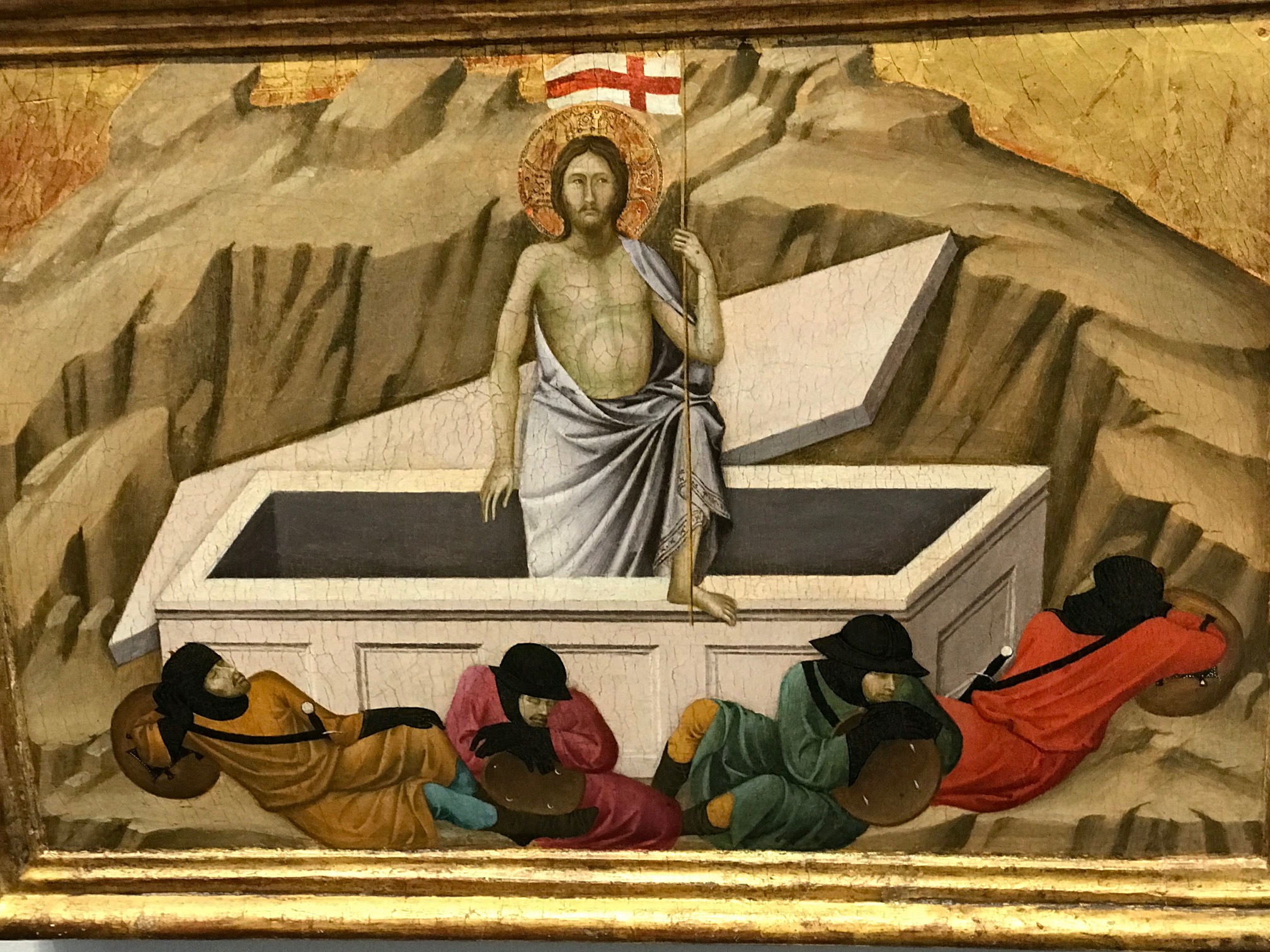
If you look closely into the foliage you will see an intricate battle between monsters and men illustrating the eternal conflict between darkness and light. It was likely an altar piece and commissioned by the Benedictine Monastery of St Peter Gloucester in 1107. And in case you were ever in doubt that the Resurrected Christ was an Englishman


Friday, 10 June 2022

Camille Pissarro


My wife, mathematician and art-lover, has opened so many doors in my life, most recently artists, and exhibitions I would never have otherwise gone to. The most recent one was the Pissarro exhibition at the Ashmolean, where I was reminded again how great art, prejudice and mean-minded passion can mix a cocktail of poison. 


Camille Pissarro 1830 – 1903 was born in the Virgin Islands but with his family, re-settled in Paris. From the start, he revealed an independent mind, disappointing his conservative Jewish mother and father  by marrying their non-Jewish maid. It was a wise choice, for her work ethic subsidised his early, precarious artistic career, as well as gifting him eight children. 


The former maid, Julie Vellay and Camille Pissarro


In fairness, Pissarro was equally generous, especially to younger artists such as Degas, Cezanne, Gaugin and Renoir. 


And then everything changed. In 1894 the Dreyfus Affair erupted and split France as bitterly as Brexit or MAGA today. Alfred Dreyfus came from an Alsace Jewish family and became the highest-ranking Jewish artillery officer in the French army. In 1894 he was accused of treason, passing military secrets on to the Germans. Antisemitism exploded, confirming the prejudice that the rootless Jew owed loyalty to no particular country. When it was later discovered the real traitor was Major Ferdinand Esterhazy, an impoverished French nobleman, the fact was covered up to save embarrassment, and Dreyfus was imprisoned on Devil’s Island off the coast of South America. 


The case split France as well as a previously close-knit artistic community. Despite his Jewish background, Pissarro as a radical anarchist, hesitated before leaping to the defence of a wealthy military officer of rank, but when he did so, his commitment was complete along with Monet and the writer Emile Zola. For Pissarro, injustice was injustice.


Some of his oldest friends, Degas, Renoir and Cezanne, took the opposite view, the first two revealing an almost rabid antisemitism. It must have hurt Pissarro profoundly when his old friend Degas crossed the street to avoid talking to him. Renoir went further, denouncing Pissarro’s family as part of "that Jewish race of tenacious cosmopolitans and draft-dodgers who come to France only to make money.” He linked this to Pissarro’s sons who had failed to do military service precisely because of this 'lack of loyalty'. In 1882 Renoir protested against showing his work with Pissarro, arguing that ‘to exhibit with the Jew Pissarro means revolution.’


Camille Pissaro in old age. Self Portrait


Pissarro continued to admire Degas’ work. Degas on the other hand suggested that Pissarro’s art was ignoble. When reminded that he had once praised it, his response was ‘Yes, but that was before the Dreyfus affair.’ 


The elderly Pissarro and family 


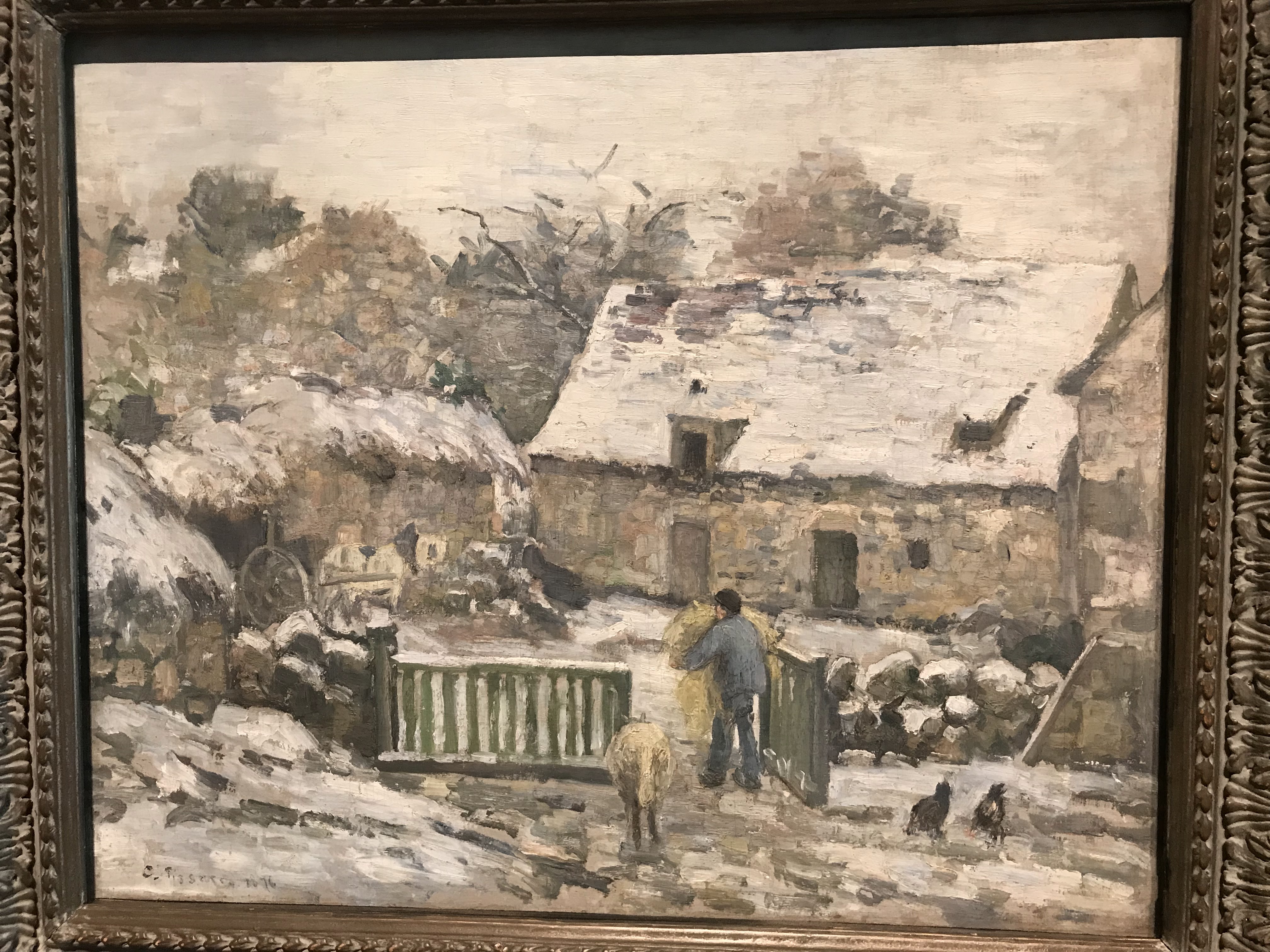
Degas was the loser in this, degenerating into an almost mad caricature of the antisemite, but this post is about Camille Pissarro. Below are the paintings that caught my eye, some giving you the illusion you could almost walk into them, else seeing them from a window and wishing you could. 


Landscape near Pointoise.
The eye initially takes you to the rickety fence before catching a glimpse of the hay cart moving in from the edge of the picture. This is one of Edgar Degas' favourite pictures and he continued to own it until his death. Which is ironic


The Pea Stakers Here, realistic toil is replaced by colour and  grace. The women are planting poles to train pea plants, but it looks as though they are dancing.


Village seen through trees A nice medley of green and brown with small patches of brilliant reds and blue. A sense of real homes and a community at work oblivious to anything outside of the frame.


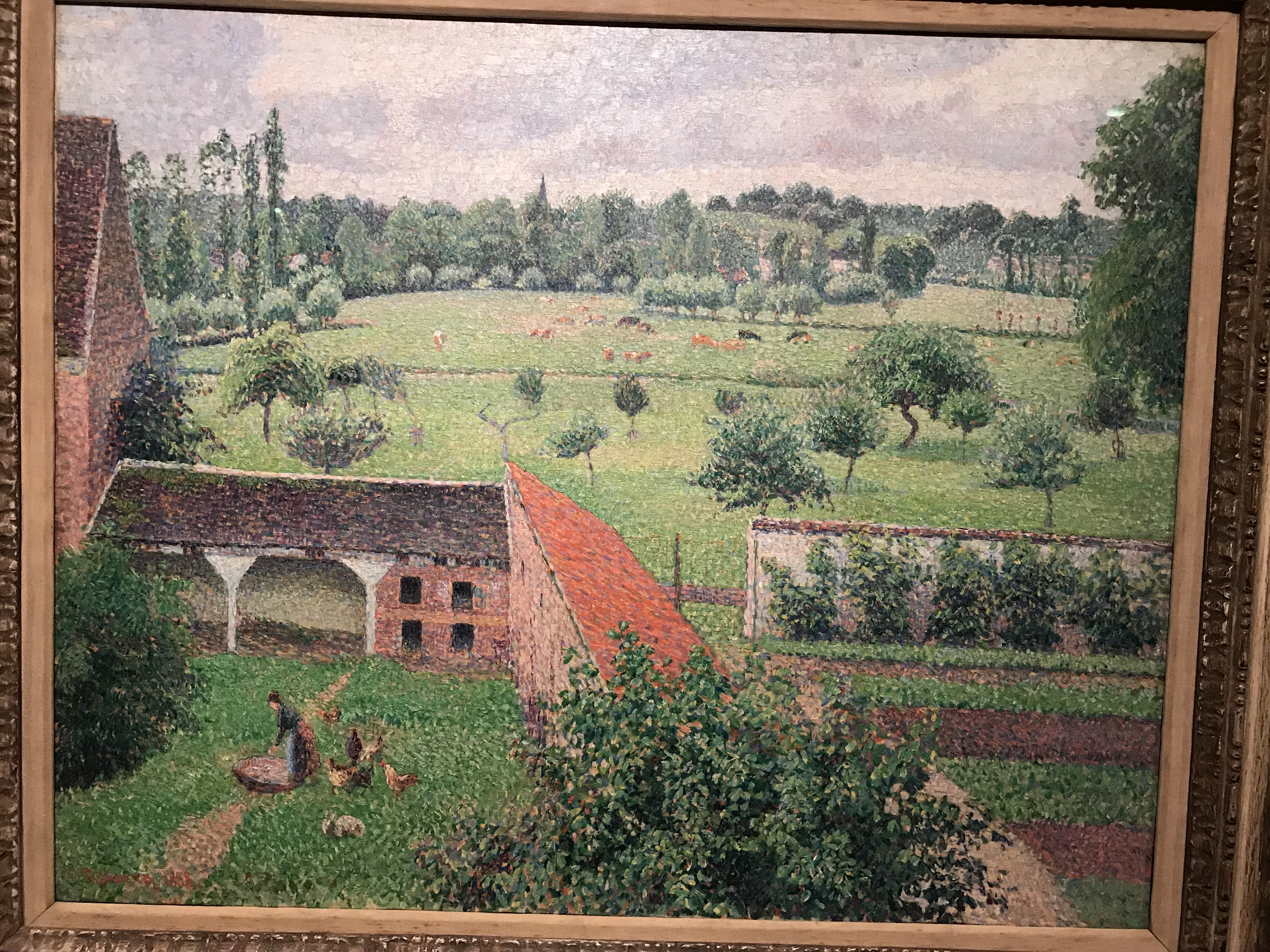
View from My window. Pissarro described it as 'primitive modern' and was distressed when his dealer said it was unsaleable. It reveals the view from the first floor of his house in Eragny


Man sawing wood - Pointoise 


Lucien Pissarro, the eldest and perhaps favourite son. An artist like his father who continued the impressionist tradition. He moved to London permanently in 1890 and died in 1944 having influenced a whole generation of British artists. You feel as though he might turn and smile at you on the moment. 


One of Lucien's impressionist works


"Rodo" Pissarro's fourth son aged four or five. Pissarro catches the nervous smile.

One of the nicest experiences at the exhibition was seeing how a group of thirty junior school pupils reacted to him. I inwardly groaned when they entered en masse , but within ten minutes they had split into groups of three and were studying each painting, engrossed and discussing what they saw in them. After a time they sat and sketched their favourite painting. The old man looking down at them would have been as pleased as punch. Degas, perhaps less so.


Thursday, 2 June 2022

And books which told me everything about wasps, except why

“I cannot persuade myself that a beneficent and omnipotent God would have designedly created the Ichneumonidae (parasite wasp) with the express intention of their feeding on caterpillars.  (Life and Letters of Charles Darwin, Vol1)


I once tried to get rid of a wasps’ nest in our garden by sneaking up on it with a long stick and thwacking it hard. The plan was to do it unobserved from behind a bush and walk briskly away. With an innocent air. Whistling maybe. It didn’t quite work that way and I barely escaped. I was thinking of that, listening to a review of Seirian Sumner’s new book Endless forms, grateful that God had not made me a caterpillar.


Seirian Sumners refers to the wasp as a ‘sweet killing machine’ and lavishes praise  on its ingenuity in securing prey. The jewel wasp can turn a cockroach into a zombie helplessly guided into its nest, where it is eaten alive by newly hatched wasps. Parasite wasps lay their eggs inside caterpillars, which carry on, unaware they’ve been injected and are being eaten from the inside.  It’s like a bad Sci Fi movie


A bird feeds the jostling beaks of its young, and we think how cute without thinking much about the worm. But the wasp? In Sumner’s view, wasps get a bad rap.  Bees sting, and people occasionally die, but they are tolerated – even revered because of their perceived economic value, beeswax and honey, and as natural pollinators. The wasp’s value is less obvious than their sting.


Sumner puts bees in their evolutionary place as ‘just wasps who have forgotten how to hunt.”  Wasps, she points out are carnivores so an essential part of the eco system, a form of natural pest control. Without wasps we would be over-run with spiders, greenery stripped by caterpillars. 


We most often see social wasps at picnics. Some picnickers are as ingenious as wasps when it comes to killing them. They boast of leaving jugs of sugared water or orange juice (laced with vinegar to deter the sainted bee) The wasps are drowned as an inconvenience as we continue to chew the flesh of once living creatures. 


These are the wasps we notice, not the solitary hunters, the parasite wasp. But then we aren’t farmers in Brazil or Zambezi.  There, the parasite wasp is bred as an ‘insecticide’ and released into the fields at just the right time. 

‘And books which told me everything about wasps, except why.” Dylan Thomas should have looked farther afield. And we should have more humility.


According to legend a Han dynasty eunuch, Cai Lun, was lazing under a tree when he observed a wasp scraping bark and chewing it to a paste before applying it onto its nest. Curious, Cai Lun followed suit and thus discovered paper. 


Again, wasps have been around longer than us, achieving sociality 250 million years before humanity emerged blinking from the dinosaur’s shadow. Wasps can also recognise human faces as well as one another’s. I’ve yet to recognise the face of a wasp. I sometimes have trouble with humans. 


So, wasps have their place but caution is good too:

“The serpent, the king, the tiger, the stinging wasp, the small child, the dog owned by other people, and the fool: these seven ought not to be awakened from sleep,” Chanakya 350 –383 BC

Friday, 27 May 2022

The Tribulations of Anne


Last Christmas I bought my wife a stocking filler—well, two stocking fillers really—a first edition of Five Go to Billycock Hill, and another Famous Five Book published the same year she was born. Out of delicacy and a sense of self preservation, I won’t give away the name of that particular book. 


One wet afternoon, we opened a book each, sat in front of the fire and cracked open a bottle of chilled Sourgal Moscato. Pretty soon the peace was shattered by hoots of disbelief and laughter. We’d anticipated it, been looking forward to it—the archaisms, the profusions of adverbs and exclamation marks, and above all, the cheerful sexism of our childhood. 


Billycock Hill begins on a promising note. The five are at Kirrin cottage, studying maps and planning a jaunt when George suddenly erupts: “And just us Five together again on a sunny week’s holiday!” said George, giving Timmy a sudden thump of joy. “Hurrah for Whitsun!”

George is the tomboy who today would probably be packed off for gender reassignment. Julian is officer material, Dick his subaltern, and Anne—poor Anne—housewife and homemaker with all the perceived frailties of her sex. 


Anne picked a spray of honeysuckle and put it through the buttonhole of her blouse. “Now I can sniff it all the time,” she said. “Delicious.”


Cycling up a high hill is hard work.  ‘Thank goodness,” panted Anne. “We’ll be as stiff as anything tomorrow.”

They pause for a rest and Anne falls asleep. Then she felt something crawling up her arm and woke with a jump.

“Ugh – a big beetle!” she said and shook it off.”


When they reach their destination, they’re treated to a farmhouse tea, and here Enid Blyton reveals her astuteness. In an age of post war austerity and the shadow of rationing we have wish fulfilment writ large.

They all sat down to tea, and the four visitors wished they had not had such a big lunch! A large ham sat on the table, and there were crusty loaves of new bread. Crisp lettuces, dewy and cool, and red radishes were side by side in a big glass dish. On the sideboard was an enormous cake, and beside it a dish of scones. Great slabs of butter and jugs of creamy milk were there, too, with honey and home-made jam. No tripe and onions for them.


But soon after this it’s back to business for poor old Anne who assumes the role of domestic goddess when camping in a field. Roles are traditional and clearly spelled out.

Anne loved arranging anything, and she was soon at work putting away the food and the milk into her queer larder.


Asked about food, Anne tells them what’s available. “Sounds jolly good,” said Julian. “What do you think, Timmy? Anne, if you and George get the supper ready, Dick and I will prepare our heathery beds.”


After the meal, they decide on a swim: “It sounds jolly good,” said Julian pleased. “Well, we can’t bathe immediately after a meal. The girls will want to do their bit of washing up and put the rest of the food away. We’ll sit here and wait until they’re finished, have a bit of a rest, and then go and find this pool.”

When expressing an interest in seeing an aeroplane, George is put in her place. “But you’re a girl," said Toby. “Girls don’t understand the first thing about aeroplanes or motor cars or ships – or spiders either, come to that! I really don’t think you’d be interested Georgina dear.”


On finding the pool a bossy airman appears and shouts at them, but it’s only Anne who feels scared. It’s Julian who sorts things out with upper class smoothness. “Well, we apologise for trespassing,” he said in his clear, pleasant voice. “We shan’t bathe here again, I promise you. Sorry to have made you come all this way to warn us off.”

And the bossy airman regards Julian with new respect. There was something about the boy that reassured people, and the man now felt quite sure that was all Toby’s fault. He smiled and gave a sketchy salute.

“That’s all right,” he said. “Sorry to have cut your bathing short this hot day” It’s the salute, I can’t get over.


Back at the tents one of them suggests they listen to Beethoven’s Pastoral Symphony on their portable radio as the sun sets. Anne’s not so sure. She ‘loathes’ inconsiderate people who play their radio loudly in the countryside “I could go and kick their radios to pieces!”

“Gracious, Anne—you do sound fierce,” said George, looking at her cousin in surprise.

“You don’t know our quiet sister Anne quite as well as we do, George,” said Julian, with a twinkle in his eyes. “She can be quite fierce if she thinks anyone is spoiling things for others.”

“Oh Julian! How can you say such a thing!” said Anne. …

“All right, young Anne!” said Julian affectionately, and patted her hand. Both he and Dick thought the world of their quiet, kind little sister.


Listening to Beethoven as one does when camping

Later, back at the farmhouse, Mrs Thomas automatically asks the girls to make tea. The girls bustled about, setting out cups and saucers, while the boys talked to Cousin Jeff and asked him eager questions about planes and flying and how this was done and that. 


Jeff is Toby’s cousin and the Five are enchanted: A tall, good-looking young man stood up, smiling. The Five gazed at him, liking him very much indeed. What a fine young fellow—how strong—what keen straight eyes he had—what a cousin to possess! They all envied Toby at that moment.

When it appears Jeff is a traitor, the Five are distraught.

“To think that Jeff could do a thing like that – Jeff a traitor – flying off with a plane of ours to sell to an enemy,” said Julian….

(Dick similarly) “…fancy Jeff doing that! I liked him so much.”

“So did I,” said Anne, turning her head away.

Later they learn that the stolen plane has crashed in the sea. “But that means Toby’s cousin is drowned – or killed,” said Anne, her face very white.

“Yes, but remember, if he flew away in that plane, he was a traitor to his country,” said Dick gravely, “And traitors deserve to die.” 

“But Toby’s cousin didn’t seem like a traitor,” said George. “He seemed so – well, so very British, and I can’t say anything finer than that. I feel as if I shall never trust my judgement of anyone again. I liked him so very much.”


In solving the mystery, they come across 'butterfly man'


Later a new crisis emerges. A young child is missing. All hands on deck. They need to look for him – but not on an empty stomach.

“Well, can you make some sandwiches very quickly?” asked Dick. “We’re all very hungry, and it won’t take a minute. We can munch them as we go. Let’s make a plan of campaign while you’re cutting them.”

George and Anne set to work with the sandwiches. Anne’s fingers were all thumbs, she was so shocked to hear that little Benny was missing. 


Could little Benny be down here?


It all ends happily as you know it will and there’s another farmhouse tea, with no doubt the girls washing up afterwards. We finished the wine, looked at each other and turned on the dishwasher. 

Friday, 20 May 2022

The Goose Egg


A few weeks ago, we went to Pengethly Garden Centre to buy some compost. Like all of these places you leave with more than you originally set out to buy; in this case two bags of compost, two dwarf rhododendrons, eggs—six chicken and three duck—and one Goose Egg – capitalised because of its size. I’d never seen a Goose Egg before, (a sheltered life) but once seen it immediately soared to the top of my bucket list and ticked off with the reckless swipe of the debit card. 

They found me a special box and green tissue paper for my Goose Egg, and on the long journey home I nestled it between my legs, resisting the urge to honk. 


Aphrodite, for reasons best known to herself, occasionally rode a large goose. I wondered if the egg suddenly hatched, would I turn into Aphrodite; or was I in fact Leda, hatching the egg of Nemesis and Zeus . . . and what would my wife say if Helen of Troy unexpectedly appeared between my thighs. 

Funny thing, geese. In the air they’re referred to as a skein, on land as a gaggle and around the world they’re associated with creation or death.


 In Egyptian creation myths, the cosmic goose, Kenkenwer—the great cackler— was reputed to have laid the cosmic egg from which the world was born, and the Egyptian God, Geb was often painted with a goose on his head. 


He, too, was a great cackler and adds a further thread (if we needed one) to the current controversy between gender and sex. According to another Egyptian myth, it was Geb who laid the cosmic egg from which the sun emerged every morning. Geese are everywhere in mythology. 


In Hindu mythology, two divine birds called the Hamsa in the form of geese, sometimes swans, laid an egg on the cosmic ocean from which the Creator God Brahma was born. Like Aphrodite, he too rode a goose, clearly the only way to travel. Siberian Shamans were of a similar mind, soaring over mountains and tundra on geese.


Across the world, geese have been associated with death, carrying or embodying the souls of the recently departed. Tibetan female spirit guides—the dakini— were seen as voluptuous goose-headed women, which is both off-putting and weird. But as Monmouth approached, the first stirrings of unease emerged: Was it sacrilege to boil, scramble or fry something so sacred?
 

As things transpired, I was faced with more material problems—not should I, but how to cook the damn thing.


To big for egg cups


Inspiration! Pestle and Mortar!
Back to the drawing board


It was even too big for an omelette pan, but a full sized skillet did the trick.


And with Oxford Sauce, of course - as a tribute to the gods
So far, I have not incurred Aphrodite's wrath.