Friday, 4 November 2022

The Wrong Side of History


Oxburgh Castle was completed in 1482 for Sir Edmund Bedingfield, and the family have lived here ever since surviving civil war, periods of near dereliction, and, in the C20th, the threat of demolition. The Bedingfields are an object lesson in loyalty and on being on the wrong side of history, but throughout imbued with the will to survive. 


Lovely Tudor brickwork and you can see where there have been repairs and modifications.


And in the woods, 


their own private chapel


In 1951, the end appeared nigh when, with mounting debts and taxation, the house was sold to The Eagle Star Insurance Company, which planned to resell house and estate in lots.


 Lot one, the house and gardens, attracted the interest of a developer who planned on knocking it all down, salvaging the oak in the roof and surrounding trees and demolishing the beautiful Tudor brickwork for use as hardcore. The house’s contents had already been sold. Prompted by an uneasy Eagle Star, Lady Sybil Bedingfield, her daughter, Frances, and a niece scraped the money between them to buy it back again, intact but without fixtures and furnishings. Somehow, scraping more money for its upkeep, they persuaded the National Trust to take it on and replace what they could of its former furnishings.


Ornate hearth with portrait of Sir Henry Bedingfield who somehow kept his head.


Having sold everything, and with nowhere else to live, the family were allowed to inhabit a wing, a far cry from their glory days.


Wonderful Jacobean carvings and two very weird children


The Bedingfields rose to prominence during the War of the Roses, when the victorious Yorkists rewarded them for their loyalty. Edward IV granted Edmund Bedingfield permission to build Oxburgh, and Richard III knighted him. 


After Richard’s defeat at the battle of Bosworth, Sir Edmund switched sides, supporting the new Tudor dynasty. He hosted Henry VII and his wife Elizabeth of York, and the king’s mother, Lady Margaret Beaufort. At this point, they were on the ‘right side of history.’


Edmund’s third son, Sir Edmund Bedingfield 1480–53, had fought for Henry VIII in France, and after the king’s divorce, Catherine of Aragon was placed in Sir Edmund Bedingfield’s care. Similarly, Edmund’s son, Sir Henry, offered loyal support to the new protestant boy king, Edward VI, and in 1549 helped suppress a rebellion against the enclosure of common land. Up until this point Bedingfield loyalty to the reigning monarch had been both astute and pragmatic. 


Then events took their course. When the Catholic Mary Tudor ascended the throne, Sir Henry’s loyalty to the reigning monarch proved disastrous, largely because of Mary’s short reign 1553-1558. He suppressed a rebellion against her, was placed third in command of royal forces, and became the effective gaoler of the Queen’s half-sister, the future Elizabeth I. This was peak Bedingfield, Sir Henry achieving the giddy heights of Lieutenant of the Tower of London. 


How the mighty fell. Elizabeth had a long memory, and when she came to the throne, Sir Henry lost favour, was removed from the court and lost his position as Lieutenant of the Tower of London. Though still referred to in letters as her ‘trusty friend,’ Sir Henry retired to Oxburgh in disgrace—made worse when he refused to sign the Act of Uniformity, a key pointer of loyalty to the new regime. Like many  old Catholic families, the Bedingfields resorted to building a 'priest hole' to hide visiting priests from the authorities. The first link is brisk and informative. This link is more atmospheric and with some lovely music


From this time on the Bedingfields were linked with Catholicism, and after Elizabeth’s death, the new Stuart dynasty. From now on it became very much a game of Snakes and Ladders. They prospered during the reign of Charles I—then the Civil War ruined them. Oxburgh was ransacked and partially destroyed by the Roundheads.


At the Battle of Marston Moor in 1644, the Bedingfields miraculously escaped when out of 18,000 Royalist troops, 4,000 were killed and 1,500 were taken prisoner in just two hours. The painting shows the crowned Virgin Mary sheltering Sir Henry and Lady Margaret Bedingfield and their family beneath her blue cloak.


It was all change again after the Restoration, when Charles II became king. He awarded the new Sir Henry Bedingfield a Baronetcy—which cost nothing—and failed to compensate the family for all they had lost. Things became worse after the Stuarts were driven from England. Under successive Protestant regimes, to be a Catholic was akin to being a jihadist today—in this case with some justification. For much of the C18th the family remained firm Jacobites, funding rebellion and secretly plotting to overthrow the Protestant Hanoverians. 


Those who supported James III would raise a toast to the king while passing their special drinking glass over a bowl of water to symbolise the king in exile in France. The glass is engraved with secret symbols of their loyalty. The rose and twin buds represent the 'Old Pretender' and his son, Bonnie Prince Charlie. Fiat means 'let it come to pass.' The oak leaf was a Stuart symbol from the Restoration. 


  The family was on the edge of ruin. Eventually, Oxburgh was leased, whilst the Bedingfields lived abroad. The castle was used for hunting parties, even leased out to a fashionable Bond Street hatter, and fell into disrepair. 


In the C19th it enjoyed one final flare of glory. The Sixth Baronet, Sir Henry Bedingfield, married Margaret Paston, the last in line of a rich and ancient Norfolk family. Her wealth transformed the Bedingfields, and Oxburgh was restored to all its former glory—until 1951 where this story begins but not necessarily ends. 


The heir to the baronetcy is now a priest – one suspects a pleasant posting rather than a parish in Blackpool. There remains a younger son, the new heir and begs the question, where will the Bedingfield story end?


Thursday, 27 October 2022

Everything was closed


We’ve just come back from a short holiday in Norfolk, a place we’ve always wanted to visit. Flat, unlike Wales. The first sign of trouble and a harbinger of things to come was the motorway. It was closed, or at least a part of it was.


Enroute, we stopped for the night at Cambridge and discovered the hotel restaurant was closed and we ended up with a Pret A Manger sandwich.  Thus nourished, we walked by the side of the Cam on a scenic path.


 Across the river were some of the major colleges which, seen from the back, exuded a peculiar intimacy. From the front, they merely look impressive, Trinity especially.


Trinity above. Kings below from the back


 Unfortunately, like the motorway and the hotel restaurant, every college we went to showed the same sign: Closed to visitors. Fortunately the Anchor Pub was open. 


We sat and watched the light gradually fade

Ely Cathedral


It towers over the town and can be seen for miles on flat fenland. 


The following day we stopped off at Ely, eager to explore the Cathedral; to our horror, that too was closed for five days. A major film production, a very nice lady explained. Even The Almonry – an interesting looking tea house was closed and not a film crew in sight. 


Unable to see the interior we took exterior shots from every conceivable angle and imagined what we were missing.


Oliver Cromwell’s house and information centre was not closed; there I bought three bottles of beer, a compensation Cromwell would have understood.


Our cottage – we half expected it to be closed —offered a fine sunset and an eerie walk in surrounding woods. 


Along a dark and gloomy path, a sinister rustling prompted X Files unease. A weird guttural wailing sound clinched the matter, and we retreated briskly. The following day we felt a bit ashamed on hearing we’d been spooked by a Muntjac – a small stocky deer about the size of a dog.


And finally, our first real day in Norfolk. Blakeney, a truly magical place. And open. Blakeney was very open


 I suddenly had boat envy


 Salt marshes for as far as the eye could see


Here, I played mind games, trying to imagine this as an arial view of Canadian forests and lakes. It worked if I squinted. 

Blakeney, meaning Black Island is a fine name and a vast improvement on its earlier name of Snitterley. That in turn was a corruption of Esnuterlie recorded in the Domesday Book along with its two major landholders, Walter Gifford and William de Noyers. Snitterley to Blakeney was, in my view, a triumphant rebrand. But there it stops, its only other claim to fame being that Edward III’s wife, Queen Philippa enjoyed a fish that came from Blakeney. Other than that minor gastronomic triumph  Blakeney was noted for its piratical inhabitants and its refusal to supply a ship for the battle against the Spanish Armada. 


Can you see that house in the far distance? (It's easy if you try, as John Lennon might have said)


And there it is  zoomed in from a distance. We were thoroughly intrigued. No garage but a boat for when the tide's in. But then what happens to the house?

And because it was 'open' a final photo. I found the bleakness exhilarating after the rolling, wooded hills of 
Monmouthshire. 

To be continued.


Friday, 21 October 2022

Ludlow Castle


Built on a rocky outcrop overlooking the River Teme, Ludlow Castle was started by Walter de Lacey who died in 1085. The family lost possession after a series of rebellions against William II. 

During the 19-year anarchy ‘when Christ and his saints slept,’ Gilbert de Lacy took advantage of the chaos by siding with Matilda against King Stephen, seizing back the castle while he had the chance. Stephen marched his army into Ludlow, risking his life to save Prince Henry of Scotland. The unfortunate prince had been caught by a grappling hook and was being hauled up the walls of the castle by its defenders. King Stephen leapt on him and dragged the young prince free as battle raged about them, and in 1139 regained Ludlow Castle.

The castle was eventually returned to the Lacy family but in the early C14th fell into the hands of the powerful Mortimer dynasty


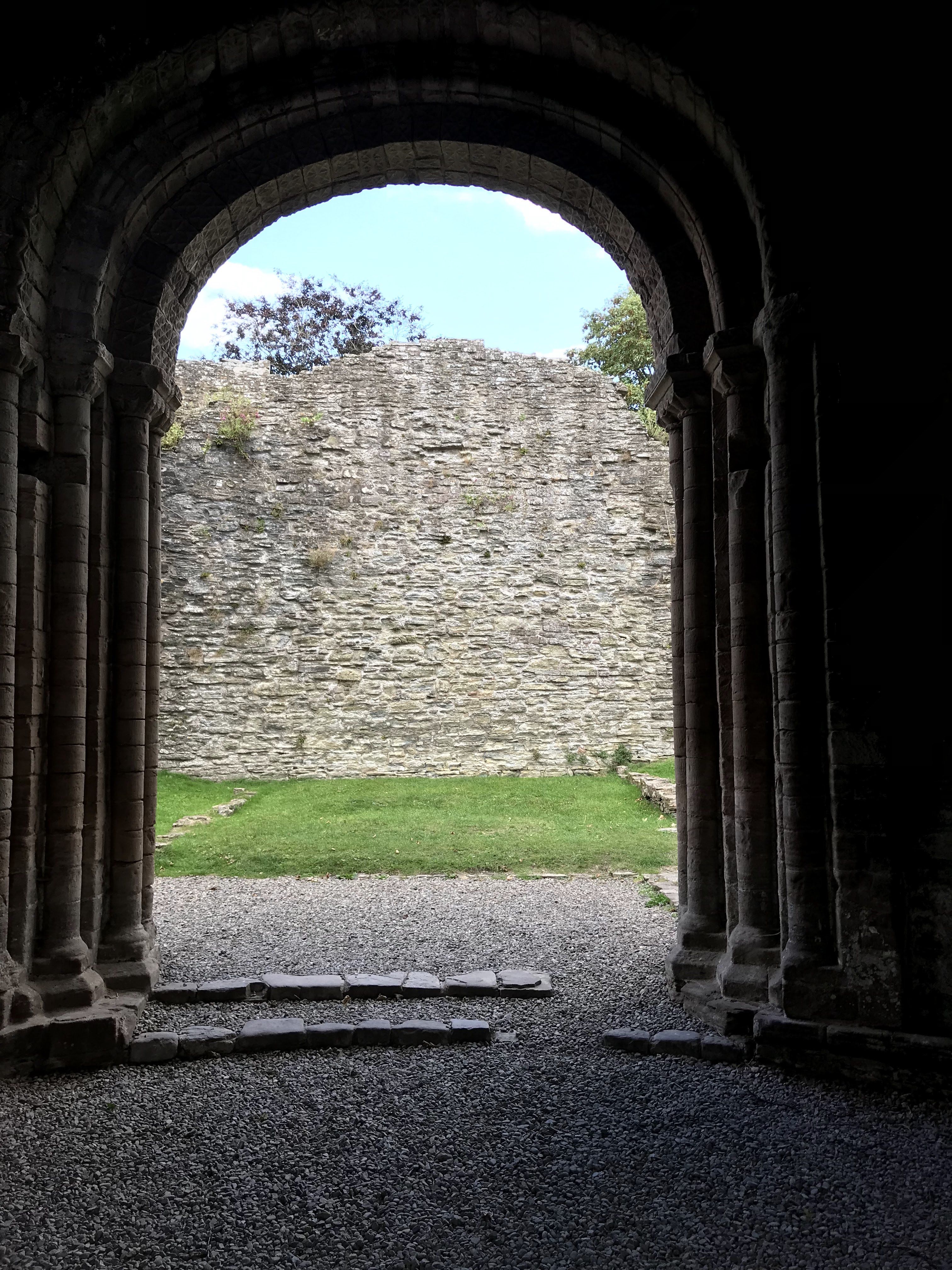
Chapel interior. The walls show where a first floor  balcony would have been laid for those too important to hear Mass with the rabble. 


Through the portal you can see the foundations of the chapel's full extent. 


During the C12th the round Norman chapel was built in the inner Bailey, and the castle extended to form a large outer bailey surrounded by a curtain wall. The main gatehouse is on the east curtain wall facing a growing town. To the west of the curtain wall is Mortimer’s tower, a smaller gatehouse. The Keep , well and the important Northern Range are top left.


The Keep from the inner bailey and the flag of St George. I need to get up there.


Mortimer's Tower on the West curtain wall

View of the inner bailey from one of the towers.

Penetrating the ruins of the Northern Range is akin to wandering around a medieval Escher, with missing ceilings and openings leading to nowhere in particular. But my aim is in sight. The Great Keep which is higher than it looks here. 


The main complex of the castle is now a dark and
gloomy maze


But eventually, we get there

The Keep and the walls from where Prince Henry may have been hooked.


About halfway up. Yaroo!
Magnificent corkscrew stairs. Ideal for defenders allowing space for their the sword arm. Almost impossible for attackers to use theirs. By the time I'd reached the top I was too weak to use a pea shooter. 


The pole without the flag. Bit of an oversight, sorry

That's me up their waving down. My wife had more sense. I was reliving my childhood.

The castle really came into its own during the War of the Roses, when Richard Duke of York inherited the castle following the failure of the Mortimer line. Lancastrians captured it in 1459, but in 1460, Richard’s eighteen year old son, Edward, raised an army from the area around Ludlow and defeated the Lancastrians at nearby Mortimer’s Cross. It proved decisive and Edward became king in 1461.

In terms of famous deaths, Edward’s two young sons, Edward Prince of Wales and Richard Duke of York were brought up there before being taken into ‘protection’ by their uncle, infamous Richard III. They disappeared soon after in the Tower of London.


Arthur, a later Prince of Wales enjoyed married life with Catherine of Aragon in Ludlow, before his premature death in 1502. The excitement proved to much for the fifteen year old boy who'd boasted that he had 'been in Spain.'  His heart, (a euphemism for his bowels) is buried in St Lawrence Church, as seen from the top of the keep.


Outer Bailey and St Lawrence Church beyond


More specifically here:

Close to the High Alter


But back to the castle.

In the C16th Ludlow Castle became the administrative centre of The Council of Wales and the Marches, which met in the Great Hall. A new ‘Judge’s Lodgings’ was built near the entrance to the Inner Bailey, with a first floor bridge connecting it to the round chapel. 


The Judge's Lodgings
Note the Elizabethan style windows

Showing on to the Inner Bailey, Northern Range in foreground.


And the round chapel that once had a connecting bridge to the Judge's Lodgings

In the Civil War, it surrendered to the Roundheads and fell into disuse after the Council of Wales was abolished in 1689.

As for us? We ended our stay in a very nice tea-room with Earl Grey and a bun. 

Carvell's—it was like stepping into an Agatha Christie

Friday, 14 October 2022

Feathers and Ghosts


After exploring Powis Castle we stayed the night in Ludlow, to be precise at The Feathers Hotel. It’s long been on our bucket list, which fortunately fills up as soon as it's emptied. Behind that façade it’s very reminiscent of an illustration I remember as a child. It was from a book of nursery rhymes with a picture of the interior of a large leather boot and the accompanying rhyme.

There was an old woman who lived in a shoe.

She had so many children she didn’t know what to do

She gave them some broth without any bread

Then whipped them all soundly and put them to bed.

I spent hours imagining myself in that shoe, climbing its Escher like stairs and exploring each nook and cranny. Now I was in its equivalent, though it offered more than broth and bread, and we weren’t whipped soundly to bed.


From the street it is hard to believe that The Feathers has 40 ensuite rooms, never mind a Reception, large bar and lounge, and spacious restaurant with oak panelling up to the ceiling; presumably there’s a kitchen  somewhere in there too, certainly toilets.


The building itself was constructed in 1619 and when it became an inn in 1670, a balcony was added to the frontage for electioneering. Inside, it’s an intimate but visual feast, the weird nooks and crannies: Jacobean carved cupboards and chests, and above, richly plastered ceilings, exposed Elizabethan timber-framing and ceiling beams. It even has the original C17th door, which I stroked as I walked through. And, of course, it’s heavily haunted. I now regret we weren’t in room 211, though my wife probably doesn’t.  


But back to important things. The food was excellent, as was the beer. The New York Times was so impressed, it referred to it as the ‘most handsome inn in the world’. And I won’t argue with that. 

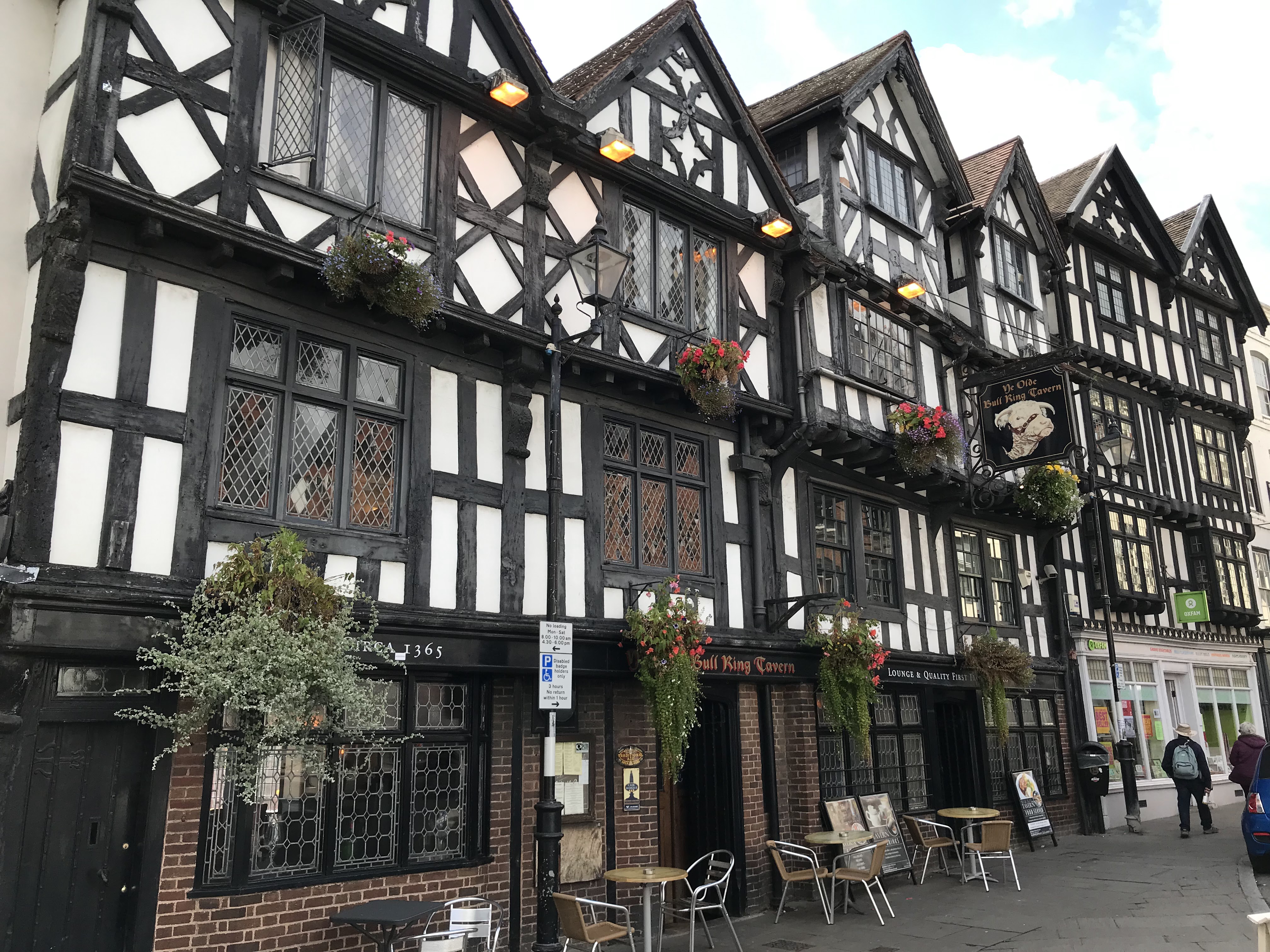
Still, it has its contenders. Opposite The Feathers is the even older Bull Inn and such is the rivalry, they have a yearly ‘Tug of War’ across the street on Boxing Day.


This is the Town Preacher and Lecturer's house. Worth enlarging for detail


Again worth enlarging for detail

There are more Elizabethan and Stuart buildings in Ludlow than you can shake a stick at, and when done with shaking sticks, pubs I could spend a happy week exploring.