Friday, 5 May 2023

And we have Damien Hirst


We went to the Donatello Exhibition last week. I never knew the ninja mutant turtle to be so talented, nor we so lucky. We discovered a tunnel at South Kensington Tube Station that took us under busy streets and busier roads directly to the V&A. Up some steps and ‘Bob’s your uncle’ we were there. It was like discovering the North West Passage or the Harry Potter platform at Kings Cross. 


To celebrate we had lunch in the V&A CafĂ© (not a ‘greasy spoon’ this) and took surreptitious photographs, though why surreptitious I have no idea. People were almost standing in line to snap its various nooks and motifs.


At last, our allotted time to enter the exhibition arrived and for me a name and two dates became suddenly real. Donatello 1386-1466. Until now he’d been only a name I could place in or around certain key events: The Hundred Years War, Agincourt-1415, The Battle of Nicopolis 1396, The War of the Roses, and of course, the Medici. 

Donatello though, just a name until now.


Bust of a man.

Possibly that of the Lord Mayor of Florence, Niccolo da Uzzano, or Neri di Gino Capponi, merchant and politician. We shall never know, though personally I think it looks like the present day Lord Adonis. Uncanny resemblance. I love the way his expression changes as you look at him from different angles.


The Reliquary Bust of San Rossore

Earlier Reliquary busts created idealised images of a saint. Donatello’s San Rossore appears as a real person, a harbinger of the Renaissance to come. 


Head of a bearded man, possibly a prophet. Art historians see his gaze as one experiencing a vision. I was caught by the attention to detail and how long I enjoyed studying it.


Not Donatello but Beltramino's  God The Father. What’s truly striking, apart from the obvious is the painstaking craftsmanship. A copper sheet was hammered from the back to create the complexity of the front that was then gilded. The attention to detail in the contours of the face and beard is staggering. Great art, along with the myriad and unrecorded acts of kindness and  generosity are flashes of light in an age of deprivation and brutality. 


And I’d never heard of rilievo schiacciato before, still can’t pronounce it to the amusement of my wife. It literally means ‘squashed relief’. The technique, mastered by few, conjures up a sense of space and depth within just a few millimetres of carving. 


The Ascension with Christ giving the keys of Heaven to St Peter


Donatello’s use of ‘squashed relief’ conjuring up a sense of space and atmosphere within the shallowest depths of carving.


The Betrayal of Christ. Ligolino di Nerio 


Ligolino was an earlier Sienese painter who undoubtedly influenced Donatello in his use of rocky terrains and inter-reacting figures. I love St Peter’s grumpy expression as he attacks one of the guards with what looks like a pencil.
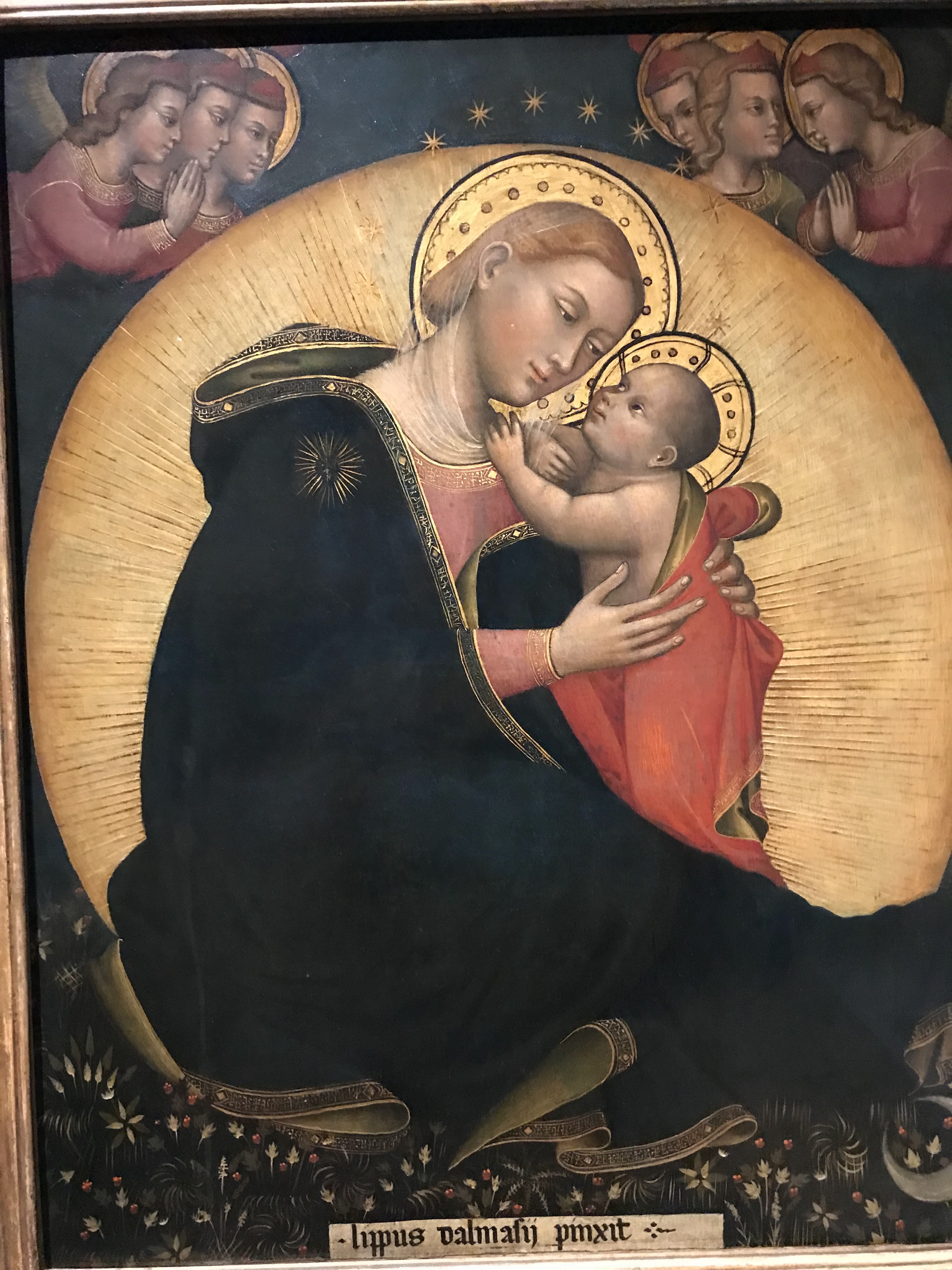


Another contemporary, Lippo di Dalmasio’s The Madonna of Humility (1390)

Its name derives from The Virgin actually sitting on the ground with the Christ Child on her lap.


Virgin and Child (about 1270)

Not an imitator but one who likely influenced Donatello. Giovanni Pisano 1248 to 1319(?) here combines classicism with the Gothic. When viewed from the left, the Virgin’s hand points to the infant, who directs a blessing to the onlooker. It might be just me, but there’s an almost accusatory look in the Madonna’s expression.


The Genoa Madonna


Luca della Robbia was a younger rival and collaborator of Donatello. He used a new tin glazing technique which brought colour and protection to the terracotta surface. The heavenly blue and white figures imitate polished marble.


Madonna of the Apple

Worth contemplating the Madonna’s thoughtful gaze, perhaps signalling her meditation on Christ’s future sacrifice for humanity. The apple perhaps a reminder of the ‘fall’ about to be redeemed.


The Miracle of the Mule

One of four bronze reliefs illustrating the miracles of St Anthony. Its story is simple, the execution complex: a starving mule given a choice between food and the Host, kneels in front of St Anthony to receive communion. The use of gilding guides the eye to the focal point of the Eucharist


Crucifixion 

This is absolutely brilliant and bursting with contrasts – the texture of the draperies and armour, the flesh of the semi clad soldiers, the chiselling of the rocky landscape and roughly worked foliage. As the eye wanders, the reflective gilding draws the eye to the crucified Christ.


Dead Christ with angels.

For those interested in technique, the textiles were hammer formed, Christ’s skin given a smooth sheen, and the feathers delicately modelled in the wax mould. The hair was chiselled in the cold metal after casting for added crispness.

Crucifix

It’s worth focusing on the deep eye sockets and tightly drawn flesh, the fluttering of the loin cloth suggesting Christ is still alive but in his final moments.


The Lamentation of Christ 

Again, emotions are heightened by Donatello’s treatment of the  bronze—the way the polished, ‘soft’ flesh of Christ contrasts with the raw, unfinished surface of the weeping woman 


Don't tell me you don't see Morecambe and Wise here!


Virgin and Child by an unidentified sculptor but associated with a Donatello design. It was painted to imitate gilded marble.


Bronze cherub designed to decorate the organ loft of Florence Cathedral. Art historians highlight its ‘fleshy rotund body’ which made me pause


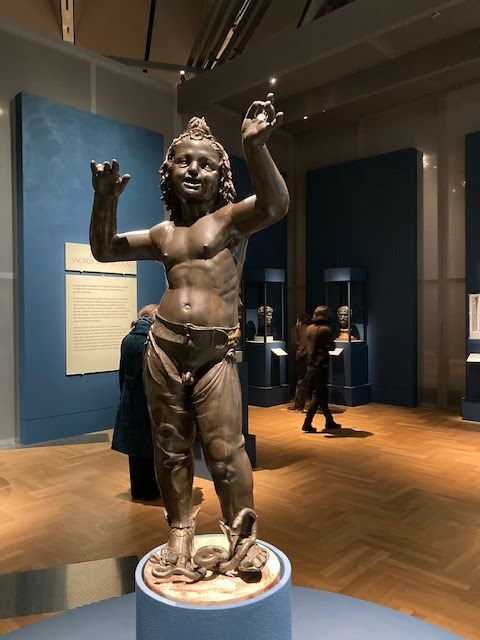
Attis-Amorino


Here Donatello exploits the bronze to create something almost alive. The open breeches suggests the Phrygian Shepherd Attis, and it has the wings of a young cupid (amorino) on its back. And then Donatello gets carried away, giving him the tail of a faun, the winged feet of Mercury, and a snake, most often associated with Hercules


David

I took no photo here - an oversight. Credit Patrick A Rodgers

This was remarkable for the time, being the first unsupported bronze of the period and the first free standing nude made since antiquity. It makes an interesting contrast with Michaelangelo's David made 60 years later. Donatello's bronze is five foot tall, Michaelangelo's seventeen foot tall. One is youthful and slender, the other muscular and mature. 


It was a labour of love going through these photos again and browsing in close up, remembering which were mine, and which  of them were my wife's.

 Something more mundane next week. There's only so much elevation I can take.


Friday, 28 April 2023

Labyrinth: a legend come alive


 I still have the books, almost sixty years old*


I read these two books in my youth, and they had a profound effect, opening up an alien and sun-soaked world, introducing me to the exotic—the ancient past. The window, once open, never shut. I loved Liverpool, my family and friends, its streets and grand buildings, the Mersey—another opening to strange and different worlds; the past though was different, the deep past especially so.


I remember showing the books to my English teacher, Mrs Fahey, a merry, middle-aged Catholic lady who twinkled when she smiled. To my surprise she borrowed and read them, probably  to encourage me. ‘A trifle salacious,’ she said on returning them to me a week or two later. Salacious! A lovely sound. A new word to learn. I’m not too sure she was right, but then again, salacious was good—catnip to the adolescent.


Undeterred, I read more of Mary Renault and a host of others, and more windows opened, allowing me alternative lives in Minoan Crete, Greece, and ancient Egypt. The circus never stopped. 


When my wife suggested a visit to the Ashmolean— an exhibition on the Minoan culture, I hesitated—a momentary perversity of mind. I knew the myths of Theseus and Ariadne back to front and round again, the archaeological story and Sir Arthur Evans. It seemed an awful long way to go (Oxford is just two and a half hours away) to see what I knew and worse, pay for it! A momentary perversity, it was worth every penny—especially the Pithos. 


The exhibition: Labyrinth had spine tingling moments.  


It also  had several evocative paintings based upon  archaeological finds and scraps of colour and surviving frescos.


So yes, yes: a familiar story, to see the actual artefacts, some well over four thousand years old and to wonder how much of our culture will studied in four to six thousand years’ time, the judgements made about us.


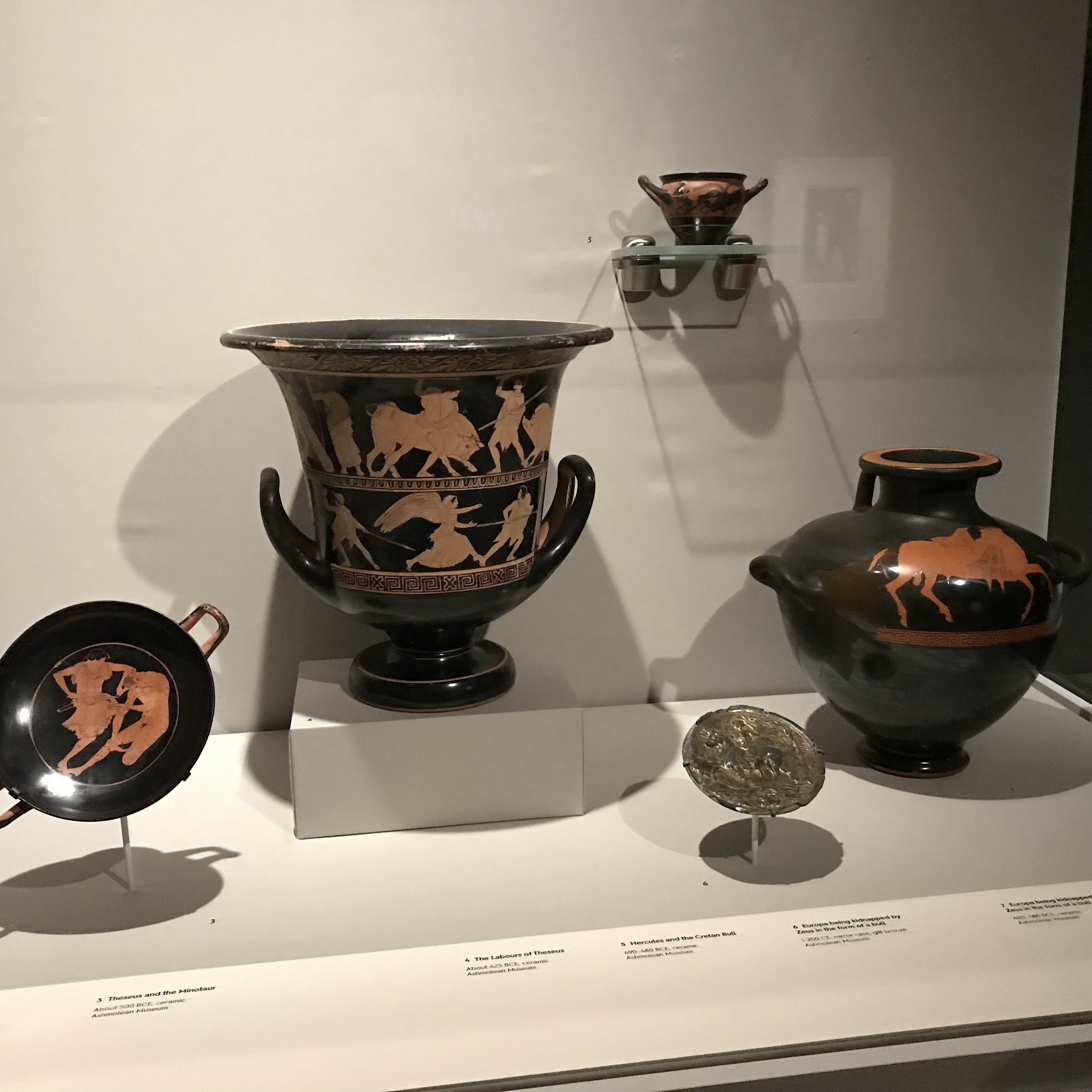
These are a mere 2,500 years' old but illustrate the potency of the Minotaur legend thousands of years after the supposed event. 


'Royal Pottery' so called or if you wish 'interpreted ' by Sir Arthur Evans because of their delicate and intricate pattern. 


The octopus 1450-1400 BC  is portrayed as being underwater surrounded by coral and seawater. As a motif the octopus seems peculiar to Knossos, so many examples having been found there. 


This octopus decorated stone weight represents a 'talent' or a standard 29kg in the Eastern Mediterranean of the time. (600-1350 BC) It would have been used to weigh trading goods like textiles for example. But what boggled my mind was relating that to biblical references like talents of silver or gold etc.  


Tritons are large marine snails found along the Cretan coast. Their shells were collected and used as containers. The one above is a breathtaking copy (1600-1450BC) Carved from solid marble,  a tantalising glimpse of a vanished world.


A gold headband with argonaut beads found in the tomb of a teenager not far from Knossos. He would have been quite rich because other valuable goods were buried with him. (1400-1375BC)


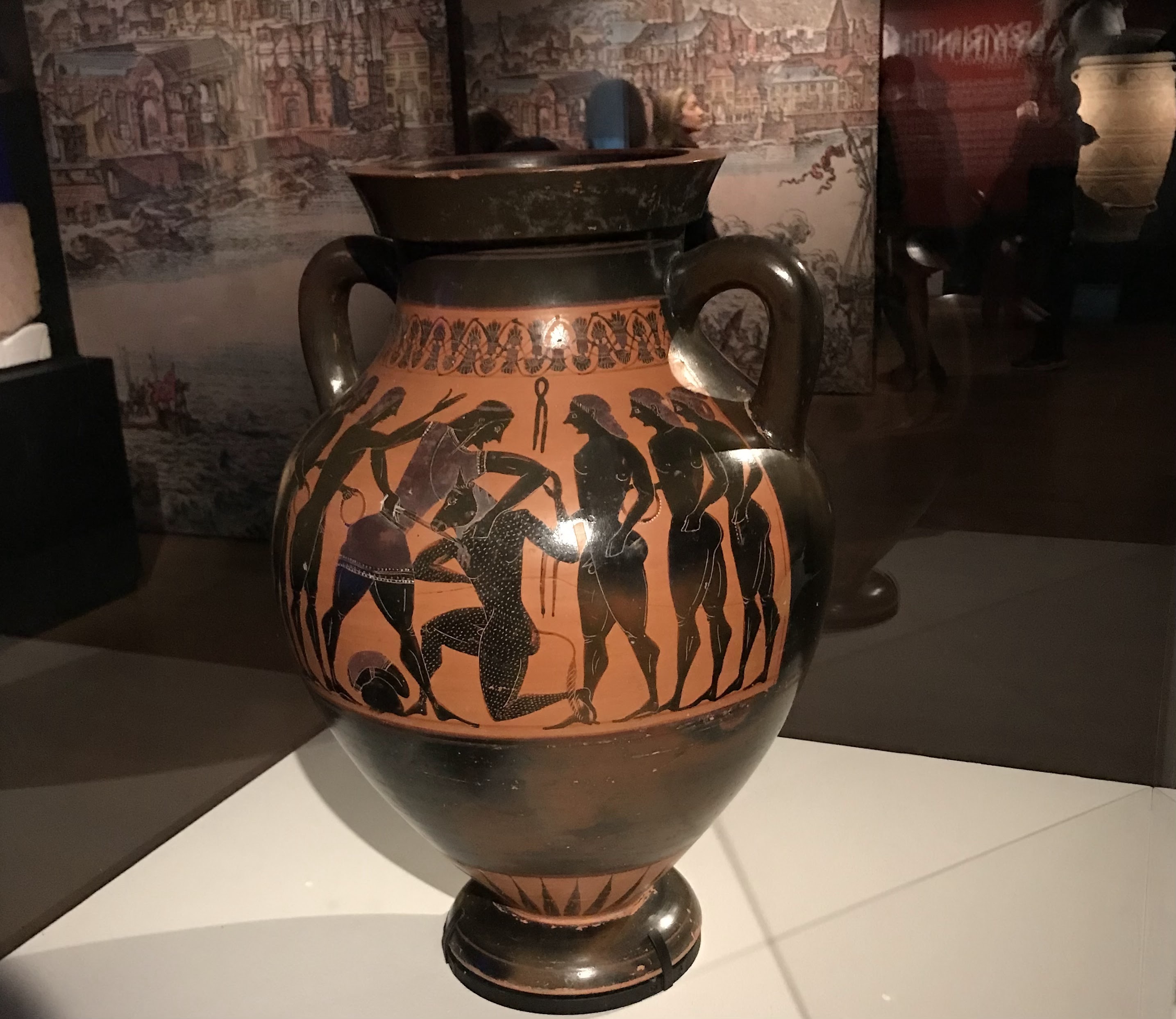
Dated 550-530 BC the Minotaur vase here shows Theseus forcing the beast to its knees before cutting its throat. He's surrounded by the sacrificial victims—Athenian youths sent to the labyrinth every year as tribute to Minos.


A lot of these artefacts range over thousands of years from early Minoan to much later memories of the myths behind the reality. Below is a useful dating chart followed by dated fragments to give some perspective. 


Most of the exhibits were guarded by glass. There was this one spectacular exception. It was discovered by the Greek archaeologist Kalokairinos, whom Sir Arthur Evans ruthlessly airbrushed from history. It's a huge Pithos probably used to store olive oil or similar produce, and is dated 1450 - 1375 BC


It stood with a notice that warned people about touching it and thereby sealed its fate. It drew me almost magnetically. I rationalised it of course. It was thick ceramic, solid, and had survived for thousands of years. The truth was more basic. I had to touch it, however briefly. A surreptitious but lingering stroke was enough and made the whole exhibition worthwhile.  


A 3D reconstruction of ancient Knossos


*The goblets are Welsh not Minoan stolen from the Ashmolean, 

Friday, 21 April 2023

The Queen's Dwarf


Jeffrey Hudson, ironically born in Rutland, the smallest county in England, had an interesting life, at its peak a favourite of Queen Henrietta Maria, falling to the depths of a Barbary slave. Nicknamed Lord Minimus, Hudson was the smallest dwarf in Europe at 18 inches high during childhood and early adolescence. Folklore asserts it was due to his mother choking on a pickled gherkin. 


Luck favoured him at an early age, being gifted to the Duchess of Buckingham when dwarfs were all the rage. Fortune continued to favour him when the Duchess had a wheeze. Entertaining Charles and Henrietta Maria, she served the monarchs a savoury smelling pie, from which popped out the child dwarf dressed in armour and waving a flag. Henrietta was so enamoured of young Jeffrey, the Duke and Duchess presented him as a gift for her ‘amusement.’ 


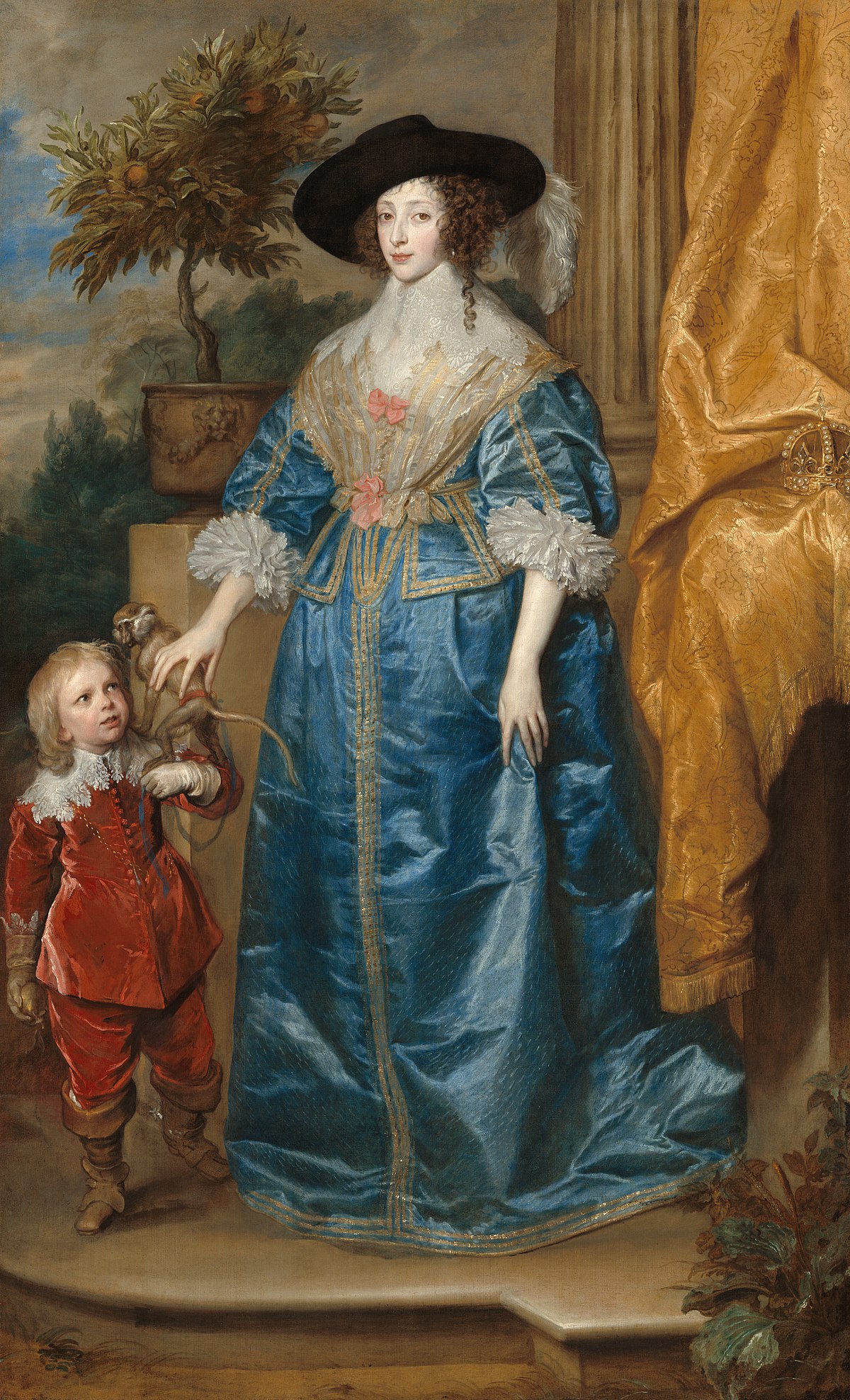
Known as the Queen’s Dwarf,  he became an instant sensation and was painted by Van Dyke as representing “the most perfect imperfection of nature that ever was born.”*


She almost lost him in 1630 when he was sent to France to fetch Henrietta’s favoured midwife. The ten-year-old Jeffrey caused a sensation and was cuddled and showered with jewels by ladies of the court. Events took a darker turn when, on their way home, he and the midwife were captured by privateers off the coast of Dunkirk. 


She’d lost Jeffrey, her ‘human thumb,’ and the midwife of course. The queen was distraught and moved heaven and earth to effect their release. 


A few years later, she lost him again, this time for good. It may be that an adult and mature Jeffrey had become tired of condescension, whether affectionate or sly. Be that as it may, he made a fatal mistake.

In France with the queen, he fought a duel with the brother of William Croft, another favourite of the queen and captain of her guard. The nobleman in question thought it all a huge joke and charged at Hudson firing a water pistol. Hudson shot him in the head. 


Killing a noble was bad enough; worse, duelling was a capital offence in France. Again, Henrietta pulled strings and his sentence was commuted. He was banished from the country.


He must have breathed a sigh of relief in the Channel and seeing the white cliffs ahead but fate is a tricky beast. He was captured by Barbary pirates and Hudson spent the next twenty-five years as a slave. 

The queen never saw her favourite dwarf again, though she may have unwittingly ransomed him when she paid for the release of a number of English slaves—something she occasionally did as an act of charity. There was, however, no reunion. She died in 1669, the year records show him arriving back home. 


In 1676, and now an old man, he visited a greatly changed London but was arrested for being a Catholic. Released in 1680, he died in relative poverty two years later.  It's a shame he couldn't have lived long enough to see his little green trousers sold for £10,000 a few years back.


* In middle age he achieved a growth spurt and reached the height of 3 6 Hard labour as a slave in North Africa may have been responsible, though Hudson attributed it to hard buggery by his captors. 

Friday, 14 April 2023

Harlots with Golden Tresses


This is a wonderful book, with Charles I’s queen as its focal point. In this respect it is quite a feminist take on a turbulent period in British history, the civil war seen from Henrietta Maria’s perspective. The book is also a treasure house of the arcane and a reminder that even the most powerful women of the time paid a price for their position—giving birth being a prime example.


Of course, the rich enjoyed some perks in that respect. You could for example pay for a freshly flayed skin of a black goat to wrap yourself in and thus slow down post-partum bleeding. And if you were a queen you enjoyed a state bed of red velvet embroidered with gold in a grand pavilion—the birthing room then had to be quite large to hold that, a separate ‘bed of travail’ for the actual labour and the ‘chair of travail’ for the pushing out. It also had to be large enough to hold all the courtiers ushered in to see the newborn child. I’m sure there’s a Reality TV programme in there somewhere.


On the 22nd September 1601, Marie de Medici sat in her ‘chair of travail’ with a small audience to witness the state event. She sought to maintain her dignity by remaining silent during the painful event whilst her husband Henry IV begged her to scream for fear her throat would swell and then burst. “When the child was born, Marie fainted and she was still lying on the floor when the proud father ushered in 200 courtiers to celebrate. ‘Don’t be angry,’ Henry told the horrified midwife: ‘This child belongs to everyone.’"

The child who belonged to everyone was the future Louis XIII who, at just two days old, had small incisions made into his mouth because his sucking reflex was deemed insufficiently strong – in the opinion of royal doctors. It left the future king with a lolling tongue and a stammer.


 Henrietta Maria was the last of the royal children. Born in November 1609, she never knew her father who was assassinated just six months later. His assassin was suitably punished.


 “The execution took place on 27 May in the Place de Greve where Ravaillac was tortured again before being slowly torn apart by horses. Even this did not satisfy the crowd. The remnants of flesh and bone were stamped on by the Parisians, stabbed at and eaten, then a bonfire was lit beneath Marie’s window to burn the scraps.”


The proxy wedding between fifteen-year-old Henrietta and twenty-four-year-old Charles had a bumpy start. The naĂŻve Henrietta with orders from the Church to aid the cause of Catholicism, found herself in a violently anti papist country and was subjected to the insolence and sly manoeuvres of Charles’ best friend, the powerful Duke of Buckingham. Despite all this the marriage flourished even as the country floundered into Civil War. 


The hatred and bigotry of the time is masterfully described, two particular examples coming to mind.

Henry Marten, no puritan but a ‘great lover of pretty girls’ had a personal axe to grind against the king who had called him a ‘whore master.’ His companion, Sir John Clotworthy, was a violent Presbyterian, on one occasion murdering a hundred Irish prisoners in cold blood.


In 1643, with differing motives and accompanied by soldiers, they now set out to destroy Henrietta Maria’s private chapel in Somerset House. 


Clotworthy took particular offence at a Rubens crucifix in a gilt frame. Grabbing a halberd, ‘he struck Christ’s face in contempt with such offensive words it would be shocking to repeat them,’ (A French witness) He next attacked the Virgin Mary’s face, then directed his fury on the crucified Christ, ripping the painting to shreds. Next an enormous ceiling painting of the Assumption was destroyed. The vandalism was mirrored across London and later the country. 


The altarpiece in Henry VII’s chapel in Westminster Abbey was similarly smashed, including a carving of the dead Christ designed by one of Michelangelo’s pupils. It was, in the words of the grieving Venetian ambassador: ‘one of the finest ornamentations of this city, admired by all foreigners for its antiquity and the perfection of the beautiful marble carvings.’ The vandalism of the self-righteous is a recurring theme throughout history.


The book, too, is a useful corrective to films such as Cromwell, which show him and his ‘Ironsides’ as essentially heroic. Seen from Henrietta’s eyes, reality has a different slant. A case in point, rarely mentioned in popular histories, is the fate of the Royalist ‘camp followers’ after the King’s defeat at Naseby. Cromwell’s cavalry slaughtered and mutilated these women. Four hundred or more were killed, others had their noses and mouths slit, marking them forever with the ‘whore’s mask’. The atrocity was celebrated in the Parliamentary press as just desserts for these popish ‘harlots with golden tresses.’


And yet Henrietta Maria survived, fighting heroically against all the odds for her husband and then her children after Charles was beheaded. Following the Restoration, when her eldest son became Charles II, Henrietta returned to the country she had come to love. It’s not surprising perhaps her appearance had changed. Samuel Pepys described her as ‘a very little plain old woman and nothing more in her presences or garb than any ordinary woman.’ She was though extra-ordinary.

Thursday, 6 April 2023

Ulf and the Oliphant

In or around 1030 AD Ulf, a Viking noble strode down the nave holding his Oliphant. He placed it carefully on the altar; carefully because it was filled with wine.

An oliphant, as the name suggests, was carved from the tusk of an elephant and quite often used as a war horn, sometimes marking territory, occasionally used as a drinking vessel. 

In this case, the wine-filled oliphant was a symbol of a substantial gift of land—a small but interesting  acorn from which the present York Minster emerged in its present form and glory.


And the  much whiter statue on the front is clearly


the recently deceased Elizabeth II seen close up


Ulf did good.


As you can see, the oliphant is beautifully carved, the animal motifs copied from Syrian and Babylonian art and probably made in Southern Italy, a testament to the sophisticated trade routes of the time.


 I think I enjoyed the crypt and undercroft almost as much as what was above. Both are  treasure troves  of the Minster’s past. They offer glimpses of a previous Roman building, its foundations and some walls. The   crypt also houses the  tomb of St William, the patron saint of the Minster. 


There are so many saints, it is hard to keep up with them all. William for example had slipped  through my radar.  He was appointed treasurer of York, and King Stephen’s chaplain in 1130, and is the patron saint of victims of injustice. Clearly an over-worked saint. For those interested in his miracles and his possible murder you can read it here


And this casket dated to 1148 is believed to be the personal reliquary of St William himself. It probably held the heart of a crusader and pilgrims would hope to draw strength by touching it. 


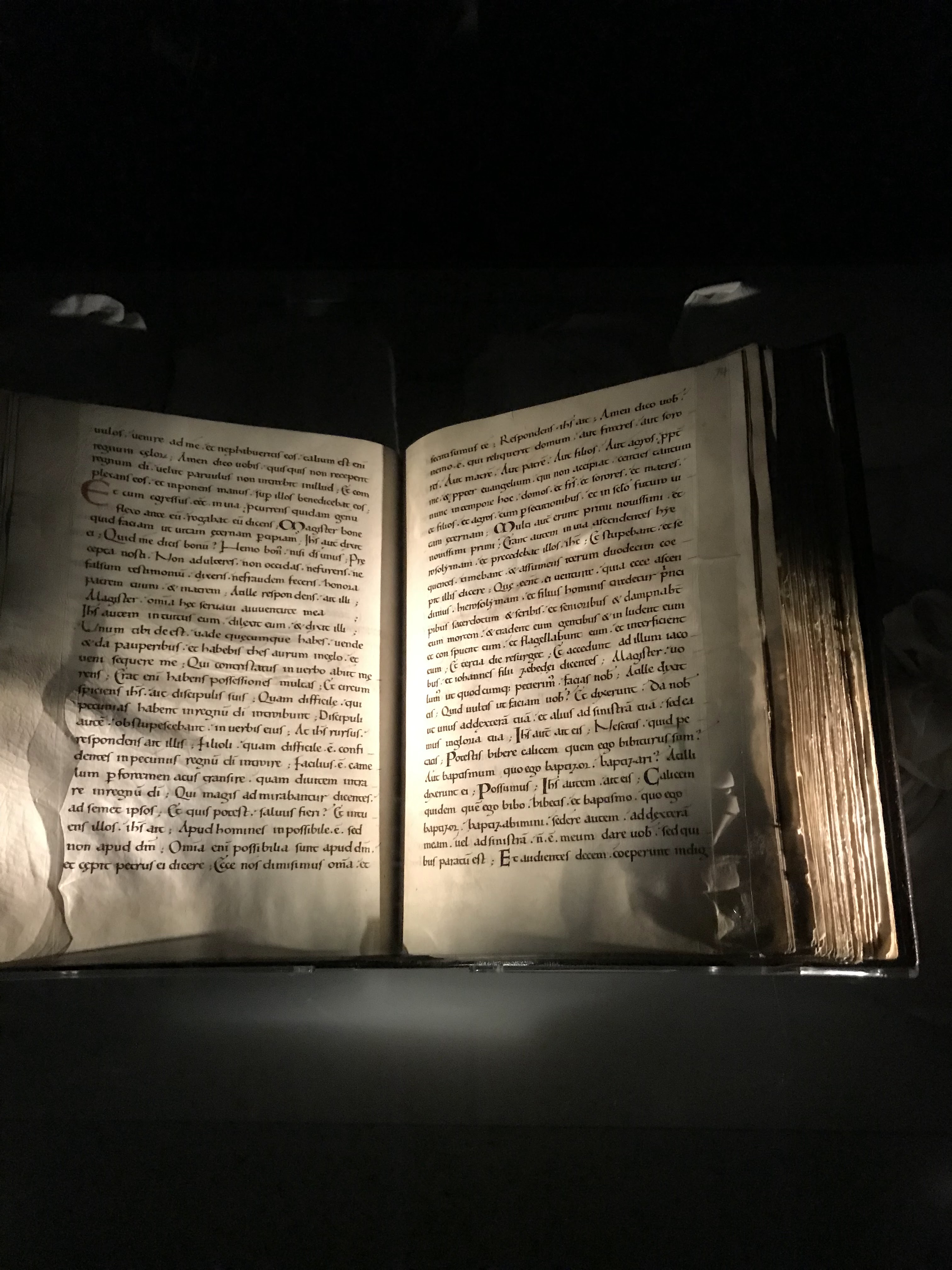
You'll also find the thousand-year-old York Gospels here,  probably made by Anglo Saxon monks at Canterbury around 1020 and brought to York by Archbishop Wulfstan. It is the only book from before the Norman Conquest to survive at the Minster, and for centuries new canons have sworn their oaths of allegiance on this book – right up to the present time.


And this, a survival from the first Norman Minster,  is a Doom Stone, something that would come horribly alive in gloom and flickering candlelight.  It shows the ‘mouth of Hell’- a gruesome scene of lost souls being relentlessly pushed into a boiling cauldron by demons. At the top left you can see a man carrying two bags of money, a symbol for greed. To his right is a woman showing the sin of lust. The stone is also decorated with toads. Thought to be creatures of magic, they were associated with evil and darkness. It may have formed part of a much larger image on the west front of the C12th Minster


Above the crypt the Minster soars to the sky, the Norman structure that replaced the Saxon replaced in turn by the more graceful perpendicular. Inside, you walk past the sacred and, shall we say, idiosyncratic,

 and you drift slowly by as though in a dream.


The Quire, with comfortable seats for its choristers


Above, the benches and below the stained glass and roof of the circular Chapter house


Peaceful light in the nave

A knight's tomb


Another tomb, husband and wife suitably prayerful 

And another tomb, the wife clearly having the last word

But my favourite are the kings of England carved in stone. If you look closely at the exuberant beards and the various expressions, you can see the sculptors were clearly enjoying themselves. All of the monarchs are shown with their right foot forward except for Edward II a king reputedly fond of men. The sculptors, perhaps as sly comment or purely by coincidence carved him with his left foot presenting. 


Kings from William the Conqueror to a very irate King John


And above, the kings from Henry III to Henry VI


I was though struck by the fact that in this Cathedral of York, every one of the Lancastrian kings are shown but not the two Yorkist kings, Edward IV and Richard III.


The answer was reasonably prosaic. When the Yorkist  Edward IV was on the throne, the original statue of the Lancastrian, Henry VI was, as you'd expect, destroyed. Unfortunately Edward didn’t live rule long enough for his statue to replace the unfortunate Lancastrian; Edward's brother Richard III had an impossibly short reign. And if  you look closely at that last statue, a replacement of the original Henry VI, you can see it’s markedly different from the rest.  The reason is,  it's a Victorian copy, weathered by time as Elizabeth II on the outside of the cathedral will also  be in due course.