Friday, 1 December 2023

The Mingan Archipelago


Our first stop at the mouth of the St Lawrence was Havre St Pierre. It was cold, the rain unrelenting, but it was good to get off the ship, or so we thought at the time—especially since we had a destination: a Tim Hortons coffee bar. To be honest there was nothing else in walking distance. A mile or so along the waterfront and turn left. It seemed easy enough. And to  be walking where the St Lawrence met the sea.


The rain ultimately dictated otherwise. Nevertheless, we persevered for a time, trudging, heads bowed low,  along a grey and dismal waterfront, a line of pretty looking bungalows to our left. Ultimately common-sense broke through along with the rain. We were sodden and had yet to face an excursion to the Mingan Archipelago in the afternoon. We never did enjoy a Tim Hortons coffee, (though ironically we drove past a branch in Warrington a few weeks later in the UK)


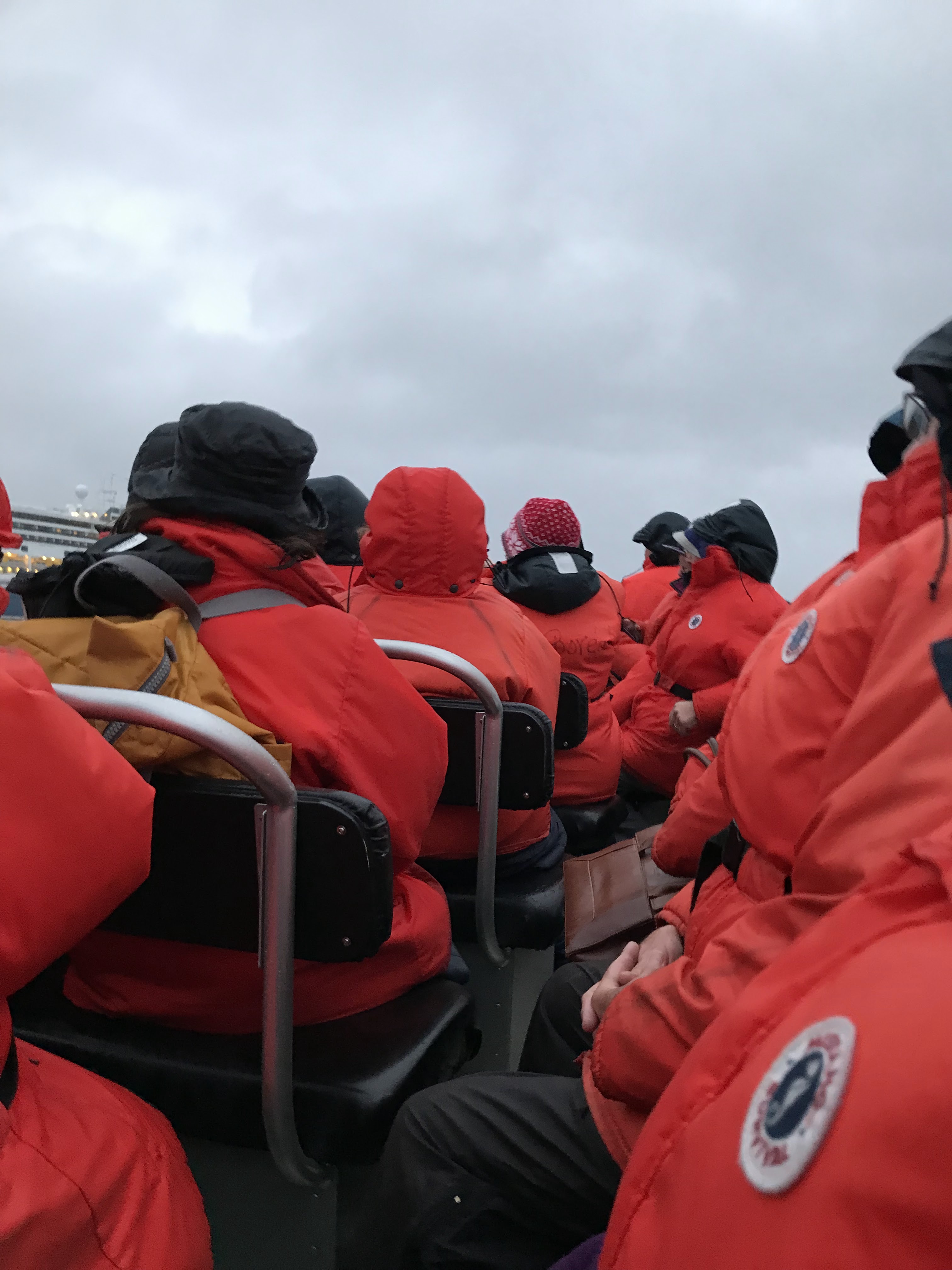
The journey to the archipelago was an adventure in itself, a twenty-five-minute boat journey through heavy seas and a thickening drizzle. Dressed in orange, fluorescent waterproofs, we looked formidable – The SAS on a mission, or perhaps a branch of the RNLI out on a jolly.


The park ranger, a merry French woman, guided us over the island, speaking fractured English through loud bursts of laughter.  


The landscape was bleak, the merriment welcome 


The island oozed melancholy though she assured us it was beautiful in summer. I wasn't convinced—and there'd be midges.


Eventually, we reached what I had been dying to see, and where, despite the drizzle, I could have stayed longer. 


The archipelago we had sailed through and what we now walked on are mind bogglingly ancient. In the words of a botanist, I’d never heard of before: ‘…the Mingan Islands are daughters of the sea; they are fragments, pieces of an ancient land slowly deposited in the bottom of the ocean…’

The North Shore Canadian shield itself is nearly a billion years old. Vast rivers once crisscrossed the land, eroding and carrying rock particles into unknown seas. This sediment, combining with the remains of marine organisms, slowly formed a limestone sea floor. 


Millions of years later the earth’s crust shifted, and this limestone seabed emerged as a large plateau. Limestone is friable and over time, the criss-crossing rivers carved deep into the limestone plateau. turning it into a series of discrete and separate entities—the Mingan islands. 


The monoliths, now dominating the beaches are examples of time and erosion creating natural works of art.


A mere 20,000 years ago, great icesheets, two and a half kilometres deep covered the whole of North America and the archipelago. The ice pressed the land down. When the earth grew warmer, the ice melted, and water levels rose, though slowly (ten thousand years ago the present archipelago was still 85 metres beneath the sea.)


2,800 years, later the islands fully re-emerged and the erosion really took off. What we walked around are the results––monoliths of friable limestone carved by ice,  rain and wind 


The sea, here quite placid, has worn the land down leaving the  limestone silent sentinels.


An alien landscape like three dimensional Rorschach patterns, you see what you want to see: from a distance cyclopean ruins, closer up, unearthly monstrosities, alien beasts and alien runes.      


A dog, back of a giant cat, rhinoceros, gargoyles and monsters. I tried to imagine walking through them at night under a full moon.


A naked torso dominating Cthulhuian walls


Close ups of erosion in action, definitely alien script in one form or other


Warmth and luxury in sight.

And here, an epiphany. A dolphin no one else saw but me (my wife says she believes me) as we were setting off I just casually looked over my shoulder. A few feet away a dolphin surfaced and slid silently back under water. The thrill of the sudden.

Friday, 24 November 2023

Vikings!


Keenly aware of their Norse heritage and aware, too, of the Leif Erikson legend, the Olsens financed and encouraged two archaeologists, Anne and Helge Ingsted. Their mission was simple enough:  explore Leif Erikson’s route and find the evidence that Vikings had settled in America. 


The Ingsteds hadn’t been the first to search for evidence, most of their predecessors focusing on Erikson’s reference to Vinland and searching farther south where grapes were more likely to grow. The Ingsteds re-interpreted ‘Vin’ as old Norse for meadow and consequently searched farther north. It also seemed logical. Northern Newfoundland is close to Greenland, where the Vikings were already established.


 After a painstaking exploration of the coastline, studying sagas, and talking to locals and fishermen, they at last found their evidence. It stood on the northern tip of Newfoundland at a place called L’anse aux Meadows.


 There are variations in the Saga accounts. One version has it that Leif Erikson was blown off course on a return trip from Norway to Greenland and discovered America largely by accident. Another account asserts, the whole thing was a planned expedition, that a previous Viking Bjarni Herjolfsson had similarly been blown off course, discovered an unknown coast and returned to Greenland with the story. According to this saga, Lief approached Bjarni, gathered a crew of 35 men and sailed in the direction Bjarni described. They landed, over-wintered and left a small settlement. Lief himself returned to Greenland for more supplies and men but never returned. Others did, including a tough old bird called Gudrid Thorbjarnardottir, the widow of Lief’s brother Thorstein Erikson. She married Thorfinn Karlsefni, a powerful warrior, and in the New World gave birth to a son, Snorri Thorfinnsson—the first European child born in America.


A modern reconstruction of a vicking turf house based on evidence found.


Climate change saw both Greenland and Newfoundland become less clement; the Viking settlement, largely constructed of wood and turf, vanished from history until very recently. Arial photography and carbon dating of wood excavated at the site further reinforced the saga accounts.


Climate change, I could have done with some of that just then. It was bitterly, bitterly cold, and just a few steps away was comfort, hot coffee and warmth; what was I doing here, shivering on deck, staring at a few unremarkable bumps on the horizon in search of a few hairy has-beens?


 Unworthy thoughts. Hot coffee could wait. We were sailing in the wake of heroes, trying to recapture the thrill of seeing land, now inhospitable and  bleak but less so a thousand years ago. It took an imaginative squint, several imaginative squints to see these hazy whale-like lumps as a Viking might have done. New land, and the important question, what lay beyond?


This may be St Anthony a more modern settlement sixteen miles away. 

Wednesday, 15 November 2023

St John's, Referendums and Ghosts


St John's just before dawn


Our first port of call was the capital of Newfoundland, St John's where we were blessed with an exuberant and passionate guide who got us under the skin of a truly unique community. St Johns is a natural harbour, a port of refuge for sixteenth century French and Portuguese fishermen. 


It must be said, they lacked the chutzpa and acquisitive instincts of  our Sir Humphrey Gilbert who, in August 1583, planted his flag and claimed it for the English crown. A simpler time. 


No good deed goes  unrewarded. On his way home to England, Sir Humphrey was shipwrecked off the Azores. For the full and detailed story of how he claimed Newfoundland, read this eyewitness account here. You can scroll down the tedious maritime details until you get to him in St Johns. His self confidence is breathtaking. 


St John's had its ups and downs during the C18th when Britain and France fought for control of Canada and much of the world. British victory saw peace for a time and Newfoundland happily slumbered until 1948—when it experienced two referendums. The first referendum offered Newfoundlanders the choice of remaining under British control, joining the new Canadian Confederation, or embarking upon a close, economic union with America. One can imagine the rubbing of hands behind closed doors in the White House. 


For that first referendum, Newfoundland voted narrowly in favour of sticking with Britain, perhaps to the embarrassment of the British Labour government, which was financially strapped and had no great enthusiasm for retaining what they saw as an economic burden. Interestingly, the option of a closer union with America was not offered on the second and decisive ballot. 


For the second referendum,  all the stops were pulled out and the struggle between the two sides was vicious, intense, and reminiscent of Brexit. The Catholic Church was in favour of ‘remaining’ with Britain. Those favouring confederation with Canada were forced to play ‘dirty,’ mobilising the Orange Lodge and calling upon all good protestants to vote for union with the mainland. Like Brexit and the last Presidential election, there were rumours of widespread voter fraud and the dead coming alive again to vote. The Confederates won by the narrowest of margins. There are some not reconciled to this day. 


Speaking of those arising from the dead, St John's is chockful of ghosts; two currently reside in or around the Anglican cathedral, another in a nearby Masonic lodge, and a third in the Duke of Duckworth – which also sells some excellent beer. 


The Duke of Duckworth


An accurate reflection perhaps of the effect of its beer


On to more salubrious topics. The Anglican Cathedral, St John the Baptist, dominates a hill upon which a Methodist Chapel, a Scottish Kirk and a Catholic Cathedral—also called St John the Baptist—sit in close proximity. 


The Methodist Chapel with some stunning stained glass windows inside.


The Catholic Cathedral of St John The Baptist


The Anglican Cathedral of St John the Baptist


All church photos credit. BM Keyton

The original wooden church dates back to 1699 making it the oldest Anglican parish  in Canada. The building of the stone church began in 1843 but was largely destroyed by fire in 1847. Perhaps God is a Catholic and objected to two Cathedrals in close proximity bearing the same name.


During the post fire  rebuilding,  a young stone mason fell to his death. His spirit though lingered, glimpses of him seen every now and again by his fellow workmen.  In this group photograph shot in 1850 ––years before photoshop or AI skullduggery––you can glimpse him too. Look closely to the left of those in their Sunday best celebrating the opening of the nave: a man in work clothes—transparent—the stonework clearly visible behind him.


More ghosts haunt the adjacent Anglican graveyard  dating from 1699. It's estimated some 20,000 bodies have been buried there, one on top of the other.  Heavy rains and ground movement quite often means that  bones are unearthed and found on the adjacent pavement. 


Most of the corpses lie in unmarked graves.  One such corpse  was  that of an unknown seaman discovered dead in an alleyway. A grave was dug, his casket lowered into it, the hole near-filled—when a loud knocking was heard. The casket was hurriedly retrieved, the body re-examined, and once again pronounced dead. The body was returned to the grave when once again the same thing happened. After the third such reoccurrence the man was buried this time for good. Though the knocking continued. 


On McMurdo’s Lane stands the Duke of Duckworth where I sampled a pint of Quidi Vidi (Look it up. Well worth a drink or three) but failed to see its famous ghost nicknamed ‘the Duke.’ Several have seen him in the window, waving at passers-by, others have sensed or glimpsed him in the pub itself. Maybe if I had stayed longer….or drank more Quidi Vidi, but there was a ship to catch. 


Ship seen here peeping coyly behind buildings.


 Still, time for a little more sight-seeing


There are various reasons given for the brightly colours houses. The proximity of the Gulf Stream and the colder Labrador current give rise to dense fogs,* and the winters are dismal. Colour cheers the soul and aids visibility in mist. The flat roofs too have a story behind them. Another great fire, in 1892, destroyed much of St Johns and to this day is remembered as 'the great fire.' Rebuilding was hurried and flat roofs were easier and relatively cheap. 

 * Because of the many dense fogs, moose are a problem, cars crashing  into them on misty roads. During such fogs many roads are closed to protect both motorist and moose.


And finally, it was time to leave hopefully with better luck than Sir Humphrey Gilbert.


·   


Next stop—in search of Vikings.