Friday, 24 February 2023

Hubert, Bridget, John, and the witch


Skenfrith, or if you wish Ynysgwynwraidd* lies on the banks of the Monnow ten miles northwest of Monmouth. It houses a fine pub called The Bell, a C17th coaching inn on the old road from Ross to Abergavenny, and one of the three castles built to hold down this area shortly after the Norman conquest.


As well as the castle, Skenfrith also boasts St Bridget’s Church, mentioned in 1207 and enlarged in the C14th. The village has been used in the Dr Who episodes ‘Amy’s Choice’ and in other episodes name-checked as the village ‘which time forgot.’

We went there last Wednesday. 


My man, Hubert de Burgh, rebuilt the original castle as a state of the art early C13th fortress. An experienced soldier, he’d held many castles for the king in both England and France and had seen the advances made in military architecture. Hubert’s layout of a round central keep surrounded by a curtain wall foreshadowed the ‘concentric’ design of later castles like Beaumaris and Caerphilly. 


In its prime


Today


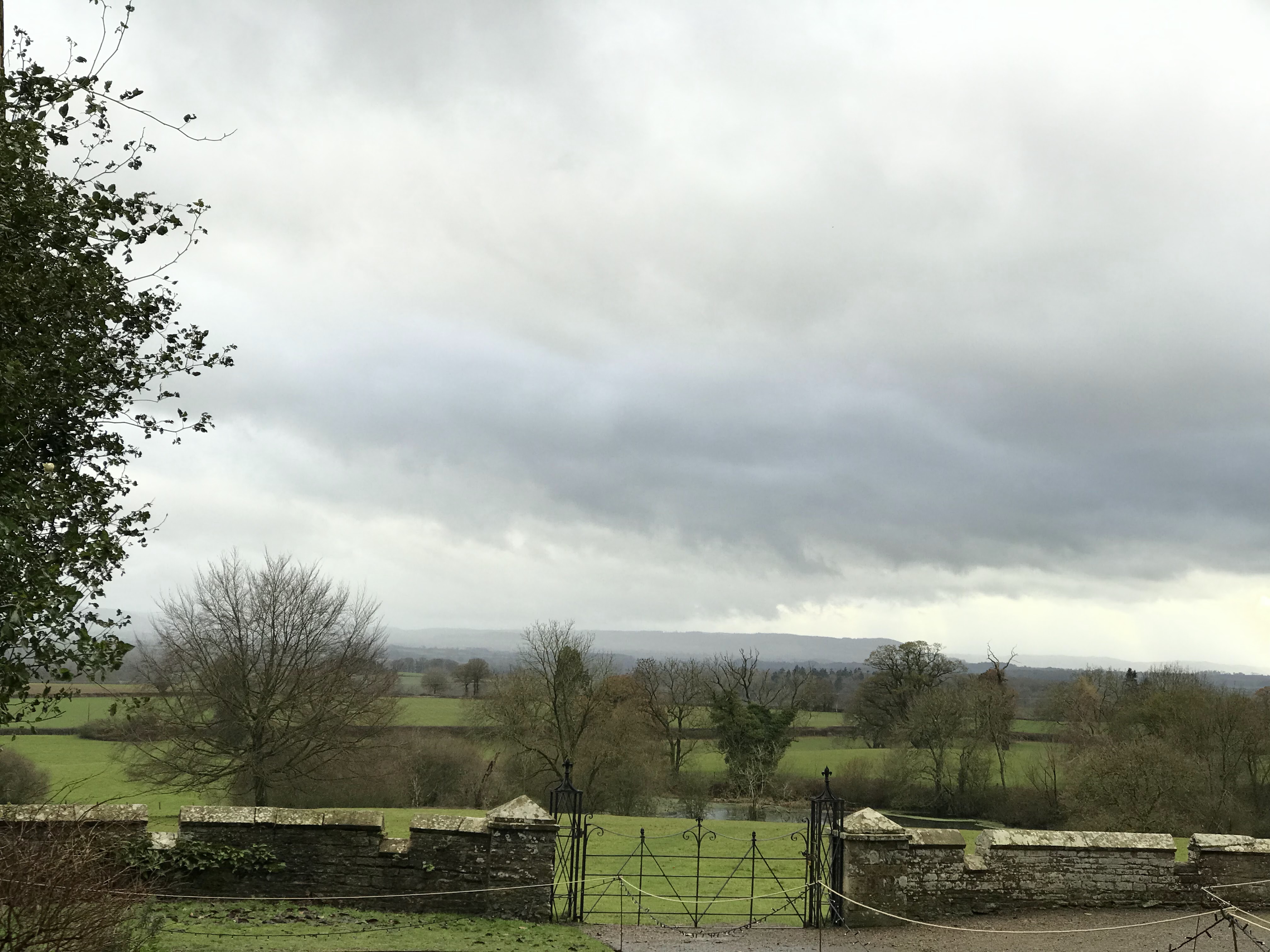
You never get a bad sky in Wales


The castle was built on low ground near the river and its crossing points into England. Strategically it made good sense but with one disadvantage. Built on low ground and surrounded by hills, it gave an advantage to those who attacked the castle. See photos above.


Hubert’s keep was the solution, dominating the castle and built high enough for its defenders to scan the surrounding countryside. Hubert’s private accommodation took up the two middle floors, height protecting it from winter floods and a great fireplace to warm his bedchamber. 


And inside the tower, stone work that grabs the eye


These mysterious steps lead to the watergate


 as you can see. 

Note how far away the river is today


Skenfrith stood guard over key crossing points on the River Monnow. Other strategic advantages included unlimited fresh water.  In a previous warm period (global warming anyone?) the river was deeper and ran right up to the castle’s walls, which allowed the channelling of a moat on the other three sides. Being deeper, the river was also navigable for barges bringing supplies, as the ruins of a nearby wharf indicate. 


A couple of welsh warriors reincarnated as trees

Another tree with an identity crisis


In sight of the castle stands St Bridget’s Church, one of the oldest churches in Monmouthshire still in continuous use. The church was consecrated in 1207, extended in the late C14th and once more in the C17th. Note the squat and sturdy tower with its wooden belfry and the single huge buttress. No big bad wolf is going to blow this house down. 


The stone altar is original, hidden under the church floor during the Reformation to save it being destroyed by Protestant zealots. 


I tried to avoid the reflections, but couldn't. What's so wonderful about the two lists is the sense of history they impart and the questions they beg. What happened to David Lewis  and his unnamed successor during the English Civll War? And how did Lewis Parry make his peace with the new king following the Restoration of 1660?


And then we have the Lords of Skenfrith, some famous, some less so. The last governor of the Three Castles, John Morgan, is buried in the church. His fine tomb stands weathered by time but evocative still. 


The chest tomb has the effigies of John (d. 1557) and his wife Anna (d. 1564) and on its sides, beautifully carved figures of four kneeling men, likely their sons, four unknown women on the opposite side with wonderfully detailed costumes, and the couples' respective family coat of arms  at either end. 


And facing the church, clearly a witch's cottage, broomstick at the ready.


*  Ynysgwynwraidd is Welsh for ‘Island of Cynfraeth’  - best guess a local C6th ruler – re-anglicised to the more easily pronounced Skenfrith.


Friday, 17 February 2023

Slow Horses


I finally got round to all but finishing, Mick Herron’s ‘Slow Horses’ series and would thoroughly recommend them, though with two and half small caveats. The premise is a necessary though perhaps unlikely conceit: unable to fire unsatisfactory operatives without involving HR and/or threaten security, those who MI5 are unable to dismiss are sent to Slough House, a dismal building sandwiched between a Chinese takeaway and a derelict Newsagents somewhere near Aldersgate tube station. There they are encouraged to quietly resign, unable to cope with the menial and soul-destroying tasks given them by the monstrous and politically incorrect Jackson Lamb. Politically incorrect, I must warn you, is too weak a phrase. Lamb tears up the rule book: a fat chain-smoking, alcohol abuser, with a gift for farting at inopportune moments and coming out with what would spark demonstrations if uttered by the likes of Jeremy Clarkson. 


Sly racism or pure comedy? Lamb commandeers a car from an Asian underling called Rodney Ho. He’s in a hurry and tells Rodney to ‘Chop Chop.’ And calls after him: ‘And when I say Chop chop, I hope you don’t think I’m being racially insensitive. . .  only you Chinks can be pretty thin-skinned.’


He treats a black operative in much the same manner riffing on ‘Spade’ and casually suggests to yet another colleague, a struggling alcoholic, that he thought she must be on her ‘third stomach pump’ by now.


No one is immune to Jackson Lamb’s put downs. In terms of being non pc he’s very much an equal opportunities kind of guy. When a non-spook, a dwarf called Reece is in the room, Lamb is warned not to give too much away:  

'You’re aware we have a civilian in the room?’

‘I wouldn’t worry,’ said Lamb. ‘This is going way over his head.’

‘Does the term ‘punching down’ mean anything to you?’

‘Be reasonable. If I punched up, I’d miss him by a mile.’

(When the subject of this mockery fights back with): ‘Can we move on to the fat jokes now?’

Lamb looked hurt. ‘There’s no need to get personal.’


Jackson Lamb is monstrous, complex, damaged and very funny, though the perpetual farting is in danger of being overused. But back to the humour:

Lamb rolled his eyes. ‘God, you’re a drag to have around. Moan moan moan. It’s like being shackled to the ghost of Bob Marley’.

‘I think you mean Jacob’

‘Depends,’ said Lamb. ‘Which was the one surrounded by wailers?’


So, the two and a half caveats. The plots, though topical, are not entirely convincing—almost ‘Boy’s Own’ stuff. Dead Lions, for example could have come straight out of an early Avengers episode. He’s also prone to the over-wrought— Dickens on a bad day—when describing atmosphere or weather. The ‘half-caveat’ is Herron's Oxford disdain for Brexit or Islington bogymen like Piers Morgan, Jeremy Clarkson, or Donald Trump. I believe strongly in the right to hold an opinion—any opinion—but not indulgently slipping them in to make a point rather than advancing the story. They tend to come across as authorial intrusions and dropped in as the mood takes him. Predictably, this aspect enthuses those of similar views, most of whom are either gatekeepers in the publishing industry or the more ecstatic reviewers. 


And yet I read the entire eight book series, so why, despite the caveats? Setting and character along with moments of inspired comedy. The characters are iconic. After the first, admittedly, slowish book which establishes the set up and characters, those that follow are increasingly compulsive as you become invested in the likes of Rod Ho—a great comic creation—Louise Guy, Rivers Cartwright, Catherine Standish, Shirley Dander and of course, Jackson Lamb. 


Every hero needs an adversary, Holmes and Moriarty, Punch and Judy, Elmer Fudd and Bugs Bunny, Tom and Jerry.  Jackson’s adversary is his nominal boss, the ambitious Diane Taverner, who despite every inclination finds herself increasingly dependent on Lamb who foils and sometimes rescues her when she bites off more than she can chew. 


Confession time, I have yet to finish the final book so have no idea whether these characters will live to fight another day and whether there are more books in the series to come. The only worry I do have is how long can the joke last, how long can such extreme characters like Jackson Lamb and Rod Ho live on the page before becoming one trick ponies. One reviewer compared Jackson Lamb to Falstaff in terms of being one of the great literary creations. I wouldn't argue, but perhaps pose the question how many books about Falstaff could you take before you started scouting around for a Reichenbach Falls?

Friday, 10 February 2023

Great Expectations


Will Cross's latest book


Agamemnon sacrificed his daughter Iphigenia in order to ensure his conquest of Troy. The ruling classes have been doing it ever since with their daughters, often with the connivance of  mothers who went through the same experience. A sweeping statement but exemplified in the story of Winifred Burghclere and her four daughters, Juliet, Alathia, Mary and Evelyn, as told by William Cross.


Winifred  the sister of the more famous Lord Carnarvon, was no great beauty but a formidable lady. Following the imperative of the day, the family were desperate to find her a husband and settled on the dull personage of the 36-year-old Alfred Byng, Captain in the 7thHussars. She was twenty-three. 


The marriage proved a disaster with Byng showing more interest in his valet and groom than his wife. He was though polite. Winifred remained dutiful and suffered in silence, relieved no doubt when her husband died of a ‘stoppage of the bowels’ nine months later. It did mean, though, that Winifred faced a bleak and uncertain future as a widow with little to offer in terms of money or land, and she faced immense pressure to find a new husband—one her family had to find acceptable. Thirteen years later she fixed upon Herbert Gardiner, a rising star in the Liberal Party and dedicated herself to his political career and having children for the greater good.


Herbert and Winifred Gardiner


Juliet was born in 1892, Alathea in 1893 and Mary in 1896. In 1903, aged 39, she gave birth to Evelyn. And then stopped, disappointed that she’d not been able to give Herbert a son and heir.


Alathea and Juliet Gardiner


 Mary Gardiner to the left

Gladstone's Cabinet of 1892


And now the wheel turns as her four daughters experience a recurring pattern in the English aristocracy, childhood neglect, sometimes benign, and cast iron expectations for the girls of these families.  The two pictures, above and below, exemplify the millstones that would grind down the four girls.


Highclere: Visit of the Prince of Wales


Whilst Winifred and Herbert were hosting parties and advancing Herbert’s political career (he reached the giddy position of President of the Board of Agriculture but did gain a title: Lord Burghclere in the process) the four children were left under the supervision of nurses, maids and governesses controlling everything from lavatory training to deciding what books they might read. Still in early childhood, Winifred had them posing for high society magazines, the first stages of the cattle market culminating in ‘coming out’ around the ages of 17 – 18 and finding a husband.


The shy and fussy Juliet was shunted with military precision from social engagement to social engagement in search of a husband. Alathea experienced similar pressure when she came of age in 1913.

The First World War accelerated the process, women put under even more pressure. Even the Archbishop of Canterbury got involved, urging patriotic young men and women to get married ‘in order that our beloved country may not lack men to defend it in future.’


And here, a high class cattle market,  with a vibe of lost souls


Mary succumbed in 1914, marrying Geoffrey Morley, heir to a hosiery and textile millionaire, and sharing with her a love of horses. It worked for a time, Mary producing two daughters, Mary and Elspeth, before things went awry.


In 1915 Alathea married the chocolate millionaire Geoffrey Fry, much to the delight of Winifred, mother and daughter finding out too late that Geoffrey was a predatory homosexual who used his wealth and connections to groom young, vulnerable or ambitious young men.


Alathea: "ethereally pale, with long elegant hands, auburn hair, and dauntingly large, melancholy blue eyes" 


Geoffrey Fry

In 1916 Juliet also succumbed, marrying Captain Alexander Cumming Russell but, as it was rumoured, running away from her husband on the night of the wedding. She had realised too late she didn’t want a husband. She didn’t like men. ‘Winifred sulked. Juliet sulked. The captain returned to the war.’ Juliet’s decision to go her own way— scrubbing floors for a living if needs be—shocked the domineering and strait-laced Winifred still further.


Now it was Mary’s turn. Fed up with motherhood and bored out of her skull by a husband who put his business before her, Mary drifted from her role as mother goddess to scarlet woman. She fell for Alan Hillgarth, charmer, novelist and future diplomat, and was pictured drunk, teetering down a London Street causing the over-firm Winifred embarrassment and grief.


Undeterred, the indomitable Winifred focused on the remaining unmarried daughter, Evelyn who also became the despair of her mother. 


Evelyn Gardiner

“She engaged herself to a guardsman of impeccable background (but inWinifred’s) view of insufficient income. Her next fiancé was the ADC to the Rajah of Sarawak but he, it transpired, was already married. To clear her head of that particular nonsense, her mother dispatched her . . . to Australia—a voyage from which she returned engaged to the ship’s purser.” Finally, she married the novelist Evelyn Waugh, much to her mother’s outrage who regarded him as a second-rate schoolmaster in a third-rate school. 


Evelyn Waugh

Worse, after checking up on him at Oxford, she discovered rumours of lewdness, drunkenness and homosexuality. She need not have been alarmed. The marriage barely lasted a year.


By this time, Winifred’s head was spinning. Juliet was advertising herself as a domestic help amidst rumours that she was one of those mysterious lesbians;  in 1928, Mary’s divorce was finalised with her named as the guilty party. And then there was Alathea.


Her marriage with Geoffrey Fry, the chocolate millionaire, had started well. She was noted as a glamorous, generous and witty hostess, their dinner parties were the talk of the town.  On the surface everything seemed rosy. But Fry was very much a Jekyll and Hyde character, charming in political and diplomatic circles and of course with the boys he patronised, but a monster to his wife and child. In Alathea’s hearing he once vented his disappointment in the lack of a male heir, telling his daughter Jennifer that: “he wanted to drown her in a bucket of water like a kitten,” and pushing her away as a child. Bullied by a domineering mother unable to escape a hellish marriage, Alathea suffered severe mental health problems and the once glamorous hostess was placed under medical supervision for the rest of her life. 


As to what happened to the surviving girls who lived on to the swinging sixties and no doubt compared the general permissiveness with what shaped and warped their own younger lives—the book is available on Amazon.


Friday, 3 February 2023

There is No Going Back


I grew up in the shadow of the Beatles, listened, sometimes danced in the Cavern, lived and breathed the idea that anything and everything was possible. And after all these years finally got round to watching Peter Jackson’s The Beatles – Get Back DVD and enjoyed 60 hours of recorded material condensed into six hours on three discs. 


Four words sum up the experience: awe, joy, tedium and sadness. The awe has many sources, the sheer charisma of the band. Some people ‘own’ the stage. In the footage shot by Michael Lindsay Hogg, the Beatles own the camera which pans lovingly over them for the entire six hours. Without verging on the homo-erotic, I was struck by just how good looking they were and then as the recordings proceeded, struck by their doggedness as much as their magic.


The recordings begin in the desolation of a Twickenham film studio surrounded by hangers-on, over persistent cameramen, and even a walk on part by Peter Sellers who wants to be seen touching the magic but who in fact has nothing to offer but small talk and embarrassment. Throughout you have a young Michael Lindsay Hogg, the rumoured love child of Orson Welles,*  poncing around like a sleek piglet with a cigar in his mouth. The Beatles look bemused, uncomfortable and increasingly bored. It’s not working. Boredom leads to self-indulgence, John Lennon gurning at the camera until it becomes irritating—likely reflecting his own irritation, nervousness perhaps, frustration with the whole situation.


And this is what hit me— the sheer tedium of ‘take after take’ in the search for perfection. I doubt many would buy into six hours of ‘Take That’ or ‘Little Mix’ in a recording studio, but with the Beatles the boredom was an essential part of the fascination—the deconstruction of a myth in loving and heart-wrenching detail. It also revealed why their break-up was perhaps inevitable. 


McCartney summed it up, talking things through with the rest of them. ‘In the beginning we had a ‘boss.’ Brian Epstein told us what to do and when—and we played music. With him gone there’s none of that, just arguments because no one can be or wants to be boss.’ Or words to that effect.


 Other factors would have to include their increasingly separate lives, and the sheer grind of album after album after Album. The White Album had been released just six months earlier, Abbey Road would be recorded a few months after Let It Be (As to which was really the last album you can argue the toss here. Suffice it to say the struggle to carry on becomes apparent in the Get Back DVD. 


The partnership of Lennon and McCartney had once been intuitive, bonded in touring, clubs, and hotel bedrooms; songs flowed, albums could be knocked off in a week. Please Please Me was done in 13 hours. Michael Lindsay Hogg wouldn’t have had time to set up his cameras.


By the time of Let it Be  everything had changed. The magic was still there; watching them conjure songs from a few chords and thin air was riveting, but behind it all was a sense of real effort, conjuring blood from a stone. 

Equally, there are instances of real joy—the exhilaration of playing and coming together as a band. Their faces and body language in the iconic roof-top scene said it all. For a brief magical moment, they recaptured the myth. 


But, as evidenced in the documentary, for them the effort seemed no longer worth it.

Throughout, there is fractiousness and irritation eating into friendship and shared experience. They appear weighed down by expectations – other people’s expectations. Michael Lindsay Hogg for example is overly persistent, pushing them to end the documentary with a grand concert in a Roman amphitheatre. Where? Tunis. How will the fans get there? We’ll charter a liner. Their faces said it all, especially at the suggestion they’d be on the same liner with their thousands of fans. Ringo’s main objection appeared to be Tunisian food. 


And at the end of it all, melancholy – summed up in George Harrison’s first album, ‘All Things Must Pass.’ Sadness pervades those six hours of recording because you already know the outcome and in the film, you see the early signs as they struggle to make something out of nothing. The music is still there but it is as though the ‘Beatles’ as a construct has become limiting, too small, and they know it. You can sense it in their eyes and glances as they play 'Two Of Us'


In this case there is no going back


Oh yes, you also get Yoko screeching. 


And I can't resist the curiosity of this version of Paperback Writer with the music stripped out.


 I miss McCartney's pounding bass but, as always, struck by the power of their  harmonies.


* and a future 5th baronet of Rotherfield Hall after his mother the actress Geraldine Fitzgerald
 went on to marry Sir Edward Lindsay Hogg, 4th baronet of Rotherfield Hall.


Friday, 27 January 2023

Meddlesome Messiahs


‘You will own nothing, and you shall be happy’ has become the lightning rod for conspiracy theorists and associated, perhaps not accurately, with Klaus Schwab, the founder and present leader of the WEF, an organisation that descends upon Davos each year to pontificate and make backroom deals. The actual quote, as far as I can make out, comes from a WEF Promo video made in 2016; it headed a list of Utopian prophecies i.e. what an ideal world might be like in 2030. The conspiracy gained traction when, during the Covid crisis, the WEF talked about ‘The Great Reset’ i.e. the world would not return to what it had been before Covid but would ‘Build Back Better.’


Conspiracy theorists (and a label doesn’t make them necessarily wrong) believe that this is a well organised plot to reshape the world in the interests of global elites, a world where property rights are restricted politically and/or economically, where dissent is controlled by digital currency that can be cut off for ‘bad’ behaviour eg Trudeau and the Canadian truckers (the stick) and Social Credit where rewards accrue for ‘responsible’ behaviour, (the carrot)


The great and the good are quick to rebut these arguments as exaggerated fears and disinformation. Some inadvertently shoot themselves in the foot, when they attack the internet for spreading ideas they don’t happen to agree with. Rather like renaissance popes, preferring restriction to debate.


In photographs Klaus Schwab appears a pleasant old man, a benevolent grandpa handing out a Werther Original toffee, and yes, I know his father was a  Nazi—another label used as a club by every man and his dog. Those who defend him see value in creating a forum where the world’s movers and shakers can share ideas on neutral ground. For example this year provided remarkable insights into the future of AI—one that is almost upon us. 


 You could even argue that ‘You will own nothing, and you shall be happy’ —rather than a chilling threat, is the essence of the Christian—certainly the monastic ideal. On a minor note, I ‘own’ CD’s but much prefer my Apple subscription for music I will never own. 


But, at the back of my mind, are the words of Christ. ‘A good tree cannot bring forth evil fruit; neither can a corrupt tree bring forth good fruit. By their fruits ye shall know them.’ It’s a useful yardstick to judge individuals and organisations. With regard to the WEF, the conclusion is debatable, especially with men like Tony Blair rumoured to have his eyes on the presidency when the 82 year old Klaus pops his clogs and forgoes the profits he accrues from the organisation.


To be honest,  I can’t call to mind any ‘good fruits’ emanating from the WEF other than the well remunerated prostitutes that flock to Davos every year charging £700 an hour – not a euphemism for the politicians. What I am aware of is the carbon footprint of those who’d lecture others. And what I am aware of are the delusions of grandeur from some of its participants, in particular John Kerry, who enjoys multiple homes, cars, yacht, and private jet. As one who has been touched by the finger of God, he rambled on: ‘When you start to think about it, it’s pretty extraordinary that we – select group of human beings because of whatever touched us at some point in our lives—are able to sit in a room and come together and actually talk about saving the planet. . . I mean, it’s so almost extra-terrestrial to think about saving the planet.’ And there was me thinking that was Superman’s job. Perhaps he’d been at the sherry.


What Davos man doesn’t say is that it is the ordinary Joe who will be doing the saving, restricted in travel, in heating their homes and doing without, learning to enjoy factory food and sustainable insects—meat preserved for those who can afford it along with the other small pleasures in life. 


It may be that the likes of Kerry, Gore, Schwab, Blair, and their ilk have the power and wealth to make mischief, meddlesome Messiahs, touched by the finger of God or the Devil.  It may be they’re a bunch of delusional men with more money than sense. In the words of John Lennon ‘Life is what happens when you’re busy making other plans.’ And when life and plans conflict, it can sometimes get messy.

Friday, 20 January 2023

Croft Castle


St Michael and All Angels. Twelfth century origins but essentially C14th . Worth reading about here


Here lies Sir Richard de Croft and Eleanor, his wife, slumbering in stone while the world around them changes. 


And just outside——the castle. 


When you wander through its rooms you sense the family around you as each generation of Croft leaves their imprint. It’s akin to drifting through transparencies, one overlaying the other. Here for example is the drawing room, restored to interwar tastes, and which resembles an Agatha Christie set waiting for Poirot. 


I love the phonograph and small drinks' table.

But back to the very beginning or, at least, its Norman origins.


A Norman knight, Bernard de Croft, was rewarded with an estate and on this spot built a rudimentary castle;  in 1085, he was rewarded with a mention in the Domesday Book. The family next stumbles into the spotlight  when Sir John de Croft marries Jonet, the daughter of Owen Glyndwr in the 1390s and finds himself in an embarrassing position—caught up in Glyndwr’s rebellion against the English Henry 1V. 


His grandson, Richard de Croft, a wily dog, fought for the Yorkist Edward IV against the Lancastrian Henry VI and after the Yorkist victory at the battle of Mortimer Cross (1461) was duly rewarded. Twenty-seven years later, he changed sides and fought for the Lancastrian, Henry VII and never looked back, and never will, buried in his splendid tomb in the adjoining church.


In 1570, his grandson, Sir James Croft became Elizabeth I’s Comptroller of the Royal Household, and it was then that the old castle was pulled down and replaced by a more comfortable Elizabethan equivalent, complete with formal gardens. 


Sir James’ grandson, Sir Herbert Croft, complicated things a little, becoming  a Catholic, and retiring to a Benedictine monastery in France. Three of his sons inherited Croft in turn. The eldest, Sir William Croft fought for the king in the English Civil war and was killed in 1645  during his retreat from Stokesay Castle. 


Sir William Croft


The second son also fought in the war but died without an heir, and so the inheritance passed to the third son, the Reverend Herbert Croft, shown above to the right.

After the Restoration, the newly restored Charles II made him Bishop of Hereford as a reward for his loyalty. Over the years, Herbert spent what he had restoring the castle, unaware of what his grandson would do to the Croft estate.


The grandson, Sir Archer Croft. invested in the South Sea Company, exporting slaves to the Spanish Americas. It was a gigantic Ponzi scheme later to become known as the South Sea Bubble. When it collapsed in 1720, Sir Archer Croft was ruined and lost much of his wealth including the castle. 

Crofts were not to return to Croft Castle for another 170 years. Even so, they remained an important family though never a fortunate one. 


A later Herbert Croft— the Reverend Sir Herbert Croft 5th Baronet is a case in point. One of his great treasures was an early Samuel Johnson's Dictionary. Sir Herbert, though was never entirely satisfied with Johnson's own definitions, and if you look at his copy, it is marked with his own 'superior' definitions scrawled in the margins. Herbert was also obsessed with trees and planted three million of them over 1000 acres.  It cost him more than he had and he was arrested for debt, imprisoned, and eventually fled to France where he lived in exile. His worst sin, perhaps, was being unable to provide a dowry for his three daughters who remained unmarried as a result. 


Herbert's library and study. His portrait adorns the wall


                                                  Sir Richard Croft 1762 - 1818


Sir Richard Croft, a leading obstetrician, was called upon by the future George IV to handle the pregnancy of his daughter, the Princess Charlotte. Unfortunately, both mother and child died, and the shamed Sir Richard committed suicide soon after.  


During the C18th  the castle was owned by a succession of richer families, each making their mark on the building as shown below. The Crofts though were never far and never forgot the castle they'd once owned. 


The Blue Room with its distinctly C18th clock. The eyes near the top of the clock move from side to side with every tick. Most unnerving. 


The Jacobean panelling was brought from Stanage Park in Radnorshire and painted pale blue. The gilded rosettes at the centre of the panels were hand painted - 300 of them - so no two are exactly the same. The 'trompe l'oeil' technique gives the roses a 3 D effect. 


A chest of drawers with a porcelain Tulip Holder for each individual very expensive flower. 


And then, 170 years later the family repurchased Croft in 1923 for the young James Croft, the 11th Baronet. During the interwar years the castle was brought back to life by these modern Crofts.


Mrs Owen Croft 1885 - 1972 as a young woman. She  married Major Owen Croft a younger brother of Herbert, the 10th Baronet. When her husband died in 1956 she went into deep mourning. She had her car sprayed black, edged her stationery in black and wore mourning clothes until she died sixteen years later. 


Henry Page Croft and his wife Nancy painted by society artist  Phillip de Laslo in the 1920s

 In 1941 James, the 11th baronet died and his cousin, Sir Henry Page Croft inherited what had become a temporary Girls' School— St Mary's Convent School for Girls. 


As, perhaps, the painting and photo indicate, Sir Henry was ‘old school,’ a military man, a Brigadier General in World War I, later an MP and then Under Secretary of State for War in Churchill’s wartime cabinet. In 1940 he was made Lord Croft, championed all things imperial, opposed the League of Nations as an interfering folly and had opposed self-government for India in 1935. When he died he was succeeded by his son, Michael, the 2nd Lord Croft, and he and his sister worked non-stop to save Croft from speculators, preserving it instead for the nation through the National Trust. And all the time, Sir Richard and Lady Eleanor slept undisturbed in their tomb.


https://chat.openai.com/auth/login the National Trust cafe there has a wonderfully warm fire but their sausage rolls are horrible. 


It also has a small second hand book shop where I bought this book from my childhood past.


.