Friday, 23 August 2019

The curse of the Carnarvons

-->


In 1923 the Fifth Earl of Carnarvon died from a flea bite after financing the discovery of Tutankhamun’s tomb. At the same time the lights went out in Cairo. Thus the curse of Tutankhamun was born. If truth be told, the Fifth Earl of Carnarvon had been long cursed before then.

In this fascinating book, William Cross traces and analyses the relationship, between Prince Victor Duleep Singh and George Herbert, fifth Earl of Carnarvon and their respective wives. It’s a strange story, not an edifying one, but though meticulously recording their faults in forensic detail, the author is remarkably non-judgemental. Well, I’m not. Though devoted to each other, Victor and George were arrogant, self-indulgent liars and cheats. In Billy Bunter (someone Victor comes to resemble in later life,) you have ‘Herbert Vernon Smith, the bounder of Greyfriars.’ Well, Herbert Vernon Smith is Francis of Assisi compared to these two.


Prince Victor Duleep Singh in later life
As a rather beautiful child
His development over the years

Prince Victor was the great grandson of The Lion of Punjab— founder of the great Sikh empire and godson to Queen Victoria. He was also one of life’s great chancers and blew what he had in brothels, gambling dens and casinos. It began in Eton, the two boys finding solace and comfort in each other to the eventual alarm of their parents. By then it was too late. Their addiction to moneylenders had already begun, their addiction to other activities also. Not yet twenty-one George Herbert Carnarvon contracted syphilis of the mouth.

Meanwhile, in an attempt to discourage their relationship, Prince Victor was persuaded to join the army and, in 1888,as a lieutenant in the 2nd Dragoons, was posted off to Canada. He left in a cloud of disgrace his manifold bills paid for by the army to avoid further scandal.

For those worried by the alleged peccadillos of Prince Andrew, the Cleveland Street Scandal involving leading aristocrats and the Duke of Clarence illustrates the fact that nothing changes in the lives of the powerful and wealthy, or at least vacuous rich. Prince Victor and George Herbert left the country barely in time.

By 1893 the George Herbert Carnarvon was hopelessly in debt and in desperate need of a rich wife. Scarred by smallpox, venereal disease and in very poor health, he had one advantage. The lucky woman who married him would assume the title of countess. Enter Almina Wombwell, daughter of Marie Boyer who happened to be the  mistress of Baron Alfred de Rothschild, who in turn was godfather to Almina and possibly even her father.

Almina, her reward


Lord Carnarvon and Almina at the races

Money talks and thus began a loveless marriage. George Herbert Carnarvon was sickly, incapable and had little interest in women. His bosom companion Prince Victor was also in need of a ‘show marriage’ and found it in Lady Coventry. The queen was not amused by the possibility of an Indian marrying into blueblood, but was assured by Lady Coventry that she wouldn’t be sleeping with him.

For those who want to find out how and by whom Almina became pregnant, and gave birth to the sixth Earl of Carnarvon; and how the Countess Almina ended up in a terraced house in Bristol where she died in 1969 – the year of Woodstock and Altamont, you will have to buy and read this excellent book.

Friday, 16 August 2019

Damsons gone rogue


Are damson trees sentient? Are some wilful? Can some turn rogue? From a tree that appeared to be on its last legs, a branch emerged. We thought nothing of it. And then it charged. In slow motion, admittedly, but its charge and purpose is unmistakable. Like the medieval warhorse and knight, its lance is aimed four square on our conservatory.

                                                           The sickly, ivy drenched stump

I read somewhere trees are social and cooperative, their roots transmitting aid and succour to other trees, their canopies sharing light with fellow trees. Not this bugger. Beneath its headlong rush is an ornamental tree, which has been all but swallowed up.

Somewhere underneath the shaggy dragon is an ornamental tree.

The shaggy dragon advances still farther
And farther

When the wind blows, this rogue branch laden with damsons nods sagely like some knowing dragon. It whispers strange thoughts into my head. I’m saving you having to cut the grass, Michael. And look at the fruit that I bear. Unarguable. It is laden with fruit, and you can’t get past it without stooping, like a small Quasimodo—something impossible dragging a lawnmower. It is also, as my wife reasonably points out, preventing her from reaching the washing line.     

As you can see, laden with fruit

Can you see our access into the garden
Look closer!
There it is, that tiny green gap for washing and lawnmowers.

                                                                         
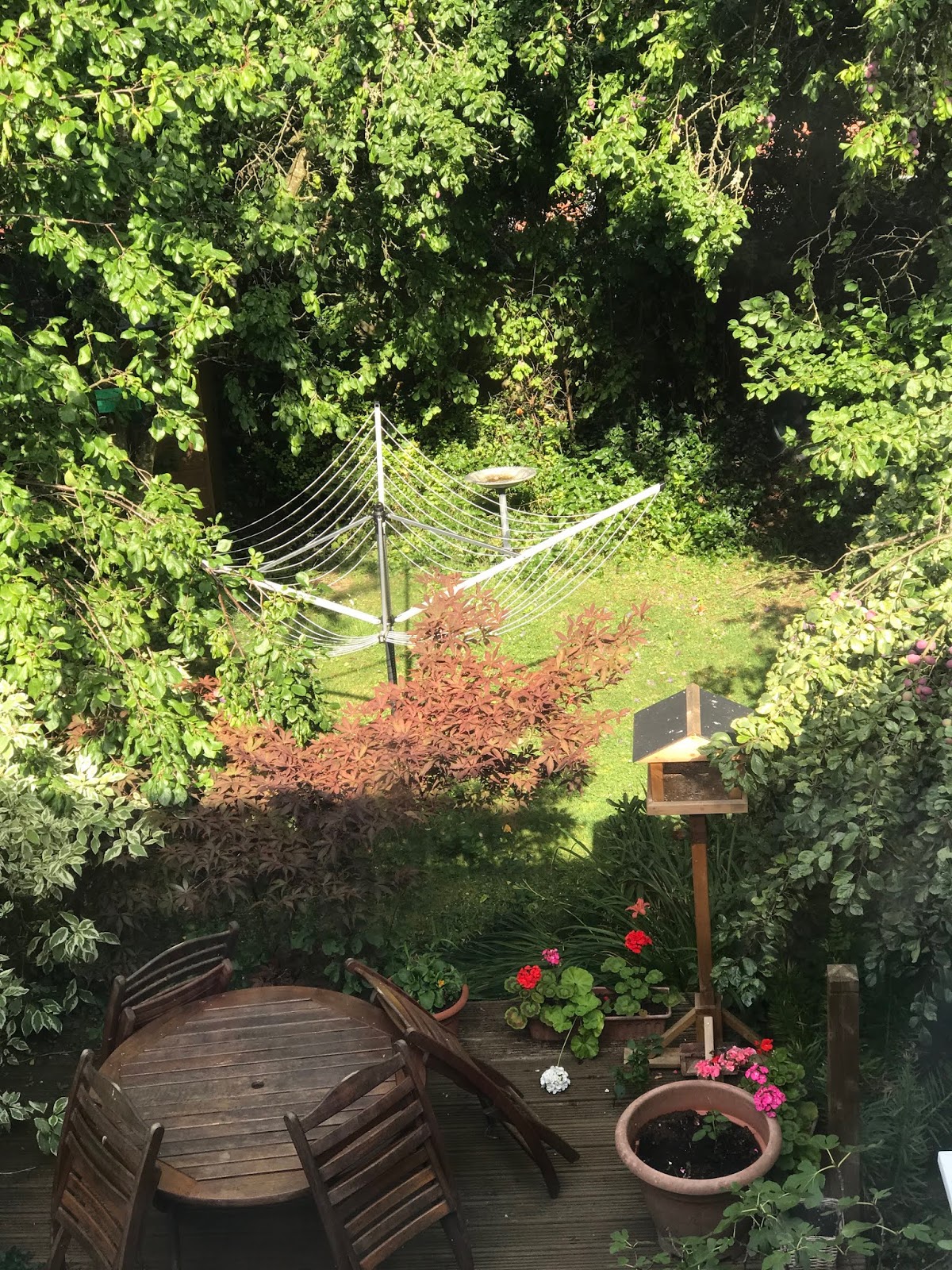
Looking at it from above, you can see how my damson forest has shrunk our garden into little more than a glade. Personally I like it. It has mystery. At night, I imagine hedgehogs and fairies outrageously flirting. In the meantime there is washing to dry via a goblin tunnel

And birds to feed if we can but reach the bird table.

We have arrived at an uneasy understanding whispered only at night.  As soon as the damsons are picked – in a few days – the branch will be sawn to a stump. The branch is not aware of this fact. I think. If there is no blog next week—you will likely know why

Friday, 9 August 2019

It takes all sorts


In his parliamentary maiden speech, Jacob Rees-Mogg invoked ‘three great Somerset men as his role models: Alfred the Great, a Eurosceptic when it came to the Danes, the C11th anchorite St. Alphege, and John Locke. His speeches ever since have invoked great historical figures in the form of languid asides; calculated self-mockery but effective nevertheless:

‘I was thinking initially of Achilles sitting in his tent and about whether that was a first example of industrial action …’

‘Let me start with that sad day in March 1603, when our beloved sovereign of blessed memory, Elizabeth, died …’

‘I was concerned about my hon. friend’s attack on the Victorian age, which was one of the finest ages in British history, when most employers were benevolent, kindly, good …’

‘I know that sometimes I bore the House with historical examples, but on this occasion I thought that I would go back to Odysseus …’

‘Queen Elizabeth I … did not need special measures, advancement and protection to get her going; she did it through her own vim and vigour …’

‘Does the lord chancellor recall that in the reign of Henry VIII it was made high treason to take an appeal outside this kingdom? …’

‘I think one can take back the divergence between our legal system and that of the continent to the Fourth Lateran Council.’


His opponents see him for what he is, an effective class warrior using humour and courtesy to devastating effect. Another class warrior, one who had a great influence on me in my youth, and who I still admire for his clarity, moral integrity and consistency is PeterTaaffe.

The young Peter Taffe
In 1985

It may seem strange, perversely contradictory in fact to admire two men with such divergent views, but it takes all kinds to make a world and individuals transcend tribes. As Jacob Rees-Mogg might say, ‘I’m reminded of the medieval warhorse moments before a fearsome joust.” It is blinkered on both sides so that it’s limited solely to the view ahead, and caparisoned with loud and tinkling bells to blank out all distraction. 
There’s the enemy, nothing else exists. Go charge.

But on to other things, the world beyond the blinkers.

What do these two figures on opposite sides of the class war have in common?
Brexit.
Both men reaching the same conclusion from different angles.
The Labour Party and The Guardian once regarded Brussels as a corrupt, anti-democratic gravy train, a convenience for global capitalism. So I ask myself what has changed—Europe or the Labour Party?

Thursday, 1 August 2019

Gentleman Jack!


-->


When Gentleman Jack aired, I had little interest assuming, wrongly, it was going to be message laden and grim. I read in the study instead, occasionally coming out to refresh a drink and catching the bravura performance of Suranne Jones in the title role. The way she strode over those moors, like Heathcliff on speed. To my surprise I became gradually hooked but refused to admit the fact and so missed most of the series.

A few weeks back we had a short Yorkshire break and visited Shibden Hall, the ancestral home of Anne Lister, aka Gentleman Jack and I fell in love with the woman—admittedly a cul-de-sac since Anne Lister is dead and even if that was not the case she would have little interest in me.


She was born in 1791 and had her first full-blown affair as a schoolgirl in West Yorkshire. From 1806, she kept a detailed diary amounting in the end to over five million words. There are exhaustive entries on the political situation in Prussia, canal tolls and toenail cutting, but sandwiched in-between and carefully coded are detailed accounts of her sexual conquests, all of them women. Many years later, John Lister discovered the twenty-six volumes and decoded the ‘interesting’ bits. Despite being gay himself, he was so shocked he promptly hid them again where they remained undiscovered until 1933 when Halifax Corporation took full ownership of the hall.

The main Hall 


The Dining Room


The Buttery. Comes from the old French for bottle and was where the beer and wine was kept. By Anne Lister's time it was used as a discreet passageway between kitchen and dining room, where food was placed in the hatch for the servants on the other side. 


The Kitchen. The Blunderbuss over the door was to deter rodents. 


The kitchen was small, the spit and fire large so that the heat was unbearable in the room directly above. 

Anne Lister's bed. There were quite a few bedrooms, which I won't bore you with. One of htem however had a bed with the ropes supporting the mattress showing at the end of the bed. The ropes had to be pulled tight for a firm mattress and a good sleep. Hence the old saying 'Sleep tight'.

Anne Lister's view from her bedroom. It wouldn't have been so prettily formal in 1839

A rather nice corridor. And, just by the way of things a random man who just happened to appear and spoil a perfect shot. Regard him as a worrisome ghost. 

The back of Shibden Hall.
Walking around the house, I came upon the portrait of Anne’s father, Jeremy Lister. In the series he was played by that stalwart of costume drama, Timothy West and portrayed as an aging, benevolent nonentity. It was good to read about him in his prime as a young ensign in the American War of Independence. In 1770 he sailed for Canada with the 10th Regiment of Foot and saw action at Lexington and Concord where his right elbow was smashed. Despite this he lived on to the ripe old age of 86 —Anne Lister inheriting Shibden Hall and estate in 1836. (Although she’d been actually running things for the previous ten years)

In addition to the diaries she also left behind fourteen travel journals detailing her several mountaineering exploits and extensive travels across Europe. In 1839 she set off for the last time with her lover, a local heiress, Ann Walker. They got as far as Astrakhan (modern day Georgia) where, in 1840, Anne Lister died from an insect bite. Ann Walker brought the body back home where it was buried in Halifax Parish Church in 1841. 

The story darkens further. Ann Walker inherited Shibden Hall but was forcibly removed by her brother-in-law and taken to an asylum in York. She died in 1854.

The diaries tell their story.