Friday, 25 June 2021

The Black and White Trail


I’ve always been intrigued by the term 'Chocolate Box Art, not with regard to its origin; Richard Cadbury was the culprit. Son of the founder of Cadbury's chocolate he designed his chocolate boxes using his own paintings. The phrase then adopted a life of its own, coming to mean any painting critics labelled as kitsch.    

No, what puzzles me is its longevity as a phrase. Chocolate boxes haven't used scenic covers for years - you will find them on biscuit tins—but virus like the phrase has moved on from its original host and is currently residing in Herefordshire. 


Dilwyn

The Black and White Trail is a circular route, beginning and ending in Leominster and rivals the Cotswolds for picturesque villages. The term black and white comes from the manner of construction, ie timber frames from green oak, each beam cut to size were it was felled. The timber was numbered and assembled on-site. The space in between the frame was infilled with rubble or wattle and daub and whitewashed with limewash for added protection. The unseasoned oak eventually turned black with age, hence the black and white appearance of the houses. 
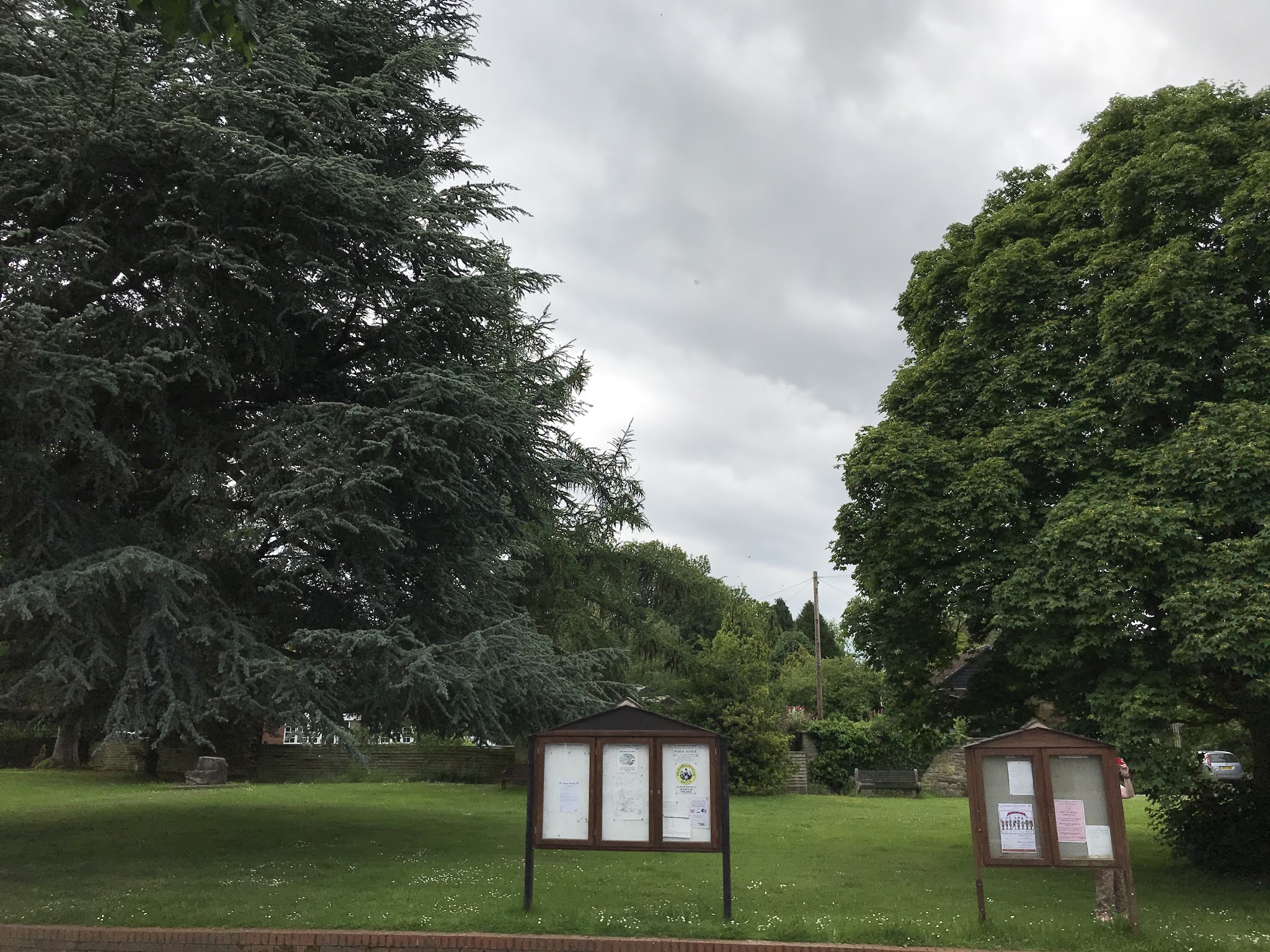

 
Dilwyn Green and main street.


On a fine summer’s day, we drove through Dilwyn, Weobly, Sarnesfield, Kinnersley, Eardisley, Kington, Lyonshall, Pembridge, and Eardisland. It was like driving back through the 1950s on empty roads and countryside bursting in green.
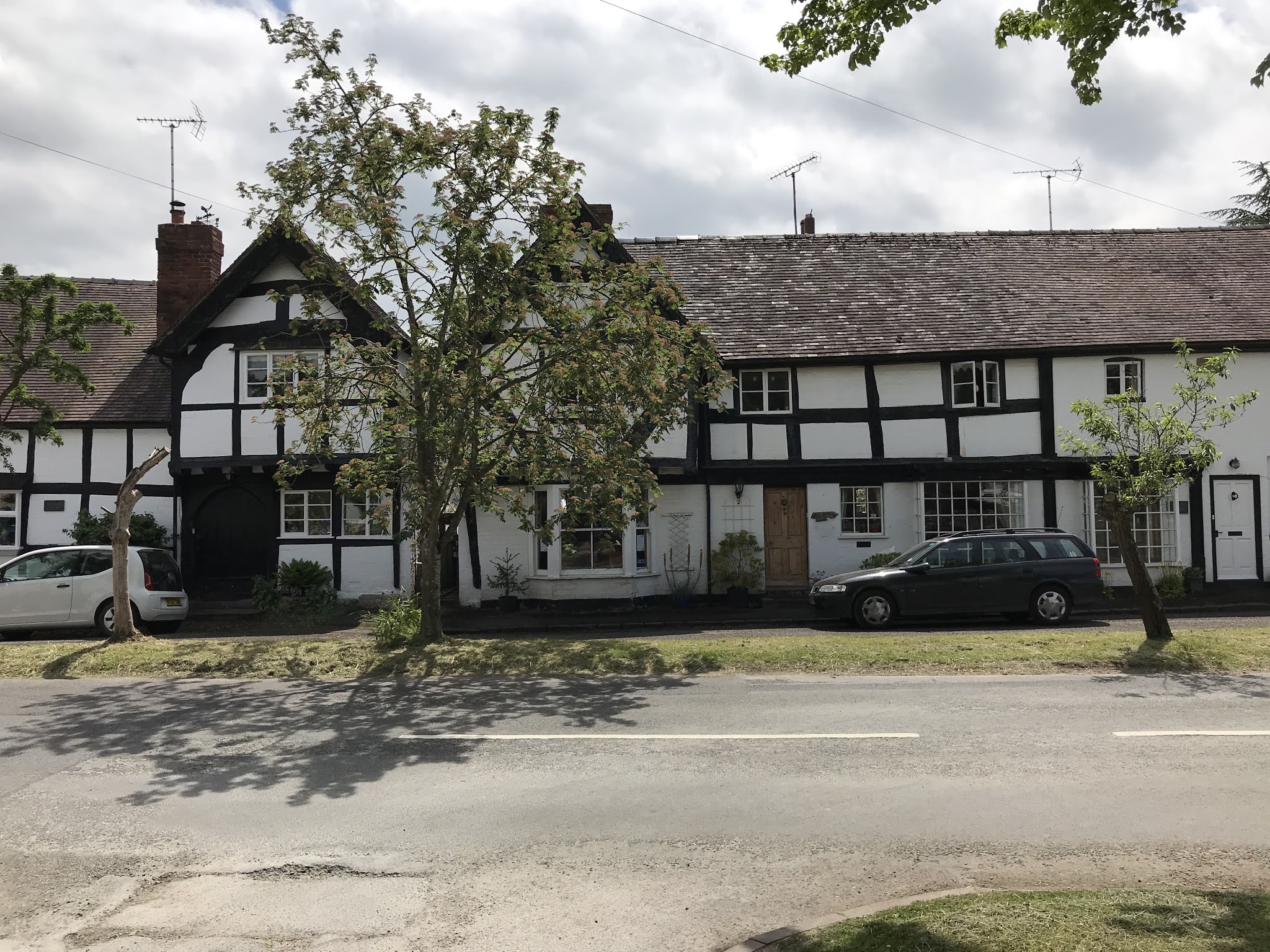


Weobley


Weobley is one of the best-preserved Tudor villages in the country and like Leominster, the ‘o’ is silent, so they are respectively pronounced Webbly and Lemster. (Just to confuse Americans and Scousers) The name comes from a Saxon chief ‘Wibba’ and ‘ley is a Saxon name for glade. So long ago, it would have been known as Wibba’s woodland clearing. It’s mentioned in the Domesday book as Wibelai held by an Eadwig Cild before it was granted to the Norman Roger de Lacy. South of Broad Street are the remains of a castle first recorded during the mid C12th civil war between Stephen and Matilda and, during a later civil war, Charles I stayed in the Unicorn Inn formerly sited on the corner of High Street and Hereford Street. 

A more permanent though less famous resident was James Tomkins. He had a cottage in the centre of the village. It was the C16th and he used his time wisely. Tomkins fathered 33 children by two wives and is remembered in verse

Babes thirty three did from two mothers spring,

To famous Tomkins, O, admired thing!

And may the loud resounding trump of fame, 

Proclaime great Tomkins for a man of men.

The two wives have left no comment. 


The Parish Church of St Peter and Paul. The building to the left was the rectory where Dorothy Wordsworth briefly drank tea. 


Yes, I'm a sucker for the peace of an English country church.


After Weobley, and having whipped through Sarnesfield*, Kinnersley, Eardisley, we were starving and needing liquid refreshment. Kington sounded a nice place to stop, but in this respect we were disappointed. Everything was shut or closing. 


Kington main street.


This soured things. It was all well and good being another village mentioned in the Domesday Book of 1086, all well and good being recorded as Chingtune from the old English Cyne Tun meaning royal manor and that the Normans built a castle on the high ground above the river and the town itself spread from its base. It was all very well that here lies the tomb of Sir Thomas and Lady Ellen Vaughan; that Thomas was known as Black Vaughan who died in the Battle of Banbury in 1469 and came back as the Black Dog of Hergest, the source of the Hounds of the Baskervilles. We cared not a fig. We eventually found food, in my case a cheese and pickle sandwich, and moved on. 


The last two villages are gems. First Pembridge built near a ford across the River Arrow—which supplied drinking water to the village. Drinking water wasn't put on tap until 1960.  Like the other villages on the black and white trail it predates the Domesday Book and was granted the right to hold fairs in 1239: the Cowslip Fair in May and the Woodcock Fair in November. Most of these timber framed houses date back to the C15th – Bishop Duppa’s Alms-house on Bridge Street being a C17th Johnny-come-lately 


Pembridge


As you walk from the car park


Full of interesting nooks and crannies


Main street.


Village shop


Bridge Street on the way to the river


                               The river Arrow which connects many of these villages


The parish church of St Mary has one of only seven detached Bell Towers in the county. Behind the church are traces of the castle owned by the powerful Mortimer family. When Edmund Mortimer died in 1435 the land was passed on to Richard Duke of York.


Bishop Duppa's alms-house on Bridge street. Zoom in on notice. 


Eardisland

The River Arrow


Eardisland was once a Bronze age settlement, later held by Morcar, the Saxon Earl of Northumberland, seized by William the Conqueror and given to Baron William de Braose  by the Conqueror’s son. It ended up in the hands of Richard Duke of York via marriage, forfeited to the crown and held briefly by Catherine of Aragon and her daughter Mary I.

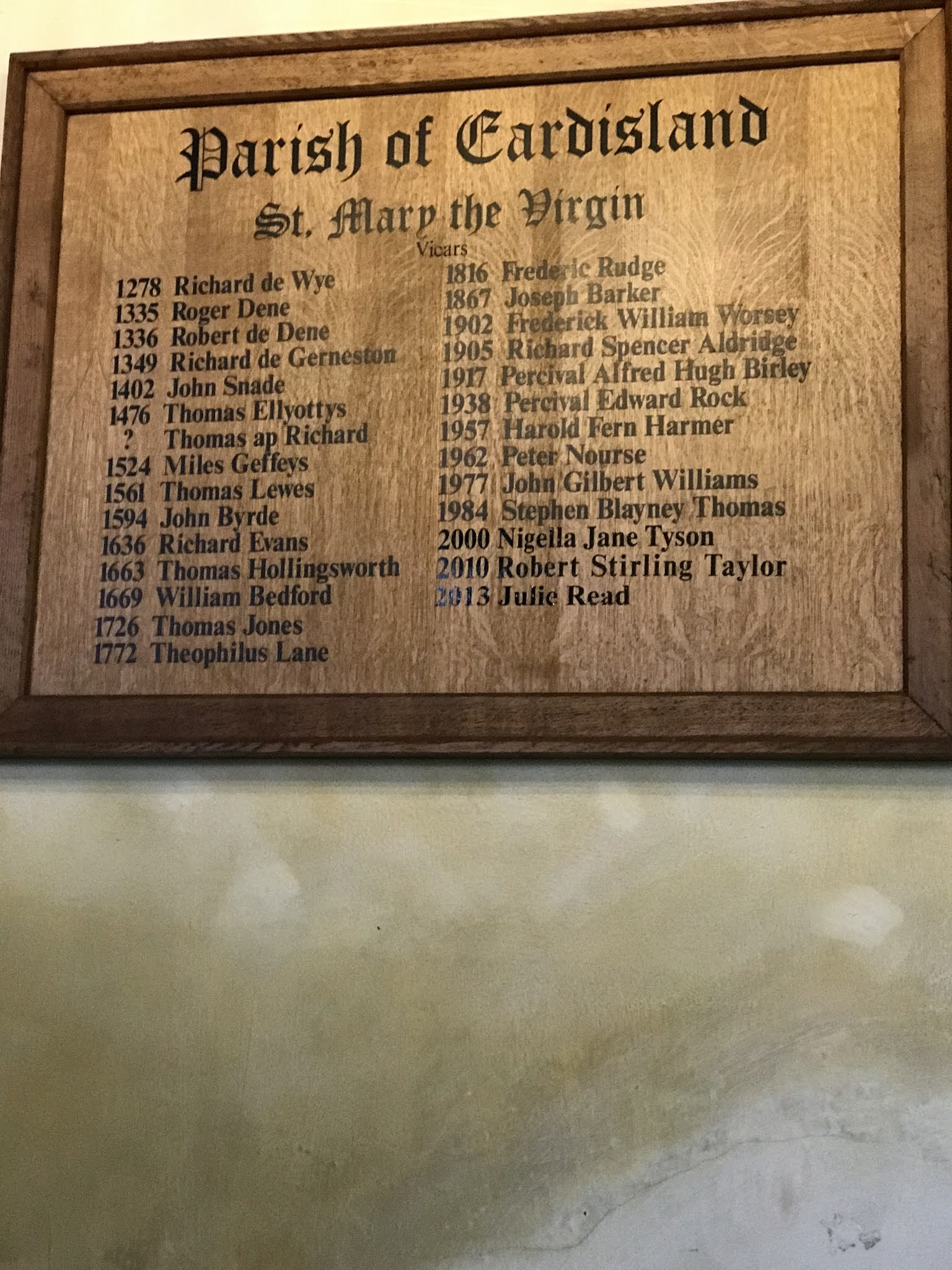


We passed Parish volunteers  
weeding in silence on our way to the church


I was intrigued by the incumbent who obviously survived the turmoil of Henry VIII and beyond


Set farther back from the C13th Church is a moated motte, all that remains of a castle defending the land from the Welsh. Now visitors are provided with afternoon teas. 


At Sarnesfield is the grave of John Abel , Carpenter to Charles I. I wanted to pay my respects but time didn't allow. Retrospectively distraught. 

Friday, 11 June 2021

Clay Cross: The story continues


Clay Cross first appeared in 2015, the book making the point that pulp fiction is but a blink from reality. The original aim was to bring a 1950’s private eye into late C20th Newport; but how to do it? Eventually inspiration struck—expressed in the introduction to the original book, Clay Cross:

When James Finn ran down the priestess daughter of Ginny Mambo in a Louisiana bayou, he never imagined the consequences. 


When Laura Finn begins a search for her husband, the nightmare begins. Imprisoned in ‘soul bottles’ by the houngan, Ginny Mambo, they are inadvertently released in an inferno caused by one seeking to escape a similar fate.  


In what becomes a nightmarish blaze that sees the release of hundreds of imprisoned souls, Laura and James Finn are transformed into Djinn, creatures of fire and dust seeking form. James Finn finds himself trapped in the persona of Clay Cross, a cold war warrior and misogynist private eye, in fact, a composite of every pulp novel he’s ever read. 


The equally cultured Laura Finn has mutated into Sheri Lamour. Earthbound and heralding a new age of Djinn, both become the playthings of two competing Loa, Damballa and his brother, Baron Samedi. Clay Cross, now a noir Don Quixote out of his depth and far from his comfort zone, is pursued through time by a vengeful Ginny Mambo, horrendously changed in her quest for immortality. 

Clay Cross is a swirl of Voodoo and Noir, mangled metaphors, and flights of misplaced hyperbole. In it, comedy, horror and tragedy fused in a 1950’s private eye out of his time.


This collection continues the story, Cross and Lamour’s adventures ranging from the near to the far future with occasional forays into the past.  It is, essentially an ode to old time pulp fiction and noir  cliche.


But this is where I need your help. The back cover is as yet unfinished, the present text just a place holder for what is to come. Below are a few suggestions. Any feedback/preference for one or another would be most welcome. Currently the first one is my favourite, but its a moveable feast or, perhaps, amuse-bouche.


“Sheri, you ever think we’re in a goddamned comic book?”

“We’re all in a goddamned comic book, Clay. Some call it life.”

“Some call it lots of things.”


The Chronicles are an ode to pulp, the mangled poetry of noir cliché and two unlikely heroes, Clay Cross and Sheri Lamour 


OR

Sheri, you ever think we’re in a goddamned comic book?”

“We’re all in a goddamned comic book, Clay. We just turn the pages."

"Some call it life.”

"Some call it lots of things."


The Chronicles are an ode to pulp, the mangled poetry of noir cliché and two unlikely heroes, Clay Cross and Sheri Lamour


OR

Sheri, you ever think we’re in a goddamned comic book?”

“We’re all in a goddamned comic book, Clay. We just turn the pages until the end."

“We don’t have an end, Sheri—we’re Djinn.”


The Chronicles are an ode to pulp, the mangled poetry of noir cliché and two unlikely heroes, Clay Cross and Sheri Lamour 


Friday, 4 June 2021

Cats on a mission


Cover Artist: Gerard Whyman 


The Murenger sells a good pint of Sam Smiths. It also has stronger stuff under the counter judging by ‘Tails of Phoebe and Mags Worthington of “The Mew’s” Belgravia.Think Lucia and Mapp on acid, Hunter S Thompson’s ‘Fear and Loathing in Vegas’ channelling E. F Benson. It’s what I love about The Murenger, the eccentrics it attracts, (myself included) Within those walls there is something in the air, mercifully not covid, that sparks gentle weirdness.


As the Forward in the book states: ‘The ‘Tails’ originated in the period 2005-09,’ amongst a group of writers who enjoyed working together. The ‘Tails’ were later circulated via round robins, revived during lockdown and now finally published. I should add I had no part in this, a project begun before my time. In fact, until the book was presented to me, I had no idea of its background or how it was all put together. 

So, how best to describe it? First of all, it’s not a children’s book, not with lustful mice like Podge Ogilvy Innes III  or characters like Lady Leonora Cooperwhitty, one ‘of that class of women who enjoy being on top of men, women, children and elephants.’


Lady Leonora 


Not someone to trust with a gun


Think 'The Famous Five' meet ‘All Creatures Great and Small’ in a world that oscillates between Scotland and Belgravia; a world where cats, opera singers, Russian spies, gangsters, and feline family trees interact, a hallucinatory whimsy that needs to be read in a firm Scottish accent. 


Cats on a mission


Toffs up to no good

For Paval Zoubok, “Collage is the cut, the tear, the rupture and the overlay of our contemporary culture. It is the hybrid language of urbanity – the remixed, recontextualised, and wholly built from the fragments of daily life.” He was explaining a new school of art.


Lady Katrina Ogilvy Opera singer and cat lover

A disturbingly erotic cat


In this sense, ‘Tails of Phoebe and Mags Worthington of “The Mew’s” Belgravia’ is the literary equivalent but set in the interwar years. In this world, characters like Podge Ogilvy Innes III (a mouse) Dimples Dennistoun (a nanny,) Dame Sheba Gingers, Babs McTooth, and Phoebe and Mags Worthington (two cats) have a series of loosely connected adventures in the 1920s. Archive photos side by side with beautifully drawn Cats blur the line between different states of seeing: the mundane and the almost impossible. The book should be read with “Three bottles of 1907 Heidsieck Champagne Gout Americain,” the favourite tipple of Olga the White Russian cook.


Friday, 28 May 2021

Middlemarch and Cookery books

I remember reading Middlemarch as a seventeen year old, eager to impress my first girlfriend. I remember, too, being repelled and afterwards scared by Edward Casaubon, the pompous, withered middle-aged academic who married the idealistic heroine, Dorothea Brooke; she sees in him her idea of a real intellectual. Casaubon is currently amassing material for his masterwork the ‘Key to all Mythologies,’ his aim, to show that all the mythologies of the world are corrupt fragments of an ancient corpus of knowledge, something he will reveal in due time. Dorothea is enthralled to be his helper, compiling and editing, putting every scrap he's written in some kind of order. 


Too late, she realises she’s married a dud: ‘Somebody put a drop of his blood under a magnifying-glass, and it was all semicolons and parentheses.' It might be that there is/was no key to all mythologies and that the answer to everything is to be found in The Hitchhiker’s Guide to the Galaxy, ie 42. But poor Edward Casaubon never finds out. He dies having written nothing but leaving behind copious notes. 


It may be the fictional Casaubon and those of similar ilk derive comfort and purpose, a sense of security in the effort alone. Rather like the Hermit crab with its need for the shell of a dead mollusc to protect its vulnerable rear end. (I feel a joke coming on) The cannibalised shell serves as both home and protection. But at a cost. It’s something the crab has to drag along wherever it goes. And when it grows too large for the shell, it has to start all over —little different perhaps from those on the mortgage treadmill.  


So, what has all this to do with recipes and cookery books? I’m awash with recipes and books. It began at Catering College all those years ago. Little did I know then where it would end up. 

My first college cookery book.

The book has been thumbed, stained and used


Then the ‘Blessed Delia’ came along.


Since then there’s been no holding back. I have folders on my desk-top, folders in my email. I have all these and more. 


And like most people, I suspect, there are just two or three recipes in each book that have been actually used. The ‘Google’ cookbook has become the cuckoo in the nest. But, like the Hermit Crab, I cannot bear
parting with what I increasingly don’t use.


In theory, any recipe that ends up in here is a keeper.

In theory. The reality is that any recipe ending up in here is forgotten. Is the thing I'm after in one of my folders, or do I have to thumb through the sacred, sauce-spotted book?


The exception is Boboutie. 


 I keep promising myself I will—and here the ghost of Edward Casaubon looms over my shoulder— systemise my recipes in an all-encompassing computer program, one that will bring the exact recipe needed for any occasion at the tap of a key word on iPad or phone. 


It’s a nonsense of course. I’d be too busy doing it to do any actual cooking and, like Casaubon, be dead before the ‘key to all cooking’ was actually in place. Then again, there would be far less washing up to do.

Friday, 21 May 2021

Lunacy is addictive


I do most of my thinking somewhere between 6.40 and 8.00 along with strong tea and the news in the background telling me what I should be concerned about and what I should be thinking.


When the thinking stops, I browse social media and pick up every kind of rubbish like a downmarket magpie.


 Two days ago, I discovered there was some kind of mystery involving cats and squares of various sizes. I’ve seen countless pictures of cats in small boxes. Facebook is awash with them, but I was unaware of the experiments showing cats were equally attracted to one dimensional squares painted or chalked on the floor. I sat in silent wonder contemplating the mysteries of life and the nature of the experiment itself. 

Success was measured by the length of time a cat sat in the square, three seconds being the minimum to record a success. The cats were recorded via a camera or smartphone, and to ensure the chosen cat owners didn’t influence their pets in any way, they (the owners not the cats) were told to wear sunglasses so no eye contact was made. I’ve been told on good authority that cats read minds, so I’m not too sure how effective the sunglasses would prove apart from startling the various cats. 


The results, to my mind, were not that successful. Thirty cat owners conducted the experiment in full, which involved six days of trials. Only nine cats were cooperative (sunglasses, the reading of minds). These 9 cats were cooperative in that they sat in a square at least once during the trials. Squares apparently remind them of boxes, which in turn remind them of being squashed with mother and siblings in the days following birth. Squares relieve stress. The same supposedly holds true with big cats, pumas, tigers and lions, which must be a boon for trophy hunters. Draw a square in the jungle and wait.  


By this time, I was way down the rabbit hole, googling all kinds of animals—dogs and optical illusions for example. Nothing too definitive there either, though I’m guessing there must be some value in knowing whether dogs enjoy Rorschach patterns and are able to differentiate between bowls that look differently sized but are in fact the same. 


Near the bottom of the rabbit hole, where tunnels diverged and proliferated, I stopped by an article on pigeons, a church in Brazil, and a priest who preferred hypnosis to miracles. It was time to turn back before madness took over, though I suspected it was already too late? 


The memory came without warning: how to hypnotise chickens by gently pressing their beaks to the ground and chalking a line. I was transfixed, my nose far from the ground and without a square or straight line in sight. I’d once intended to test that experiment and discover whether it was applicable to other birds, pigeons, robins, plover or grouse—perhaps not ravens or crows—but then I wouldn’t know whether it applied to all birds.  Was it too late? Where chickens to be found in Osbaston. I sighed and made a fresh pot of tea, hoping the insanity would pass, knowing at least it was better than the news on the radio.
Friday, 14 May 2021

1607

In theory, you are able to walk the entire coast of Wales, something I’m unlikely to try, though last week we managed an eight mile stretch along the Gwent levels ending our walk at Redwick.  When you look at these pictures, it’s hard to imagine that the earliest coastal defences built by the Romans and maintained and developed by the monks of Goldcliffe and Redwick extended farther into the sea. The present line of defence was built in the late middle ages but were allowed to fall into disrepair after Henry VIII’s dissolution of the monasteries. 


This looks so peaceful. Hard to imagine anything bad could possibly happen. On the other side of the channel is Bristol and Somerset. 


A section of the modern sea defences stretching mile upon mile to Chepstow.
Courtesy of Bernadette..

Mind you, they probably would have made little impact on what occurred on the morning of Tuesday, 30th January 1607. A twenty-five foot wall of water sped up the Severn estuary at 38 miles an hour – faster than a man could run.  It crashed through the sea defences from Peterstone to Redwick and beyond, hurtling  up to four miles inland. 


In the words of William Jones of Usk: ‘huge and might hilles of water, tumbling over one another, in such sort as if the greatest mountains in the world’ overwhelmed the land. More than 2000 people drowned and 2000 square miles of farmland were destroyed along with much of their livestock. William Jones went on to describe the spectacle: ‘Sometimes it so dazled the eyes of many of the Spectators, that they immagined it had bin some fogge or miste, comming with great swiftness towards them: and with such smoke, as if mountaines were all on fire.’


Today, especially in light of William Jones’ description, academics argue as to whether it was a tsunami or merely a freak storm surge, though the day was sunny and bright. Jones had no such worries. The explanation was clear. It was God’s warning to his people…Many men that were rich in the morning when they rose out of their beds, were made poore before noone the same day: such are the judgements of the Almightie God, who is the geure of all good thinges, who can and will dispose of them . . . at all times, according to his good will and pleasure, whensoeuer it shall seeme best unto him.’


I confess, my auto spell is going berserk here, but William Jones’ account is so lively, I must give him free rein.


‘…as soone as the people of those Countries, perceived that it was the violence of the Waters of the raging Seas, and that they began to exceede the compasse of their accustomed boundes, and making so furiously towards them, happy were they that could make the best and most speed away, many of them, leaving all their goods and substance, to the merciles Waters, being glad to escape away with life themselues: But so violent and swift were the outragiouse waves, that pursued on an other, with such vehemencie, and the Waters multiplying so much in so short a time, that in lesse than five houres space most part of those cuntreys …were over flowen, and many hundreds of people both men women, and children were then quite devoured by these outrageous waters, such was the furie of the waves of the Seas . . . 


Many there were which fled into the tops of high trees, and there were inforced to abide some three daies . . .without any victuals at all, there suffering much colde besides many other calamities . . . beholding their wives, children, and servants swimming remediles of all succour in the Waters. Others some sitting in the top of Trees might behold their houses overflowne with the waters, some their houses caryed quite away: and no signe or token left there of them.’

‘Gods warning to his people of England By the great over-flowing of the waters. . .’ by William Jones 1607


Mind you, there is another explanation bypassing storm surges, tsunamis and God. Whatever the case, 

the immense waves would have badly damaged the complex pattern oreens draining the 1500 kilometres of wetlands, some of which are 2000 years old. This is a modern 'Stank' altering the level of a section of the reens.  


I love the optical illusion, but then I'm a simple soul.


This is St Thomas's Church, differently named in the C13th and with the tower, unusually in the centre of the nave. 


This is the porch from some distance away to allow perspective. Note the gargoyle to the right where the arch ends.


Now, look at the plaque marking the height of the flood. 


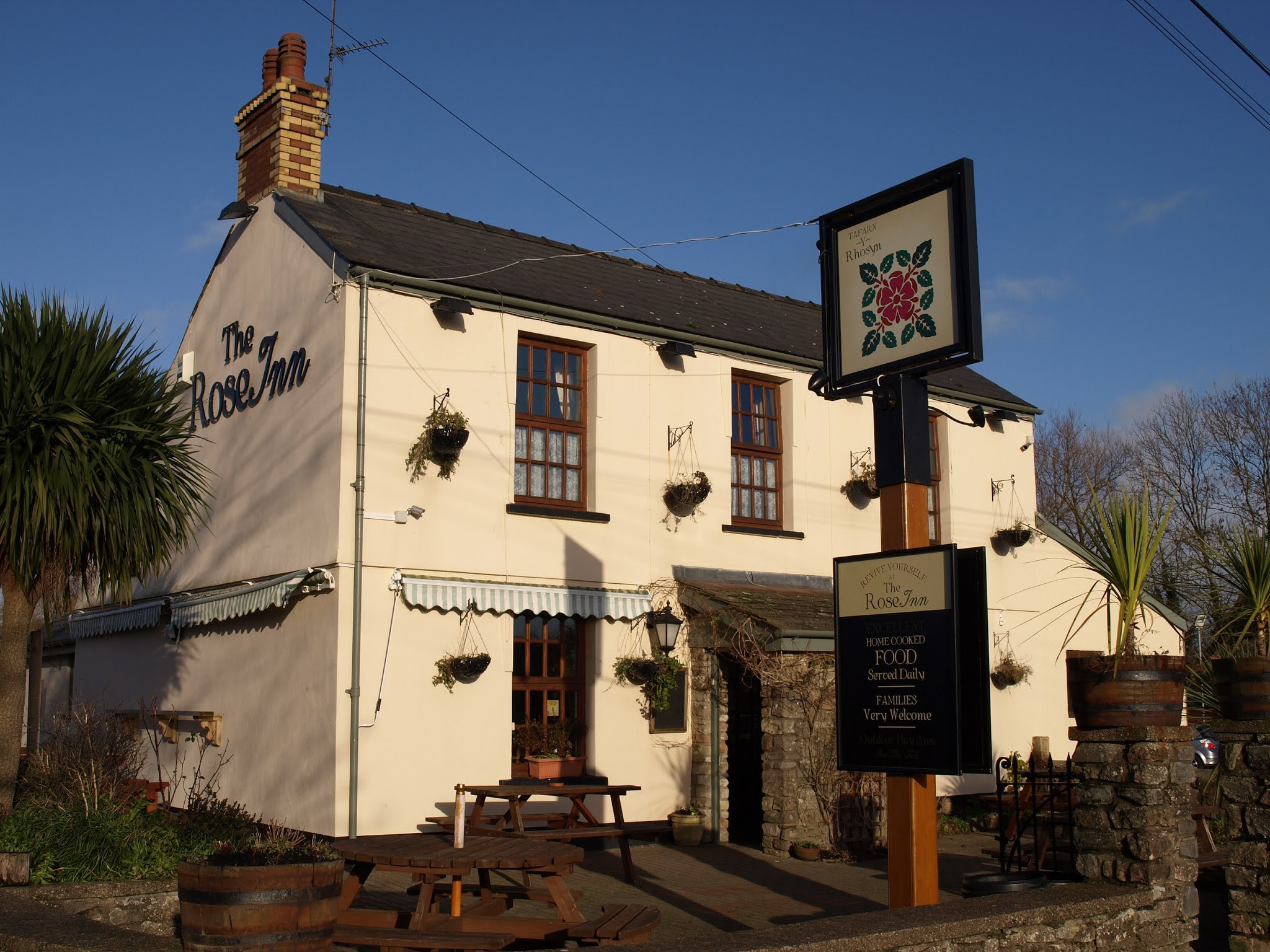
The Rose inn and a welcome pint of Marston's Pedigree. My first pub pint since lockdown began. 
If William Jones were alive, he would write about it. 


Friday, 7 May 2021

Radio Caroline


Little did I know that, in 1964, I was to become no. 21722 in a fragment of cultural history. Another snotty nosed adolescent had joined the revolution: The Radio Caroline club. This was a time when music was confined to the BBC with shows like 'Music While you Work'  ‘The Billy Cotton Bandshow'  and ‘Two Way Family Favourites.' Rock music could be heard on tinny Radio Luxembourg, but they were essentially a payola operation, playing 'paid for music' by the likes of EMI, Decca, and Pye.


And then Radio Caroline came along. In its original form it lasted a mere three years but its influence was profound


In the recent film, ‘The Boat that Rocked’ some of the spirit of pirate radio was captured. In the process, history was falsified. The film falls into the anti-Tory trope, ie the stuffy Conservatives were responsible for closing down pirate radio, whereas in fact the opposite was true. 


The Marine Broadcasting Offences Act became law in August 1967 and was introduced by Harold Wilson’s Labour Government. Its architect was the Postmaster General, one Anthony Wedgewood Benn. Tony Benn as he later preferred to be known. That very archaic title gives the game away. In those halcyon days, British Broadcasting was controlled by the GPO, the General Post Office, which had granted exclusive radio and Television broadcasting licenses to the BBC, and later, through gritted teeth, television licenses to 16 regional independent TV stations. It was in effect a state controlled closed shop. 


Then pirate radio came along, broadcasting from unseaworthy shops from outside British territorial waters and Harold Wilson personally authorised the use of the most powerful transmitter in Europe – a one megawatt facility reserved for a national emergency – to jam Radio Caroline’s signal. 


Why did Wilson use this sledgehammer to crack a nut? There were rumours that some pirate radio stations were intent on exposing his affair with his secretary, Marcia Falkender. Certainly, and now with good cause, pirate radio was instrumental in Wilson’s surprise 1970 election defeat. 


But there also other factors in play. Government action had European links even then. The 1967 Marine Broadcasting Act represented the UK’s ratification of the 1965 ‘European Agreement for the Prevention of Broadcasts Transmitted from Stations outside National Territories.’ A bit of a mouthful and for obvious reasons known or disguised as ‘The Strasbourg Treaty. 


Despite every effort to disrupt and destroy pirate radio, Caroline persisted in one form or other, its low point being 1980 when a storm sank the unseaworthy Mi Amigo. The DJs and their pet budgie, Wilson (named after the British PM) were evacuated. The ship sank leaving only the mast visible above the waves – and the memory fifty years later—along with my Radio Caroline membership package.


A little bit of history (but more in depth here) 


My membership package arrives.

And it it a small glossy booklet.


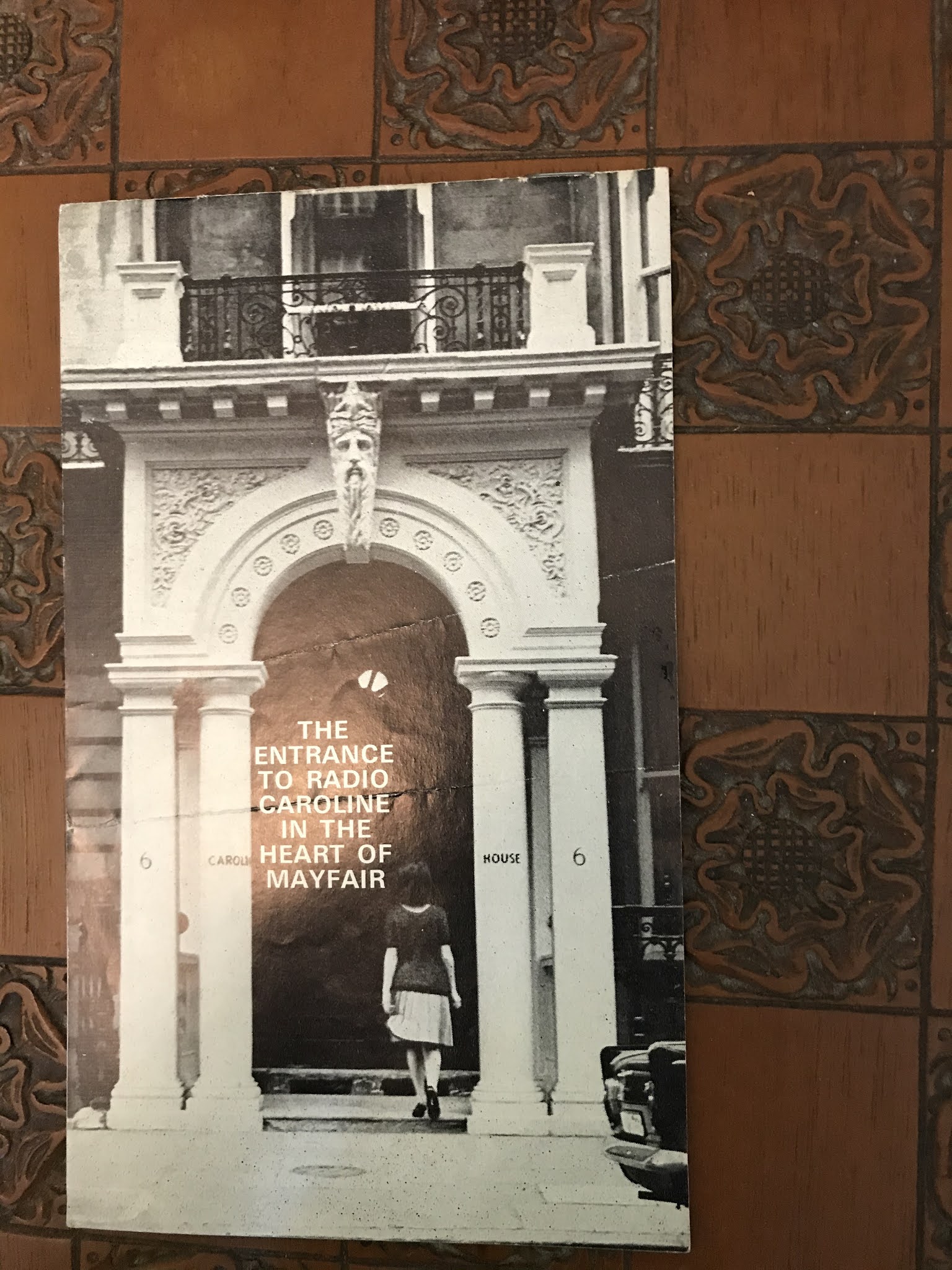
I immediately look at the back to see this, along with the legend 'From the centre of Mayfair'. Such sophistication. And the girl. The snotty-nosed adolescent knows he is part of something big 


And if there was any doubt, there is this!

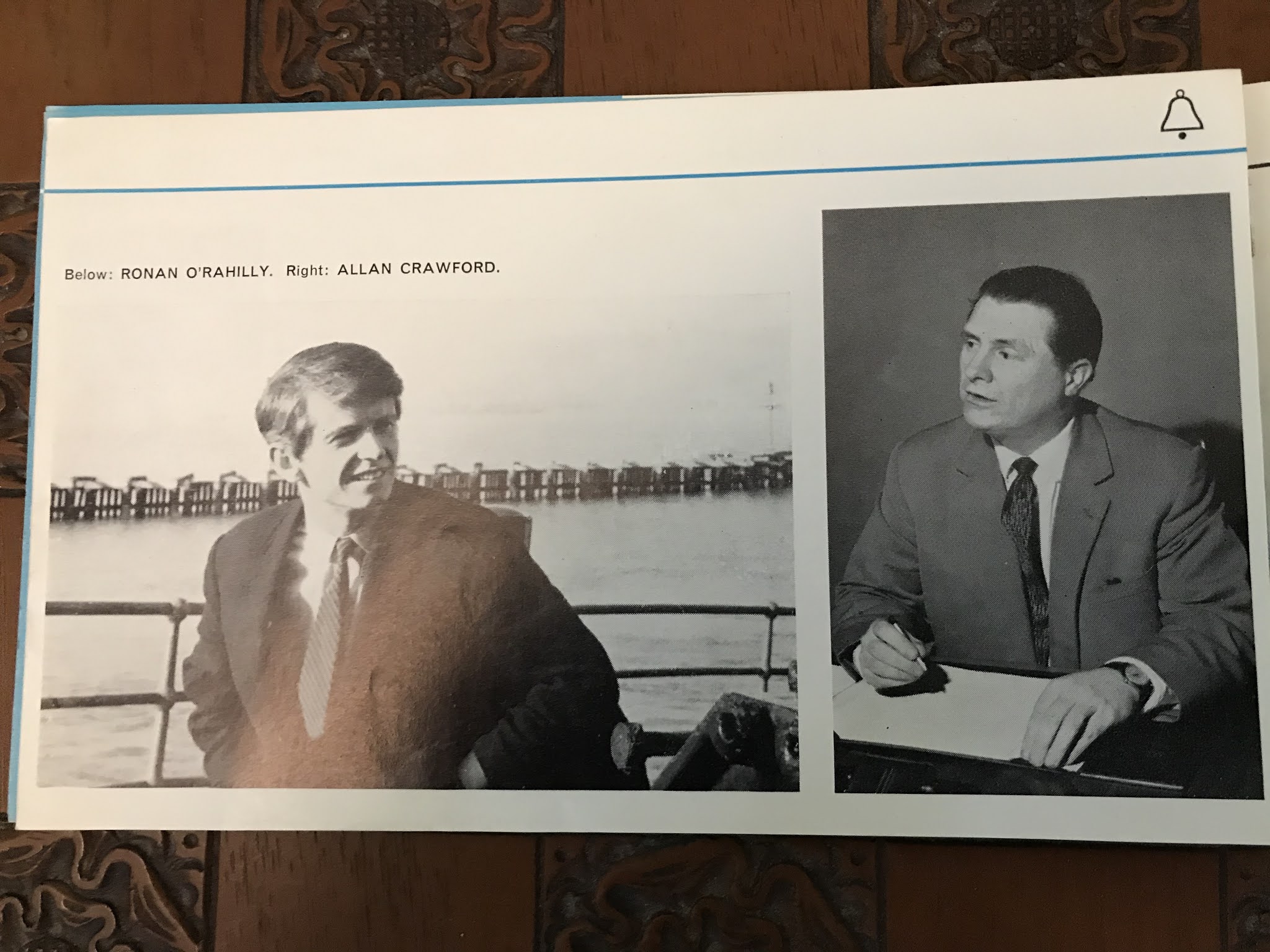
Ronan O'Rahilly and Alan Crawford, the two founders


The booklet is a mine of information - history and DJ's one of whom was a friend of 'the popular Jimmy Savile' Ah, innocent days.


In these digital days of word processors and photocopiers, this seems from a different age - which of course it is.


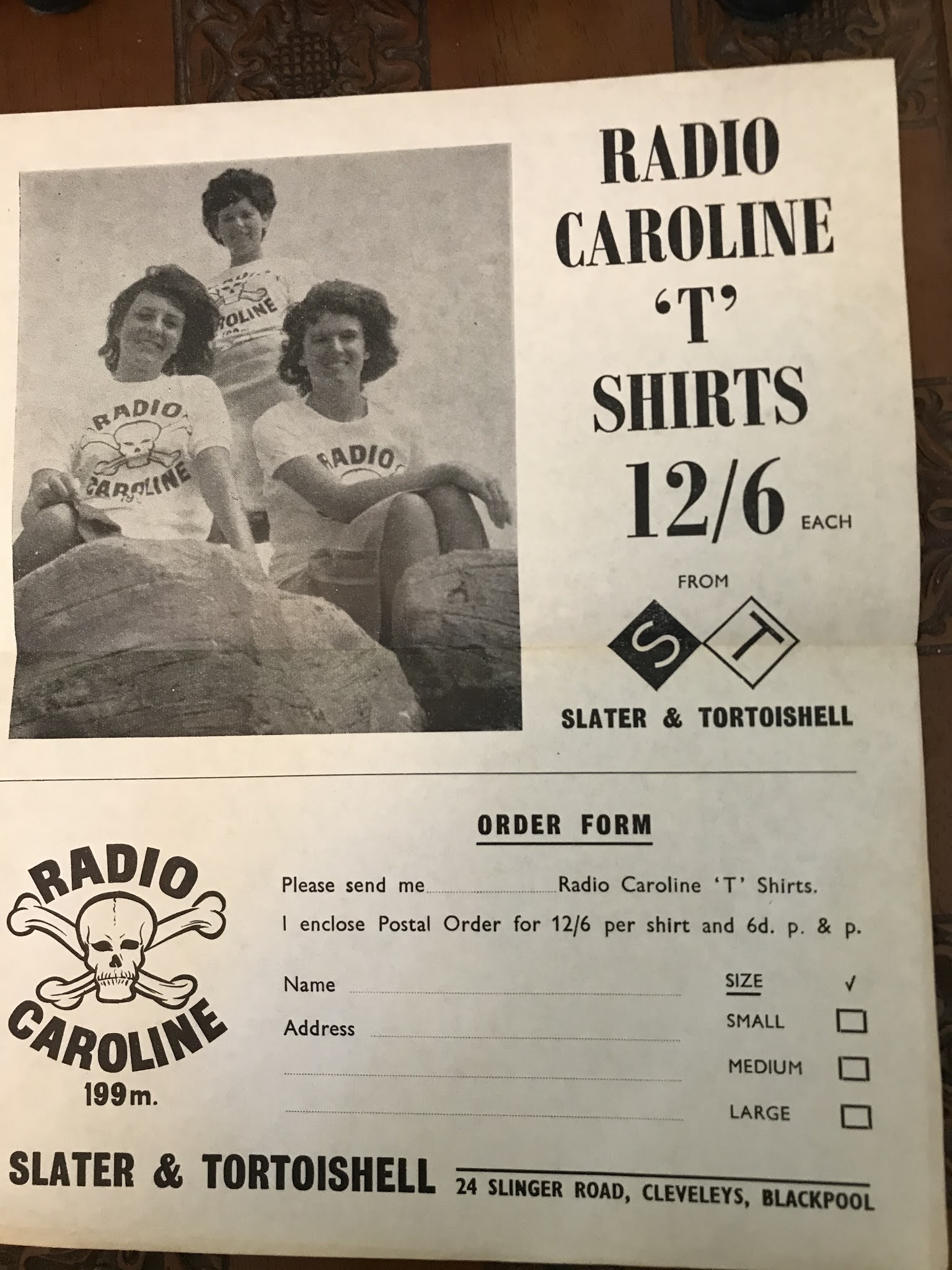
As is this: The Radio Caroline T shirt. 


I also got three signed photographs of Radio Caroline's hottest D Js. Well, they no doubt thought they were

And my Radio Caroline club membership card with the knowledge that 21721 other people had been similarly seduced.  I was now an official member of the 'Swinging Sixties.'