Friday, 13 May 2022

The Moles of Intriguer House

Sometime during lockdown, I heard a heavy thud through the letter box and saw a brown paper parcel on the mat. In it was a slim salmagundi of a book: ‘The Moles of Intriguer House’ 


It begins with a savage attack on the shortcomings of the National Trust— throughout referred to as the National Untrustworthy—and, surprisingly, an attack on the entire Morgan family of Tredegar House —in the book, as a tribute to Robert Firbank, referred to as ‘Intriguer House.’ 


As satire, it reads like Jonathan Swift on Mescalin, and when it comes to generalising on the Morgans as a whole, the writer seems possessed by the spirits of Bukharin and Lenin.  He refers to Morgan dynasty as a bunch of megalomaniacs and ‘land thieves’, masking ‘their proclivities (and) greed, mocking human rights and committing vile deviancies. Although well known for their charity giving, there NEVER was an act of charity or a donation” without ulterior motives such as to “lessen death duties and taxes and to protect their own family interests.”


With that out of the way, William Cross, with the aid of the artist, Gerald Whyman, develops an exuberant whimsy of a book with moles running rampant.


The medieval monk loved nothing better than to adorn religious manuscripts with weird and wonderful monsters and everyday creatures made strangely sinister on the page. Every creature told a story, for every creature had an attribute from which a moral hung.


The Medieval bestiary lives on in ‘The Moles of Intriguer House, but unlike the monkish manuscript where fabulous creatures merely decorated the margins, William Cross, under the influence of Covid and curative bottles of Macallans, has his creatures taking over the entire book. 


Open the pages, and you’re plunged into a parallel world where moles have replaced the Morgan dynasty from 1700 to 1962, their activities running side by side with their real-life counterparts:


Sir William Morgan 1700 -1731 becomes a mole, “dubbed ‘Wild Bill’ by Sandy Boggy Mole, his old dirt tutor who patiently tried to coach and teach him the Greek and Latin Mole verse of worms, slugs and centipedes. The precocious, William (his Sunday name) was only interested in . . . following the cockroach racing on the Taffy Mole Hills of Cardiff. So fond was he of cockroaches, that William had them farmed under the Basseleg Fields for racing and for the high table at lavish dinner parties, and his head cook ‘Wee Shug’ gained fame with an accompanying book of recipes and exhibitions as far away as the annual Abergavenny Mole Food Festival.”


Evan Morgan Papal Knight, predatory homosexual and Satanist: 


“In Moleland, the complex skills of tunnel building were much prized. Male tunnels were generally straight, female tunnels were curved, and in each case the systems were arranged at two different levels.

When it came to tunnelling around Intriguer Park the honourable Eddie Intriguer…was only able to dig curved tunnels and his mole heaves of earth were decidedly queer as they were just on one level, and he was never able to keep his tunnels straight.”


Newport was once famed as the ‘Home of the Mole Screw Wrench.’ It may have had Eddie Intriguer in mind.   

Friday, 6 May 2022

And Normality Restored.


We settled on the paint colour, Florentine Red. The Medici gene and/or delusions of grandeur. 

Much of it will be hidden by tiling. 


Delivery day. Bit like Christmas but with  more hassle.


The job underway


All units in, but for the quartz worktop. The space it will cover was measured by laser. It was manufactured in Darlington and delivered from Worcester.  But something is missing.


And here it is. the beast, the Leviathan, my pride and joy. Every now and again it emits a comforting purring sound


The work top. I'm rather liking the Florentine Red. 
Perhaps something Sistine on the ceiling . . . ?


And finally, the tiled kitchen from every conceivable angle. Property porn. Mea Culpa. But we've earned it. 


I know, it's bit like a missing tooth. The combi microwave/oven is missing.
It's probably still in Germany waiting for its Chinese microchips. A first world problem and perhaps more in the pipeline


Ignore the debris. 


Friday, 1 April 2022

Organised chaos


The unsuspecting kitchen. We whisper its fate as the clear-out begins


The pictures below pretty much reflect my state of mind. They also reveal a powerful truth.  We largely function along familiar lines and routine. For someone who has a fuzzy, anarchic mind, external tidiness and order is everything. Without it I’m a lost soul, drifting confused and without purpose.


What am I talking about? This week we began the process of installing a new kitchen. Initially I was against it until I was asked the question as to whether I’d really want to be doing this in ten- or twenty-years’ time? 


On the strength of the evidence so far, the answer is obvious. Even so, I held out for a big American Fridge Freezer as the price of my capitulation. 


The American fridge freezer hiding in the wings. It knows.


Kitchen cleared (almost) awaiting its execution.


What is absolutely staggering is how much a kitchen actually holds. By the time we had emptied every cupboard and drawer we’d turned the entire bottom floor of the house into a complex labyrinth of plastic bags and deep boxes holding everything—food—pans—cups, plates, bowls, cutlery etc. The old fridge is presently looming over my shoulder in the study.


Eating becomes a mind-game, first locating the food. After that the game increases in complexity: What are we going to cook it on? Kind friends have lent us a Russell Hobbs portable two-ringed hob, ideal for tinned soups and boiled eggs. porridge when feeling adventurous. They also lent us a slow cooker, but how to clean it without a kitchen sink?


We could eat out but not every night for three and a half weeks—the kitchen is expensive enough—so a dinner invite is a gift from heaven.


We have no water downstairs, so a simple cup of tea involves filling the kettle upstairs in the bathroom, boiling it in the conservatory, then walking through the house to the study for the milk, all the time weaving your way between mazes of boxes. This is hell in the morning when I’m barely awake. Then there’s the noise, and the dust, which despite dustsheets and closed doors, gets everywhere.


Here ends the long whine. I’m sure the new kitchen will be wonderful, and the American fridge freezer will bow gravely to its new master as I enter the kitchen. But no more blogs for the next two weeks.  I'm with the destroyed kitchen, dazed and confused.


Must go now. I’ve an egg to boil. 


Day one. Demolished and gutted, new cabling put in.


Day 2 more electrical work, ceiling and one wall plastered


Still deciding on paint colour to accent white quartz surfaces, pale tiles, and shades of grey units. Probably going for the Florentine Red.


The plastering finished. Drying slowly


Meanwhile, outside

Sigh. . . sorry, old friend


Thursday, 24 March 2022

Gerald of Wales


I liked teaching about Gerald of Wales, his tall tales—like beavers chewing off their testicles to escape hunters—went down well with most classes I taught, but it must be said, the man was a bit of a stirrer. Last week, we visited his birthplace, Manorbier Castle on the Pembrokeshire coast. 


Climbing the tower was tricky, the steps narrow and steep and nothing to hold onto but the wall. Even so, well worth it.

Wonderful internal corridors still extant


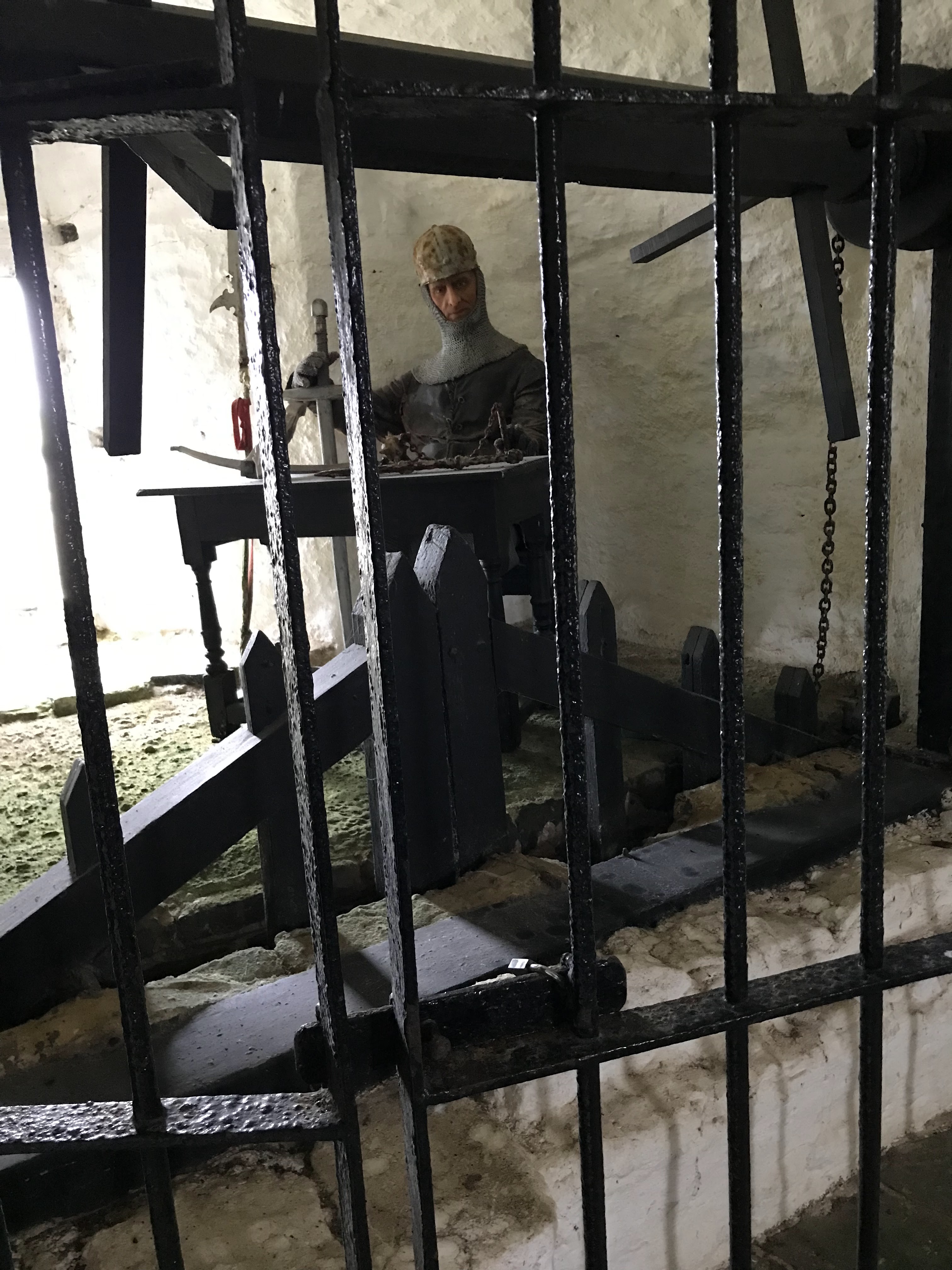
They were a little overfond of dummies, but the info was useful


The Great Hall where they feasted on every kind of roast including heron and swan and occasionally dolphin.


Manorbier is fascinating enough. It was granted to a knight who fought for William the Conqueror at Hastings, and Odo de Barri constructed a motte and bailey castle where the present stone castle stands. It was Odo’s son, William who built much of the limestone castle standing today. And in 1146, Gerald of Wales, the fourth and youngest son of William, was born there. It may be relevant that he was related on his mother’s side to Nest ferch Rhys, the daughter of Rhys ap Tewdwr, the last king of Deheubarth, south Wales. The Normans were quite savvy when it came to marriage. It may also explain Gerald’s obsessive ambition later in life. 


Gerald studied in Paris, was employed in various ecclesiastic missions in Wales, and showed his ‘sneaky’ side when reporting the Archdeacon of Brecon for having a mistress. The old Archdeacon was sacked, and Gerald took his place. For him, Brecon was a stepping stone. He had his eyes on a  bigger prize, the bishopric of St David’s held by his uncle. When his uncle died, the Chapter unanimously chose Gerald as his successor, but Henry II wasn’t having it. Henry knew well enough that St David’s wanted independence from Canterbury, and after having just got rid of one troublesome cleric—Thomas Becket— was wary of another. 


According to Gerald, the king remarked that: 


“It is neither necessary or expedient for king or archbishop that a man of great honesty or vigour should become Bishop of St David’s for fear that the crown and Canterbury should suffer thereby. Such an appointment would only give strength to the Welsh and increase their pride.” 


One suspects that Gerald put some of these words into the royal mouth. In 1184 Henry sweetened the disappointment by appointing Gerald as Royal Chaplain where he mediated between the crown and Prince Rhys ap Gruffydd, and the following year, accompanied Henry’s son, John, to Ireland. There Gerald wrote Topographia Hibernica, followed a few years later by an account of Henry’s conquest of Ireland. Though admiring Irish music, Gerald reflects the prevailing Anglo-Norman view that the Irish themselves were little more than savages.


In 1188, he began a comprehensive tour of a densely wooded Wales accompanying Baldwin, the archbishop of Canterbury, on a great recruitment campaign for the Third Crusade. It was there he wrote his two greatest, certainly the most well-known of his works: Itenerarium Cambriae  1191and Descriptio Cambriae 1194. Despite a credulous acceptance of Welsh superstitions and legends like poltergeists, hauntings, and self-castrating beavers,  the two works give a wonderful insight into C12th Wales and bring history to life in the classroom.


In 1198, Gerald had a second chance of being appointed Bishop of St David’s. The local chapter again chose him as their new bishop; King John was also favourably inclined, but Hubert Walter Archbishop of Canterbury wasn’t. For the next four years the Pope was hounded alternately by a desperate Gerald and agents of the archbishop. Again, Gerald lost out. 


As I said, Gerald was a bit of a stirrer and had no trouble getting leading Welsh princes on side; he was accused of fermenting rebellion against English rule and fled to Rome, where the Pope, fed up with the whole business, appointed a tiebreaker as the new Bishop of St David’s. 


Gerald protested vehemently saying that it was because he was Welsh, he was being denied the job and  never forgave King John, siding with the French when Louis VIII was invited by rebellious barons to seize the English throne. He died at Hereford aged 77. Denied the bishopric of St David’s, his body may or may not be buried there. His dummy resides in Manorbier castle.


Friday, 18 March 2022

Best days of our life: Part II


Percy wore a long, sand-coloured coat and a brown flat cap. His face was red, weather-beaten, and he looked like Mr. Punch. He was our milkman and delivered it punctually on horse and cart. We would lie in wait, lurking in alleyways and then leap on the back of his cart. There we hung, hidden by milk crates, pursued by Kiowa, and mouthing silent but deadly gun sounds: the Deadwood Express, now peppered with arrows, tearing along at two miles per hour and Percy the Milkman oblivious to the carnage around him. Or so we thought or liked to think. 

The Deadwood Express ended halfway down Greenwich Road opposite the graveyard where the horse had its stable. 


To the right of the power-station at the bottom of our street, ran a narrow alleyway bounded by a high brick wall. On the other side was a long unkempt field called ‘The allotments’, though nothing grew there, and any would be gardener would have had to have been fairly agile because there was no way into it other than by climbing over the wall. On the other side of the wall was a sea of grass and beyond that the railway embankment, thick in bramble and gorse, rich in wartime artefacts.


Ours was a world dominated by gangs— innocent but real—one in particular based in and around Kingswood Avenue off Greenwich Road. We called them the ‘Kingy-elly Gang,’ (Adding the letter Y to the end of a word makes for a pleasing rhythm and is the essence of abbreviation in Liverpool.) When they flowed over the wall at the furthest end of the allotments we would wave sticks at each other, throw a few stones, and then one or the other, sometimes both, would retreat in clouds of defiance and clods of earth. 


Once we built, what we hoped would be a lasting monument to our tiny nation-state: a deep, roughly circular underground den, its roof made from earth and branches, and the whole thing cunningly disguised by a thick layer of grass. 


 In children’s picture books, rabbits and voles live in warm and cosy burrows which, on the page, resemble snuggle-up-able orange or brown blankets. There are even armchairs down there, occasionally a fire. Our den was dark and wet. We sat on lumps of mud and could easily have suffered from ‘trench-foot’ had we known what it was.


We tried lighting a small fire and almost suffocated, smoke tearing at our lungs; but we stayed put, unwilling to admit to a further bad idea. From there, it was a natural progression to inhaling smoke more directly. Cigarettes. 


 I can’t remember who, first introduced them. They were bought singly, or pinched in ones or twos from parental packets, and referred to as ‘loosies.’


In the days before marijuana became prevalent, we sat underground passing round the single cigarette, Shamans in short trousers. To cough showed weakness and provoked mild derision. To leave a ‘ducks-arse’ however was the greatest sin of all. The origin of the name is shrouded in mystery. No one had ever seen a duck’s arse, let alone felt one. Poetry again. Our first introduction to metaphor. 


In real terms it meant passing on a cigarette wet in spit and I, unfortunately, was the greatest sinner of all. I coughed and spluttered and was brutally re-assigned to guard duty, banned from the inner circle of hardened smokers. Ironically today the reverse is the case, the hardened smokers banished outside to guard the pub.


One day, on a whim, or perhaps because of a collapsed roof and a blazing hot summer, we decided on a swimming pool. The cavity became even deeper; we dug and dug; our ambition knew no bounds.

 When the hole was sufficiently deep, a human chain was formed, passing buckets of water from the nearest house to our hole in the ground. In our minds we’d visualised a deep, blue pool. We ended up with a chocolate brown mess we felt honour bound to paddle in. 


When I went back some years later, small houses crammed close occupied where we once used to play.

Friday, 11 March 2022

Best days of our life, they say

We enjoyed street games as children, games such as Kick the Can and Rallio, both a variant of hide and seek but with the added excitement of a crafty ‘hider’ being able to ‘free’ those caught. It was a wonderful pitting of wits; the seeker had to leave the precious can or wall where his ‘prisoners’ were lined in order to find those hiding, but he or she couldn’t stray too far knowing that any moment someone might dart in from a bin, bush or alleyway and touch the wall/kick the can and thus free the prisoners. There was a distinct Colditz flavour to it all, fusing Nazis and the Resistance to an otherwise ordinary game of hide and seek. 


There were other games I was less proud playing, ‘How many miles to Fairy land?’ being one of them, along with Queeny-eye with its childish chant that to my shame, I still remember. In this game a person turned their back on the other players, one of whom had a ball hidden behind their backs. Then in a peculiar sing-song we began:

Queeny-eye, Queeny-eye, who’s got the ball?

I haven’t got it.

It isn’t in my pocket,

Queeny-eye, Queeny-eye, who’s got the ball?

As I remember the person had three guesses, pretty pointless if only three people played. 


My favourite game was British Bulldog. There, one person stood in the middle of the street as the rest of the gang charged towards him/her with some force. If he/she managed to catch and hold onto one of those charging, there would be two people standing in the middle of the street – and so on – and so on until only one person was left to run through a wall of bodies. 


And now to the worst game of all, Shin kicking – 'Britain’s stupidest sport 'as one newspaper put it. 

We took for granted it was a Liverpool game, a pastime peculiar to Aintree. But apparently it originated in the Cotswolds and is a feature of the Cotswold’s Olympick Games. As stupid sports go, it has a long history, its first pictorial recording being in the Annalia Dubrensia 1636. The noble sport of shin kicking is to the right. The hill in the middle is ‘Dover Hill,' named after the founder of the games and shin kicking in particular. 


So, what are the rules? Two competitors face each other with their hands on each other’s,  and you are allowed to kick anywhere between ankle and knee. The rules changed a little time later when steel-toed boots were banned. And in Chipping Campden, a small Gloucester village, where the Cotswolds Olympicks are held, straw is allowed—stuffed in long socks to cushion the blows. We in Ribblesdale Avenue, of nobler stock, eschewed such namby-pambyism. We didn’t even have a Cotswold’s stickler – a referee with a long stick to separate us shin kickers if or when the occasion demanded. We just gritted our teeth and got on with it, kicking in turn until one or both gave up yowling in pain.  

Best days of our life, they say. 


Friday, 4 March 2022

Close the door


Sayings we once all took for granted are going the way of the dinosaurs. Increasingly few people use or understand the origin of ‘nail your colours to the mast,' and 78% admitted they never used the biblical phrase ‘pearls before swine.’ 


‘A stitch in time’ is another casualty, and half the population have never said that they were going to ‘see a man about a dog’ or mouthed the simple poetry of ‘snug as a bug in a rug.’ 


I’d be ‘Mad as a Hatter’ if I told someone it was ‘raining cats and dogs’ or I was ‘going to spend a penny.’ If they even knew they phrase, they’d likely tell me to ‘put a sock in it,’ perhaps hint it was about time I went  to ' the knackers yard.’ Then again, others might say all this is a  ‘storm in a teacup?’ 

Language changes. 


I’m particularly fond of American slang of the 1930’s, some of which I’ve used for Clay Cross. 

In that world you drank not whiskey but ‘giggle juice,’ you’d urge a dame not to ‘blow her wig’ and run from the cops on your ‘get away sticks’, perhaps shouting out ‘Abyssinia.’  If making tracks didn’t work and you were cornered, you wouldn’t waste time ‘bumping gums’ but take our your ‘convincer’ and ‘let them have it.’


I’m also quite fond of the subtle contempt underlying some modern contractions, such as ‘obvs’ or ‘whatevs’. For those who take offence at the Australian ‘No worries’ as an implied criticism of those who  can't help but worry, the only real response is a shrug and a 'whatevs' Of course you could go for ‘Don’t get your knickers in a twist,’ but would that be casting ‘pearl before swine" ?


And now, because ‘I know my onions’ I’m about to share with you ‘a load of old codswallop’ that puzzled me mightily as a child. I mean, what’s the point of closing the door when they’re coming through the windows? And how quickly will you get this piece of malarky out of your head?

You're welcome 😇

PS the C17th word for a song you couldn't get out of your head was a 'Maggot' because we all know what maggots turn into. Or do we?