Friday, 28 May 2021

Middlemarch and Cookery books

I remember reading Middlemarch as a seventeen year old, eager to impress my first girlfriend. I remember, too, being repelled and afterwards scared by Edward Casaubon, the pompous, withered middle-aged academic who married the idealistic heroine, Dorothea Brooke; she sees in him her idea of a real intellectual. Casaubon is currently amassing material for his masterwork the ‘Key to all Mythologies,’ his aim, to show that all the mythologies of the world are corrupt fragments of an ancient corpus of knowledge, something he will reveal in due time. Dorothea is enthralled to be his helper, compiling and editing, putting every scrap he's written in some kind of order. 


Too late, she realises she’s married a dud: ‘Somebody put a drop of his blood under a magnifying-glass, and it was all semicolons and parentheses.' It might be that there is/was no key to all mythologies and that the answer to everything is to be found in The Hitchhiker’s Guide to the Galaxy, ie 42. But poor Edward Casaubon never finds out. He dies having written nothing but leaving behind copious notes. 


It may be the fictional Casaubon and those of similar ilk derive comfort and purpose, a sense of security in the effort alone. Rather like the Hermit crab with its need for the shell of a dead mollusc to protect its vulnerable rear end. (I feel a joke coming on) The cannibalised shell serves as both home and protection. But at a cost. It’s something the crab has to drag along wherever it goes. And when it grows too large for the shell, it has to start all over —little different perhaps from those on the mortgage treadmill.  


So, what has all this to do with recipes and cookery books? I’m awash with recipes and books. It began at Catering College all those years ago. Little did I know then where it would end up. 

My first college cookery book.

The book has been thumbed, stained and used


Then the ‘Blessed Delia’ came along.


Since then there’s been no holding back. I have folders on my desk-top, folders in my email. I have all these and more. 


And like most people, I suspect, there are just two or three recipes in each book that have been actually used. The ‘Google’ cookbook has become the cuckoo in the nest. But, like the Hermit Crab, I cannot bear
parting with what I increasingly don’t use.


In theory, any recipe that ends up in here is a keeper.

In theory. The reality is that any recipe ending up in here is forgotten. Is the thing I'm after in one of my folders, or do I have to thumb through the sacred, sauce-spotted book?


The exception is Boboutie. 


 I keep promising myself I will—and here the ghost of Edward Casaubon looms over my shoulder— systemise my recipes in an all-encompassing computer program, one that will bring the exact recipe needed for any occasion at the tap of a key word on iPad or phone. 


It’s a nonsense of course. I’d be too busy doing it to do any actual cooking and, like Casaubon, be dead before the ‘key to all cooking’ was actually in place. Then again, there would be far less washing up to do.

Friday, 21 May 2021

Lunacy is addictive


I do most of my thinking somewhere between 6.40 and 8.00 along with strong tea and the news in the background telling me what I should be concerned about and what I should be thinking.


When the thinking stops, I browse social media and pick up every kind of rubbish like a downmarket magpie.


 Two days ago, I discovered there was some kind of mystery involving cats and squares of various sizes. I’ve seen countless pictures of cats in small boxes. Facebook is awash with them, but I was unaware of the experiments showing cats were equally attracted to one dimensional squares painted or chalked on the floor. I sat in silent wonder contemplating the mysteries of life and the nature of the experiment itself. 

Success was measured by the length of time a cat sat in the square, three seconds being the minimum to record a success. The cats were recorded via a camera or smartphone, and to ensure the chosen cat owners didn’t influence their pets in any way, they (the owners not the cats) were told to wear sunglasses so no eye contact was made. I’ve been told on good authority that cats read minds, so I’m not too sure how effective the sunglasses would prove apart from startling the various cats. 


The results, to my mind, were not that successful. Thirty cat owners conducted the experiment in full, which involved six days of trials. Only nine cats were cooperative (sunglasses, the reading of minds). These 9 cats were cooperative in that they sat in a square at least once during the trials. Squares apparently remind them of boxes, which in turn remind them of being squashed with mother and siblings in the days following birth. Squares relieve stress. The same supposedly holds true with big cats, pumas, tigers and lions, which must be a boon for trophy hunters. Draw a square in the jungle and wait.  


By this time, I was way down the rabbit hole, googling all kinds of animals—dogs and optical illusions for example. Nothing too definitive there either, though I’m guessing there must be some value in knowing whether dogs enjoy Rorschach patterns and are able to differentiate between bowls that look differently sized but are in fact the same. 


Near the bottom of the rabbit hole, where tunnels diverged and proliferated, I stopped by an article on pigeons, a church in Brazil, and a priest who preferred hypnosis to miracles. It was time to turn back before madness took over, though I suspected it was already too late? 


The memory came without warning: how to hypnotise chickens by gently pressing their beaks to the ground and chalking a line. I was transfixed, my nose far from the ground and without a square or straight line in sight. I’d once intended to test that experiment and discover whether it was applicable to other birds, pigeons, robins, plover or grouse—perhaps not ravens or crows—but then I wouldn’t know whether it applied to all birds.  Was it too late? Where chickens to be found in Osbaston. I sighed and made a fresh pot of tea, hoping the insanity would pass, knowing at least it was better than the news on the radio.

Friday, 14 May 2021

1607

In theory, you are able to walk the entire coast of Wales, something I’m unlikely to try, though last week we managed an eight mile stretch along the Gwent levels ending our walk at Redwick.  When you look at these pictures, it’s hard to imagine that the earliest coastal defences built by the Romans and maintained and developed by the monks of Goldcliffe and Redwick extended farther into the sea. The present line of defence was built in the late middle ages but were allowed to fall into disrepair after Henry VIII’s dissolution of the monasteries. 


This looks so peaceful. Hard to imagine anything bad could possibly happen. On the other side of the channel is Bristol and Somerset. 


A section of the modern sea defences stretching mile upon mile to Chepstow.
Courtesy of Bernadette..

Mind you, they probably would have made little impact on what occurred on the morning of Tuesday, 30th January 1607. A twenty-five foot wall of water sped up the Severn estuary at 38 miles an hour – faster than a man could run.  It crashed through the sea defences from Peterstone to Redwick and beyond, hurtling  up to four miles inland. 


In the words of William Jones of Usk: ‘huge and might hilles of water, tumbling over one another, in such sort as if the greatest mountains in the world’ overwhelmed the land. More than 2000 people drowned and 2000 square miles of farmland were destroyed along with much of their livestock. William Jones went on to describe the spectacle: ‘Sometimes it so dazled the eyes of many of the Spectators, that they immagined it had bin some fogge or miste, comming with great swiftness towards them: and with such smoke, as if mountaines were all on fire.’


Today, especially in light of William Jones’ description, academics argue as to whether it was a tsunami or merely a freak storm surge, though the day was sunny and bright. Jones had no such worries. The explanation was clear. It was God’s warning to his people…Many men that were rich in the morning when they rose out of their beds, were made poore before noone the same day: such are the judgements of the Almightie God, who is the geure of all good thinges, who can and will dispose of them . . . at all times, according to his good will and pleasure, whensoeuer it shall seeme best unto him.’


I confess, my auto spell is going berserk here, but William Jones’ account is so lively, I must give him free rein.


‘…as soone as the people of those Countries, perceived that it was the violence of the Waters of the raging Seas, and that they began to exceede the compasse of their accustomed boundes, and making so furiously towards them, happy were they that could make the best and most speed away, many of them, leaving all their goods and substance, to the merciles Waters, being glad to escape away with life themselues: But so violent and swift were the outragiouse waves, that pursued on an other, with such vehemencie, and the Waters multiplying so much in so short a time, that in lesse than five houres space most part of those cuntreys …were over flowen, and many hundreds of people both men women, and children were then quite devoured by these outrageous waters, such was the furie of the waves of the Seas . . . 


Many there were which fled into the tops of high trees, and there were inforced to abide some three daies . . .without any victuals at all, there suffering much colde besides many other calamities . . . beholding their wives, children, and servants swimming remediles of all succour in the Waters. Others some sitting in the top of Trees might behold their houses overflowne with the waters, some their houses caryed quite away: and no signe or token left there of them.’

‘Gods warning to his people of England By the great over-flowing of the waters. . .’ by William Jones 1607


Mind you, there is another explanation bypassing storm surges, tsunamis and God. Whatever the case, 

the immense waves would have badly damaged the complex pattern of reens draining the 1500 kilometres of wetlands, some of which are 2000 years old. This is a modern 'Stank' altering the level of a section of the reens.  


I love the optical illusion, but then I'm a simple soul.


This is St Thomas's Church, differently named in the C13th and with the tower, unusually in the centre of the nave. 


This is the porch from some distance away to allow perspective. Note the gargoyle to the right where the arch ends.


Now, look at the plaque marking the height of the flood. 


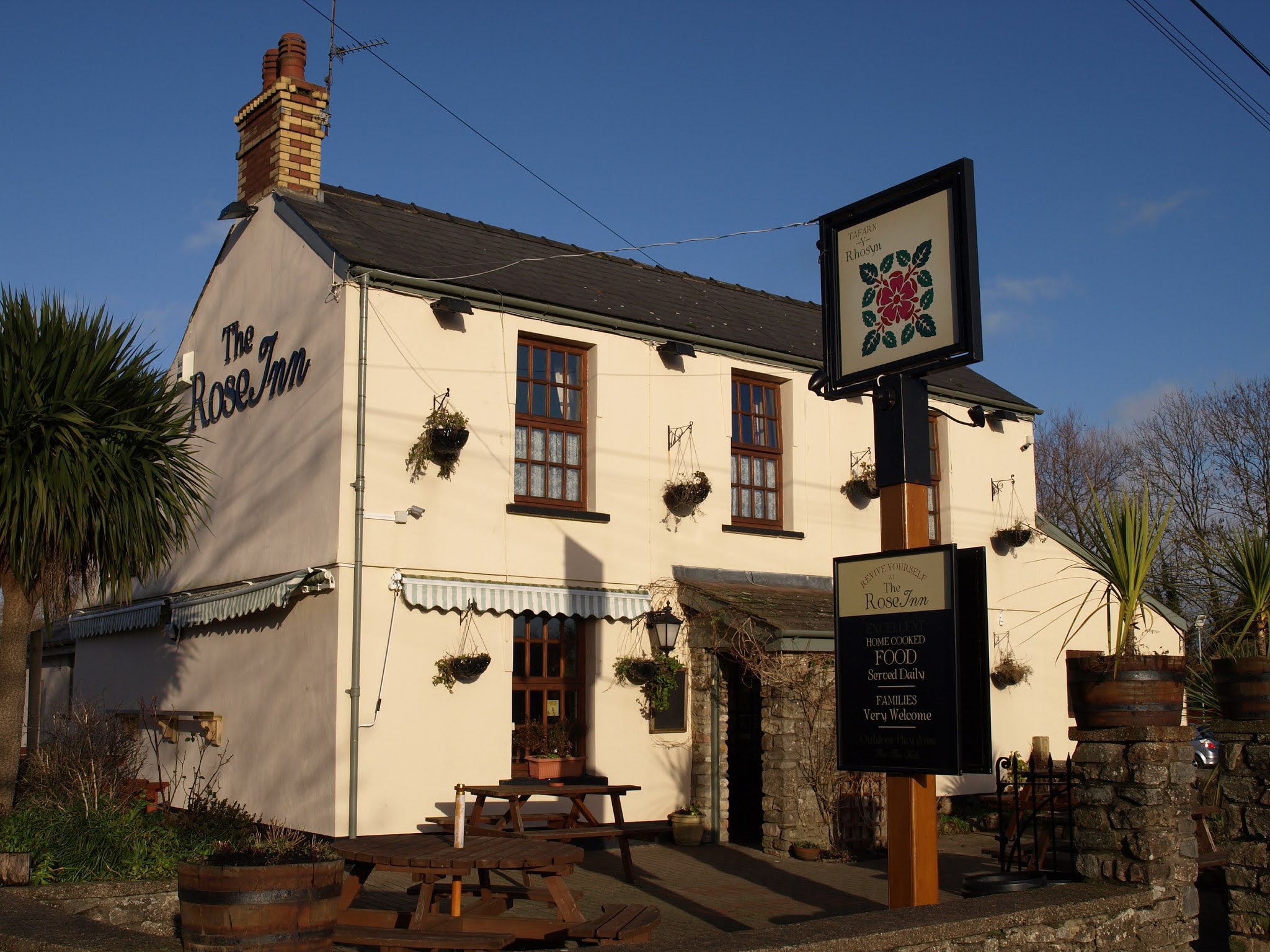
The Rose inn and a welcome pint of Marston's Pedigree. My first pub pint since lockdown began. 
If William Jones were alive, he would write about it. 


Friday, 7 May 2021

Radio Caroline


Little did I know that, in 1964, I was to become no. 21722 in a fragment of cultural history. Another snotty nosed adolescent had joined the revolution: The Radio Caroline club. This was a time when music was confined to the BBC with shows like 'Music While you Work'  ‘The Billy Cotton Bandshow'  and ‘Two Way Family Favourites.' Rock music could be heard on tinny Radio Luxembourg, but they were essentially a payola operation, playing 'paid for music' by the likes of EMI, Decca, and Pye.


And then Radio Caroline came along. In its original form it lasted a mere three years but its influence was profound


In the recent film, ‘The Boat that Rocked’ some of the spirit of pirate radio was captured. In the process, history was falsified. The film falls into the anti-Tory trope, ie the stuffy Conservatives were responsible for closing down pirate radio, whereas in fact the opposite was true. 


The Marine Broadcasting Offences Act became law in August 1967 and was introduced by Harold Wilson’s Labour Government. Its architect was the Postmaster General, one Anthony Wedgewood Benn. Tony Benn as he later preferred to be known. That very archaic title gives the game away. In those halcyon days, British Broadcasting was controlled by the GPO, the General Post Office, which had granted exclusive radio and Television broadcasting licenses to the BBC, and later, through gritted teeth, television licenses to 16 regional independent TV stations. It was in effect a state controlled closed shop. 


Then pirate radio came along, broadcasting from unseaworthy shops from outside British territorial waters and Harold Wilson personally authorised the use of the most powerful transmitter in Europe – a one megawatt facility reserved for a national emergency – to jam Radio Caroline’s signal. 


Why did Wilson use this sledgehammer to crack a nut? There were rumours that some pirate radio stations were intent on exposing his affair with his secretary, Marcia Falkender. Certainly, and now with good cause, pirate radio was instrumental in Wilson’s surprise 1970 election defeat. 


But there also other factors in play. Government action had European links even then. The 1967 Marine Broadcasting Act represented the UK’s ratification of the 1965 ‘European Agreement for the Prevention of Broadcasts Transmitted from Stations outside National Territories.’ A bit of a mouthful and for obvious reasons known or disguised as ‘The Strasbourg Treaty. 


Despite every effort to disrupt and destroy pirate radio, Caroline persisted in one form or other, its low point being 1980 when a storm sank the unseaworthy Mi Amigo. The DJs and their pet budgie, Wilson (named after the British PM) were evacuated. The ship sank leaving only the mast visible above the waves – and the memory fifty years later—along with my Radio Caroline membership package.


A little bit of history (but more in depth here) 


My membership package arrives.

And it it a small glossy booklet.


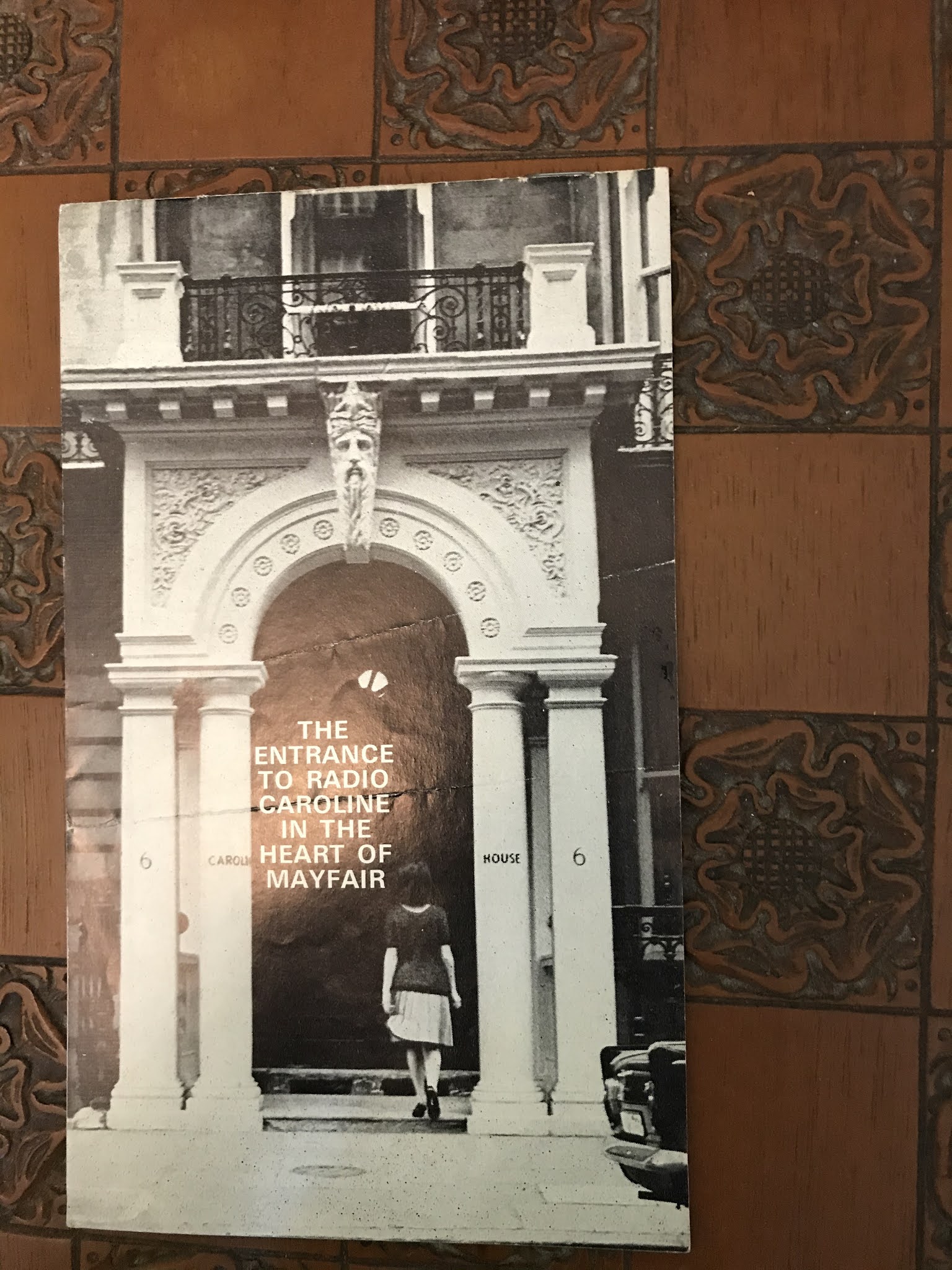
I immediately look at the back to see this, along with the legend 'From the centre of Mayfair'. Such sophistication. And the girl. The snotty-nosed adolescent knows he is part of something big 


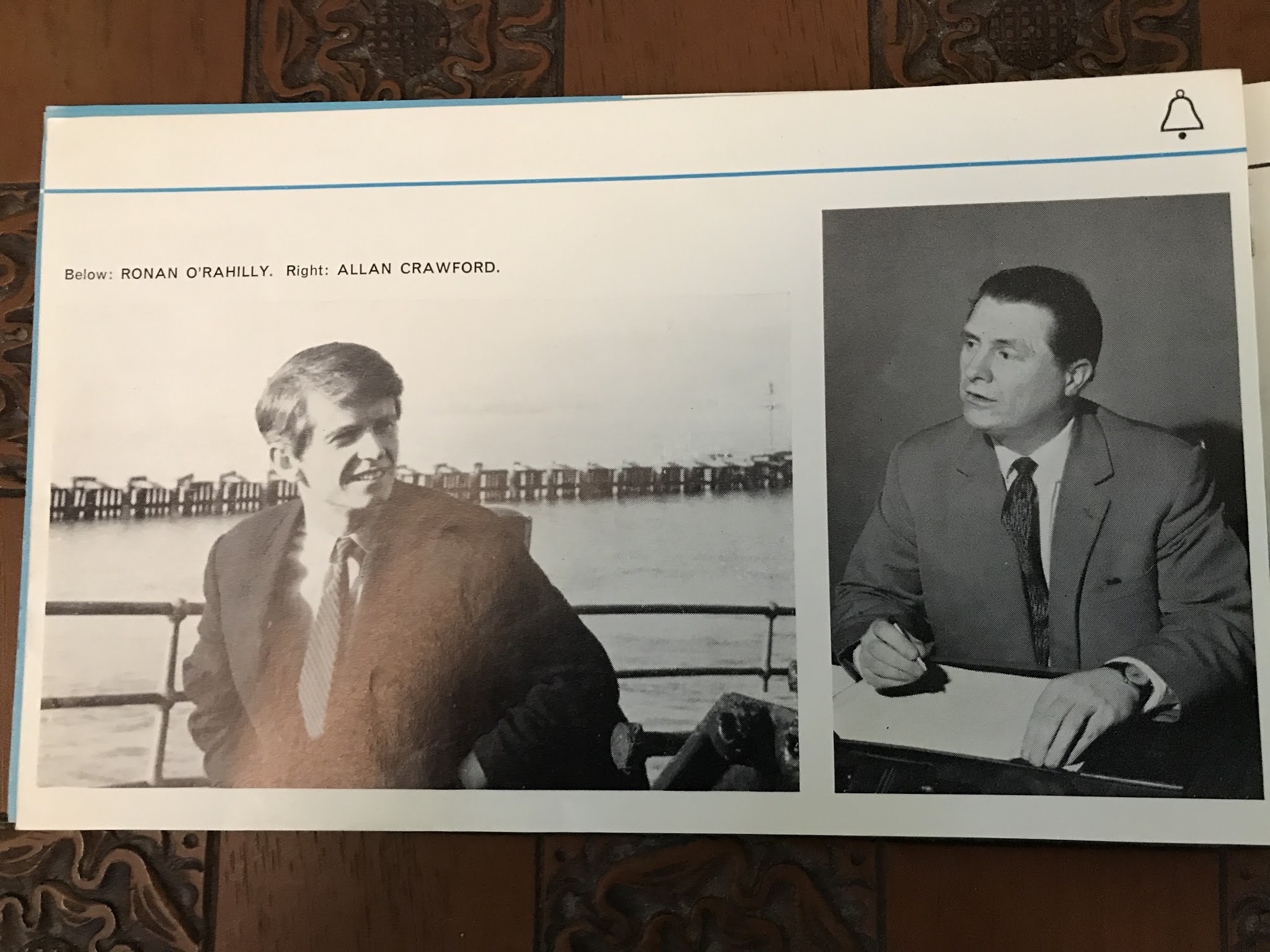
And if there was any doubt, there is this!

Ronan O'Rahilly and Alan Crawford, the two founders


The booklet is a mine of information - history and DJ's one of whom was a friend of 'the popular Jimmy Savile' Ah, innocent days.


In these digital days of word processors and photocopiers, this seems from a different age - which of course it is.


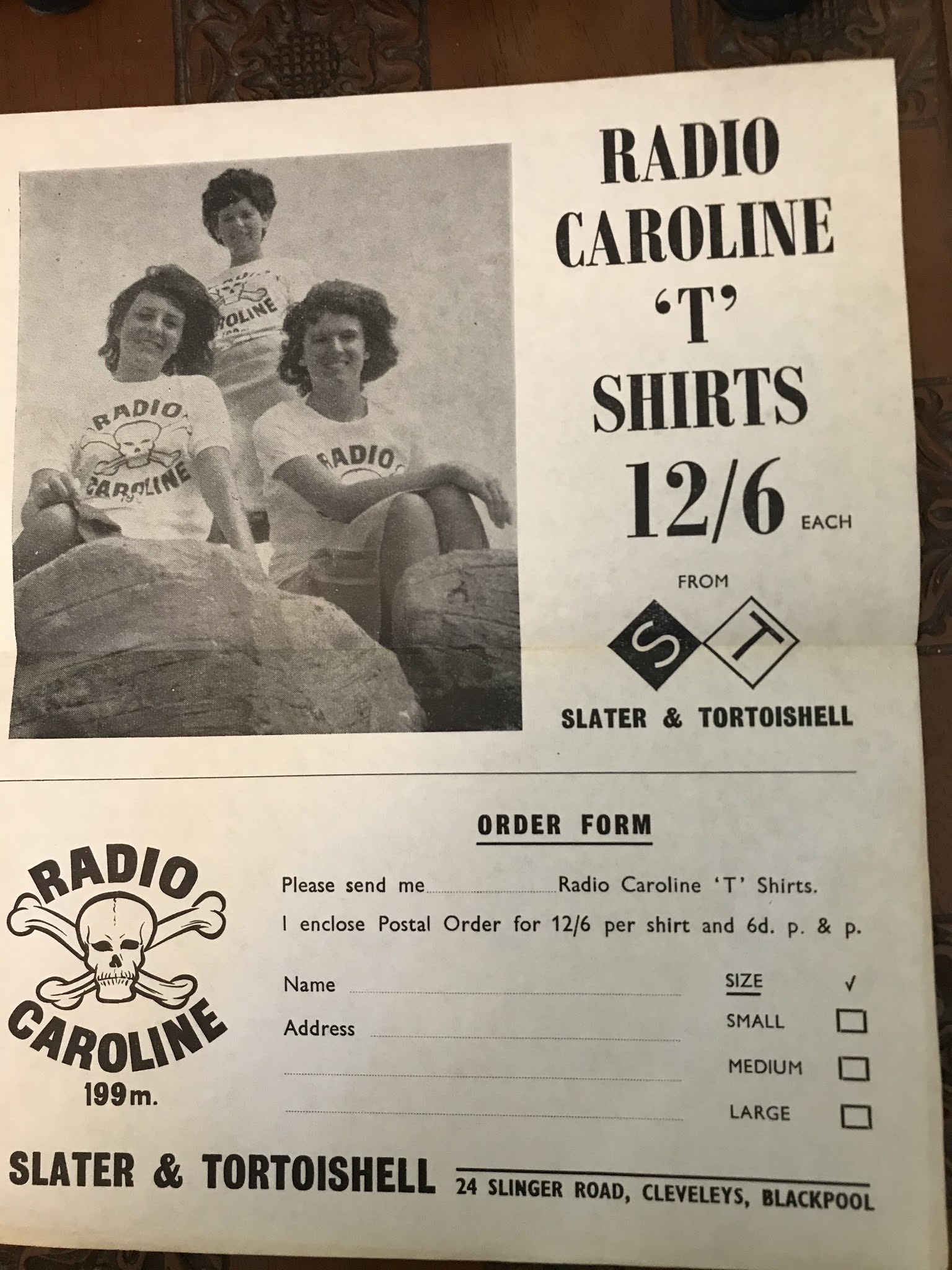
As is this: The Radio Caroline T shirt. 


I also got three signed photographs of Radio Caroline's hottest D Js. Well, they no doubt thought they were

And my Radio Caroline club membership card with the knowledge that 21721 other people had been similarly seduced.  I was now an official member of the 'Swinging Sixties.' 


Thursday, 29 April 2021

I hope I have better luck.


One of the great joys of life is discovering something or someone new, and in terms of the dead, the supply is inexhaustible. I bought Jules Renard’s Journal 1887 – 1910 for my daughter who, to my relief, liked it immensely. But then what was there not too like, the man had opinions and expressed them in unexpected ways. He had none of the showy flamboyance of Oscar Wilde, who he described thus:

'Oscar Wilde next to me at lunch. He has the oddity of being an Englishman. He offers you a cigarette but selects it himself. He does not walk around a table: he moves the table out of the way. A face worked over by tiny red worms, long cavernous teeth. He is enormous and carries an enormous cane.'

But he had all of the wit, and this despite or because of a troubled childhood. His father was a peasant farmer who rose to become Mayor of the village, but after the death of his first-born child he became increasingly bitter, barely spoke to his subsequent three children and didn’t speak to his wife for the next thirty-three years, which must have made procreation interesting. When he had something to say to his wife, he would use the young Jules Renard as go-between and whenever she entered the room he would pause in mid conversation until after she’d gone.  It is perhaps not surprising that Jules Renard, in contrast enjoyed a long and happy marriage with two children he affectionately mocked but adored. 

Reading through his journal is a delight, the bons mots interlarded with gossip, every day life, and the profound, most of them involving deaths in the family. But it's the pithy comments, some of them one liners that stick in the mind, and there are hundreds of them.


below are just a few examples and believe me, it was difficult to stop :


German, my favourite language in which to be silent.


To snore is to sleep at the top of one’s voice


While talking, he directs a quantity of spittle in my direction, almost a gob of spit. He does not wipe it off. Nor do I wipe it off. I avenge myself by not wiping it off, and has to keep on talking, his eye drawn unavoidably to the spittle. There is something between us after all.


A friend is like a suit of clothes. You must replace it before it becomes too worn. Otherwise, it is you who are replaced.


With all due respect for the Sermon on the Mount, if you thirst for righteousness, you will thirst forever


How monotonous snow would be if God had not invented crows


When they broke the news to a politician, ‘Your wife is dead,’ he replied: ‘Is that official?’


Solitude, a place where you can finally blow your nose with enthusiasm


Very pleased with myself for having noticed that, when a woman farts, she immediately coughs afterwards


She has teeth worth their weight in gold, literally


You could see through his beard how ugly he must have been without it


I thought you were dead. Oh, well, another time


Not only was he the master of the offhand put down, Renard was also a keen observer of life:


The rat is on the end of a branch, the cat is on the trunk. Neither moves. A rifle shot. The rat falls. The cat jumps, sniffs the air and moves off, impressed none the less by her own powers.


I complain of my lot, but I have just seen a small child with a wooden leg hitting the ground with all his might, in a rage because he could not keep up with the others. 


If Renard had any fault, other than his dislike of bananas, it was in his belief that French literature was the only literature worth speaking about. Heine, Dickens, and Thackeray, he consigned to the dustbin. Shakespeare, he found disappointing until, in 1906 he read Julius Caesar. A damascene moment. The Englishman, he concluded was ‘less literary. . . but more human than Victor Hugo; and that, whereas Hugo left us with an image burning in our mind, Shakespeare left us with the truth, the muscles and the blood of truth.’ Renard died four years later, his appreciation of Shakespeare perhaps proving too much for him.


I hope I have better luck, appreciating Renard.

Friday, 23 April 2021

Walking Through Invisible Worlds


A childhood treat was watching and then later participating in the making of a fire. First the cold ashes were raked out from under the grate, placed on two sheets of newspaper, rolled into a parcel and taken out to the bin. Kindling and more sheets of newspaper rolled up into balls were already at hand. These were placed in the hearth and dotted with small pieces of coal on top and around. The matches were lit and we’d ease back and watch as the first small flames appeared, reinforced by fresh sheets of the Liverpool Echo—one or two sheets kept in reserve.  

A sheet was placed in front of the fire with instant effect. Hot air sucked at the paper which had to be held with some firmness. ‘Drawing in the fire’ was the term, encouraging the fire to take hold. Gradually the paper browned. Timing was everything. Leave it too late and the paper would flame in your hands. The trick was judging the moment—release one end of the paper and in the same movement seize the poker and thrust paper and flame up the chimney.


A real coal fire made excellent toast, but the real magic didn’t involve toast. The real magic was staring into the flames and seeing strange patterns that turned to an alternative world. Later, the coal would settle into an intensely deep motley of black and grey, and varying shades of reds from salmon pink to ruby, flickers of crimson. I remember it sucking me in to magical kingdoms inhabited by fire-elves and sorcerous kings. 


In time all this was replaced by a modern tiled hearth and a three-bar electric fire. It made lousy toast and the magic vanished. For a time.


The thing is, in those pre-reading years, without TV or any kind of screen, long dark evenings were spent in front of the fire lost in strange patterns; the habit doesn’t die and as you grow older, you realise you walk through invisible worlds unless you know what to see.


In the sky, there are all manner of things.


A sky in Wyoming, a storm rolling in. Our tents didn't stay up 


In woods, especially so


And with thanks to two friends—even in gardens.


To my mind, sinister topiary. Once seen, it stays in the mind: a fusion of the Green Man and a crocodilian creature from the mythos of Cthulhu. It stalks the innocent with their drinks on the terrace. As twilight falls it edges closer. Sometimes I wonder whether by just saying it the invisible becomes real. But that would be the plot for a book. 


And often what isn't there is more fun so maybe it should be . . . and is.


A lake in Yosemite, some friends on a rock, but look down to the right - a pair of exposed buttocks or somebody's shoulder. You decide. 


Friday, 16 April 2021

Ancient Woodland


Along a lane we often walk, there’s a river on one side where sometimes otters play. On both sides of the lane are trees, the remains of ancient woodland. Recently, the owner of this woodland parcelled it into three acre lots and sold it. Being an unashamed nosey parker I took the first opportunity to quiz two of the new owners. It’s easily done. We passed them every day, coppicing and clearing unwanted trees. And the great thing about walking in country is that people are friendly, and everyone likes talking about themselves given half the chance.Or may be it's just me and it's why I have a blog  ðŸ˜Ž


        A compulsive viewing spot before girding our loins for the walk back home.


One of the men was in his seventies with 70k going spare and rather than blow it on a car he didn’t need or an even newer kitchen, he decided to buy three acres of land facing the river. His aim was to clear a small glade, plant wildflowers and create a viewing spot for himself and his wife. For a man in his seventies, he’s admirably energetic, thinning trees and planting more interesting but traditional alternatives. 


The second guy—on the other side of the road—was equally interesting. He is much more the committed woodsman, there virtually every day, chopping down unwanted trees. At first glance it looks like vandalism. In fact, it’s enlightened forestry work. 


The wood has overgrown, packed with sickly trees enjoying little light. A lot of the trees are unhealthy pine. His aim is to thin, thin, thin; allow sunlight in and, like his neighbour replant with traditional broad-leaf trees. 


This gives some indication of how sickly and light starved the trees are.


I loved his attention to detail, constructing a traditional woven fence marking his boundaries.


And below, you can see the next stage, planting along the edges for when the fence decays. 


Of course, it put me in mind of Annie Proulx’s Barskins. It also put me in mind of an article I read on Ruislip Woods, a small forest in London. It’s what remains of a vast forest that once stretched from London to Nottingham. The remnant is still large and has survived largely unchanged from medieval times.


The forest was given to Ernulf de Hesdin by Willliam the Conqueror but later came into the hands of the periodically insane Henry VI who gave it to King’s College Cambridge.  The great oaks of Ruislip were used in the building of the Tower of London, Windsor Castle and the Palace of Westminster. And something else, I learned. Hornbeams were planted amongst the oaks to make them grow straight and tall. Wonderful things, trees. The hornbeam grows more quickly than the oak, and so to claim their share of the light, the neighbouring oaks have to grow straight and tall to avoid missing out. Having done their job, the supple branches of the hornbeam were used in the making of fences. 


Things changed in 1914 when the Local Authority began the process of chopping it down to make way for 7,600 houses. But, luckily for the trees though not the luckless soldiers, World War I brought things to an abrupt halt and Ruislip Woods were saved. 


Having had such a narrow escape, King’s College sold the woods to the local authority in 1931 on the condition that no building would be allowed. The council were as good as their word, coppicing the woods on a 20-year cycle and cutting out unwanted species. And so, what you have is a forest of hornbeam and oak, one that a Norman, a thousand years ago, would recognise.